

Take the shrinking pill Alice took in Wonderland because today, we will join Dr. Schurger and Dr. Bagley in jumping into the rabbit holes in healthcare! So, buckle up because we’re going for a wild ride in this episode, taking stops at different topics. Dr. Bagley and Dr. Schurger unveil the mysteries around the latest on Wuhan and C19. They also delve into a thought-provoking question, “Do kids get you sick, or is your immune system weak and susceptible?” The fun and informative ride doesn’t just stop there because Dr. Bagley and Dr. Schurger will also take us into the proper amino acid profiles for food, glycine, and the old 96’er. Join the Blonde and the Bald in the Healthcare Wonderland before the Queen of Hearts chops off this opportunity!
Listen and read the full blog post here
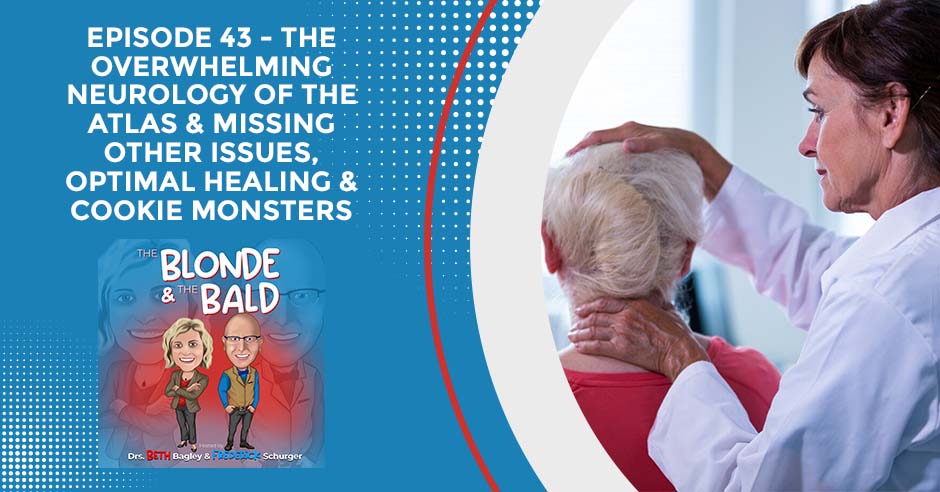
Drs. Bagley and Schurger discuss their findings regarding how often most people will come in with a lower cervical problem that has been hidden by the Atlas problem. This is a great discussion regarding how sometimes it takes a couple of extra visits to really dial in all the healthcare needs that a person has. We also discuss how we’re trying to get you back to optimal health as quickly as possible. And stick around to hear how we stuffed our faces over the holiday.
---
How are you doing?
I am doing good. It is our first recorded episode of 2024. We have had a crazy week already, both of us. This is going to be a little bit disjointed. We have a little bit of a plan for what we want to talk about, but quite honestly, it's 6:20. Dr. Bagley texted me saying, “I put the last one down to rest and I was getting one up.” Honestly, I'm yawning already.
We are going to get our second wind. We are going to kick butt on this episode because all of you need some of this information. Some of you have no idea. Your life is going to change after tuning in to this episode.
Let's address the elephant in the room. Why am I exhausted? I know you're as busy as I am. This is the first day that I had a morning shift, but I think I’ve had 4 new patients in 2 days out of the blue. I'm managing all of that myself. I have people who are saying, “I need to go see Dr. Schurger.” A lot of them just moved to the area and they said, “I think this upper cervical stuff might be for me.”
I love that. I'm never going to complain about being busy or not being able to breathe for a second. I love being busy. It was simple. I'm also the type of doctor who doesn't like when too many people are waiting in the waiting room because it makes me nervous. Second of all, I don't like going to a doctor's office and waiting for a long time.
There are certain professions where it has to happen, like OB-GYN, they could have been called when a thing happens and I get it. In a chiropractic office, we should be able to manage patients effectively. I had people waiting in the waiting room for longer than I liked, maybe 15 to 20 minutes past their appointment time. I hated it. Apologies to any of you that I made you do that. A whole bunch of people had hurt themselves after the holidays.
Can you imagine that?
It was great to see some of them, but you also need to take better care of yourself.
I was the same way. I had one of those new patients start at 1:30, but I was starting my afternoon at 2:30. She took longer than expected because she's a complex PI case from an auto accident. I walked up and everybody was either a hair late or a hair early. By 3:15, I had a full waiting room as I was getting everybody back and forth between the two rooms. I didn't get to my notes until the end of the evening because I was like, “We'll take care of notes at the end.” It saves me about a minute per person.
Still, I don't think I stopped moving until 5:30 or 6:00. I took a nap and then had to get more work done because some of these people were coming in the next day to get their first adjustment. Sure enough, the one young lady is doing much better from getting that first adjustment after that car accident. She's as tall as you. She might be taller. What's funny is I was joking that she might be able to stand herself up straight and hit 6’3”. She said 6’2.5” is the tallest.
I didn't measure her before we adjusted her, but the machine measures 72, but it takes an inch out automatically. She was at 73 after her adjustment and she came out of the resting room and said, “Everything is brighter.” I'm pretty excited. I think she's going to do great. Time will tell, of course. I’m always curious to see how many people have messed themselves up over the break.
I was on vacation officially between Christmas and New Year's. We get back into town on Friday afternoon at 4:30, and at 5:00, I have a half dozen patients waiting for me, including one who's a regular who got in a car accident earlier that week. It's been busy and it's wonderful. I like this. One of my nuns who works in a hospital system commented, “Doc, you want to see 50 people a day?” I'm like, “Yes, I do.” I was enjoying that extra busy afternoon. It was a great opportunity.
One of the things that I thought about was when you have a husband and wife or two family members come in together. One of them starts doing well and fast for care. The other one is a slow changer and everybody is different. I had to have that heart-to-heart conversation with the wife and I was like, “I know your husband is one of those types of getting an adjustment,” and miracle changes. All these changes. His vision is better, his night vision is better, his headaches are pretty much gone and they were constant, and his range of motion is better.
He's a truck driver. Not that it's not important for everyone, but driving a truck at night, you need all of your senses and big trucks too. She manages the business but also is a mom and her symptoms are changing a little bit, but not much change. It's not like better. It's not like, “I feel great.” She feels icky still. That's one of those hard conversations and saying, “It's okay.” You can't ever compare apples to oranges. You can't compare yourself to your husband or anybody else because everybody’s journey is different.
Everybody's journey is different.
You’re starting in different places.
Sometimes, people take longer to heal. I was one of those people. I did see some immediate changes, but it was a good four months before I realized how much better I was. Anyway, that's my little win and story about how it's okay for it to take time.
I see those very regularly. Sometimes, one spouse will notice a change and the other one won't. The worst is when they both notice it. The one says, “I'm not sure if it's a change,” and they play it down. It's like, “Did you have this problem last week?” “Yeah, I suppose. I could do everything that I was supposed to do.” You also have the situation where the wife comes in and she's like, “Doc, something's still not right. Something lower hadn't cleared out yet.”
She was complaining and she had a first rib that was out of place and hadn't released. Give it a week. It probably would've taken care of itself, but it might have knocked her out one more time. I said, “We'll do a little bit of a tap on that,” and that helped her out. She's still complaining about her husband. She's like, “Doc, I don't think he got them clear because he's still snoring.” I'm like, “I’ll keep on looking. I’ll keep on doing my best,” but sometimes these things take a little bit more time. There are other factors that we aren't adding to the equation here that might be playing into the symptoms that we're seeing at the time.
One of the questions, and we talked about this, is if somebody comes in and needs a C1 adjustment and then the next day or two days later, they come in and need a different adjustment like C2. Why does that happen?
I think there are layers. I joke that we are like ogres. We have different layers, like an onion.
Maybe like a trifle. Why can't it be a trifle? Everybody likes a trifle.
That is a good reference. We should start using trifle now. I like that better. We have different things going on at any given time. There are two different ways to approach this. The first way is that we have injury A that we are healing through over time, and this doesn't necessarily get into C1 and then a couple of weeks later, at C2.
This gets into the way the atlas had gone out as we'd been adjusting them from the right and then, 4 or 5 months down the road, that adjustment from the right wasn't clearing them out. You take a new picture and you're like, “I have a new angle. We are going to have a better adjustment on the left.” Sure enough, we adjust them on the left.
It’s a very similar adjustment in regards to how they have gone out of place, but it is a big change for how we are approaching it. We've probably healed past one injury and now we have a new injury. It’s not something that happened recently, but an older injury that is now surfacing to a new need to get fixed. That's one way to approach that.
Sometimes we'll have a situation where they’re like, “Doc, something is lingering.” We went in there, and we checked it and did not find anything. We look for a couple of visits and then all of a sudden, it pops up. What I think is we have two things going on. One, neurologically, the atlas is a prime. I don't know whether or not the doctors are primed for it or whether or not the body recognizes that the atlas has a huge component to the healing process.
So much so that if the atlas is out of place and the others aren't to a similar level of impairment, it’s not the right word but it's close, then maybe both of them will show up, the atlas and the axis or the atlas and C3. Generally, what I suspect is the atlas being out of place overwhelms the nervous system so much that even those C2, C3, or C4, maybe not all three of those, but one of those might still be a problem.
It's so overs shined by the atlas that unless the atlas is properly back in alignment and staying there, those others don't show up to any significant degree. Whether or not that is a situation where the body says, “I'm ready to address those lower ones,” because that other injury has finally come up to the surface or because it is overshadowed still by something of the atlas not being as clear as we would like it to be.
I'm so glad you brought this up the way you did and that we haven't pre-talked about this because I feel the same way. I don't think this is taught. They don't discuss it the way we're discussing it here. You're 100% on track with it because I see the same thing in my office where C1 is blazing out and I can't see anything else. They could have seven other misalignments, but I can only see that because C1 is so impaired or impairing the nervous system, we have to adjust it.
We adjust it. Late links will come back to even and the scan clears out, but those other things are still there and they're still present and we neurologically can't see it until C1 is stabilized. I do explain that to my patients in a very similar way as you do. I don't have a double-blind placebo-controlled study that says that that's correct. Considering I see it in the same way that you're seeing it and 2 different doctors in 2 different states, we're on the right track with that.
There are a couple of things to think about here and the reason that it's not discussed amongst the techniques is largely because it's very observational at this point in time. We understand there's not a chiropractor on the planet who adjusts the spine. Let's be specific. There are a lot of chiropractors on the planet who do nutrition and acupuncture. If they ever adjusted a spine, the last spine they adjusted was in the clinic as a student. They did not take it out to their practice. I'm talking about chiropractors who adjust the spine. If you ask any of them where are they going to adjust, gun to their head, they have one segment to adjust to get someone better, they're always going to say atlas because they know that that has the greatest impact.
We understand that and that is something that we can address. What we don't understand is whether there are hierarchies along the spine that may be more important than we should be looking at. Certainly, the Gonstead folks who do a more full spine approach, when you start talking to some of the guys who are teaching and understanding what Dr. Gonstead had figured out, you might see using the thermography breakpoint analysis, multiple spots showing up. Maybe you'll see an L5, L4, T1, T5, C7, and C2; maybe all of those will show up.
You might only choose 3 of them and you're not going to choose 4 and 5 because they're too close to each other. You might choose 5, you might choose 1 of those thoracics or maybe that lower cervical and then C2. They like to keep them spread out because they believe that that is having a neurological impact that is maybe too much for the body to handle if you want to take care of all of them.
We can all say that the atlas has this high priority. This comes back to what the doctors are looking for. Most doctors practicing upper cervical chiropractic think, “What's going on with the atlas today?” Whereas those of us who practice the Blair work certainly have a strong look towards the atlas. We at least acknowledge that those lower ones might have some involvement day in and day out.
How does one segment shine another and how many people have been trained to be sensitive enough to feel, “Something else is out and I know what my atlas feels like.” Case in point. One of my concussion cases was a military Marine. I need to have him on the show sometime soon. He's fantastic. He's been doing some injection work with a doctor down in Myrtle Beach. He's super excited about how much it's changed.
Normally, his atlas is out, and we changed how we adjusted his atlas, which is completely new for him. He got back. He flew down there over the holiday, came back, and said, “Doc, something is off. It's not my atlas or at least it's something different.” Sure enough, his axis was out of place. I adjust his axis and he is like, “Yeah, that's the one.” If I could have seen more non-atlas patient adjustments, most of them were axis. I saw a lot, I’ll be honest.
Me too. I don't know what the holidays did to people but I did.
Maybe everybody relaxed over the holidays and their atlas were able to settle.
I have a lot of atlas holding, but then also a lot of weird stuff today too.
I concur. I am right there with you on that. It begs the question, what is the body available to heal? One of the worst comments, not towards me and my practice, but one of the comments that I had, I ran into somebody randomly. We were talking shop and he knew that I was a chiropractor. The comment that was made was, “The thing I don't like about chiropractors is they don't get all of the segments that need to be adjusted and I have to come back for another visit.”
I thought about that for a second and I know that's not the case, but why isn't that the case, and what else is going on and how do we explain it to patients? This has been at least a decade running through my brain. How do we address the person who thinks that we're not doing everything we can on that visit as opposed to addressing the fact that we've done everything that can be done on that visit?
We also have to give the body a chance to heal. That's what I feel like it's the instant fix mentality of I take a pill and I feel better. Chiropractic does not fit into that peg. That's a square peg and a round hole. It doesn't fit. The way I explain it is like, “Doc, I don't think you got it.” I'm like, “You are in alignment at this point. Your body is catching up with that. You can't feel it immediately. It's not an instant fix.” I say, “I wish it was an instant fix. If I could snap my fingers and make you feel 100%, I would do that, but that's not how our bodies work and it's okay. I bet tomorrow, you will be feeling a little bit better. If I do more at this point, I will hurt you. I'm not going to do that.”
It's the instant fix mentality of "I take a pill, I feel better." Chiropractic does not fit into that.
The other way to think about this is if you go into the gym and you say, “I'm going to bench the bar plus four plates. Can you do that? Maybe you can bench the bar.”
There are those wooden plates.
If you want to bench 225, can you do that first? If you can't do that, where do you have to start? You have to start somewhere lesser. Can you even do the bar? Do you have good form on the bar? Everything is a progression in life, even getting adjusted. I'm all about what the fastest and shortest distance between two points is. How can you do things smarter and more efficiently to get from point A to point B?
In our case, I want to move from not being healthy to being healthy and moving in that direction. What's the fastest way? Getting your atlas checked and adjusted is going to be the fastest way. Maybe we'll have a couple of corrections in between. There are so many things that we have to learn about their paths. Some paths are better than others. I have about three different ways that I can get down to your office. Two of them Google suggests. I look at that and I'm like, “I don't need to take a 3-hour tour to get down to your office in 2.” Google likes to do that. Have you noticed that?
Yes, I have because it took me in a weird way.
It's like, “Why are you making me want to take an extra 45 minutes?” “It's the eco-friendly route.”
I'm like, “No. It’s me being in the carless. It's my eco-friendly.”
It's understanding that we're trying to figure out the shortest point for people to get from point A to point B as efficiently as possible.
We're trying to figure out the shortest route for people to get from point A to point B as efficiently as possible.
Know that we want that for you. We want you to get well quickly, and the quicker the better, and feel well. We want you to not get well but feel well. We want both. There are some chiropractors or doctors who might string people along and make bad decisions that way. When you meet someone, you know if they have integrity or not. You can feel it coming off of them.
I know you have integrity and I try my hardest to have integrity with that. I never ask people to come in more than I think they should. I'm the first one to decrease this care frequency if they're holding longer periods of time. I don't need to see as often, but sometimes it takes more work with certain people and a certain problem.
If you have a new injury, let's say you lifted a box wrong. A lot of people are taking the Christmas decorations down and carrying tubs of stuff down the stairs. I had multiple of those injuries. It's an injury. If you've pushed your ankle, you don't expect it to feel good after a day. It'll take a week or multiple weeks, depending on how bad the injury is. When you hurt your back, neck, spine, or vertebra, it could be very quick or it could take time too. Those soft tissue injuries that surround a misalignment take time to heal.
The adjustment itself, although it’s very quick and easy for us because it's relatively painless, starts in motion the healing. We get to say, “It's going to take some time. It's not time to go run a marathon on this. You need to take the time to heal.” A lot of people don't take that time to heal. They go immediately back to the gym or immediately to lifting things. That reinjures the same problem over and over again.
I have another patient who has been a student for the past couple of years, but his college career is not going in the direction he wanted it to go. He's also getting into a bunch of courses that don't appeal to him the way they wanted to. He's back to work. He's working as a laborer, making good money, and doing work. Now he's going from needing to get checked and adjusted once every 3 or 4 weeks to “Maybe we should get you in every 2,” because he's doing all this extra work and he's more physically active.
He changed what he was doing. That change then consequently gets him in a situation where he's like, “I need to take care of my body just like I take care of any other of my tools and make sure my head is on straight.” He was saying that in the past two days, he's having a migraine. He texted me, “Doc, when's my next appointment?” I'm like, “If you didn't get texted today to tell you that you have an appointment today, we probably should schedule you for today since you're asking to get an appointment for today.”
That's always a fun text that's like, “When's my next appointment?” “If you're texting me, it's today.”
That is accurate. We're not doing magic pills that immediately change symptoms. We're not talking about things that happen overnight with minimal problems. Let's also address some of the supplements that are going on. We've talked about magnesium in the past as being something good for people. A lot of people will notice an immediate improvement in sleep by taking magnesium before bed. It’s so fast. It’s amazing.
It's a good sleep too. It doesn't feel like a drug sleep. Sometimes, even melatonin will feel like a drug sleep to me. I'm taking magnesium glycinate before bed. I know you take a different type.
I take a malate glycinate, something else, plus magnesium 3 and 8. I'm technically taking four different forms.
I take all the magnesium all the time.
The crazy thing is Tuesday night, I was good about it. I was good about it Monday night and felt good for those days. Not that I didn't feel good waking up this morning, but I know I forgot to take them last night. Sure enough, my recovery was down. Not that I'm feeling tired and didn't give my best, but I can feel I will go to bed early tonight or, at the very least, fall asleep in front of the TV faster.
Don't tell people that. That is bad.
No. I'm in my recliner and I'm in a good posture. I turn off the TV. The other thing that I'm going to point out since I’ve put these out, is Omega-3s. This is another one of those things that are going to take a long time to see benefits. I shouldn't say a long time. You might get a quick benefit early on.
It might lower inflammation pretty quickly.
I think the inflammation is what's going to take some time. You might notice your skin looking better by taking it.
I got a skin thing with that. Here's one of my secrets. When you go on vacation and get a sunburn or a sunburn in general, I triple up on Omega-3s. I take maybe two twice a day or 2 or 3 times a day. Typically, it's one pill that you take and the sunburn gets better so much faster. Don't get sunburn in general, but sometimes it happens.
Interestingly, the standard process has a product called Cataplex F. I'm like, “What is in this product?” It is an essential fatty acid. Fish oils. It's the same thing. It's not a fish oil capsule from standard, but it's trying to deliver that same fatty acid profile that helps say, “Bring this into the cell properly.” Understanding that a lot of sunburns are simply an imbalance of Vitamin D to your body's mineral content in the cells because Vitamin D doesn't care whether or not the minerals are in your gut or your cells. It's pulling all of the minerals into the bloodstream when you get that high exposure. If you can force them back into the cells, you have less of a problem with that burn as well.
Is that one of the things that you would also take an extra dose of Vitamin D after getting sun exposure like that or not?
No, definitely not because you had the dose of Vitamin D. You don't need more Vitamin D at that point in time. You need something else to counter that. As you said about the fish oils, I like Cataplex F. Of course, my first choice so that I don't have any problems with this is the carnivore diet. Quite honestly, since I’ve been on the carnivore diet, I don't burn. It is surprisingly a solution. Everyone is like, “What's the best superfood?” It's beef.
Funny story, talking about meat. We got done with the holidays. At Christmas time, normally, we haven't had everyone coming back for a while. It was the first time that all the siblings were at the house, plus all the grandchildren. It was a wild time. My brother Dave doesn't come to the family gatherings as much. I don't know. Dave's angry.
I did make a comment to his wife that I don't think I’ve seen them in what feels like a decade, but it's certainly been two years. Anyway, I made this brisket. I'm experimenting with times and have him try it because I’ve already tasted it and wanted to get his opinion. He takes a piece and he’s like, “It’s good.” That's high praise from Dave.
We were all like, “That was the best thing ever.” They complain about me telling my sister that she didn't temper her chocolate turtles properly because they're melting in my fingers. I'm like, “I know.” They're giving me grief because I'm bringing up the fact that she didn't do them right. As I kept on stuffing my face full of chocolate turtles because they were so good,
That's the thing. Over the holidays, we sometimes indulge in our sweets or something like that. What I did was threw all that crap away. There was still stuff left in the pantry and now it's gone. Now I have my meat and vegetables. I know you don't eat the vegetables. I'm sorry to say the V word in front of you.
I'm okay. I will not die.
I'm back on my meat and vegetables and I feel so much better.
It's so fast. The crazy thing is this. Did you notice how, in the first couple of days, you were craving the stuff that you had thrown away? It is addicting. Our food supply is designed. Designed is the right word. I don't want to say it's poison, but it's poison.
It's designed to be an addictive poison.
One of my patients was complaining about her fibromyalgia, but she went to a place called Ollie's. Are you familiar with that?
Yeah. We have one right by my house now.
That might've been the one she went to. She walks in there and sees Boston Cream Pop-Tarts.
They're probably almost out of date, by the way, because that's what Ollie's about. It’s stuff that's about to go out of date.
The other side of it is I'm like, “That's pure diabetes.” I miss Boston cream donuts, but not that much.
I can't have Pop-Tarts in my house because I freaking love them. If I had one day where I was like, “I'm going to eat whatever I want,” you put all of the things in front of me, like all of the brownies and cookies and Pop-Tarts is one of them, like a strawberry Pop-Tart or cherry Pop-Tart, I'm all over that one. It's a chemical storm that my body craves once I eat one. It's a package of two serving sizes. Of course, you eat the second one. How much do you suffer after that too? Let's say you've been eating well for a week now or for 3 or 4 weeks.
That one moment where you're like, “I'm going to eat this Pop-Tart,” you have a choice at that point. You can eat it and say, “That's the one thing I'm going to do and I'm right back to where I'm supposed to be.” You can do that. Now you've turned on that center in your brain that says, “Just one more and one more thing.” You start craving that. You know those four other Pop-Tarts are sitting in the back of the pantry. It’s just one box. It's like cigarettes. You have one more and then you go another pack, another pack and then you're back to addiction.
The worst part is that in about a week or two after this episode gets released, Girl Scout cookies will be everywhere.
It's Girl Scout cookie time. It is happening.
Here's the worst part. Realize that a serving size of Thin Mints isn't two cookies. It is one sleeve. It is the whole sleeve. There are two servings in that box and it's a sleeve of Thin Mints. You all know that that is a true statement because it is that addicting.
You eat two and you may even put them in the freezer because they're delicious in the freezer. You will go back to that freezer and go back and back. At some point, you'll be out of cookies and you'll be sad. You're also going to be sitting in your soul, and then your knees are going to start to hurt when you go up and down the stairs. That's me because the inflammation levels go straight up. What do you do when you go to the grocery store? You buy more of that crap because now you've started the cycle again. Don't do it. If you want to support the Girl Scouts, you do not have to buy their cookies. You can buy cookies for servicemen or overseas service people.
Just write them a check. I write them a check because all they're looking to do is they're going looking to do their jamborees or their trips or whatever. We don't need to feed a cookie industry and literal cookie monsters.
A good name for the show should be Cookie Monsters.
We'll talk about Cookie Monster. The other problem was that my sister-in-law knows that I love seven-layer bars and makes them gluten-free. She had these cute little plates, the square plates. She had different cookies on them. On both of the plates, she had two of them on the table. I could pick the one that had a few of them. What she was doing was coming in with this square tin 9 x 9 tray and putting it back.
About the second time that I saw her bringing that tray out, I'm like, “No. Michelle, you're going to put that right here in front of me so that I don't have to reach and you don't have to keep on filling up the plate,” because I knew I was going to eat those things until they were gone or until I decided that I was done with them. Somehow, at 8:00, done. My brain said, “I’ve had enough. I had already had a pound of ground beef earlier. I made sure to eat a bunch of chicken at dinner. I prioritized protein.
The entire week I'm over at my dad's, I expected that brisket to last me a couple of days. It was gone that night because that's how good the brisket was. It wasn't just Dave and I that liked the brisket, but Dad had three hams. Instead of doing the packet glaze with all sorts of extra chemicals and garbage in it, we put butter and honey together on it.
You guys make your own honey, don't you?
We do. The bees make the honey. We harvest it.
I know, but you harvest the honey.
We did that, and honestly, every time that I had a chance to eat ham, I ate ham. I ran some numbers. Jean had bought me a couple of chuck roasts because I was out of beef and I knew I needed beef daily in my diet. She gets these two-and-a-half-pound chuck roasts. I smoke both of them. I proceed to eat one on one day and then the next, the next. I'm probably also eating a pound or more of ham on those same days. I probably put down anywhere close to 4,000 calories of meat. All of that protein is protein and my body says, “You're fine.” I'm still a little bit higher as far as the scale.
I want to put a little disclaimer. You are not necessarily trying to lose any weight at this point. You're trying to maintain and build muscle, correct?
I would like to lose some body fat at this point. The new program I'm on is doing that.
I'm saying for people tuning in, you do not need 4,000 calories of protein. You, personally but that person tuning in probably does not need 4,000 calories of meat in a day unless you're an elite athlete.
No, because I was listening to a guy down in New Zealand. What's his name? He was on John Baker's Carnivore podcast. He said he did about a couple of weeks’ worth of 6,500 calories a day of beef, just red meat. He lost 15 pounds. I'm thinking I might have to try that because, quite honestly, I'm also trying to build muscle.
How many ounces of beef would that be?
I’ll look at what the math was from last week that I did.
I know there's fat and stuff like that.
We use chuck roast because chuck roast is probably the best bang for your buck when you go to the grocery store for that. Folks, also bear in mind that I was probably walking anywhere from 10,000 to 15,000 steps. There was a lot of chainsawing and wood chopping going on.
I’ve chopped no wood this year.
Everyone has their own. Thirty-six ounces of Chuck Roast is 3,300 calories.
How many did you say?
Thirty-six. Two and a little bit more pounds. Thirty-two ounces is 2 pounds. Thirty-six is 2 pounds, 4 ounces.
We're looking at about 5 pounds of meat for the 6,000 calories. I don't think I could do it, doc.
You have to work up to it. I don't think you can do this. If you go over to Dali's across the street, get 2 pounds of brisket and work your way through that with coleslaw. You need to have their coleslaw. The coleslaw will help cut some of that fat.
You told me that vegetables are trying to kill me.
They are, but coleslaw will help you eat the brisket. There is a balance for some of these things. Some things need a little bit of vegetables so that you can eat more meat.
You have weird rules. I don't know if I believe all of them, but I think you might BS-ing some people here.
I didn’t say I'm always a carnivore. I'm saying I'm mostly carnivore and if when people are like, “Doc, where are we going to go eat?” I'm like, “I don't care. Just find me a place that has beef.” I was thinking about this at lunch. The next time we are looking at steakhouses, my rule will be who has a 2-pound ribeye on their menu. I won't care who it is. That's where I want to eat.
Let's put that away. That's a lot of meat.
It is. I like a lot of meat.
I think that should be the name of the show.
I thought the show was going to be Cookie Monster.
No. I like a lot of meat.
It's probably going to be Cookie Monster. Folks, you'll know because you'll see it before you hear about this. I think that's a good place for us to end because I need to go get some bacon and some eggs.
I'm starting to get slap-happy.
Dr. Bagley, where are they going to find you?
Precision Chiropractic. We are on the West side of St. Louis. You can find me at PrecisionChiroSTL.com.
I'm glad I'm not too far from where you're at as far as the slap-happy either. I'm at KeystoneChiroSPI.com. Keystone Chiropractic in Springfield, Illinois. Folks, make sure you like, subscribe, and hit that thumbs-up button. Tell people about it. Share the show because, quite honestly, I'm hearing weird things about the algorithms not sharing stuff. This is a health show. This is not sponsored by any of the pharmaceutical companies.
I don't want them to sponsor us. I think we should be sponsored by Merck.
Of course, I heard an alternative news podcast that I was listening to sponsored by ABC and I'm like, “They will take that money.” Folks, you have a good one. We'll be back for another episode. Have a good one.
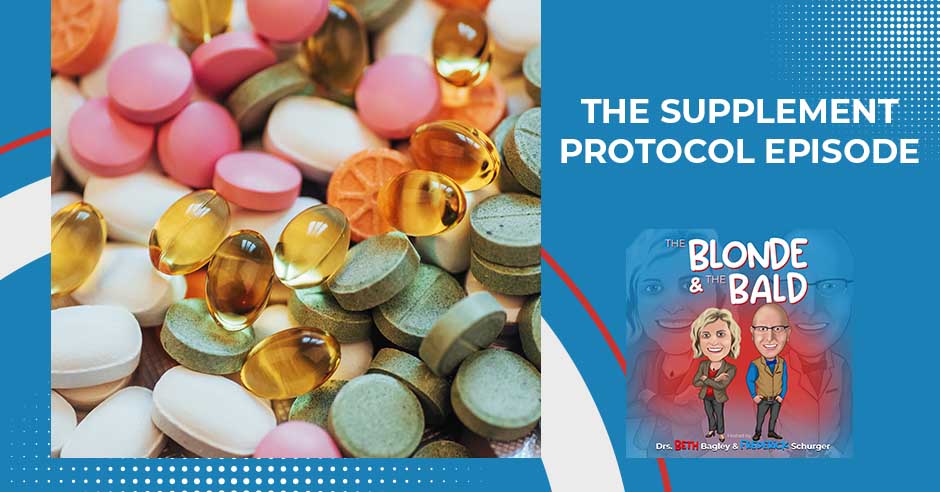
We've covered a lot of supplements in the past, and we wanted to do a dedicated episode to why we are using Fullscript and what protocols we have posted at this time. Supplements are a secondary priority in our practices because so much healing starts with your head on straight. But there are some things you need during the entire year (like Vitamin D in the winter) that you must have in supplement form.
If you buy supplements, we want to make sure you get the best ones that you can. We've done the hard work putting together these lists to make your ordering easier. This is also a great way to support the podcast as any sales help us keep the show going.
Listen and read the full blog post here
New Year's resolutions FAIL!! There, we said it. While the intent is great, the execution never pans out. Drs Bagley & Schurger discuss better ways to ACTUALLY make a difference in how to approach your health goals for the new year by changing one habit today (like right now as you read this) that will make a positive impact on your health. We're here to help guide you on your health journey, and this episode is a step in the right direction to getting started.
Listen and read the full blog post here
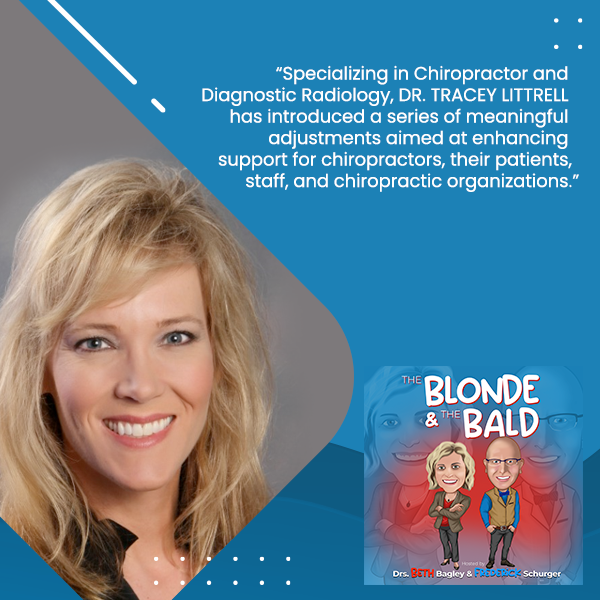
For her first podcast, Dr. Tracey Littrell joins Dr. Frederick Schurger and Dr. Beth Bagley to discuss Dr. Littrell's journey into chiropractic and then ultimately into academia and radiology. Dr. Littrell is a graduate of Purdue University where her future husband introduced her to chiropractic. With a newfound vitality, she pursued her chiropractic education at Palmer College and followed up with a residency in radiology. We take a deep dive that hopefully isn't too technical into chiropractic research, chiropractic education, and radiology that is used in healthcare to make better decisions for patients.
---
In this episode, we have Dr. Tracey Littrell, who has been our radiologist for the past several years, helping us out, trying to make sure that all these cone beam CTs that we take, we don't miss anything that's there because there's so much more information on a CT than there is on an X-ray, that needs a second set of eyes to make sure we don't have any problems. Dr. Tracey, tell us a little bit about yourself and your background. What is a chiropractic radiologist?
I am a chiropractor. It's important that your readers know. You don't get to be a chiropractic radiologist without first becoming a chiropractor. My background is like so many of us in chiropractic. When I was younger, I did not know that I was going to be a chiropractor. Events happen in our lives that lead us in a direction that's unexpected. Mine was not a lifetime but I had many years of low back pain when I was a pediatric and adolescent athlete, not having a lot of knowledge or experience and knowing that athletes are tough and put up with a lot.
I lived with low back pain. No one in my family saw a chiropractor. That wasn't on my radar at all. I went to college. I went to Purdue University in West Lafayette, Indiana to become a developmental psychologist. I wanted to be in healthcare. It seems like a different route but when you take care of patients, that's not the case. It's not a disparate field at all. When I was a student there, I met my now husband. His family went to chiropractors. He probably got tired of me talking about my back. He still married me.
I went to a chiropractor for the first time when I was a junior or senior at Purdue. I share the story with my students because it's important that they understand some of the psychology of the symptoms and symptom management that our patients deal with, even before they get to us. It was six months of care before it hit me that I was not afraid to bend over anymore or reach for something. This is mind-blowing to me because I was 20 or 21 years of age.
I'm going to sound so smart and insightful but I was not at all at the time. It took me many years to realize that I had become back pain and back pain was part of me where you have to own your addictions. I feel like back pain was not my addiction but it was part of my personality. It drove everything. As a young person, I spent an awful lot of time thinking about what I couldn't do. I can't do that because of my back pain.
Six months into care, it hit me like, “I'm not scared anymore.” I used to be so scared of being hurt because I had significant back pain. I changed my course and was like, “I want to do what you do.” I asked more about chiropractic. He was a Palmer grad. He said, “You have to go to Palmer.”I said, “Okay.” I trusted him so much. He changed my life. I wasn't going to consider going any place else. He had a phrase. He would say the oldest, the biggest about Palmer.
One of the reasons I'm telling this story is that I didn't know I was going to be a chiropractor, let alone a chiropractic radiologist. I was on a different route. Many years later, becoming a chiropractor and teaching at Palmer, I got to teach one of his sons. We were halfway or more through the term. This gentleman was talking about where he lived. He mentioned Lafayette and it hit me. He has a common last name. I never put it together that the last name I was seeing in this student was the last name of my first chiropractor. I have taught the offspring of the person of the man who got me into chiropractic.
It makes me tear up. When this student graduated, I accosted his dad as they were walking away from graduating. I don't know if you know or remember what it's like to wear a mortarboard but it's not good for your hair. I had my hair pulled back in this ponytail. I met him and his wife. I introduced myself. It is an alleyway between some buildings. I didn't think I'd get a chance to see him but I was able to tell him, “I got to teach your son. Here's who I am. I don't expect you to remember me but I appreciate the role that you played in my life.”
What you asked me is about how to be a chiropractic radiologist. When I was at Purdue, I was a Psychology major and also minored in Physics. Those go together like peanut butter and headlights. That was an odd pairing but I liked Physics. I wanted some additional science background. I give that as a basis. I got to Palmer. In the fourth trimester, we had Rad Physics. I could not have been more in my element.
I remember coming home to my husband and looking at this book of printed notes. I'm like, “Look at this. I'm going to be able to take apart an X-ray machine.” I could not have been more excited about the idea of this part of it but I still do not understand anything about chiropractic radiology. When I was in the fifth trimester, there was a national conference called the NCLC, the National Legislative Chiropractic Conference that's held in Washington DC every year. This is a chance for representatives from our state and national organizations to come together and lobby our representatives in DC.
As a student, I was able to go to this. We had dinner one night with a group of Palmer people. Across the table was a man I hadn't met yet, Ian McLean, for any of your readers who are certainly Palmer grads but in chiropractic, in general, would recognize that name. I hadn't had a class with him or met him yet. He talked about being a radiologist. That was another pivotal moment where I was like, “Not only can I be a chiropractor but I can also read X-rays.” From that fourth trimester on, I set my sights on being a chiropractic radiologist.
DACBR, for readers, is what we call a chiropractic radiologist. What does that stand for?
It's the Diplomat of the American Chiropractic Board of Radiology. Those are the initials of the designation. We put DC behind our names. Sometimes, people have other initials. DACBR is the indicator that this is a person who has gone through a radiology residency. Those are additional years of training beyond the chiropractic college education. Importantly, they have passed at least two other board examinations to be able to call themselves a chiropractic radiologist or DACBR.
I know some of them who have been in practice and become DACBs and some who don't adjust patients at all anymore. Do you adjust patients at all? Is your primary concern being the radiologist?
It is now. I was in active practice for a while. Both of you got some appreciation for this. When you own your business and you are responsible for yourself and many other people, it's hard to get away. Anybody in healthcare struggles to get away from the practice that they need respite from but to turn over that responsibility. I had the privilege. Even though I was in active practice when I went over into academia, I was part-time as a resident. I got to see patients. I was a staff doctor at the Palmer Clinics for a while.
Once I got out of residency, I did want to take care of patients but I didn't want that job to be full-time for me. Getting into the residency, getting into academia, and teaching physical diagnosis and clinical psychology, I got to do that for a while. There's a full-circle moment. I was going to be a psychologist and teach psychology.
I have been able through COVID and 2021 to do locums tenens work. For my area chiropractors, they sometimes would ask me to come in and cover a few days for them. I am not a grandparent but I feel like that's the best grandparent-like experience. I got to adjust people and do the documentation but I didn't have any of the other responsibilities of running a business.
That’s all the fun parts of being a chiropractor.
I feel like I have the best of the world to go in and take care of patients.
You're still teaching at Palmer College for a full course load.
I have a full course load. I'm in 2 physical diagnosis courses and 2 radiology courses. We teach physical diagnoses 1 and 2. That takes our students through the head-to-toe examinations, history, vital signs, eyes, ears, nose, throat, head and neck, and thyroid. Our second course takes them through the respiratory, lungs, cardiovascular, heart, and abdomen.
There are other courses that teach about neuromuscular skeletal testing, like reflexes and muscle testing. I don't teach in the NMS courses but I teach physical diagnosis. I have one of their first radiology courses called Diagnostic Imaging One. I get to see them. It's not their first Rad course but it's their first diagnostic Rad course. I get them for that. I also get to teach them for their last radiology course in the curriculum, which is chest and abdomen radiology.
You don't get to teach the physics.
I don't. I'm okay with that.
Having an engineering background myself, when I went through the program, I was like, “This is going to be easy and fun.” I said that when they introduced the right-hand rule. The way I learned the right-hand rule in engineering and the way they teach it in school are backward. Once you figure it out, it's like, “They have the body on a slab face up.” I still don't understand why we do it that way.
In many schools, there's an expectation for the professors to do research. Is there an expectation at Palmer?
There is. Let me back off that a little bit. We have a research center. We have faculty and staff, specifically in the research center, hired to do that work. Since the time I started at Palmer as a student, that research center as well as their grant applications and funding has risen. I don't know the numbers but I know that we, as an institution, are applying for grants. We're receiving grants from the Federal government but also from other agencies to engage in research.
We have staff and faculty that are dedicated to that. As an academic faculty person, I am encouraged to engage in research on the level of publication. It’s maybe not traditionally what we think of as research. I'm not performing interventions on controls or subjects. Not that kind of research is for me but my academic research category is to do publications like case studies on some of the interesting cases that come through my practice.
The stuff we're sending in for cone beam readings is like, “This is weird and different. This is something we should be pursuing or looking at. It would be a great place to start doing a research study.” One of the other things that people may be unaware of is that several years ago, a lot of chiropractic schools had their own research departments. That is not the case anymore. Palmer is one of the few that still has a fully staffed research department, which is saying something to Palmer for keeping that on board.
For the institution, it's a luxury to be able to pay people to do this work that's so necessary in our profession.
People like to think, when they hear about research in healthcare, that it's all figured out. That couldn't be further from the truth.
Are you saying the science isn't settled?
It isn't. There have been gatekeepers in the research field for so many years, chiropractic from even publishing or sharing what we found. They changed the rules at one point in time from what we had been doing, which is a more rigorous form of research. It's neat to see that we have that and we are showing that there is efficacy for what we do, as well as huge safety differences between what we do and what the medical profession does. For the best intentions sometimes, things don't go the way that we would like them to. In chiropractic, even the one failed study that didn't pan out the way they wanted to for blood pressure showed that for everyone who got a neck adjustment, there were no serious adverse events.
There's a positive when there isn't what they were hoping to see. Publishing is important. It’s like, “This didn't turn out what we thought but unfortunately, we don't always get to see the things that don't turn out.”
I agree with both of you. You propose a hypothesis and a prediction of what the outcome of the intervention will be. Sometimes, we convince ourselves that what we're doing will create a response. The research that counters our theory is as important as the research that supports our theory. If you're not in research, I feel like it requires a bit of a challenge and discipline to say that the message that you got is the opposite of what you thought it was going to be. It opens up other doors for us in research. I'm a firm believer that if a hypothesis is disproven, that is as valuable as the hypothesis for which we find evidence.
Are there any case studies or some things that you can think of that you've seen on some of your private clients or at school that are interesting, or the readers might find the information beneficial to them?
At the risk of sounding self-serving, my head is steeped in what I'm doing. Doesn't that sound self-centered?
That's to be expected.
I am privileged to be an assistant editor for a journal. I am a peer reviewer for ACC-RAC submissions, American Chiropractic College of Chiropractic Colleges. It’s a research agenda conference. Sometimes, I get asked for a peer review for other journals. I get a sampling of what other people are writing, and predominantly in the case studies.
The case studies are the base level. Those are what start us out and might eventually lead to a controlled clinical trial. That's a challenge but it might happen. In our profession, there's been more of an awakening and an invitation to publish what you're seeing in your offices, not just in academia or the clinic system but in the individual private practitioner's clinic. “What's happening in your clinic? Tell us about that.” I get to read a fair number of case studies.
I'm helping an author write about nutrition in incarcerated populations. This was eye-opening for me. How is that related to chiropractic? On the surface, it might not seem like it is. We talk about somebody who is of poor nutrition, regardless of the reason but specifically in an incarcerated population where cost-saving measures for the penal system are often reflected in poor food choices, a lack of the elements that are necessary, and fresh fruit. For those elements that we need in nutrition, they frequently get packaged food. It's not good quality and nutritionally enough for some of the incarcerated individuals to be healthy on any level.
This proposal for publication looks at the musculoskeletal influences of poor nutrition. How does that affect the patient who is the primary? How might it impact the way that we take care of patients? Here's an obvious one. If you have poor nutrition, your bone density isn't going to be as good as it should be. We all know that, as we age, we are going to lose some bone mass to some degree as a consequence of aging. When we have poor nutrition, that gets amazingly accelerated.
If you have poor nutrition, possibly your bone density isn't going to be as good as it should be now.
Think about an incarcerated population that might not get a lot of physical activity because they are confined, only get out of their cells for 1 hour or 2 a day, and have no opportunities to do weight-bearing activities. It opened my eyes to the cascade of poor health that comes from when you don't have good food available and you don't have the opportunity to maintain your muscle strength and bone health.
I never considered that before but it's eye-opening. Their brains aren't going to work correctly. You have to have nutrition for your brain.
There have been some studies and suggestions that, unfortunately, the way the food is given to institutionalized patients and people in jails and lockups is poor quality because it's based on the food pyramid and what the Federal government has been saying, “This is what we think is what it is.” They throw out a lot of the research saying, “No, you need so much protein. Animal protein isn't all bad for you. It's not going to give you all these problems.”
The question comes down to how much of these people's bad behavior came from the poor nutrition that has been around their lives throughout. They've made poor decisions to put them in there. It gets worse because they can't have choices of what they're going to eat. When we start thinking about brain chemistry, for acetylcholine alone, you need a precursor choline.
If people can't eat eggs for an egg allergy, they need to find some other way to supplement with that. Acetylcholine is one of the more calming brain chemicals that lets your brain relax. If you're wound up, why do fights break out? Why do people have problems? Why do people get extra time when they're in prison? They decided, “I didn't like that guy because I was mad.”
It could be that your brain is dysfunctional because of poor nutrition. I feel like my brain exploded a little bit. When you're helping with the author of a study like that, do you get to co-author? How do you get acknowledged in that process?
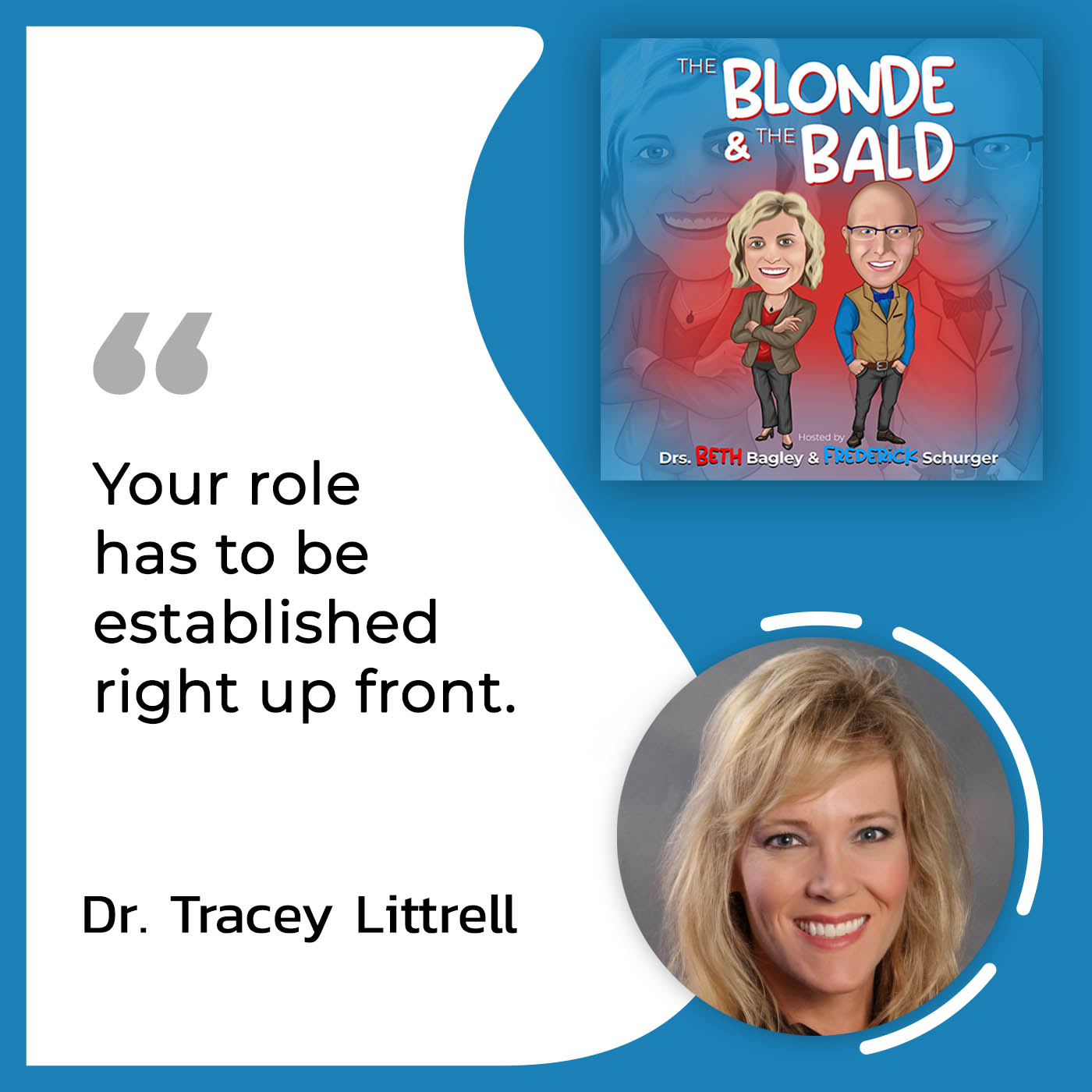
I'm thankful that you asked this question because there isn't one correct answer. What I've learned over the last couple of years is your role has to be established right up front. I've got a couple of case studies rolling around in my head and partially written down. I'm going to want help with them. The reason for me is I agree with everything I write. You have to have somebody else who's objective, who doesn't have the skin in the game, and who has less of an invested interest, and that it's published but still wants it to be published.
I'm a fan of co-authorship but I'm a fan of, before that ever starts, that you define what the rules are because there's a lot of misconception, and not just in our field, where a co-author might think that he or she is only going to proofread but the primary author thinks that they're going to be doing the literature search, going online, visiting libraries or getting interlibrary loans.
As an editor, I would not be a co-author because those are mixed roles. I need to remain objective and have the submission blinded to me so it can go through my review and that review of the other assistant editors. The journal that I am an assistant editor for is the Journal of the International Academy of Neuromuscular Skeletal Specialists. It's JIANM. We have a blinded peer review process. Sometimes, I'm one of the peer reviewers as I’m blinded to the authors. I run that through peer review.
I see all versions of it. I see single authors and multiple authors. What I hope is, before they have decided to put pen to paper or fingers to keyboard, they've decided clearly what role each person will play. That also is important in academia. This is a little bit of a side note. Primary authorship is weighted more heavily in terms of your promotion application. If you want to move from a probationary faculty member or an instructor who's passed probation, in terms of academic promotion, our next level would be assistant professor, associate professor, and full professor.
Primary authorship is vital to that progression upward. The secondary authorships, being second, third, and fourth authors, are also considered important. It sits a little bit lower in the basket. I'm glad that you asked that question because people who wish to partner together haven't thought ahead about who's doing what work. Some conflict can result because somebody had an expectation that the other person didn't.
I encountered this. I wrote the article and asked for somebody to review it. I intended to grant co-second authorship for that review but I was confident in what I had. We had a bit of discrepancy about what percentage it should be broken down. I thought that the peers with whom I wanted help were claiming a big slice of the pie. That's important. It is also based on a minor mistake that I made when I was a primary author. I didn't define the role ahead of time.
That crosses over lots of things but it's important.

If we're not going to learn that lesson, I'll continue to make that mistake.
We all do but expectations are in our heads. They have to be said out loud, whether it's a relationship or research.
You think it's writing a paper and there are so many other things going on if you don't say, “Let's sit down and figure this out.” Unfortunately, in the world of Zoom that we have had to live in the past couple of years, the conversation that you would've had about was like, “How much of you know this credit do I get and that credit that you would've had in person?” It gets lost a little bit, especially if they're half a world away and they're not in the same ballpark.
I've got a hard question. If you could wave a magic wand about the situation around research and change something, what gets under your skin? What would you change about the politics of doing research, funding, people, or the type of research?
In full disclosure, I do not work for the research department. I'm research adjacent. I want to promote research and publication within our profession and support my peers in all walks of chiropractic and healthcare who wish to get the message out. I'm not doing that grunt work of grant application, shaking hands, and kissing babies for the political side of it.
There is an awful lot of politics wrapped up in getting grant funding. I'm not feeling sorry or sympathetic to chiropractic. I believe that we've had a bit of a steeper hill to climb. Establishing the legitimacy of what we do needs further research. I acknowledge that. That's why we're not funded as well as some of the other professions in our research.
The other aspects I would like to change specifically within chiropractic, and I'm going to make a broad statement but I fully acknowledge it doesn't apply to everyone, is there seems to be a bit of an epidemic in practitioners who want to publish or talk about their cases. They want to use the word proof. They want to use case studies as proof of something as if one case study would then demonstrate to the rest of the world what some of us have been saying for a long time about whatever, whether it's about a technique, the need for X-rays, or the utility of therapeutic ultrasound, whatever the aspect might be.
As a profession, we have to be realistic. What we need is to build the base of the pyramid with many case studies. Those are put together to become a case series. We can eventually climb that pyramid to a randomized clinical trial. In our field of hands-on interventions, a true blinded or double-blinded study is nearly impossible. We have to accept. We're not going to reach a phase where we can do that out. Maybe computer algorithms and computer models could establish that.
Sometimes some of us want to publish because we are the defense against criticism that we've heard about our profession. If you find that personally motivating, that's good. We have to come to a comfort level of every bit of our experiences that we contribute to the public domain in terms of broadly called research but the evidence for what we do, whether we think it's a negative or a positive outcome, all of that helps build our future and support for what we do.
We've all been doing this long enough to realize that digital imaging alone has been a game changer in terms of the information that we get. If case studies become case series and more narrative research, I hope that we can recognize the connection and that we might develop computer programs that allow us to mock up an adjustment and see that intervention. I would like to take our ego out of our publications. When we're not immediately satisfied, we internalize that. We might think, “Here's the proof.” It's not about proof. It's about evidence and being as objective as possible.
Every case study is, at best, a data point. Everyone is going to get this one immediately. If you get on the scale, you look at that number, and you're unhappy with that number, write it down and walk away. You're not going to be happy with that number but you might be happy with that number. Do it again tomorrow and the day after.
If you are saying, “I'm going to track my calories and change what I'm eating.” You can weigh yourself on Friday morning after Thanksgiving but you're not going to be happy with that number because you ate grandma's pies. You say, “I'm getting back on my regular eating habits.” You see the data go in a different place. It is all data. A case study is a data point. A case series is a little bit better than you could say, “I've seen this trend here. This is why I want to put these cases together.” It says, “This direction makes sense.”
One of my favorite stories that I heard, and I don't know if this is true because I haven't been able to confirm this, but I was sitting in a sophomore engineering class and they were bringing in professors and interviewing them. They were supposed to give a presentation to my class. I remember the professor who came in and said, “Here is why calculus is important. The B2 bomber, the wing design looks cool and futuristic, and UFOe, was at an optimal for the first derivative.” If you understand calculus, that means it's at its peak.
The problem is they never did the second derivative. That's telling you whether or not it's the best peak or the lowest peak. In fact, it was the lowest peak. Science is interesting, and you can figure the stuff out but you don't have the data to do the math to figure out, “Is that a positive or a negative?” In this case, it was a negative but the Federal government decided, “We're going to put billions of dollars into that. Did you check the next thing?” I'm not going to say it doesn't look cool. I'm saying that there are better designs that could have been out there.
It looks cool. It was amazingly intimidating. Who didn't want to get in one of those things? I never walked up next to one of those but they're amazing.
I'd rather get into an SSR 71 and all of the technology that went into that thing because that thing is wicked crazy. The things they figured out were engineering feats but they were able to run data. We have years of engineering to figure out an airplane. Unfortunately, we have not had the scientific approach got lost after Dr. Palmer passed away. Nobody carried on the research for several years. We started saying, “Let's do some research.” There were no funds to do research by modern-day standards, which is huge.
I agree. Everything is about case study. People want to prove something. I joke about the immune study that we did. At the end of the day, I saw ten patients who all had an improved immune response after their adjustment. What can I say definitively? Odds are good. If I adjust somebody, their immune response is going to go up. I can say that. Dr. Bagley can't. She does the same thing that I do and I've trained her.
I didn't do it.
Doc, do you remember some of the fire back and forth and the criticisms of the Bakris blood pressure study?
I don't remember enough in detail. I'm certainly aware of it. I want you to keep going but a good example is the oversimplification of that because that was the title of the headline. Another example of our ego is that we have felt like we are not second place to other healthcare providers but fifteenth place. We're grasping everything that we see as a potential positive and owning it but we're also misinterpreting it. We're writing these inflammatory headlines about proof. I remember some of it.
I would go to a NUCCA conference as a non-NUCCA doc. I was like, “They're going to do it with toggle recoil.” They all laughed and were like, “That's never going to work.” I'm like, “You have no evidence that it's never going to work first.” There was one doctor who did all of these adjustments that brought these blood pressures down. At the end of the day, he was the best in that group of upper cervical docs.
I got on an elevator with him as we were going back up to the conference after lunch. My blood pressure went through the roof standing next to that man. The question becomes does NUCCA improve blood pressure or did Dr. Dick Holt Senior, because of his adjustment and his years of practice, do the job? We have to define that. Sometimes, the ego gets in the way. I was taught by him and I'm like, “Can you clear him out?”
It has to be repeatable. If it's not, we can't claim it as proof. I have a separate question. Both Dr. Schurger and I use CBCT in our office. You, as a radiologist, it's a newer technology for chiropractors to use. CT is not a newer technology for radiologists. What are the differences in visualization for you between a typical CT scan and a CBCT scan?
If you send a patient for a CT of their chest, abdomen, or spine, they are likely to go to an imaging facility and have what's called a fan beam CT. Fan beam CT, which is so nicely named in comparison to the cone beam CT, gives your readers a great idea of the path and the spread of the X-ray. Fan beam CT is quite a bit wider and has a higher ionizing radiation dosage. The consequence of that is it gives us great potential for fine detail.
Fan beam CT has some flexibility in the thickness of the slices. That sounds very aggressive but we're going to shoot this radiation through the patient. As we move the radiation source, we can image the patient in tiny slices. Fan beam CTs aren't the same for every person because they rely on the reason for the study. If I go to the hospital and they think that I have a bowel obstruction, they're going to do an abdominal CT and it's going to give us gorgeous detail of the organs, the bowel, the air within the bowel, and contents of the bowel.
It's also going to give me an excellent view of the vascular structures. It's going to take a lot of ionizing radiation to do that. If they think I have a bowel obstruction, it's appropriate but the abdomen is large. The slice thickness is fairly thick, maybe on the order of about 5 millimeters. We take a 5-millimeter slice. We have a small space in between with no slice and we do another 5 millimeters and another 5 millimeters.
On the other hand, let's say that I have lung cancer of any form. I'm being treated for that and monitored for it. There's a different version of fan beam CT where the slices would be much thinner. If we're trying to monitor a person's response to treatment of their lung cancer, it's important that we take skinny slices through the chest to be able to see if the tumors have grown or regressed.
There's a third order of a CT called spiral CT. In spiral CTs, instead of slicing the patient top to bottom or bottom to top with radiation, the spiral CT is literal. There is an X-ray source that truly spirals around the patient or the patient moves through the spiraling X-ray source, and there are no disruptions to the image. It's a solid exposure for the patient. If I had lung cancer and I was being monitored for a whole bunch of teeny tiny nodules, I would want, at least on occasion, a spiral CT. All of that is leading up to this. Cone beam CT offers us an amazing amount of detail but it does so with less radiation and in a manner that it can conned down to smaller body parts.
It's relatively new to the field of chiropractic but maxillofacial air specialists and orthodontists have been using it for several years. I don't know who we have to thank for bringing it into chiropractic. I'm a little bit ashamed but not globally ashamed of us that we didn't think about incorporating it a bit earlier because of the amazing detail that we can have with not just the teeth but as we focus on the occiput and the rest of the spine. There is a bit of a difference, as you too well know, in the technology. Cone beam CT is not as high resolution as spiral CT or the thinly sliced CT that I was talking about earlier. For the larger structures that we see in the soft tissues, the bony structures in the head and neck region, it's appropriate.
I was talking with one of the manufacturers of not the cone beam that we necessarily have in our office but one that is a little bit more advanced. There's certainly a little bit higher dollar as far as what they're doing but they've been doing one that moves up and down. They figured out, “I can splice these together.” They're figuring out that they can do a much larger array and do the whole body. They're figuring out how to do that.
Once that happens, we're going to see so many changes both in orthopedics and the regular chiropractic field almost immediately and overnight. It's going to be exciting when those changes come in. We have Dr. Jake Hollowell, who was over in Italy when he figured out that cone beam CT would work for what we're doing. He is our pioneer in this work but we've been slowly incorporating it into the Blair offices throughout the country as well as other upper cervical practices. It's exciting to see where that's going.
You brought up a good point about ionizing radiation being significantly less, depending on how you parse the data. I've seen some different studies that even a regular X-ray series and modern X-ray technology are still much better than it was many years ago. I want to get your take because there seems to be this back-and-forth about all ionizing radiation being bad. There seems to be this new approach that suggests we shouldn't get too bent out of shape about when we need to make a clinical decision. Let's get the imaging.
I love the field so much that there's an inherent bias to me, in my opinion. I love X-rays and imaging. I lean towards the pro imaging because I get to see the value of it. On the other hand, I have the responsibility to guard it to make sure that the use of it benefits the patient and whomever the doctor is or the healthcare provider that they see, chiropractic or otherwise, that it is the best fit for the patient.
I was talking to somebody. He works in a hospital system. This was a conversation not related to imaging but he was saying that he virtually never sees X-rays anymore because, working in the hospital system, they might take a chest X-ray but they tend to go right to CT or MRI for predominantly musculoskeletal concerns. I get it if you're in a hospital and you have both of those techniques. The CT and the MRI are going to offer us so much more detail than we can get with an X-ray. His point wasn't that X-ray is bad. It's that he has gotten out of the habit of interpreting those because they're almost always going right to the advanced imaging.
I feel like this is an extension of our conversation about research, where we want to take the answer that fits what we need first. We want to support that answer. Here's what we'll find. In our profession, there are some who want to X-ray every single patient. Therefore, they will find a clinical rationalization for that. There are others who skew the other way. There's no need to do imaging. They're both wrong, to be blunt. There's no reason to take an approach to everybody getting an X-ray or no one gets an X-ray.
If I substitute different procedures, everyone gets a laminectomy and no one gets a laminectomy. We have to be reasonable between. That ionizing radiation has been vilified on many levels and sometimes appropriately. When it was the only tool that we had, we probably overused it. It’s us in healthcare, not just chiropractors. The response to that by some has been, “If it doesn't give us what we need and it doesn't impact the care of the patient, we shouldn't do it.” That's a reasonable approach to this.
This profession and others operate in the extreme of always and never. The judicious use of ionizing radiation is the purview of our profession and others. Don't feel bad about taking it if you think that it's necessary. Why would you think it's necessary? Your education and experience tell you that the entity, condition, and diagnosis that you're looking for will either be confirmed or excluded by taking the X-ray. Substituting anything else in it will be included or excluded on cone beam CT, MRI, or colonoscopy.
In healthcare, we've probably overused ionizing radiation. For those of us who aren't in a hospital system, sometimes we're a bit naïve about how much ionizing radiation patients get because they're seeing other providers. They're getting chest X-rays from their pulmonologist and hand X-rays from their rheumatologist. They're going to a walk-in clinic for suspected fractures. If our patients have chronic illnesses or malignancies, repeated CTs and chest X-rays are the norm.
What I've got my students to do is don't be naïve. What you are going to do with a patient by taking an X-ray might be what is necessary. To oversimplify it, say, “They've crossed my threshold and I'm going to take X-rays on everybody.” That doesn't serve the profession or the patients well. I'm not anti-ionizing radiation. I feel like the pendulum is back in the middle. It's not an all-or-nothing anymore. You know that digital radiology has helped us significantly.
Don't be naive. What you are going to do with a patient might be exactly what is necessary.
This has been the evolution of radiology in general because when B.J. Palmer bought the second radiology machine in the world back in 1910, it was a low-frequency, high-dose machine. I knew a doctor who had one. He would take a couple of pictures. He had to give it away and say, “We're writing this off and chopping this up. It's junk.” I saw two of those in my time in practice.
The one that I have, which was a modern X-ray since the ‘70s but certainly the ‘80s, as the technology was advancing, was a high frequency, low dose machine. Digital has taken it to the next level. The cone beam is taking it to the next level. As technology progressed, when people would go to the shoe store, they put their feet under the fluoroscopy thing and hang out there. They'd burn out their toes because of the radiation dose they had.
I'm glad that's not like that anymore.
There are things that we did. Somedays, I want my flip phone because it would be a whole lot less annoying than this thing. There are a lot of benefits to an iPhone. Some would argue that mine is an archaic piece of junk because it's a 7 instead of 15. Yours tracks you better.
Dr. Littrell, thank you so much for coming on. I feel like I want to go back in time or make myself younger so I can go to Palmer and be one of your students. We could talk for four hours but we won't keep you all day.
I feel the same. You come to my lectures and I'll come to you. We should hang out. We're going to keep bread out of it. This is you and me.
First of all, is there anything that you want to convey to the readers? Second of all, one thing you could give, like a little piece, why it's amazing for someone to come to Palmer and be a student there.
We should have confidence in what we do. I hope every person out there who's taking care of other people has confidence in the decisions that are right for them and their patients. Not to oversimplify but when you're following your head, you’re teaching your experience, and you value that, and you're not second-guessing yourself, you're most likely doing right by that patient.
We should have confidence in what we do.
An offshoot of that is I've learned that the older I get, I have pride in myself and my work. The beneficial part of that is not having too much pride to admit when I'm wrong and not admit when I need help. I would hope that your readers don't get their pride wrapped up in that. It's not an aid to the patient to seek out help.
In healthcare, we're leaders, doers, or fixers but we think we have to do that all ourselves. I couldn't do what I do without having a team around me. A lot of it I do by myself but it is with the support of my family and coworkers. We need to spread that message a bit more. As far as Palmer goes, I'm Palmer loyal. It's a place that I've made my home. I am proud of Palmer. It’s the advances that we made in a long time but a relatively short time that I've been there.
I am very impressed with our academic rigor and continue to do so. With the support that the administration has given us, we always have a little pushback. We have the technology that we need. We are progressive. In some ways, our IT and Center for Teaching and Learning are pushing the faculty to be even more progressive. We're being driven by those who support that technology.
My heart is at Palmer and I am proud to be a Palmer grad. I have clients who graduated from all of our chiropractic colleges. I have pride in all of us. I will not be one who would ever say, “You have to go to XYZ school because that's the only place where you will flourish, grow, or blossom.” For each person who may be considering becoming a chiropractor, you have to find the best fit. If it's Palmer, we're going to welcome you with open arms. If it's Logan, they're going to welcome you with open arms. You have to find the place that fits best for you.
I want you to plug your website so doctors who are reading can find you and start a relationship with you. They can get better reads on their images.
I have a boring website name. It's my last name. It's LittrellRadiology.com. My email is DACBR@Me.com. Fred, I'm an Apple user.
I know it. Same here. I am 100% with you on that Mac stuff because they work.
Dr. Fred, where can they find you?
I'm at KeystoneChiroSPI.com and all the socials in Springfield, Illinois.
I'm in St. Louis, Missouri, PrecisionChiropracticsSTL.com. Dr. Tracey Littrell, it was amazing having you. Thank you so much.
I'm so honored. You are my first interview. You may be my only ever interview.
You'll get called into others. It happens. We'll be back with another episode. You have a great day.
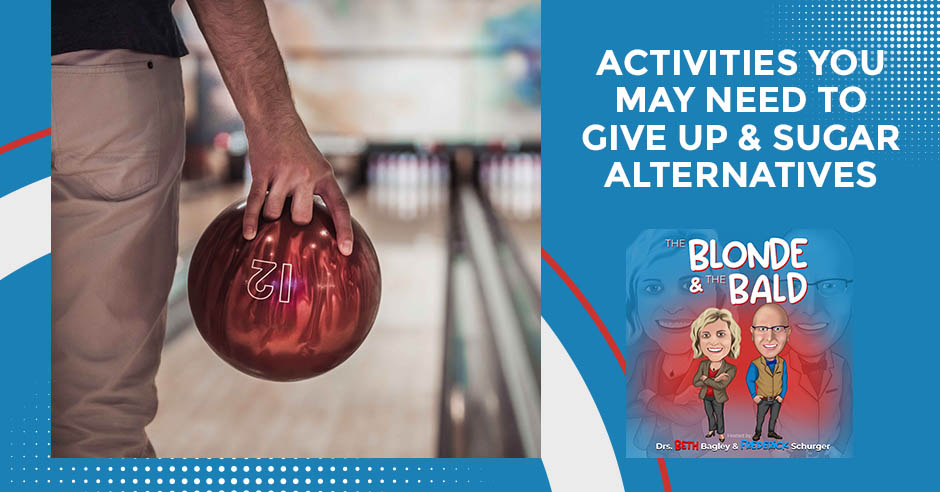
We all love our hobbies, but some can be detrimental to our health! In this episode, we cover how some activities like bowling, Jiu-Jitsu, and golf may need a break in activity to allow your body to heal while under care. And since it is the holidays, we're covering a little more on how to avoid it through food substitutions and HEALTHIER sugar substitutions.
Listen and read the full blog post here

Health isn't just about what you take; it's about what you surround yourself with. In this episode, Dr. Bagley and Dr. Schurger discuss the hidden truths behind over-the-counter medications in the second part of their discussion. They talk about the history of medicine, exploring how aspirin's dominance declined and the interesting shift towards the use of Tylenol. But that's just the beginning. Throughout the episode, they shed light on chiropractic care, the real effects of aspirin, the sustenance of holistic health, and so much more. Don’t miss out on this value-packed episode. Tune in now and learn how to live a healthier, more vibrant life.
---
Dr. Bagley, how are you?
I'm well. It's been a great week. It has been a little slow because deer season is about to start here in Missouri. Is that in Illinois?
It's been deer season. Rifle season starts. It's slow because of the silly daylight savings time and nobody knows what time it is.
It’s dark and sad.
Here's mine with daylight savings time. First, we changed the time and I got an extra hour of sleep. I'm like, “I didn't get to bed until midnight. I was out with friends on Saturday night. We didn't get out of Fogo until about 11:30 midnight almost.”
That's way past my bedtime.
I started eating dinner way past my bedtime and then got a nice extra hour of sleep. I was in a hotel room. I was able to ease into my workout and get prepped. Monday morning comes along and what happens? I woke up at 3:30. Not 4:30, which would have been 5:30 before. I wake up at 3:30. My brain says, “No, this is definitely not the right time to get up. Go back to sleep.” I go back to sleep for three hours, sleeping through both of the alarms that I have.” I'm finally getting out of bed a little bit after 7:00.
What time do you start seeing patients on Monday mornings?
9:00.
That was getting started pushing it because it is your morning routine.
My morning routine is not happening. It becomes, “Get my coffee and try to resemble being a human. It wasn't bad on Monday. On Tuesday, I do the same thing. On Wednesday, it's still that way.” For this Indiana boy, it takes two weeks to get reset after the silly time change. I don't care which side it is on.
We've talked about in the previous episode how the time change will cause people to have heart attacks. One of the subjects we're going to talk about is a medication that is a lot of times given to people to prevent that, how that works and what they talk about now. There's no research on it. I have a win from one of my patients. We've talked about her before. This person has pots that she passes out when she changes position.
She's been doing fabulous. She’s doing more things around the house. She’s good, but then she had a real bad fall and knocked her way out of alignment. It was quite a dip in the progress she had made. She came in. She was holding her adjustment and amazingly, how fast she's recovered. That's one of the things I want to put out there.
When you've been under upper cervical care for a long time and you do have a setback and injury or something happens to you, it's not the end of the world because your body is in such a better state to heal from that injury or that stressful event in your life where that could have set her back quite a bit or kept her bed-bound in the past. I'm very excited for her. That's Dr. Lad's patient. She is graduating in December 2023.
She's doing great things already. An interesting thought that came to me as you were saying that. When you've been under care and you have a set, what would traditionally be a setback. You recover and maybe you don't go back as far. I've had patients say that they feel like they had a set fall or something to that effect. They're like, “It feels as bad as when I first came in.” I tell them right off the bat, “No. First off, definitely not, because you're not going to fall back that far unless you take off months to years.”
The other thought that sat with that was if you're taking medicine for the symptoms and trying to manage the symptoms with some medication when you have a fall like that, it doesn't just like, “I need more of the med.” You're probably taking as much of the measure you can tolerate, to begin with. The med is managing the symptoms as opposed to getting your body to function and heal better.
if you have a fall like that, it is not a, “It'll be better here in a couple of days.” No, it might be a significant setback that might take you months to recover from where you were. That is one of the big differences. A lot of people, in fact, the medication we're going to talk about takes care of pain as fast, if not faster, than a lot of chiropractic adjustments as they've compared. What is the long-term benefit of one versus the other? In any case, speaking of a similar situation, I have one of my patients. She was in the Army. She had a medical discharge due to rocking and they overloaded her pack or something like that.
What is rocking?
In the military sense, they basically have to carry all of their gear. You're carrying 80 to 100 pounds for a 20-mile walk. It makes sense in the military. You're training your infantry to be able to carry the gear that they need to survive from one spot to another.
I chose to be with my trainer. My trainer had me and my girls, because I trained with my twin, carry weight for 1 mile. I carried quite a bit of weight because I was like, “I'm strong. I can do it.” At first, you're like, “This is fine.”
How much weight?
It was a 40-pound sandbag. It was a front carry. We relied to drop it when we needed to drop it. I did drop it quite a bit. That was the hardest workout I've ever done. Many times, I thought, “I'll drive my car back here and I'll pick this weight up. I will come and get it for you.” She was there saying, “You can do this. Take it back up. Get to the stop sign. Get to the next stop.” You know that place. I should have probably picked a lighter weight. I'll be honest, that was my ego, but I still did it. I was proud of myself at the end. I was miserable the whole time.
How many people have carried not just 40 pounds in a sandbag but 40 extra pounds on their body? That's the same problem. That's why for people who are overweight and who are not physically active, going up a flight of stairs is a lot of work for them.
One more thing. When I was pregnant with the twins, I was 40 pounds heavier than I am now, but I did it. Let’s go back to your patient.
She's got some lumbar degeneration. She's had a couple of surgeries to take care of that. We've been keeping her head on straight as best as we can. We finally started putting all the pieces together because she was coming in to see me for her neck and headaches and yet that didn't all get cleared out, but then we figured out that not only was her head off balance, but her psoas, which is one of your main hip flexors to lift your leg up and spinal stabilization. That's a mess.
We started training her on how to strengthen the psoas and then she started working with a massage therapist and a PT to do even more with that. She's finding all these pieces. She gets the psoas and her hip is doing better, and now her headaches have started getting better. It is all these parts and pieces that are coming together.
She's been coming to see me for a couple of years now. We're finally integrating all these bits and pieces to get her better, which I'm excited about because she's on disability. She was medically discharged from the military and then she eventually got on disability outside of the military because she still couldn't function. Now we're putting all these pieces together again because sometimes you don't get all the answers from one doctor, which is fine.
We love our colleagues.
There's no one better than you and I put these top segments back in place, but we also realize that when it comes to hip stuff, it's like, “We can do this much. There's all of this other stuff that needs to get taken care of.” I'm excited for her. I would be surprised within about 6 to 8 months because she wants to work. She wants to be out there and doing things. In 6 to 8 months, she's going to be fully functional. She's tried to take the meds to try to calm down the pain and her response is, “It's candy. It's not touching anything. There's no redeeming quality for it.”
The topic that I wanted to bring up is Aspirin. It's something everyone knows. They've heard words like baby Aspirin, one Aspirin a day, and all these things that have changed, yet there are many people who have not changed their behavior because nobody's told them. I'd like to reiterate that we are not your doctors. We don't prescribe medications or take you off medications. We are podcasters.
If you need a doctor, find a doctor. Don't take any of my word for it. Talk to your doctor or chiropractor about this stuff. In general, chiropractors don't deal with medications directly. We do talk about medications and give people research so that they can make some decisions on their own, but this Aspirin is over-the-counter. It's something that anyone can get.
This is part of our over-the-counter medications safe series because a lot of these over-the-counter meds are not as all that they're cooked up to be.
Aspirin was the first anti-platelet medication and it decreases blood clotting and pain. People notice that pain affects. It reduces fevers.
It was originally made from Willow Bark.
If you did chew on the bark, that would be a healthier way to take it. It's probably a different form of it.
The question becomes, “How much of the Aspirin out of the willow bar, but the willow bark had other protective things going on?”
You make a tea out of the tincture or something, and it would be different. We take the one active ingredient and we market that. Aspirin has been around for hundreds of years. It was around during the 1918 flu epidemic. It was probably a little bit before then. It reverses the enzyme activity for the body that creates blood clots. The low dose or baby Aspirin can almost completely inhibit the enzyme activity. It does affect the body for a prolonged time. It does a job. It works, but there are side effects to lots of things. Aspirin has quite a bit of side effects. There's a lot.
Aspirin has quite a bit of side effects.
I'm not putting them in order of severity, but let's talk about one, which is Aspirin-induced asthma. I didn't know much about that and I was like, “That's something that can happen.” There are these people taking Aspirin daily. Maybe they have breathing difficulties, too. Could this be related? I don't know, but it's something that I should know because I did not even know about Aspirin-induced asthma. That's interesting to me. It can cause nasal polyps. This one we do know about is chronic gastritis. It causes bleeding and problems in the upper GI and it can also cause things in the lower GI. It can cause ulcers. That's a pretty big deal.
We're taking it daily. You can bruise your, which makes sense because if you're reducing blood clotting, it's easier. Nosebleed is another thing. It makes total sense. You're decreasing your clotting. Shortness of breath, which I think has to do with asthma. It could be other things, such as hemorrhage and decreased platelets. It all makes sense with the mechanism action. We call it baby Aspirin because it's 81 milligrams. It's a small dose because there are bigger doses of Aspirin out there. Can babies take Aspirin? What's your answer, doctor?
I would be very hesitant to give babies Aspirin.
They don't call it baby Aspirin anymore for a reason. People say it that way but you won't find that on any bottles.
Interestingly enough, it was always Saint Joe's baby Aspirin, which I’m like, “Really? I thought it was Bayer or Johnson & Johnson because it's been off-patent forever.” Funny aside, before we go on, I want to tell a short story about one of my good friends, Keith Wassung. We've talked about Keith in the past.
I'd love to have him on. He's so great.
He would be great to have on the show. One of the things Keith shares is he would do these health lectures because chiropractic saved his life. He would do these health lectures at various places, including medical institutions. One of the things that he would do is talk about baby Aspirin. He would take either 1/2 or 1/4 of a baby Aspirin.
Sometimes at the beginning of his lecture, the other thing he would do is he would take one of these lancets that people use to prick their fingers so that they can do a glucose or Ketone test strip. He would show how. He'd squeeze his fingertip and all of a sudden, this nice little red droplet of blood would come out. It wouldn't just pour out or money python squeezing out everywhere. It would make this nice little bubble. He'd be like, “This is how the platelet flack. Factors are supposed to work.”
He put a bandaid on that. Take that 1/4 or 1/2 baby Aspirin and then continue with his lecture. About 30 minutes later in the lecture, he would have a slide talking about the process of how the platelets, fibrinogen and all of these things come together to seal up a wound like that and how Aspirin interferes with this pathway, then that doesn't work. At that point in time, he would undo the Band-Aid and squeeze a little bit. Instead of having that little droplet of blood stay there, it would now bleed freely onto the floor.
That's how quickly it got into a system.
That's how quickly that went through the whole system. He took it in the mouth and hit the stomach. Within 30 minutes, his finger would not clot at all. It's a curious experiment. He told me that story and I'm like, “I don't want to do that.”
“I'll just talk about your fingers. I don't want to put Aspirin.” That's a great story. I've never heard that one. We definitely have to have Keith. Babies don't take Aspirin. We don't give kids Aspirin because of is this thing called Reye's syndrome. It's a rare condition. It causes swelling in the liver and brain. If children and teenagers are recovering from chickenpox or flu-like symptoms, they should not take Aspirin. It's not safe for children. It’s no longer marketed to children, which is great, but it's still being marketed to adults.

Let me bring up this CNN article, “Daily Aspirin to prevent heart attacks is no longer recommended for older adults.” Interesting. This was in 2019 and many people still don't know about it. In general, they are beginning to say that it could be good for some, but it's not one of those things like everybody takes a baby Aspirin every day. I do see it less in my patient population. Have you noticed it less?
I have. People are starting to hear about this. I don't know about you, but I remember when I was in chiropractic school around 2003, they were even talking about how half a baby Aspirin daily was too much. They were even suggesting that all signs indicated that half every other day might be a better choice, whether or not that's true or not at all.
The case studies that CNN put together and I'll bring up some more recent ones, but said, “Taking a daily low-dose Aspirin is at best a waste of money for healthy older adults. At worst, it may increase the risk of internal bleeding and early death.” It is not such a good thing. It's got to be at least twenty years of people taking these daily Aspirins.
It's been longer than that. I think that's been a standard of “care” for much longer than that. Heart attack risks started in the ‘80s, but in the ‘70s and the ‘80s, it became more prevalent. I don't remember when they said they were starting to do the daily half an Aspirin.
On this abstract, what we see is the US Preventative Service Task Force. Their guidelines are based on evidence from thirteen studies that suggest that Aspirin provides a small benefit for select patients aged 40 to 59 but no net benefit with potential for harm for patients 60 and older. It's on a case-by-case basis, adults 40 to 59 with a 10% or greater 10-year cardiovascular disease risk, but typically, doctors were putting people on baby Aspirin for, like you're older and you need to take it. It’s like statins, which is something we can talk about. That's not over the counter, though.
The interesting thing is 40 to 60 is the age range that they're looking at. How many people between 40 and 60 are like, “That's what I'm supposed to do,” then they get busy. They don't get in to see their doctors. They're not hearing about this information.
There's no benefit from 40 to 59, except for this tiny percentage of people who have this cardiovascular risk, and maybe that's not even true. It could be a random study that might or might not have been done. We don't know, but all of these other studies are saying no. My question is, who funded the study that said it was great? I didn't look that far into it and I'm not going to conspiracy theory my way out, but I'm going to guess it was a manufacturer of Aspirin.
It's that big Aspirin company.
They still sell Aspirin, a big old container of it, 81 or 300 milligrams. When a heart thing happened to my husband, we were pretty much sick with COVID. It was scary if we went to Afib. They tried to put them on daily Aspirin. He did take it for a little bit because he was scared.
It might help.
He never went back into AFib. It was like the one time. It was because his heart was probably being attacked with Spike proteins and all sorts of stuff. He doesn't take it anymore. I don't know if it's still like a better night. I'm a hoarder, not really but I don't throw things away like medications and supplements. I have a plethora of supplements, but we don't have a lot of over-the-counter meds. That might be one that I may have thrown it away, but nobody takes in in our house.
As an aside, if you show up at our house and hang out overnight and they have something that they're not using it will end up in your cooler on your way home.
Especially if it's road bacon. One time, Dr. Sugar was spending the night at our house because we were having a seminar the next day. We were finishing it up and my husband was like, “I'm going to make breakfast,” and I was like, “Dr. Sugar doesn’t eat breakfast.” I don't eat breakfast either, but he was all excited. He got a big old baggy full of bacon to take home.
That lasted more than the morning at the seminar.
In general, talk to your doctor about it. Do your own research. The research is out there. I shared some of it. This is not what people should be doing anymore and the evidence, there's too much harm. Honestly, I don't think people should be taking it as a pain reliever or a fever reducer, either. I think it's not a great medication. There are safer alternatives out there. Sometimes, it's okay to have a little bit of pain. I'm not saying that we should be in chronic awful pain all the time, but pain is our friend. It tells us when something's wrong. It tells us when we need to slow down, calm down or heal. If we don't listen to it then, and we turn off the sensors and inhibit what God gave us was this ability to feel pain and we turn that off, we hurt ourselves worse.
When you read the label, there will be something on the label to paraphrase for acute pain. A campaign means it's brand new, and you're like, you've hit your limit, and you need something to lessen it. It is not designed for you to be taking all the time. If the pain lasts more than about 1 day or 2, and two might be pushing it, you need to do something different because that's not its intent to get rid of that, but yet people pop it like it's candy.
I used to be one of those people. I used to be the person who had chronic headaches and pain. I would go through an industrial-size Sam's Club bottle of Advil over the course of a couple of months. I would take it almost daily and I didn't know any better. Nobody ever told me any different. I hadn't done my own research because I was a kid. I was a kid doing this. Last time, I probably took Advil quite a while ago because I twisted my ankle so badly. It was throbbing.
I was laying there with it throbbing like not crying but wanting to cry. I thought, “This is the time and place.” I didn't want to walk on it, but knew I needed to keep it elevated. I see all the things that you have to do, but that was probably the last time I took it. The point is I'm glad it was there for me when I needed it for that because I was unbearable at that point and it made it bearable. I only took it for like a day.
Back to Aspirin. You mentioned Reye’s syndrome. Did you find anything debunking Reye’s syndrome and Aspirin?
I didn't.
I had come across something years ago. I'm not going to go down this rabbit hole too deep, but I'd come across something suggesting that Reye's syndrome and Aspirin are not as linked as they like to make it out to be. I don't remember all the details other than that it has also been the rise of Tylenol. Tylenol became popular.

We may have touched on that before because this could have been funded by the time we have a manufacturer.
There were some questions as to whether or not Reye’s is tightly tied to Aspirin usage. I don't remember the details. It's one more of those things that people are like, “I don't want to take Aspirin because it's going to give me Reye’s syndrome,” or something like that and there's some back and forth as to whether or not that is the case.
There’s one little thing I looked up and said it can't. They're still saying there is a connection, but it says sometimes children with rare genetic conditions such as Medium-chain acyl-CoA Dehydrogenase Deficiency or MCADD can cause Reye’s syndrome and has nothing to do with Aspirin. There are genetic changes that can happen.
It begs the question of whether or not there's a causation or a correlation. Those two differences make or break some of these claims that are out there.
Number one pain reliever and fix everything in Aspirin.
Reye’s comes along and all of a sudden, it's Tylenol. There was also a scare about something being put in the Aspirin bottles. This was before they had bottles that had double or triple protections to make sure it's sealed and it's never been opened by anybody ever. This is back in the day when the pills are right in the bottle. All these safety precautions that we have. We have on our supplements that you have a special cap. I got some liver supplements and on top of this cap, there was another wrapper. I'm probably going to take this as my Vitamin D. If I take this home and open this up, there's one more safety seal. All of these things are trying to remind us, “I need Vitamin D.” All of these things are because somebody snuck some poison in at one point in time and then Aspirin and Tylenol got tainted.
It's reverse marketing. It's a guerilla warfare of these manufacturers. It worked. I don't know if, in this day and age, it would work. That stuff is still happening.
How do you package anything to be something else that you want it to be?
What I'm seeing in my conspiracy theory brain is that Aspirin was lost on the market when it started to like, “This is bad.” It's good for cardiovascular. Every adult needed to take it, so they remarketed it as a supplement. It was marketed as something healthy and it isn't.
In fact, one metastudy suggests that there is a little bit of benefit if you are in the city-bitty little group as opposed to everyone past 60. Everyone past 60 has a cardiovascular risk. They're saying everybody in that group has no benefit because as we get older, a lot of the collagen matrix and tissues will not hold up strongly. We talk about older people and having thin skin, literally. The question is how much of that thin skin is some of these medications have been screwing with their ability to create good strong skin? How much of it is thin because problems are coming on?
What ends up as we get older, a lot of the collagen matrix and a lot of our tissues just will not hold up as strongly.
It's aging and there's probably a little bit of bull. You do have a good portion of your patients who are Amish and many of them will not take medication. I know they probably would never do studies either, but comparing the health of an 80-year-old Amish woman versus a cohort of 80-year-old women would be cool.
I can tell you right now. They are stronger and healthier. They're still working. They're doing chores and things like that. Do they have their aches and pains or arthritis? Absolutely, but they are not frail or falling apart.
What's the story? Why did you get into Arthur? Why did you start doing that?
There's a two-part to this. The first part was I had a great experience growing up in an Amish community in Monroe, Indiana. I always liked their work ethic. I'm like, “These are good people and salt of the Earth. I would like to help serve them and bring upper cervical to their community.” I set up an office. I had some other patients that helped out that they didn't have to drive to Springfield. It was a shorter drive. I lasted about 3 or 4 months going over. There are no patients. That ended really quickly.
That's too far to drive.
Too far to drive for no return, and then all of a sudden, in 2011, I get this call from a mother whose a couple of the kids were having migraines, but she wanted to get the oldest son in first. She came on over. She is Mennonite. She's driving. She's not Amish directly, but it's cousin religions. She ends up bringing all the kids. They had eight kids. The youngest was a baby at the time. I'm going through the oldest’s case and I'm like, “Yes. Here's how we can help you.”
She asked, “My daughter is also having problems,” after I explained exactly what I was going to do. It happened that I had a free morning. I did at least 2, if not 3, that morning. Within about a week, the entire family was under care, except for dad. Dad needed a Saturday. We found a Saturday for him. For about one year, they came over to Springfield on a regular basis.
They asked, “What would it take to set up a clinic over in Arthur doing what you do because nobody does what you do in Central Illinois?” I said, “I'll give a presentation. I need about 50 people so I can come over once a month.” That quickly became weekly. They would have to come over here and get X-rays. I had a limit of I could see four people in the morning.
I could block off time and get 4 done, maybe 5, but that pushed it for me. We were over there in that first year twice a week with the amount of people that were coming over. We eventually said, “We can whittle this down,” because I was killing my weekend. I didn't have time to recharge. We settled on Tuesday. We started doing Tuesday afternoons every other week. We've pretty much been on that schedule ever since. A lot of it is you almost want to have a community that is ready for you and wants you to come in and do what you do. That's the way that works.

You built that relationship with somebody who was already part of the community. When you did that in Arthur, do you rent a space? What do you do? Is it just a room?
It's a side building. It's a retirement community. They do have a full-on nursing home where you need full care, but you have your own little apartment. You had to be self-service. There was nursing available, but you needed to be mobile. They had extra rooms available. I rented out a room. We moved around a couple of times. I rented out a room from them, and then they said, “We've got people who are going to be in here permanently, but we've got this little old office building next door.” It's probably a little bit more fancy than a garage, but it works.
It's twice a month.
We've got walls in there. We've got a resting area. The only thing I didn't have over there was an X-ray setup. That space doesn't have room.
If they want to start care, they come down to Springfield one time.
Sometimes, they need to come back every couple of years. I've got a couple that need to get back in.
Absolutely, for re-evaluation and stuff like that. To start care, they would come down one time. How long of a drive is that?
It's about 90 minutes.
It's a testament to your dedication, that you would spend that time to see underserved area with upper cervical chiropractic and help the community there. Way to go back. That's awesome.
I love it and it's great people. We were there on Tuesday and we saw 50 people or something like that. A lot of families do great. My only question is, I'll scan them after they get adjusted and the line straightens right out, which we don't always get with our patient base.
We have so much toxicity.
There's a lot of extra toxicity outside of that.
They immediately go build houses.
Milking cows is the easy part. I shouldn't say that. I do have a patient who owns a dairy farm. She's hurt a little bit, but I have another patient who is a farrier. What that is he shoes horses. Sometimes the horses don't want to be shoed. He's been kicked a time or two. He does great when we get his head on straight, but if he takes too long in between, he has seizures and the problem ends up being sometimes he can't get in. He's highly in demand throughout the Midwest. We've been good. I pester him. His wife keeps on top of him as well to make sure that we get him in at least every couple of months at the latest.
I've had a few patients with seizures, but I haven't had a ton. That's one of the populations that would be cool for. At least hear this information as people with seizures, kids with seizures because it could be complicated by an upper cervical subluxation.
I'll be honest. I feel like seizures are a home run almost every time. I had somebody ask me, “I was reading that upper cervical helps with tinnitus,” and I'm like, “I've read that too. My track record with tinnitus is 50%. There could be other things going on with tinnitus other than the upper neck and the atlas of the axis, but I have had more success with seizures consistently.” If we can keep them on a regular care plan, they do great.
I've talked about the one young boy who had heat seizures. He couldn't even play outside. He was only about four. His dad was physically big and a good linebacker-sized kid is what he will end up being. I can't imagine him not being able to play outside and we got him adjusted. I don't think he had another heat seizure. The last time I chatted with them, which had been a while, he was free in a seizure.
My grandfather was a conventional chiropractor. He had a lot of stories of his patients and stuff through the years. He had been out of practice for probably twenty years when he passed away. There were a few patients who showed up at his funeral. One of them was a man at this point, but his story was that he was a kid who had epilepsy or chronic seizures and it was destroying his life. My grandfather started getting adjusted. He was a good adjuster.
He was old-school diversified, but he could set some bones and change this kid's life to the point where he came to the funeral of a chiropractor he hadn't seen in twenty years. That was such a cool experience. I was in high school at the time. To see that even twenty years later, there are patients of my grandfather who still show up to pay their respects to him. It was pretty cool.
Seizures respond great. Over there, I see a lot of a lot of migraines, headaches and some low back pain. They do great and they clear out. They hold for sometimes weeks to months. I've got one family of nine that came in. The oldest daughter just got married. She's got a different schedule. The youngest, his dad owns a sharpening company. They're sharpening all sorts of stuff. He had the bright idea. He wanted to whittle his own little knife for fun. Instead of using an actual knife or a chisel, they took a screwdriver and turned it into a sharp chisel. He could do that.
He's working on this little knife handle. He bent over and it slipped as it might. He felt like his neck was giving him a little bit of grief. I don't think I've had to adjust this young man in at least 2 or 3. He's doing great. Most of his oldest brother has seizure problems. As long as we keep his head on straight, he still needs a little bit of medication for some other problems he's got, but generally, he has not had a major seizure problem in a long time. It's interesting to see these two levels where I've got to adjust the oldest brother regularly, but the youngest brother has been holding since he was a young child. It's neat.
We have the best job in the world.
At the seminar that I was at, I was chatting with a couple of guys. One of them said, “Why don't we get the miracles anymore? Why don't we see those miracles on a regular in our society?” I see him all the time in that community because they are not dealing with all the junk and the technology, but they have their phones.
We don’t talk about that. It's for business purposes.
They don't bring it into the house. They've got a little phone booth outside where their phone landlines come in, but they'll also put stuff in there and they'll charge the phones. They'll have a solar charging station for charging it overnight. They disconnect from that properly and that makes all the difference. Sunday is a day of rest for them, which you start hearing what their Sunday is like. It's restful, but somebody is still working because somebody's going to make all those lunches.
If they've got animals, you still have to feed or do chores.
I was chatting with a young man, another doc, who is Jewish. He says he got more religious a few years ago. Part of observing the religion is observing the Sabbath. Sundown Friday until Sundown Saturday, he says it's about 25 hours because of going to the synagogue and things like that. He said it's a 25-hour window where you don't even touch a light switch, “I don't know how you touch a light. Don't touch the light switch when you are in modern technology and you want to go to bed.” It's like, “Didn't you have it on at one point in time?”
That's the level. He was checking his phones before we went out to dinner on Saturday. He was catching up on all his messages. His comment was, “It was hard to do it first.” He is so refreshed. He gets to spend time with his kids and his wife. He says, “It's so much better.” We got to disconnect. We got to make that time for family. I still contend that COVID taught us that we need to take a step back and consider our immediate families and the people around us.
COVID taught us that we need to take a step back and consider our immediate families and our immediate people.
Turn off the news. You can't do anything about that.
There's nothing good. In fact, I've been busy. I’m behind on listening to my normal news sources.
You still made it through the whole week and you're still alive. It’s incredible. How did you do it?
The funny thing is I don't think I'm missing much. In fact, I feel a bunch of stuff on my YouTube feed and then I got busy and I'm like, “I can skip that. I want to watch this because it's a kettlebell training thing. It’s this or that of the other.” It is miraculous stuff we can say, “I don't need that.”
It was good to have this discussion. I'm glad we got through all the stuff we needed on Aspirin. Hopefully, a few of you reading can make some better choices, make some decisions and talk to your doctor about that. Where can they find you?
I am at KeystoneChiroSpi.com.
I'm in St. Louis, Missouri. You can find me at precisionchiropracticstl.com/ in Springfield, Illinois and Arthur.
Make sure you like, subscribe and give us a five-star review. That helps the algorithms. Apple apparently is not necessarily for us because there are only 25 or 30 of you and thank you so much. Give us a review. We will read those. We want to make sure people can find this content so that they can be informed and know how to have the best life possible. I hate being cliché like that.
It's true. That's our goal for our patients. We want you to live vitally and vibrantly.
Thank you so much. We will see you on another episode.
In this episode, Dr. Schurger honors his dear friend and colleague, Dr. Philip Schalow, who passed away suddenly. They also share some things we do and sacrifice as doctors to maintain our health. Dr. Bagley shares her struggles and journey with sugar. Dr. Schurger shares his new favorite recipe with low sugar, full of flavor, and fun to make and eat. Apologies to those watching, but Zoom changed a setting, and we didn't get Dr. Schurger's visuals, so we're missing his smiling face for this episode. Tune in to this conversation with The Bald and The Blonde and understand what doctors do to maintain their health.
https://linktr.ee/theblondeandthebald
Listen and read the full blog post here

Manage your energy, not just your time, and get your head on straight before you hit the road. As the holiday season approaches, Drs. Beth Bagley and Frederick Schurger share some of the favorite things they do to travel injury-free and fully enjoy their journeys. Whether you're taking to the skies, hopping on a train, or hitting the open road, our chiropractic experts have some valuable tips for you. Drs. Bagley and Schurger share how to make mindful choices to keep your energy levels high, even when facing long travel hours. They also share how an upper cervical chiropractic checkup before your trip can make all the difference. So, before you hit the road this holiday season, join us for some enlightening travel advice that might just change the way you travel. Tune in now!
---
Dr. Bagley, how are you?
I'm doing great. How are you doing, Dr. Frederick?
I'm doing excellent. I'm refreshed. We haven't been doing this like we normally do, and I know we have one more week before we get back to our normal schedule. I take that back. We are still going to have a couple more weeks because I have got a travel schedule coming up between hunting. I just got back from visiting my folks.
Did you get any deer?
They are on my trail cameras. Between traveling in the rain, it was one of those weekends where I had other things I was going to do. I'm not going to go out and sit in the wet muck because the deer don't want to come around in that wet muck. After all, the deer don’t want to come around in that wet muck.
No, they don't. They want to huddle down, too.
I have tried that before in that area. I know better. I got back, and I'm looking at my schedule for the next couple of weeks. Not only I'm going to head back out there in weeks, but then the following week, I have got a seminar. You should be going to it, too, in Chicago, but you are not going to. That's fine. We have a seminar at your office the following weekend.
We do. I know we are going to talk about wins and some awesome testimonials that happen in the office, but that leads us up to traveling and that's what we are going to talk about in this episode how to keep yourself healthy during travel and it's hard.
It is. I have gotten to the point where I can drive five hours without a problem, and that feels comfortable. That's a trip between here and my folk's place up in Fort Wayne, but anything beyond that, I get fatigued. I certainly don't like doing it in the rain. Half the time, I don't remember some of the things that I should be bringing with me, at least going to Dad’s. I'm like, “I can make it here and there.” I don't know about you, but I like traveling with my pillow.
I take my pillow everywhere I go because it's, first of all, my pillow, and I'm going to sleep the best of it. There's going to be something that's going to support my neck. That is my number one travel tip for people. if you can pack it, bring it. Even if it's a pillow. I don't necessarily think It’s a great pillow. As a chiropractor, it's still something. Sleep is so important and you want to have good sleep when you are traveling.
If you can pack it, bring it.
In weeks, I have spent so much talking about pillows. This is not a pillow episode, but just so people know. I have spent hundreds of dollars, probably over $1,000, in trying out different pillows. Again, it's a matter of what works and what you can sleep and rest comfortably on so that it doesn't jack up your neck. I think that's a technical term.
I read it somewhere in the study.
As long as you have a pillow that you are comfortable with using on the regular. You are going to get more benefits out of that. I use a therapeutic pillow now.
That's what I used to do.
My wife has used those in the past, but now she's found a different pillow that she likes better. I couldn't even tell you how great it is.
Speaking of sleep, I have got a quick testimonial. I have a patient who came in to see me. She started to care. She was the type of patient who had her arms crossed, and she goes, "I have tried all this chiropractic stuff, and I don't want to try." I was like, "I don't want to force you to do it, but I do think I can see this giant misalignment on your CBCT. The imaging doesn't lie. There's something going on that nobody's addressed yet." She was like, "Okay, I will try."
She got her first adjustment and felt a little difference for like four hours. It wasn't long before she felt much difference, and she was all mad. She's like, "I came back." I have been up and down. She's needed maybe four adjustments. We have done different things each time. There might be different segments, but she came in late for her appointment. It was first thing in the morning, and she said, "I'm sorry, I'm late. I slept in." She goes, "I never used to have to set an alarm because I hurt so bad when I slept, so I had to get out of bed." I was like, "You are going to have to get an alarm clock."
That is a cool story. I was like, “That's a huge win that you are able to sleep in.” Sleep is when we heal a lot. All of that is great. We see these huge miracles in our office. The recoveries from things people don't think they can recover from, but somebody with some chronic pain being able to sleep through the night. That's phenomenal.
For somebody with some chronic pain, being able to sleep through the night is phenomenal.
It is, and that would allow them to go visit with friends and family that they would never have considered because they are like, “No, this hurts too much. I can't make that trick. I'm not going to get a good night's sleep while I'm there.” If you get a good night's sleep when you are visiting friends and family. Everything is going to be better, especially during the holidays.
Bring your pillow with you.
Sometimes you might bring all your bedding too. You never know.
It depends on how gross the house you are going to.
There are a few things that I like to have with me, but generally, the pillows are the extent of my bedding needs. First off, you are getting a good night's sleep. We are going to joke about this being our planes, trains, and automobiles. A lot of people are going to be flying, and you need to know that when you are flying, you are going to be sitting for a couple of hours.
I know our trip out to Las Vegas is about an hour or two and a half. It's Southwest. Southwest has great airplanes, and generally, the seats are pretty good. It wasn't. I was already hurting, and we had another hour and a half before we got off. A couple of things you can do, we have talked about the neck exercises. That nodding, that yes and the no, coming across the horizon, then the head glides. You don't have to do the full thing while you are on the airplane, but you can do just a little bit. Don't be doing this rotation. That will knock you out of it.
Don't do rotation. That's a good point how we think about the Jane Fonda workouts since the ‘80s. They were like, “Rotate your neck and rotate the other way.” No, don't do that. Your neck is not supposed to do that. Don't do neck rotation. If you are in an exercise class and someone starts doing that. You don't have to raise your hand and say, “My chiropractor said.” You don't have to. You just do normal rotations left and right and ups and downs. You don't have to do what everybody else is doing.
This is why sometimes I tell all my patients, “Don't do the rotation except in the office.” The reason we do that in our offices with our patients is because we know it's going to stress them out. Sometimes, they are in the bubble of needing to be adjusted. Maybe they need to get adjusted, but if we did nothing, they don't need to be adjusted at that moment.
They need to be adjusted five hours later when we have gone home and they are an hour away. Sometimes, you have to force the situation as it needs to be. The other thing is if you are on a long flight and you have problems with blood circulation. You may want to take a look at some compression socks or compression hose to help with that circulation need.
If you are on a long flight and you've got problems with blood circulation, you may want to take a look at some compression socks or compression hose to help with that circulation need.
I even wear them on my long days at the office. On Mondays and Thursdays, I work 10 and sometimes 12 hours. Everyone's like, “You don't work that much.” I was like, “I do. I just don't work on Fridays.”
You don't see the hours of work that I have put in that aren't the hours that I am in the office.
They are not always when I'm seeing patients, but it's long days and not a lot of relaxation or being able to put my feet up. Now, I do move a lot, which is one of the problems when you are not moving or in a plane or train or an automobile and you are sitting for a long period. Your legs are bent. When your legs are bent up, that's going to cut off some of the circulation anyway. If you have poor circulation to begin with, consider compression socks. I like the ones that go up right below the knee.
If you have a preference, you can get higher ones, but those are the best ones. You can buy them on Amazon. They are so easy to find now, and they are cute. You can get cute ones. They are not all ugly-looking, so people don't need to know that you are wearing compression socks. I feel like my energy is better when I wear them. I did wear them on the plane, too, because I wanted to. I wanted to see what it was like wearing them since I recommended them to Vegas. I felt good with them. Now, once we got to Vegas, it was hot, and we were at the Hoover Dam that day. I did, at some point, take them off because I was like, “My legs are hot.”
That is the only problem.
They are warm, so great for the winter. I never used to use them. Now that I do, I am a believer. They are helpful. If you are going to go on an overseas flight, that's helpful too. Also, getting up and moving. I know it's a pain in the butt to get out of your seat. Your nice window seat and go to the bathroom, but you might get up. Even if you don't have to go to the bathroom, go to the bathroom just to walk for a minute and maybe stretch just a smidge.
One of the things they tell you when you are flying a longer flight overseas is to pop your shoes off so that you can allow your feet to breathe a little bit. Now, please wear clean socks.
One of the things they tell you when you are flying a longer flight overseas is to actually pop your shoes off so that you can actually allow your feet to breathe a little bit.
Please don't put your feet up on somebody else's.
Into the armrest area.
There are pictures and that is nasty. People, don't be nasty.
Again, you do that, and you get up and move around so that you can make sure your blood flow is not pulling in your legs, which can cause other problems down the road. Even if it's not an immediate problem at that time. Getting up and walking around are all big things to keep moving. The other thing is, if you are going to get jet-lagged, just realize you are going to get jet-lagged if you are going to be switching time zones. You may find that you have a bunch of things that you plan on doing, but you are not going to be able to keep track of them. Manage your energy, which we are going to talk about here in a little bit.
You have to take a look at how much time you can put into a thing that you are doing on a vacation. My dad got back. He made it out to be a Mediterranean cruise, but it was a bus and train tour of Switzerland and Italy and a couple of other neat little places. This is less a health thing than a good way to manage what's going on. Use your phone to take a bunch of pictures. The tour guides are doing this now so that they are taking a bunch of pictures, then they will upload them to a central group on your phone.
One of the interesting things they did was so you could keep track of where you were because dad was like, “There was a place here and a place there. There was this one church that had a barbershop quartet singing.” He couldn't remember what days it was, but he had videos of some of these things. They would interspersed the videos with the itineraries for each given day. Now you can go through your phone and start saying, “Which day was this?” Without having to think about it, you can start recreating your event, especially on a tour like that. He didn't have any extra time.
To get to church on Sunday, they asked him first thing in the morning, “What do you normally do on Sundays?” Most of them respond, “We go to church.” They immediately got put on a train, and they didn't get a chance to get to a church until sometime late in the evening, and sure enough, there was a service. These tours are nonstop. A lot of these things, our Blair weekend was a nonstop thing. You did family stuff, but you didn't have any spare downtime to sit at the pool. I kept on trying to get one of these things, but then they wrote me into stuff.
You have to keep doing work.
I do. You only have so much time. One of the things that I have come across in Scott Adams' new book, Reframe Your Brain. This is a great book. This is going to be gifted a lot for this holiday that's coming up. He has managing energy instead of time as an actual chapter here. The normal frame that we think of is we are going to manage our time and get so much done.
He has it flipped where it's managed your energy. This gets back to as we come off of the holidays, and we have been pushing and pushing. Two things are going to happen. We are not going to have the energy that we had when we started the weekend and all the excitement about going off to places. We are going to be done because we have been running so hard and come Monday morning. For a lot of people, come Sunday night.
They are going to be like, “I got to go to bed early,” which is why you should probably add an extra day if you can of travel or at least a buffer so that you are not going right back to work like you did this past time and I did too. I came back a day earlier, but even recognizing that there are only so many hours in the day that your tank can only be so full.
If we don't manage our energy properly, we are not going to get things done. We might have a day where we know, “That's going to be busy,” but I'm not going to do that two days in a row. I'm going to go to bed early. I crashed out last time by 9:00 trying to watch a documentary, then I said, “It's an hour earlier than I normally go to bed, but I'm going to bed now.”
That's a great point. When you are traveling, manage your energy and fatigue because when you are fatigued and stressed, your immune system is going to be lower. Also, when we are on vacation, we tend not to eat like we normally eat. Maybe you went somewhere, and it's amazing. You are eating healthy, good food, but people tend to be like, “It's vacation. I'm going to have that second dessert or dessert with lunch and dinner. Breakfast was a dessert, too, so we are just eating sugar,” which tanks your immune system. People wonder, “Why do I always get sick when I'm on vacation? Why do I get sick after vacation?”
The holidays in general because how big is the entree table compared to the buffet for all the pies?
I don't want it to be any different, but we can manage how much. I like to see it all.
Bear in mind you might need to take a nap while you are running around. I joke, but my dad jokes with my siblings. We go back to our folk's place, and the next thing we know, we are taking naps, and we are sleeping in because that's the only time we can rest. I don't know what that's about, but that was that was me. I'm like, “I'm only going to do this much. It's wet and cold out. That is not the combination I want to play with at 6:00 in the morning trying to climb a tree.”
One of the other injuries that I see in the office is lifting-type injuries from over-packed bags. I get it if you are on a flight and you have your 150-pound bag, but it's also okay to break it into two bags. You got 25 and 25, or bring a carry-on and a smaller bag. First of all, nobody wants to pick those up. Not even the people working at the airport, but you are not used to lifting 50 pounds all the time. People at the airport are. They have worked out those muscles.
You, on the other hand, pull that out of your trunk and set it on the ground and tweak your back at the beginning of your vacation and ruin your vacation. The other issue is when you are lifting something that heavy and not used to it, unlike Dr. Frederick, who lifts 50 pounds in his sleep via kettlebell. You have got to consider how you are standing because if you are standing squared up with your feet planted on the ground in a slightly squat position, you lift in that position. You are a lot less likely to blow out a disc than if you are turned to the side. You twist it, pull it out from the side, and drop it to the ground.
You have to think through those things when you are lifting that weight. The other thing is overhead compartments. If you are a small female, which I'm not. If you are a small female, ask for help. It is okay because you are going to tear up your shoulders, and you can hurt your back, too. Men love to help, too. Do you love to help? If a small female said, “I need help getting this up.” You'd be like, “Sure.”
Even as 6-foot-strong individuals as we are, a 40 or 50-pound bag trying to get into the overhead compartment is one thing. That's not a hard thing, except if you are in the center aisle. It's already a cramped space. There are people on either side of you. You feel rushed. Take the moment. Don't try to say, “I'm going to get it in this spot.” Somebody's going to be more than happy to help you, especially if you are flying Southwest, where you have already packed 2 other bags at 50 pounds a piece that you checked. Plus, the 50-pound bag that you are trying to put overhead was all free, we would love to be sponsored by Southwest, but I don't ever see that happening.
That would be amazing. We’d get some free flights. They don't have to pay us. They pay us for free flights.
I would be very fine with that.
That's a good point with the Southwest. It’s okay to have two bags with them that you check. It's awesome, and they don't have to be 50 pounds each. They could be 25 pounds each, and you can lift them in and out of your rental car then. Lifting into an overhead compartment or taking it down. If the flight is over and you want to pull that item down again, your body isn't prepared to take that force, and you are rushed.
People are like trying to get out. Everybody stood up when the plane landed, and that's dumb. I sit back and sit there. I continue to read my book until there are like two in front of me and try not to think about it because there's nowhere to go. You pull that out of the overhead, trying to rush, and you are twisting. Again, I have seen multiple injuries to the shoulder rotator cuff and also that twisting back injury again. That time, square yourself up or ask for help if you don't feel confident that you can do it.
When pulling out items from the overhead, take that time and square yourself up, or ask for help if you don't feel confident that you can do it.
Those are the big ones. Nothing else comes to mind.
There's one more for planes. When you are taking off and landing, remember that one? Dr. Forrest talks about that one. Do you want to explain it?
No, you go ahead.
Take-off and landing. The plane is vibrating. We have got this jostling happening, and the tendency is you are talking to your friend next to you or looking out the window, so your head's turned. That's going to put your neck and your upper cervical spine in an awkward position, allowing for things to line up that will allow things to slide. The best position for take-off and landing and during times of turbulence, they call it a neck retraction. I call it the double chin.
Give yourself a slight double chin and put your head slightly. You don't have to jam it, but slightly against the headrest. Hold it there straight. It does look like you are a little scared because it's a scary position, but who cares what people think around you? It's about trying to keep that alignment. Even if you are not under care, I recommend that you be under care. If you are not under the care, you can still tweak your neck in a position like that or a position turn during turbulence or take-off and landing. Landing, especially because they put on the brakes or the reverse engine, and you come forward. If you are turned, that lines up your atlas to misalign the opposite side.
All of those things are the things you can do when you are paying attention, but half the time, you are just waking up from a nap, or you are not paying attention.
I don't recommend that either.
It's hard. It is very hard to sleep on a plane.
I find it hard to fall asleep on a plane myself, but I do know people that can do it.
I do it all the time.
The tendency is that people have their heads tilted.
It's not any better when you decide, "I'm going to keep my head straight and rigid like this." You wake up, and you are like, "Those muscles contracted, and they kept my head in that position. Now I hurt and now need to go get adjusted.” That's the other recommendation.
To bring a chiropractor with you on your trip?
There is a reason we go to all these seminars when we travel as opposed to anywhere else so that we can get adjusted by our colleagues. The other thing is, even if you are on a couple of times a week schedule and you make a weekend trip or even a week-long trip, and you are back the following day. That would be ideal, but if you are on a more extended plan where you are getting checked once a month or once every couple of months.
That would be a good time to say, “Doc, I know I would normally have come in a week or two after, but I’m traveling. Do you think I should get in beforehand?” The answer is always yes because there is no modern travel. Even if you are just driving, that can be a stress on your body. My wife does all the driving now, and even though I’m still sitting in the passenger seat, I’m still exhausted. Anything longer than five hours, and I don’t have the energy to take a nap half the time on a trip, anything beyond that.
Getting back to that idea of managing your energy. I want to talk about a couple of ways that relate to our health. When we are in good health, our energy is not going to be as strong as we would like to be. Maybe our tank leaks somewhere down the side of the tank for our energy. Until we get our head on straight, those leaks will not get plugged properly to refuel and replenish.
When we aren't in good health, our energy is not going to be as strong as we would like it to be.
There are two sides to this. I like the idea of managing your time instead of managing your time. Manage your energy. Once we start thinking about managing our energy, we can start asking the questions, what are the things that improve our energy so that we can have a more productive day and accomplish all the things we want to accomplish? Certainly, the top of that list is getting your head on straight with an upper cervical doc like either of us, but other things might be, “I'm not going to eat that sugary snack after the holiday because I know that replenishes my energy. I can't recover as fast.”
Another one and it goes to get good sleep. People talk about melatonin all the time. I'm 50/50. Some people have good responses to melatonin to help them get to sleep. Other people don't. It's a great hormone. There's a lot of good research behind it, but as a supplement, it's questionable. Instead, magnesium is a supplement. It seems to be a much better choice for helping you reset your sleep cycle get your body working the way it's supposed to, and considering it feels like we are in such an epidemic of magnesium depletion in our food supply that taking magnesium on the regular is a smart thing to do.
Again, I'm just saying, “I'm going to take a nap. I am tired. I have every intention to.” There are two big bucks out on my folks' property. They walk by at about 8:00 in the morning, which is prime time. It's perfect. I could get up in a tree early enough not to disturb them walking by, but no, I was too tired. At 6:00, when the alarm started going off, which was 5:00 our time. My brain was like, “No, I have not recovered. Yesterday was a little bit. Saturday was rough.” It was wet and damp, and we didn't want to do anything.
It’s not laziness. There's a difference between taking time for yourself and saying, “No, I'm going to take care of myself,” versus sitting on the couch all day, day after day, and being depressed and giving yourself a, it's okay, like permission to rest or take a nap or sleep in. Now, we can't do that every day. I get it because we have work. On a day off when you are on a trip and sleeping until 7:30 or whatever it ended up being, versus getting out into a tree scene. That's legitimate. Is there anything in the book, or have you considered the energy choosing who we give our energy to, which is like people and who we allow in our energy and our space?
There's some content that talks about that later on. It's a different area. I was reading about that, and again, it's what are the things in your life that when you are looking at a situation, you are looking at a job prospect and a job opportunity. Which one has a better energy that you are drawn to? That's the same thing. There are going to be people that you are more drawn to and that you are energetically and excited about. That was for me with chiropractic.
I look back at certain moments in my life that were immediate. I'm going to go do that because the energy was right, and everything just clicked. Getting into chiropractic was one of those things, even though the sensible engineer in me said, "I could either go down this law route or this business route.” Neither of which was exciting enough for me to say, "I'm going to sit down, and I'm going to fill out this application." When chiropractic became an option, I was like, "I'm going to do these 17 things that seemed hard for the other 17 things that were super easy because the energy felt right."
That's like following your passion, is what I'm hearing. I get it. Sometimes, we have to have a job that we don't like. I fortunately have a job I love, which is amazing, but I get that some people have to do things. We can choose to complain, and that will continue to deplete our energy, or we can choose joy and happiness and figure out where it's the situation here that was a win. What co-worker can I compliment to bring the energy up?
You can elevate your energy just by having an attitude that is conducive to that. You can also suck the energy out of a place. I know you know somebody. Does anybody reading know someone who is the energy drain? That energy drain is also, I would say, you can pray for them and try to talk to them about this stuff, but sometimes, that's also someone you need to cut out of your life.
The joke is an energy vampire.
It's not even a joke. That's a good way to say it if they stick your energy and don't give you energy.
Folks, if you don't know what an energy vampire is, what we do in the Shadows. It’s a TV show. It's on Hulu now. I can't remember, but there is a character on that who plays an energy vampire. I don't want to meet this man because he's an actor. I don't want to meet him in real life because he does this job so well, and I have met these people. I don't need to ever interact with him as an actor outside of the acting because he might do it for fun. Sometimes, these people are doing it for fun.
We can run into that as chiropractors from our patients sometimes. What I love and what gives me joy is when I meet one of these people who is, I would call, a drain energy vampire-type personality. Through getting their head on straight and, sometimes, they become the most amazing people that I fall in love with. It doesn’t happen to everyone now because some people choose to be miserable.
This is true, but how many of these people who are falling into that category? This probably is the better way to think. Your energy is well within you. Sometimes, that well is not running, and as soon as you get your head on straight, that well can start pumping into that reservoir if you are between the pump running and all the leaks in the tank being filled up. You are going to do so much better. You are going to feel so much better, and the things that you thought were insurmountable are now easy, and you can figure out how to achieve those goals.
I had a young lady that came over. Her sister was saying all sorts of great stuff about us because her sister had been in months earlier and was having a lot of health issues and got better. She came over in her late ‘40s and early ‘50s. Up until about 4 or 5 years ago, she was still teaching and doing gymnastics at high level. She didn't remember any falls except for the fact that she did mention that she jumped off a 2 or 3-story that they practiced outside and landed on her feet. That was fine outside, but when they took it into the gym, she broke her legs.
All of these injuries and accidents. She's already said, “I'm hurting all the time. I got all these problems.” What happens after she gets adjusted? Things start getting better. Unfortunately, she's hours away, so she can't make it in as regularly as she needs, but it's in the back of her mind. I was chatting with her, and she's like, “I need to get in because I'm starting to hurt again,” and she gets it. She's got that internal reservoir. The other part was that she was like, “I don't know who else to go to. You are my last hope.” I don't need to be Obi-Wan Kenobi.
I know. That does put a lot of pressure on us, but I'm used to it at this place.
It's like, “You are not the first person to say this.”
I tell them the only thing I fix is a structural shift in your spine. That's the only thing I do.
You don't have the force as Obi-Wan did.
No, but when people say, “Doc, you fixed me. This is so great.” I always said, “I couldn't have done it without you,” because I couldn't. I don't have any of that power. All I can do is visualize this terrible misalignment on people that is affecting their health and it's making their well dry up. Remove that misalignment, put it back where it's supposed to be and restore normal motion. It's amazing what we get to see. That's why I have trouble not accepting everyone for care. Now, there are some people that we can't accept for care, but if I see a misalignment, it's possible that we can help. I'm going to try.
I need to have Pam and Jerry on the show at some point in time because Pam is doing great. We are concerned because Jerry is not as in good health as he would like to be and as she would like him to be, but there was a traumatic injury to his neck. It's healed, but it's not healed. I don't know if I will ever be able to adjust him again. Time will tell, but the short answer is I'm not touching his neck until we see it look a little bit more stable. That might be a while, and yet his energy, again, is not as robust as it was, especially when we were working on him.
All of these factors play in. When a patient comes in who's not supposed to be in our office because they have some injury that is not a neck problem, it's a surgical problem, or cancer would be the other one, which I fall into the surgery, but it's a full-on medical problem. If that's the case, we are going to make sure you get to the medical doctors first, and once you have been cleared by them, everything looks stable and your ultimate good spot. We can start talking again about what we can do to help, but we are not going to do that right off the bat.
We are not the doctors that you hear about that sneak up on the person in the gym because they are a friend and they were tired of looking at their neck weirdly. No, we don't do that. You got to come into our office and get pictures taken first. That's the bare minimum. Anything else? That wraps it up now.
Planes, trains, and automobiles are safe places to stop. The last thing I will say about being in an automobile. If you have a long-distance journey, like ten hours. When you do stop for gas, do some stretches. Move. Get out and do some things while the gas is pumping because that's going to save you.
It's a good time if you pick up a cup of coffee to drink on the way. It's too hot. Don't try to drink it immediately. Put it in the cup holder and walk around. Stretch your legs a little bit. We have dogs. They got to be walked, so we got to be walked. I at least get things moving for all the possible things that extended sitting is going to give a problem.
Where do they find you, doctor?
I am at KeystoneChiroSPI.com and all the socials, Facebook and Instagram. Technically, I'm on Twitter, but I'm not looking at it very much.
I don't load anything on Twitter. I am in St. Louis, Missouri. We are PrecisionChiroSTL.com. You can find me on all the socials also except for Twitter. I don't think I even have a Twitter handle that's related to my business.
It's not Twitter anymore. It's X.
Sorry, Elon. Elon is going to come and get me.
I like Twix. Halloween is coming up, and I need to avoid Twix.
It's not good for you, but those are good.
They are. Caramel, but not the peanut butter ones.
I don't do the peanut butter. Gross.
The only peanut butter you do is Reese's Pieces.
I don't even do that anymore. Ever since COVID, my peanut butter tastes like a butt.
That is the problem with the sinus issues, but you are not wrong. A lot of things taste different since COVID, so I get that. Anyway, folks, like, subscribe, and give us a five-star review. Tell people about it.
Especially for the butt comment. I want like a six-star review.
There was a five-star review. Everybody needs to know. She did fix it. When you learn about upper cervical chiropractic, experience the benefits and see the life-changing impacts it makes in many lives. You can't help but share how amazing it is. I'm the best example of this because I was first a patient, then decided to pursue chiropractic because of the Blair technique. I love that this show is getting the word out about a significant aspect of healthcare that many do not even know about.
These discussions bring light to some of the conditions that upper cervical care can help, but there is so much more because it has such an impact on the nervous system. I highly recommend reading and learning more about how important this type of care is to your well-being. Seek local upper cervical care, especially Blair chiropractors, to get your head on straight and improve how you function on a daily basis. She started with a one-star review, and I'm like, "What?" I read it, and I'm like, "No, it's a five-star review." She must have hit one, and she fixed it since, but in any case. Get those five-star reviews up there for us because that's how people find us, and that's what's important.
In this episode, Drs. Beth Bagley and Frederick Schurger bring you the most valuable take-homes from their journey to the Blair Upper Cervical Conference in Las Vegas. Together, they reveal the health discoveries and practical tips that can empower you to take control of your well-being right now. They dive into fascinating discussions on topics like the gut-brain connection, the importance of magnesium, the intricate dance between genetics and lifestyle choices, and more. Tune in now to start living your healthiest life.
Listen and read the full blog post here