
This is one of those episodes that you just need to listen to understand the title. Because, as Drs. Frederick Schurger and Beth Bagley get into this topic, they cover a wide range of ideas about how we deal with awkward situations and ultimately, when we need to stand up and be heard. Plus, we get into a little bit of history regarding the censorship of chiropractic and the similarities between chiropractic and osteopathy.
---
Dr. Bagley, how are you doing?
I'm well, but psychologically hurt.
Dr. Beth Bagley would like to start this episode here with things she hates.
I hate shoe shopping for homecoming with my twins when neither of them knows what they want, and then they hate everything that I say. I'm always wrong. I don't even have time to put makeup on. I feel like my soul has been sucked out of my body but we did come away successful-ish. We have two pairs of shoes and nobody's crying. I'm inside crying, but nobody's crying. I'm blessed that I got to do that. I like to think of positive things. I hate Daylight Saving Time.
I concur with you on that Daylight Saving Time. There are so many things. I was joking with a patient about that. If I run over to Indiana to visit my dad's place, the one-hour time difference messes with me. I'm a little bit groggy afterward. I try not to change too much my sleeping habits. Right now I'm trying to wake up earlier so that when I get over there, my early is normal so that when I go out hunting, it's still dark at 6:30 or something.
That means I'm getting up at 5:30 now. There's so much science that isn't disputed anymore. I wouldn't call it settled, but it's certainly not disputed about some of the bad effects that people have. The increase in heart attacks, car accidents, and poor work performance for not 1, but 2 weeks every year. Yet we cannot get that to get past, to get rid of it.
If there's one thing both Republicans and Democrats could get behind in Congress and that everyone would be excited about, it would be that. Yet that has just sat there and they've done nothing with it.
2 or 3 years that they've been talking about doing this and getting it fixed and nothing. That makes me more angry than anything else. Aside from the fact that I grew up in Indiana, I never had to deal with it for many years. It made sense in Pennsylvania. The Eastern Time zone is way too wide, and they might need to split it into two pieces. When I was working out in Pennsylvania and the sun was coming up at 4:00 AM, I got it. That makes sense. That is way too early to be waking up. It has more problems especially here in the Midwest. It doesn't serve us.
I don't ever hear one person say, “I'm so glad I get to change the clocks.” Nobody says that. We have to rise and say, “We will not change the clocks anymore.” I'm in the mindset that we want to keep the Summer Time, the Daylight Saving Time, just all year round. I want this time to be the same.
I could go either way.
No matter what not changing would be great, but I'm cool with this.
If we did that, that would keep the sun from getting up too early certainly during the summer. Whichever the case may be, it is a mess. Anything else you hate?
There's another thing I hate is when I hear patients taking advantage of the doctor. Doctors can take advantage of patients, so I'm not saying that doesn't happen. I had a story that I was reading about on one of the socials, and it's not my story, but I'm going to read it and I want to hear what you would do in this case as a male chiropractor. I would say what I would do.
“I received a voicemail from a patient that I dismissed from care six years ago. I could no longer treat him because he would not follow through with any recommendations for further testing blood work scans. He kept wanting to come in every week. He was a very difficult person to deal with. The office dreaded his visits. His voicemail was to tell me that his father recently passed and he was taking care of his 85-year-old mother and doesn't trust any other doctors to see her.”
“He wants to bring her in to see me because she tweaked her hip. He would be the one to bring her, which means I will have to see him and possibly deal with him trying to reestablish being a patient in my office. I don't want to get into another uncomfortable situation. He did sound desperate. The guilt of hearing him on the call with, ‘This is my mother, doctor,’ is making me question what I do or what to do.” This is a female chiropractor talking about that. Put that in the male perspective. You've already dismissed the patient, and now they want to bring a family member in. What would you do?
There are two sides to this. I'll flip it the other way here in a second too. If it was a male patient who I'm like, “This is not working,” and it's making the office uncomfortable just in general, this is hard because I've had that comment made to me so many times, “Doc, I trust your judgment more than I trust the medical doctors.” I don't know what that means about the medical profession these days. That begs a couple of different questions.
Whether or not they can do their jobs as effectively as they would like to. Is it the hospitalization? You've got 10 minutes with a patient because you've got to get 6 patients in. This is your quota for the day cookie-cutter type situation that so many doctors are getting stuck in with these industrialized hospital systems. That's one of those things where the problem is you want to help that person but you also realize that you are not the only person who can help them.
Quite honestly, the other side of it is you felt uncomfortable with that individual from the get-go, and it was a bad situation for your office. Flip that with a female patient. In my case, a lot of that's the same uncomfortableness, the same, “This didn't work out the last time.” This is where, as a chiropractor, for you and I, we both have people that don't do exactly what we do, that we have met, that we're like, “You're doing that work the way that it's supposed to be done. You are a good doctor.” Sometimes, some of our patients will come in and say, “Doc, I need help with this.” We realize it's not a good fit for us. We find that another doctor makes a good fit for that patient.
This would be one of those cases, “I don't feel comfortable with you. For reasons that we've already established, I would recommend this individual over here.” For the patients, we do love you. Some of you can get on our nerves a little bit. I'm not going to pretend that you don't exist. Quite honestly, some of you are coming in regularly, and I'm going to say it. We love you. You also have to realize that if you're taking up our time and we're trying to give you the time that you deserve while also taking care of the other patients, and you're taking away from the other patients, that makes everybody unhappy. That's a hard one.
We're trying to give you the time that you deserve while also taking care of the other patients.
You want to help it because It's not the mother's fault that the son is an awful human being.
It also begs the question, “How many other people has the son rubbed the wrong way that they trust in you?”
From a risk management perspective runaway, you cannot bring them in because that gives other problems. I get it. I've had those cases where everyone's like, “You're the man. I've gone to everybody else.” Great. Now we're going to do it my way, the way that I suggested we do it in the first place. If you don't follow around, you're out in a week. You have to set those standards. I had a coach several years ago that reminded me of something. One of the things he said is, and this is just great advice, “You get what you tolerate.” Learning how to say no to certain situations is important. If you tolerate certain activities, you're going to get that. That might not elevate you to the level that you want to be. If you tolerate in your diet, having just one piece of cheesecake every night at dinner.
I saw a clip, which was cute, about a father taking his son for a walk. The son at 4 years old says, “Daddy, we have gone 5 minutes and I must now be carried.” The father is then saying, “You're the one who said you don't need the stroller.” “Yes, but Daddy, we must go back. I'm tired. Pick me up.” It eventually comes down to Daddy's eating two popsicles after dinner every night. Mommy doesn't know about the second popsicle or something to that effect. “We will go back and we'll sit on the couch. Don't tell Mommy.” The first thing the kid does is turn around. “Mommy, Daddy said, ‘We can go sit on the couch for the rest of the afternoon and skip our walk.’” Again, we get what we tolerate.
In that respect, what I would agree, is I would not accept that patient's mother, or that patient as re-establishing in the practice. I would refer and I wouldn't feel bad about it. That's what I hope this other chiropractor or any practitioner comes across and doesn't feel bad about it. When you set a boundary and won't tolerate something, you're not being mean. You're being nice to yourself and to your staff. We have to protect the people we work with.
I have one more story. There was this creep who came in. He was not my patient. He was one of my associates. All of my associates so far have been female. Not that I wouldn't hire a male chiropractor, I would love to, but so far, it's just been female chiropractors. She got creeped out by him, but she never told me. I never got a good feeling about him in general but he wasn't my patient. I saw him a couple of times.
I didn't know about all of the things that led up to the final blow. Now that look back at it, we should have dismissed him way before that. One time, he was face down on the table, and then he reached out and grabbed her leg. He's like, “Is that your leg?” That's weird. You don't touch people. She didn't tell me that. Again, I would immediately have kicked him out of the practice at that moment if I had known about that. When he would talk to you, he got real close.
Close talkers are always weird.
To the point where his body was touching the side of you. He did that to me one time. I dismissed it because I didn't know all the other things. I thought, “He just doesn't understand those boundaries,” but he never touched me. He would sometimes bring her food. Again, sometimes our patients bring us food. It was like, “I made this fancy whatever, and I brought you a leftover thing.” She said it was good. She did eat it. That was again, before all the other things happened. He was giving his second set of X-rays taken, and this was when we had X-rays and not the fancy machine. We had the CBCT. He flirted with the idea of them going out together.
Now, he was married and he was much older. She came to me immediately at that point. He said it in a very not-okay way. At that point, I boiled with anger. He had already been out of there, but I would've gone up to him at that point. I'm glad he had already left. I called my coach, Dr. Noel Lloyd, and I said, “What should I do? Next time he comes in, should I talk to him? Should I tell him this is your last visit?” He goes, “No. There's no next time he comes in. Call him on the phone.”
You called him on the phone and you were done.
I called him on the phone and said, “Sir, you've been acting inappropriately with my staff. That's unacceptable. You are no longer a patient in the clinic. Effective immediately, we'll be sending you a letter with three places to refer you,” which were all male doctors that I sent it to. His comment was, “Okay.”
He knows. He's done it before.
I was like, “You swarmy bee.” I hate that happened to a young female chiropractor. It doesn't happen to me much because I am gigantic. You guys haven't seen me stand up, but I am 6’1. I'm very tall.
That is why I'm still trying to figure out why your girls just bought shoes with bigger heels because they're as tall as you are.
They're not going to be taller than me. They're plenty tall. Their growth plates are pretty much done. I took a picture not for that reason, but I could see it in that picture. They've got tall shoes. If you know that you're a gross dude, go see a male chiropractor.
Go the other way.
If you know that you have a problem with that, you need to see a chiropractor you couldn't possibly be attracted to either the same sex, different sex, or whatever your game is.
It is one of the reasons why I am surprised that any men are going into OBGYN. I know there are.
I find it interesting that they do that too.
You almost need to be a woman to be able to relate properly.
The empathy and we could say the same thing about the urologist.
The urologist goes back and forth.
Typically, you've got male patients.
It's the proctologist who knows and enjoys doing the prostate exams that I'm just like, “No.”
I don't know if they enjoy it. Maybe they do.
There's a couple.
I'm glad they exist.
Dr. Buder is too good at it. We won't talk about why that's the case.
I have another story. In Kirksville, Missouri, there is a college, and it's called Truman University. It's part of the Missouri University system. There's also an osteopathic school. It's like medical school, but osteopaths get a DO instead of an MD. They need subjects to practice stuff on. There are young college students who don't have any money.
My brother-in-law's fraternity would go and be the dummies for the Proctology exams where they'd stick the fingers up and then they'd also cut the testicles. They would call it Butts for Bucks. They would sign up for different times and they would all take their turns to make money for the fraternity. Scott got stuck one time and nobody showed up after him. He got stuck there. He was there for three hours. All of them. Poor Scott. Sorry, Scott, his poor butt. He made a lot of bucks for his butt.
Sometimes you take one for the team.
It's a funny story he tells. I'm sure he tells it better because there are probably more things. Anyway, that's one of the things that we were going to bring up is censorship in chiropractic. Osteopathy had some censorship at the beginning of that too.
A lot of people think osteopaths who do a level of manipulation do exactly what chiropractors do. There are similarities. Some chiropractors don't do much more than a gross manipulation when they go to adjust. There are folks like you and I who are so precise that we're looking down a very specific angle, a very specific vector on one segment. Not even just one segment, but oftentimes, one joint of a segment is our goal for our adjustment.
What happened is the osteopath's chiropractors have been offered something similar as well. They've looked at this, but the osteopaths were non-medical or they did not prescribe. At a certain point in time, they decided, “We're going to do prescribing rights.” A lot of their heritage and history died out as a result of that. Not all of it. Some of them are coming back to it because they realize the system is broken. As many of us have realized especially over the past couple of years just keeping on taking drugs doesn't necessarily get you healthier. There are a couple of things. I'm back and forth on homeopathy.
Quick question about homeopathy. Naturopaths practice homeopathy. Are homeopaths the same thing as a naturopath?
I don't know. You're not the only one. I've heard so many things and I don't know how the ins and outs go. I know what ended up happening though. Around the late 1920s, there was a boom as we started getting better medicines, as they started figuring out, “I can, from a chemical, create a medicine.” This was out of the oil boom because they figured out that there were carbon molecules that they could create that then created changes within the body.
This is where people like the Rockefellers came into the picture. They started saying, “If you sell our medications, and you promote that.” What is now called medical doctors were allopaths. With the help of a pharmacist, they figured out what drugs worked well for situations. They were treating the symptoms. That's what allopathic medicine has always been about. It was, “Here's the symptom. We use this to treat said symptom.”
To a lesser degree, osteopathy looked at and said, “What we are treating is improper flows in the body, specifically blood flow.” Chiropractic said, “What we're focusing on is correcting vertebral subluxations that are impinging upon neural tissue, preventing the nervous system from working the way it's supposed to.” Things seem to have fit a model. That seems to work in certain ways. In the end, homeopathy was saying, “If we dilute something down to the individual most minute spot, where it's mostly water, but there's just a little bit of whatever the toxin was, that helps you heal.”
I've done some homeopathy that worked well. I've seen some other stuff that I don't know. If it works, I'm not opposed to it. If there are questions, that means more research and study. In comes Rockefeller, and Rockefeller says, “I only want medical schools because I can make money selling our product.” All of a sudden, Rockefeller is funding all these medical schools.
They funded the textbooks. They gave them free textbooks. They wrote the textbooks and gave them to them for free. They donated tons of money to the medical schools. They pretty much owned the medical schools and the information that was transferred to the medical doctors.
Whoever owns the information flow owns the mind of whomever you're flowing it to.
It's an information war. All evil empires know this. You have to control the information. What happened then is the medical schools were told that they have to teach all this basic knowledge that had been hundreds of years in the making of, “This bark does this, and then this plant does this. It's free. You just have to find it in your garden.”
All of that was BS even though it's been hundreds of years. I'm not saying some medical technology hasn't been phenomenal and amazing. Some of these medications, things as insulin and antibiotics are saving billions of lives. There's a lot that wasn't great. Chiropractic was a baby. We're going to focus on us because we know about us.
We know more about us than the homeo. The homeopaths almost disappeared.
We don't even know if homeopaths and naturopaths are the same. We've got the American Medical Association, which should be a group of doctors that are trying to improve the medical knowledge and all that stuff. That got bought too. Now we have all of these things that are working to eliminate other health practitioners. Chiropractic took a big hit on that. There's proof and we'll talk about how some amazing lawyers and doctors found the proof. There was proof that they were systematically trying to eliminate chiropractic from the world.
That started in the mid-‘60s because the developer of chiropractic, B.J. Palmer, was a huge force not just in chiropractic and developing the technique and research, but politically, he knew Reagan. He fired Reagan. B.J. owned two radio stations in Iowa. One that is now a TV station. Reagan worked for the radio station back in the day. There are some fun, funny stories involving Reagan at that radio station regarding a baseball game. The baseball game is fantastic, as told by Reagan. Go look it up.
He was politically connected throughout the country. People knew him because of his chiropractic endeavors, research endeavors, and philanthropy that he was doing throughout the world or the US at the very least. He was connected. When B.J. died in the early 60s, ’63 or ‘62, they saw an opportunity because quite honestly, chiropractic was a little bit in disarray, especially the college after his death. Lots of problems and political infighting as with all young professions or young organizations. They saw an opportunity and started sending out little flyers and pamphlets suggesting that chiropractors couldn't join organizations.
What I want to talk about real quick is the AMA in 1983. That's not that long ago. The AMA held that it was unethical for medical doctors to associate with an unscientific practitioner, and labeled chiropractic an unscientific cult. Before 1980, Principle 3 of the AMA Principles of Medical Ethics stated, “A physician should practice a method of healing founded on a scientific basis, and should not voluntarily, professionally, or associate with anyone who violates this principle.” They were told that if they did that, they would be bad doctors. God forbid, a medical doctor went to a chiropractor. Even to this day, we still feel some of the brunt of that with the older generation. It's less than it used to be, but we still feel it. We can keep going there.
This all started in the 1960s. They would send out pamphlets. If you've got a primary doctor who happens to be a medical doctor, you should ask them if they belong to the American Medical Association. I will be surprised if more than a handful will answer yes to that question. It's 1 out of 5 if not less.
Membership is the best way to describe it. The AMA is especially one of those organizations that has a very small membership relative to the population of medical doctors that exist. It makes it out that they are the top of the top and they're the cream of the crop. They are the voice of the medical profession, yet they are only a small minority. Often many of them disagree, but at the risk to themselves and their medical licenses because they set the standards. If you let somebody set a standard for you, if you let somebody tell you what you're going to tolerate, you're going to have to tolerate it.
This stuff was going on in the ‘60s and the ‘70s and it ran through the ‘80s, but the damage was done. The genie was out of the bottle. I prefer using Pandora's box in this case if people remember that myth. You couldn't put the thing back in because it was already making a bad stain on chiropractic. Are there other things that chiropractors have done to make a bad scene in the profession? Absolutely. I'm not going to say that there isn't.
Still to this day, there are lots of chiropractors making huge mistakes on social media and making the profession look bad. I'll be honest, any profession has that. Chiropractors are a special group of idiots sometimes.
When we do it, it's a microscope immediately. When other people do it, they're like, “That happens.” Again, if one person died while under chiropractic care, it would be national news. Don't ask how many people die every day. Not necessarily because they weren't going to survive a given thing, but because of properly prescribed medicines that were improper for the case.
If someone wants to research that, it’s iatrogenic deaths associated with medicine.
This is all starting and what ended up happening, and I'm looking at a couple of things here that I haven't reviewed in a while. One of the things was it was a nationwide attack on chiropractic and the profession as a whole. In 1966, the AMA adopted a resolution called Chiropractic an unscientific cult. They were still doing that, like you said, until the 1980s.
The damage was done at that point.
They kept chiropractors out of hospitals. There was never a chance for a chiropractor to stay at a hospital, even though many had been. George McAndrews was the head of the group. He was the lawyer that led the Wilk suit, which was four chiropractors who said, “We found evidence that there is a problem here.” George McAndrews was passionate about chiropractic. I don't know if you're aware of this. George McAndrews comes from a family of chiropractors. He's the black sheep because he was the one who broke the law.
He made such a huge impact on our profession.
His dad couldn't walk and a chiropractor had tried something. Here's where it gets weird. The chiropractor jumped on him and he was able to get up and do better. That's the way that he, as a child, remembers it. In any case, he's got a family of 6 or 7 of them. It was a big family. All of the others went into chiropractic. What they eventually figured out was not only was the AMA distributing these pamphlets, but they were immediately disposing of them.
There was a group of individuals. We don't know who these individuals were. There are some suspicions that it was a group of either Latter-Day Saints or some Scientologists, 1 of the 2. I can't remember which one it was but it was a religious group. They never did know who these people were, but they ended up going to work for the AMA and the AMA’s building where they were printing these things.
They were told to shred and get rid of all this evidence of all these pamphlets that they had been putting out for years. Those pamphlets, instead of being destroyed, were put into a trash can, taken off the premises, and delivered to Dr. Wilkins, then later Mr. McAndrews used them as evidence that the American Medical Association was trying to prevent and eliminate chiropractors. That was their goal.
Let's fast forward to ’76. Chester Wilk and four other chiropractors sued the AMA, several nationwide healthcare associations, and several physicians for violations of Sections 1 and 2 of the Sherman Antitrust Act. They lost the first trial. It happened in 1981. Look at that already. They started in 1976 and went all the way until 1981. That's how much back and forth went.
This is always the case. When you have to get the lawyers and a judge involved, it's going to take a long time.
This took exceptionally long. These aren't rich people. This is a very rich organization that they're suing.
The AMA got their money from something else. There was a product that they promoted and they got a kickback on that product on the radio that gave them their fund and war chest to do these kinds of attacks on other professions.
They got a new appeal and they ended up winning in ’93 and that's when things changed. If you've been telling someone for 30 years, they're the bad guy. They're a cult. They're awful. These doctors are training the next generation of doctors and medical doctors. We still see the repercussions of what was happening. I do think it's changing. We get referrals from medical doctors now. We have relationships with medical doctors now because we don't do what they do and they don't know what we do.
Here's one of my favorite bits. There was a medical doctor who testified on behalf of the chiropractors. Per Freitag, a medical physician who associates with chiropractors has observed that patients in one hospital who receive chiropractic treatment were released sooner than patients in another hospital where he is on staff that does not allow chiropractors. That was a risk to his professional integrity.
Per Freitag was teaching down the road here at the medical school in Springfield, Illinois. I got to meet the man. Fantastic. I got to shake his hand. It's nice to meet the real heroes. When you meet somebody like that, you're like, “What kind of medical doctor are you?” The man died at his desk on a Friday afternoon. They didn't find the body until Monday because he was doing what he loved right up to the end. That's the kind of medical doctor he was so much so that he said, “These chiropractors are doing something right. I don't know what it is, but they're doing something right.”
It's neat to realize and meet these people and realize that they were helping us and making sure other people could get the care that they needed no roadblocks for censorship. That was when the US judge found a medical group conspired against chiropractors. That was August 28th, 1987. We're still dealing with it. There was another study or story that I saw looking at in 2015 about how it's still affecting us. To contain and eliminate chiropractic was their goal.
That was the terminology. That's what they found on paper. That was a memo or whatever.
It's something that we still need to be aware of because censorship of information has never stopped. We think we live in a world where we have free information. We have a lot of information that seems free, but who decided what you're going to hear? This scares me. This is what I love about podcasts. It’s to be able to share stories, share what our knowledge and our experiences have been. We see amazing things that don't necessarily fit the normal paradigm or certainly the normal narrative of what is going on.
As we were coming up with this right now, there's a lot of natural health stuff that is being censored. I remember in 2019, I was driving over to see my dad and mom and get her adjusted. It might've been 2020. Either way, I heard Robb Wolf who is a big health advocate. He owns LMNT, an electrolyte product. He was saying that justice in 2019, or maybe even as early as 2018, natural health products and websites were being suppressed by the Google algorithm.
They were not showing up as high just to say, “How do I naturally treat a headache?” Google was putting those results on the 2nd or 3rd page. You and I all know that if it's not on the first page, oftentimes, you're thinking, “The best stuff's on the first page. That's how Google curates stuff to give me the best stuff right off the bat.” It is not. That's scary and annoying that you're not getting the best information possible.
We go with, “Who's the master control of Google?” I would say the highest bidder summary.
Maybe a little bit of China in that group.
Sammy, my dog, is upset by Google.
Sammy can come over and bark at Google with us.
There's some of the government in there. Speaking of government, I've never and I hope to never see it, but I'm sure I will see the amount of censorship that happened by our government and by the power that the pharmaceutical industry and others during the COVID epidemic.
We already know that the government was saying, “We need to get these individuals censored,” so much so that Alex Berenson, a former New York Times reporter, was just saying, “This doesn't make sense.” He gets banned from Twitter as a result of that. Now he settled that case and is back out. We might find out all that data and what ended up being the reason he got censored. We know that there was a back door to at least Twitter. There is evidence that they're trying to go after other people and eliminate them from all platforms. Whether he's innocent or not, Russell Brand is getting attacked by anonymous sources which tells us nothing. I'm not going to say the man was a saint.
He says he's not a saint. He's the first one to say, he's the first one to tell you he was a drug addict and he was promiscuous. He's not anymore. He's changed.
Russell gets a letter not from any organization, but the government itself, saying, “You got to take Russell Brand off your platform because he's a problem and because of these allegations.” All of a sudden, they're like, “No. We don't need to listen to you because you are not driving this thing.” They're trying to eliminate him from the conversation. You don't hear about the information and yet you see little bits and pieces and people can talk about it. They eliminate you from the conversation.
This becomes a problem because people like Dr. Mercola have been around for several years now talking about different ways to be healthy. He's an osteopath too. He's an old-school osteopath, looking for ways to make people healthy without the need for drugs and surgery. His website, for the longest time, only had links up for maybe 48 hours. Otherwise, it wouldn't last long. He’d have to pull it down so that he didn't get attacked by various organizations. He was talking reasonable stuff about vitamin D. Folks, I've talked about taking a dose of Vitamin D. That might be too much. I say, “Don't start like that. Work yourself up to it and talk to your doctor.”
Get some blood tests and see where your numbers are.
He was talking about just going out and getting sunlight from vitamin D.
Not sunlight. Without sunscreen on my face?
He was getting attacked by not the FDA, but the FTC for making statements as a doctor.
If he can't say it, who can? I know chiropractors were at the same time talking about vitamins, which we are allowed to talk about. There's one in my town, Eric. He got sued and all sorts of stuff happened to him. He was loud. I went to school with him. I graduated with him. He's a good guy. He's still doing well. He would not shut up. I gave it to him.
We shouldn't.
He wasn't going to tolerate it anymore.
The thing is it's getting worse because now you have a world-renowned medical doctor like Peter McCullough. Folks, to understand who Peter McCullough is, Peter McCullough is a cardiologist. He has been board-certified for as long as probably some of those boards have been around.
He's more well-written in medical journals than probably almost anyone, especially anybody in his field of cardiology.
He's not just a researcher. He is a clinician. He's doing both research and seeing patients. He's doing this stuff at a high level. He is the most published doctor alive at the moment, especially as a clinician. He's saying, “I've got questions. I want to get better answers.” He's going after and into the research asking the questions. He's still being suppressed.
They tried to take away some accolades he had. They did take some away.
One of the board certifications was in question.
Just because he spoke about COVID and how to treat it. It wasn't all natural stuff either. It wasn't like how a chiropractor would be like vitamin D, rest. There were some medications that he was saying that perfectly legitimate medications.
Which are now being redeemed in the media.
They're fine three years later. Do you mean horse-based? It was ridiculous. Ivermectin, for the people who don't know what it is, is an anti-parasitic.
It has won the Nobel Prize in medicine.
For humans, not for horses.
It happens to be off-patent.
It costs pennies. They don't make enough money.
It was used around the world for malaria. I don't understand why this drug as an anti-parasitic works so well for COVID.
I did some research on it.
It's not as effective. Later strains needed other things. Ivermectin was not, and never was the silver bullet.
No. It was one of many things that was helpful.
How do you get to know that anybody said, “I found a solution that works right now. Let's run this right now,” if they're being censored? This was the worst part. I believe Pierre Kory’s testimony on Capitol Hill on C-SPAN. He testified back in the end of ‘20 going into ‘21, about his experience and how effective Ivermectin was. YouTube has taken that testimony off of C-SPAN. Another one was a Florida round table discussion that was going on later in ’21 with renowned medical doctors.
We're not talking about somebody who just got their MD and selling snake oil. These are doctors who have been asking questions and saying, “Something is not right here.” They were on whatever the Florida gov website was, but the YouTube channel was doxxed or nixed. This is why if you don't find us on YouTube and you're looking for us, go over to Rumble. I'm going to start uploading these to Rumble. Rumble said, “We are not going to censor our people if what they are saying is true.”
So far so good. Where do we go from here? For me, I loved what you said about how you get what you tolerate. Freedom gets taken little tiny bites and it doesn't get given back. Some of us never tolerated any of the tyranny that was happening in the past few years. Some of us did. What I'm going to say is I am no longer going to tolerate any of it.
You get what you tolerate. Freedom gets taken in as little as tiny bites and isn’t given back.
We can't. At a certain point in time, we have to make a decision and we have to put a line in the sand. Why am I talking about censorship now when the AMA isn't trying to censor us? I don't think it'd ever stop. There is still a group of people who are AMA-adjacent that won't come out or are not openly acknowledged and are still trying to get rid of the chiropractic profession.
I truly believe most medical doctors are fabulous people and don't feel the way that this tiny group of powerful people feels. That's the thing. It's always a tiny group with a bad agenda that feels like they're saving or doing something.
It's not necessarily that it's a bad agenda. They think they know what is right for you, me, and everyone else. That's not freedom. That is not getting to the bottom line of what is an answer for an individual. Do you and I have patients that walk in our door that we're like, “We're going to see if this helps, but I wouldn't be surprised if I'm sending you to the medical doctor?”
I take a picture and I'm like, “You do not have a problem that I need to help you with. Do not passcode. Do not collect $200. You need to go right to the oncologist or the cardiologist or whoever.” Part of our job is to not necessarily triage but to identify a problem that we cannot help with. Especially, a higher medical issue that is more pressing like cancer in the brain or in the bones.
Those lesions need to be addressed first. “Come back and see us afterward. We'll get your head on straight.” Those types of things are life-threatening. I had a patient whose neck was all jacked up. She wants to be an ER nurse and a trauma nurse and do the life flights. That is her goal. She's been in the ER several times for herself, for some health issues she has.
She's like, “I heard a lot. Who do I go to first, the ER or Dr. Schurger? I'm going to go to Dr. Schurger first because I know he can get me in pretty quick.” She had some stuff going on. I check in with her. She says it's feeling better. I had another patient who spent 3 or 4 hours in the ER, then went to the other ER here in town, not to get an answer.
Sometimes we put their head on straight and that takes care of it or at least it gets things moving in the right direction. I don't want to say that we are the answer for everybody. Chiropractic and especially the upper cervical work we do is amazing. Why would over 200 of us fly out to Vegas to hang out and not just do Vegas? We're going to be in a seminar and we're going to enjoy ourselves there.
We want to be better doctors. We're going to learn better things. I can't wait. Every time we go to a Blair conference, I come away with so much information.
We're going to have a couple of good episodes. We might have 3 or 4 good episodes that we will do.
I've got a win for one patient, but to end here is that she's a physical therapist, who works with kids. She spent the last couple of years caregiving with some elderly parents. She came in and looked like a shell of a woman, honestly, sunken, not well. She's only been with me for two weeks and she came in on Thursday. She looked at me and she did look better to me too, but she said, “Doc, I've got more energy. I was at work all day, and I had energy throughout the whole day.” I said, “That’s amazing.”
She goes, “One other thing, one of my family members told me I have more color on my face.” I said, “That's amazing. That's the power of what we're doing.” What's so cool is she knows that I'm not doing physical therapy and she's not doing chiropractic. She’s helping kids that have special needs have mobility. I love that she does that. I love that we can be chiropractors and work together. These more medical-minded practitioners, that stuff is broken now. She wasn't told that she was crazy for going to see a chiropractor. She doesn't feel crazy. That didn't even cross her mind. I love that, where years ago, she would've had to say secretly, “I'm seeing a chiropractor.” We don't have to be like that anymore.
That goes back and forth. That goes both ways. I know a bunch of chiropractors who wouldn't go to see a medical doctor because they didn't have a medical problem. They said, “Maybe I should go get this checked out.” I might have saved some people's life. I still wonder about Dr. Matthias, who's now passed. My other buddy passed as well did my mom. If he'd gone to the cardiologist, maybe they would've caught this, and they said, “Doc, you need a stent. You just need one.”
I did have a patient in fact, I didn't need to follow up with him. He's a young kid who had a heart attack. They got him right on into the ER with a bunch of stents. They’re still going in for a bypass after that but he's young. Unfortunately, his diet wasn't as great as it could be. Some other health issues precluded him from being as physically active as he would've liked to have been. There are all sorts of things.
There's a place for all of us and we don't need to eliminate. We don't need to feel like that for any practitioners. If you were doing black magic or something as a healing art, I probably wouldn't. You’d be eliminated.
There's a place for all of us; you don't need to eliminate.
I’d be a little suspect. Even then, if you're doing good black magic.
There is no good black magic. If you weren't hurting anyone, that's libertarian freedom. We took an oath to do no harm, just like the medical doctors did. We're all on the same team. We just need to work together and I'm happy to do it.
Dr. Bagley, where can they find you?
I'm in in St. Louis. You can find me at precisionchiropracticstl.com/.
I'm in Springfield, Illinois. KeystoneChiroSPI.com. Folks, thank you for tuning in. Feel free to five-star and send us a review. I'm going to go dig up some reviews to share on the next episodes or so. Share on all the socials so that people can hear this message. Remember, everything you read might not be the whole truth.
Even from us.
Do your own do your research and if you find some research, contradict what we say. Send it over. I'm more than happy to find something that contradicts what I do so I can do it better.
Take care, everyone.
Thank you, everyone.
What was initially thought of as a case of poison ivy symptoms was later discovered to be an irritation in the C2 nerve. And no, it’s not from the allergenic plant. Drs. Frederick Schurger and Beth Bagley discuss how sensitive the head can be when the zombie virus of chickenpox, a.k.a. shingles, irritates the C2 nerve route as it moves up into the head in the occipital nerve. In this episode, they take us into this particular case and how they treat the patient through chiropractic. And, as we all should view the news skeptically, they talk about aliens in the same light. Tune in to this conversation as they take you from chickenpox back from the dead to the extraterrestrial!
Listen and read the full blog post here
Dr. Frederick Schurger discovered a horrible deep drinking game: every time he uses an acronym, take a shot. Don't play this drinking game.
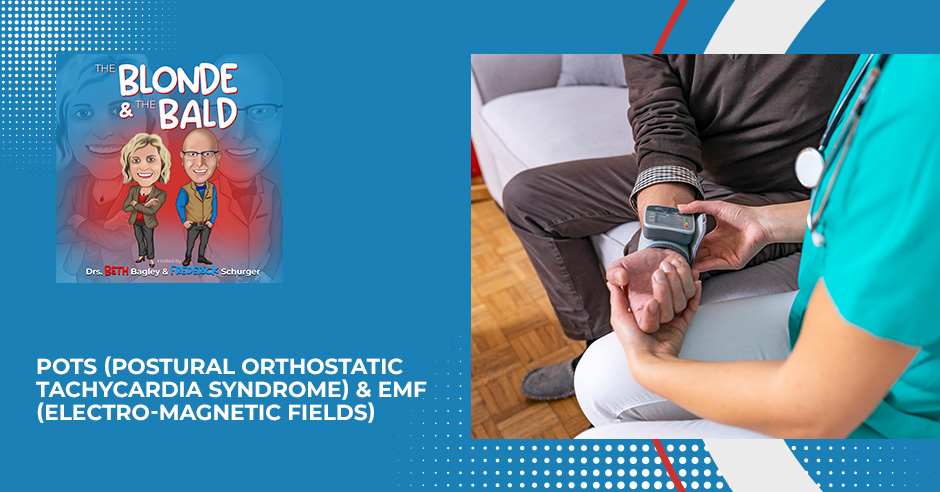
In this eye-opening episode, Dr. Beth Bagley and Dr. Frederick Schurger dive deep into the mysterious world of health issues that are often hidden in plain sight. Join them as they explore two main subjects: Postural Orthostatic Tachycardia Syndrome (POTS) and the invisible web of Electro-magnetic Fields (EMF). POTS is a condition that affects countless individuals, causing symptoms like rapid heart rate, dizziness, and fatigue. Our hosts share stories of patients with POTS, its impact on their lives, and how they have been helping them improve their function, often from disability to being able to walk in the park (Yes, moving a little 2-ounce bone at the neck is involved!) Dr. Bagley and Dr. Schurger also shed light on the often-overlooked role of EMFs—from cell phones, Wi-Fi, and more—in influencing your health in ways you never imagined. Don't let the unseen threats of our digital age compromise your vitality. Tune in now to take the first step toward a healthier, more EMF-aware life.
---
How was your week?
It was great. My wife and I ran down to see Dr. Harshfield in Little Rock. We even stopped to get an upright MRI for her. I have an upright MRI thing for people who are interested in asking questions and they say, “I want to go get an upright MRI.” For whatever reason, have you had any patients that said, “I'm going to go get this upright MRI,” and then they came back? They don't order it through you or ask how to do it right. They then come back with an upright MRI into your office.
Yes.
The results didn't look as good.
It was weird because they did two different MRIs on a section and I just needed one. That was not what I wanted.
Here's the other thing that's not what you wanted. When I told this to the radiologists who taught me a lot about upright MRIs, he was like, “What do you mean they did it that way?” When you take a regular MRI, you're lying on your back. That's how that ends up working. That changes the structures within your body. If you're walking around in gravity like most of us are, you have a different presentation of the stuff inside as well.
Everything is not suspended as cleanly as we would like, especially after a trauma. What they're supposed to do with an upright MRI is, “Have you at 90 degrees so that you are upright in gravity like you are walking around everywhere else?” What they have been doing because of motion issues is they have been taking the MRIs at 45 degrees. You are just as upset about this and dumbfounded about why you even bother with the upright machine.
We might as well take it.
You are not getting enough of gravity impacting on the patient the way that it is impacting on their daily life.
I have a question for one of my patients. I will ask her that next time I see her.
I had a patient who went down there. This is the one in Saint Louis, although I wouldn't be surprised if we have the same issues at other locations. Chicago is the other one that I see a lot of people go to but he went down there and is like, “That's how they always take them at a 45-degree angle.” I'm like, “That's odd.” We go in for my wife's and we're setting her up. She said, “We're going to take you back to 45 degrees.” I'm like, “No.” I’m glad I was there and I wouldn't have been there for hers. She even realized, “That's not what we need.”
“We need to see what it's like when I'm up.”
We have that situation. If you're getting it and they say, “No, we're going to take it at 45 degrees,” they have other ways to immobilize you. What ends up happening is you end up having some motion as you're in this upright MRI because they don't have the materials to strap you in properly. They've got you strapped into a degree but they do have a bar that they can put across your forehead to help you. It’s something that you can lean against.
I would rather a patient have something to lean their head up against and have a non-perfect posture than that bar in their lap. The bar on their lap does no good. The bar here that allows them to lean and hold is going to do far more good for them when they're getting these pictures taken. We did this not only for the regular series but also for the CCJ or Craniocervical Junction series. We can make that a drinking game. Every time I say an acronym, “Don't drink. Alcohol is poison.”
You can drink water.
You should drink water. If you're going to do the flexion-extension ones, also have that bar be the thing you're going to lean into. I need to rewrite the entire protocol.
I would love that and I bet some of the doctors reading might want that too.
It's a double part to it. It's not just a protocol of how the scans are taken but how the patient needs to be positioned. These are little things because the young lady who's running that machine is fantastic. She was very helpful. She's part-time there. She is not always the one working that machine and they're open. A lot of these places are open for long hours.
There can be multiple people working.
If they don't understand the protocols that we're doing, we're not going to get good pictures. We got great pictures. My wife's a mess but hopefully, there are some things we can do and improve. I'm going to have to write a full report for her. That's something interesting.
I'll remark on why, as upper cervicals, we want an upright MRI. We've talked about this on other episodes but in case you've picked those up. If a patient is lying down in an MRI, especially cerebellar tonsils and the brain falls into the cradle of the skull. It comes clunking down there. What it will do is if there is some prolapse of the brain tissue that is going into where it's not supposed to be going into the neck, it might not but it might go away so then you won't see it.
In operating MRI, if you're at 90 degrees, we should see on a person who has something like a Chiari or low-lying tonsils, some protrusion of part of the brain tissue, that Atlas-based skull frame, and magnum, the hole at the bottom of your skull. It will be coming through, which we don't want to be but if it is, we want to be able to see it.
That leads me to a win that we had in the office. We had a patient come in a wheelchair not because she couldn't walk but because she has this disease or a syndrome called POTS or Postural Orthostatic Tachycardia Syndrome. When she moves in certain directions, sits up from lying down, or stands up, she immediately passes out and faints. It was happening to her multiple times a day. It's terribly affected her life.
Honestly, she came into the office for something else. We didn't want to promise her that this was going to get better. We don't fix POTS or anything. We fixed the subluxation of the spine. When she started coming in, we were excited. Future Dr. Lad took her initial intake and everything. I made the initial few adjustments. Dr. Lad has made a few adjustments. This young lady was at the park and was able to take ten steps before she had to sit down in a wheelchair and still didn't pass out. That was a big win.
She was so excited to tell us that she was walking on a beautiful day and was able to get up and move. She's also been getting out of the house more because she feels comfortable doing it. That is amazing. That's one of the people that I'd want to see an upright MRI on because it can be a relationship between what's happening in there. Have you had any patients with POTS in the past?
My wife has POTS. I've had a couple. We were talking about it with Dr. Harshfield when I was down there visiting with him. He was saying that it's pretty common anytime you start having pressure in the way that things are moved. You have pressure on the vagus nerve that prevents normal hypertension-style changes. We're not talking about hypertension but we're talking about the body's normal ability to raise and lower the blood pressure as you change positions.
I'm looking over some stuff here on POTS. They're saying that it's an increase of heart rate above 120 beats a minute in the first minutes of standing in the absence of any other hypotension or Earth ecstatic intolerance, which is fancy words. There's nothing else happening. You've got this vagal tone, a problem with the vagus nerve, not working the way it's supposed to.
That can lead to a bunch of different problems. If we get Jeanne clear, she's got great days. I've seen days when if we get her clear enough, it's like she's a new woman as long as I don't say something crap. I find crap things to say all the time. I've had several who do better. The question becomes, “How much can you promise and how much better will they be consistent?”
That's why we don't promise anything. This is not a cure for POTS but it's very awesome. She was so excited that she saw any change because she hadn't for years. She's on disability. She is a young person who can't have a job and she can't do all these things. She was able to go to the Barbie movie. She was excited to say that she was able to get out and go to a movie. It's incredible.
It is amazing what the body can do to varying degrees as far as how people can heal and how fast they can heal. I had a patient come in. She missed her appointment. First off, it's her husband's fault because somehow she didn't get the message on her phone that he was supposed to bring her in. I don't know what happened there. It's like, “She was supposed to come in.” It's like, “I can't get her in. She didn't want to come in this morning.” “She needs to come on Thursday.”
It is amazing what the body can do and to varying degrees as far as how people can heal and how fast they can heal.
The ex-husband was drinking too much that night and decided to go into an embankment and under a bridge. She went through the windshield and hit her head many years ago. She's doing much better. She can get around. She's like, “I don't feel bad,” when she's in alignment. She didn't come in because Thursdays are bad for her. When she came in, she was like, “Thursdays are so bad. This is miserable. I don't want to rest too long.”
Just getting on the table hurt her to lie down. I get her adjusted. I have her go right to the resting room because I'm confident that she needs some time to rest after her head is back on straight. I could see it in the graph. It was one of those things. When is walking, she’s like, “I think I'm walking better and feeling better. Could it happen that fast?” “It can.”
I had another young lady who was 20 years younger than her come in 1 hour or 2 later. She said the same thing, “I should have been here last week.” I was like, “Sometimes you should have been.” This is the amazing thing about how we can address people in such a simple little thing like moving a 2-ounce bone underneath your skull so you can have profound effects on your overall health and well-being in ways that we don't even understand.
This is the amazing thing about how we can address people's conditions. It's such a simple little thing, like moving a two-ounce bone underneath your skull, and you can have profound effects on your overall health and well-being in ways that we just don't even understand.
From your head to your toes, everything's connected. Do you have an article on POTS that you want to bring up?
There are a couple of things. This was a chiropractic case. Relief of Orthostatic, Hypertension, and Tachycardia with Chiropractic Rehab. As we were discussing your POTS case, we were going over some bits and pieces. This was a 50-year-old female. I can't think of a whole lot of POTS cases I've seen.
I’m sure they exist.
I've seen less of them. She had all the signs of having problems. 46 out of 100 was her dizziness score.
This was general chiropractic. This is not upper cervical.
She was being seen 3 times a week for 3 months. A lot of people are like, “I'm going to see the chiropractor for the rest of my life.” If you've got POTS, you might have to. These are cases that need more things. They were doing a lot of spinal manipulation of the neck here. They did some thermal ultrasound therapy to relieve the stiffness and restore mobility. Sometimes, those therapies are necessary to break down some of the scar tissue that is present there. She was doing great. From the second week on, the patient reported that her pain and dizziness gradually improved and resolved within four weeks.
That's a great case study.
His DHI score was at 46 and reduced to 0. For people who are looking at any of these index scores, something like a dizziness handicap inventory, I like using something like the functional rating index. There's a neck disability index. Clinically significant change is only ten points. We're talking about a big change overall for this case. 10 points out of 110 % is clinically significant.
This is a huge change. She even had scoliosis that was reduced. That's fantastic. In twenty-four months, the patient was symptom-free. No adverse events were associated with treatment. A lot of people say, “You're going to have problems with chiropractic.” Generally, the adverse events are much lower than they are with a lot of traditional therapies in medicine.
The worst thing that usually happens with people is maybe 10% of patients get sore after the first adjustment. I warned them that could happen. It doesn't scare me at all. It makes me excited when they get sore because I know things are changing.
That is a fantastic situation. I didn't see this part of it, “She was treated with psychiatric medications, rehabilitation, exercise, and acupuncture back when this started for her in 2016.” That means she had 3 or almost 4 years of dealing with this debilitating condition. She was under chiropractic care and within four weeks, she was back to functional. That in and of itself is pretty profound when you get right down to it.
Chiropractic is amazing. It's the best job ever. I've said it so many times. Is it exhausting? Yes, but is it worth it? Everyday.
Do you miss working for a chemical conglomerate?
Yes, every day. I was talking about that with somebody because he's a molecular biologist. He works with human stuff. I was like, “I remembered some of the stuff we're talking about. It's been many years.”
It's funny because I was joking about somebody making a comment about my outfit and how I don't need to go to a fashion show because of the way that I dressed. I'm like, “Thank you.” As an aside, my off days are cargo pants and a T-shirt so I can go get dirty. That's the engineer in me. That's what I want to do when I'm not worried about all of that stuff and not taking care of patients. Some days, you can climb out of the rat race as I did. On some days, you are like, “I'm going to go hide in there.” I'm not going to go back into the engineering world directly but we're going to apply some of my electrical engineering knowledge to this interesting subject of electromagnetic fields.
It's called EMFs.
EMF and all of the other stuff. There is another great article that I came across as I was doing some review of Dr. Dan Murphy's site, which we get to see in Vegas. That's going to be fantastic. I'm wondering if my brain has gotten big enough to be able to not explode. We'll see about mine.
Yours is not. Mine will explode.
Who knows? He's always on the cutting edge of science and asking the question, “Is this real or not,” as he digs through all the literature.
How many hours is he going to speak?
We've got the better part of Friday. I'm going to have pages of notes and it's going to be awesome.
EMFs were told that there was no problem with them. There's no relationship between any issues that people have and that it's safe for the general public to be around massive amounts of EMFs all the time.
I would think a generally healthy person will have no problems with EMF. I'll be the first one to say, “If you are in generally good health, you're not going to have a problem.”
A generally healthy person will have no problems with EMF.
It’s like if you're generally in good health and you get COVID, you're not going to die.
Only 99% of people survived when they contracted COVID.
It’s way more than that. It’s 99.7%.
It's a high number I didn't specify as an age group. If you're 90 years old and a man, you're out of your outcomes rapport.
Let's say there's an individual who is suffering from a chronic disease, fatigue, or something. They're in EMFs.
There's all sorts of weird stuff that can go on. She texted me saying that she wanted to get in. She has been through so much. She says, “Can we do Friday at 4:30 or Saturday late lunch?” I'm like, “We'll do Friday.” I don't know how it is down your way but we've been overcast. The question in my mind is, “What else is going on barometrically?” That was another interesting article that I came across that I want to dive into a little bit deeper in the future about barometric pressure. We joked about that. People with arthritis are being able to tell barometric pressure.
This young lady gets what almost looks like a storm front come through. She's out of commission. We started seeing her in ‘18. By ‘19, she was coming out of it. They went down to Disney World and had a great time. Coming into COVID, she was more comfortable and functional. During COVID, they planted a garden. They also got kayaks and went kayaking on the lake down by them.
There are power lines over the lake. She got under the power lines and froze up. She has all these weird jerking motions that she does while they're watching TV. There are a lot of questions as to what is going on. What has changed is we've introduced all of these other things that are transmitting electromagnetic frequencies. When you and I were growing up, we had radio and TV waves. It has slightly different frequencies. That was it.
Microwaves were starting to become a thing in the home but those were only emitting when they were running. I still remember the Malcolm in the Middle episode where she's pregnant with the youngest son. She's got her belly right up against the microwave. We wonder why he was a little bit odd. That's one of those shows that I need to go back and rewatch. We started having cell phones. There were bag phones but to have a bag phone, it was plugged into your car and took a lot of power. The battery life was very short.
You didn't have it in your pocket. It wasn't all over the place but there were fields like the cellular towers we’re putting out there.
I've had some conversations with some colleagues. When I was in engineering school, there was a lot of back and forth between analog and digital technologies going on. You needed less power in your pocket, so with the analog stuff and the bag phones, as it were, you needed more power. The wavelength was a little bit more friendly. Now that we've gone more digital, they flipped it so they can have more towers. You don't need nearly as much power. You have all these high frequencies that are bathing everything.
That's not even including your Wi-Fi and Bluetooth that is everywhere as well. You're the same way as I am. I've got Wi-Fi in my office. That's for convenience so we didn't have to dump a bunch of money into hardwiring the office. That takes time and there's an expense there. However, I have gotten to the point where I'm doing more hardwiring of everything. We're trying to move away from Wi-Fi. The only downside is I've got three other offices that are in this building.
You can't get away from it. In my house, I can get five different Wi-Fi signals from my neighbors. They're locked but I can see them when I open up my Wi-Fi. There is a place you can get away from it. Do you know about it?
You go out into the woods far enough away.
It still gets a cell phone. There's a place called Green Bank, West Virginia. Have you heard of this place?
No.
This is a place where electro-sensitive people can go to live. It's a National Radio Quiet Zone. They have pretty much no Wi-Fi. There are even police who go around looking for Wi-Fi signals. If you get caught with it, you get taken away. The reason is it's not for electro-sensitive people but they are trying to find radio waves from space. This quiet zone is around that so that they can pick up space stuff, which is cool.
I don't know what they find. That scares me because the aliens scare me. That's a whole other subject. They're scary. I don't trust anyone. I don't trust aliens. This place is cool for a patient. If it got to the point where she couldn't live, this was affecting every aspect of life. People move there so that they can live without frequencies or EMFs in their lives.
This is a big question. How many people don't even realize that they are sensitive to this? We figured this out along the way with this patient. She was having all these spasmodic episodes. She had a little bit of POTS and dystonia, where everything was in spasm. She can't move. It becomes very tonic. She looked like she had some dystonia going on to varying degrees. How much of it was all the EMFs that keep on getting layered upon layered? On top of that, the other thing that most people don't realize is the smart meters that you have on your house to measure your electricity also have a big field.
We put a Faraday cage around ours and it got taken off. I don't know if a storm or the electric company took it off but we need to buy another one. Jason said he put it on there well and it was gone. We couldn't find it around it. They're not that expensive. You can find them on Amazon.
It's a thought that I've had in my mind, especially with some of the problems my wife has. There's so much EMF fog that's giving her a bunch of trouble and she's not able to function. We run over to my folk's place. We are out in the woods enough that it's low or a little bit of Wi-Fi. My dad's Wi-Fi barely works. It's almost as good as dial-up modems. It is a little bit better. The thought in my mind is, “How long does she need to be in that environment away from all the stuff but we still have cell towers and everything else?” The question is, how much is blanketed on top?
We need to take a vacation to West Virginia. It's beautiful.
We may need to do that. Let me pull up this electrosmog study here because it's fascinating.
It's a type of pollution that you can't see. It's invisible.
We don't know who is sensitive to what. That is the harder part.
That's the same thing. You think, “That's impossible.” I was like, “This person can be allergic to peanuts and this person could be allergic to nothing. What's the difference? They're different people.”
There was a comedian who was talking about taking Reese's Peanut Butter Cups to school. All the kids were freaking out. How sad is that?
I get it. If your kids are going to die, that's scary as hell. We could talk about that.
I've got to get a bunch of all this.
We should start uploading these to Rumble.
It's on my agenda. This is out of immunology research in the EMF spectrum. As far as what are the different frequencies of these waves that are coming through, there's ionizing radiation. That’s X-rays and CTs. It has a number of different uses. We're not talking about ionizing radiation. We're talking about general frequencies, what they are doing to the body, and how the body reacts to various things in the environment. Did I talk about the low-level frequencies last time?
I don’t remember.
There is a low-level frequency. Ultrasound is what they call it. This is getting below 20 hertz. There are weird things that happen to human beings when these ultrasounds come across. What's curious is they figured out what may be perceived. You start getting a frequency under 20 hertz. Your eyeball has a resonant frequency in those low frequencies between 15 to 18 hertz. When it happens, your eyeball starts shaking. You won't hear it. You might not feel it but your eye will perceive it as a shadow in the corner.
That's like the devil.
A ghost or something else. It's funny. The scientists figured this out. They installed a new piece of equipment or an air conditioner. It was producing a low-level frequency in his lab. He's looking around. He thinks they're shadow people because he is perceiving this. He's a scientist. He's trying to figure out what's going on.
He's like, “This isn't shadow people. What is it?”
He was able to measure that. Don't ask who's figured out the resonant frequencies of the heart, the eyeballs in your ears, and some parts of your brain. It was probably either the Nazis or the Russians.
The CIA.
We can go down rabbit holes all day long because there is stuff going on there, whether or not they're going to tell us anything about it.
People randomly drop dead.
That's another story.
There are weapons and all sorts of things.
The visible range between 400 and 700 nanometers is our visible light. There's stuff way outside this and then as we start getting into higher frequencies, we start seeing other things. FM radio stations, Wi-Fi, radar detectors, cellphones, and DirecTV are all megahertz. AM radio stations are in kilohertz that we kept around for a while and were generally too bad. We start getting into gigahertz, which is some of what the anti-collision vehicle radars are doing.
I didn't even think about that. That's a whole other technology. They're shooting out radar in the front of the cars.
Here's something that's crazy. One of the things they did for Tesla X, whichever is the SUV, is it has those gullwing doors that come up. When the engineers were designing this, Elon did not want that little sensor with that little round nub on the outside poking through the door. He wanted to smooth the door. He tasked them with creating a sound that would penetrate through the sheet metal of the door and then come back to be red. The crazy thing is they had to ramp up the volume effectively or the intensity up.
Maybe the volume on that thing is only about a three, unlike your car bumper to tell you that something's back there. On those doors, it was up to eleven. They cranked it. The volume effectively went up to eleven. You're shooting this sound through and screaming to see if there's anything on the other side of that door to make sure it doesn't hit anything over there. He didn’t want to have the thing on the outside because they wanted to look pretty. I do respect that because he said, “How do we solve this problem?”
He has solved a lot of those things. It is incredible. He employs incredible people too.
Let's talk about wavelengths and what they do. Shorter wavelengths have more energy and higher frequencies, do not penetrate as deep, and do not generate heat. That's what short wavelengths do. Longer wavelengths have less energy and lower frequencies but they penetrate deeper which is a longer wavelength that would be something in the 20 or 18 hertz that might penetrate the eye and increase molecular motion and thus generate heat.
Longer wavelengths have less energy and lower frequencies but they penetrate deeper.
Back up a little bit. It says, “Microwaves heat anything with moisture in water like food and people.” If I put a piece of paper and it has no water, it doesn't heat it. “Microwave penetrates the interior of food and people. Don't go inside your microwave. Cellular phones use radiation in the microwave spectrum.” Isn't that interesting?
I don't know if there's any validity to some of those early cell phone videos. This is pre-TikTok for people who watch that stuff. They put four cell phones around a couple of kernels of popcorn and then ran it.
Everybody gets to phone call each other.
The popcorn would start to pop. There was a microwave underneath the phone. You have to understand that it's different intensities. You have a different power from a microwave than you do from a cell phone. You have a much stronger power comparatively. You have even more energy from that. As an aside, it’s a great use for your microwave. Unplug it and put it in your basement or any electronic device that you want to protect from any electromagnetic pulse. It is a solar flare. It's a Faraday cage. There are some benefits to it. We have too much stuff around us. Does any one of these pieces cause a problem? Probably not. Do we have a level of pollution that we can't see and we're not feeling very well? Probably.
For some people, maybe it's like, “I'm tired all the time.” Your body's constantly having to fight some of this stuff.
The question becomes, at what point in time do we start saying, “We've done too much and we need to start getting back?” How many people go off for a vacation camping in the woods, ditch their cell, they're away from their Wi-Fi and they come back fully recharged? That is the root of where we've been for most of our civilization.
All of a sudden, in the past many years, we have had this significant increase in what these folks are calling electrosmog. This one was interesting. This is the vitamin D receptor. If you don't have enough vitamin D, you have problems with inflammatory issues and autoimmune diseases. This receptor exhibits stability to electrosmog. You have things in your body that don't like a bunch of electronic gobbledygook, especially if you already have low vitamin D. It is a compounding problem with your overall health.
Vitamin D is so important. In wintertime, talk to your doctor about getting on vitamin D.
Vitamin D is so important. Everybody, it's wintertime. Talk to your doctor about getting on vitamin D.
The only reason I haven't uploaded episode 26 is to make sure that I'm talking about vitamin D and saying, “Talk to your doctor about vitamin D. You need to take more. The upper limit is questionable as to what is an upper safe dose.” I don't think we know of an overdose in the literature. I take 30,000 a day. That might be too much for you.
I take 10,000.
You need to talk to your doctor and say, “How can I start?” Get your levels checked. Another article I came across was suggesting 60 nanograms per deciliter. It was a bare minimum for women not to get breast cancer. People are in their 40s and 50s and saying, “That's fine.” Lots of stuff. Lots of questions. I've got a couple of other articles that we may revisit another time but the take-home message is we have to find times to unplug.
If you're not using your Wi-Fi router at night, unplug it. Turn it off. You don't need it on all night. Get your phone ring from your head when you're sleeping. It does not need to be on your nightstand. You need it first in the basement.
I'm getting to the point where I'm going to get a Faraday cage to throw my cell phone in at night so that it's away from me. I had hair until I got my first Apple 3G phone. I like Apple phones.
I love Apple products.
It is a curious question in my mind, “Did my hair start falling out?” There was a car accident, complications, and other things but the timing is so close.
It could be because of the autoimmunity. We're talking about it.
That's like a pigment starting back up.
We like pigment, hair, and all the things. I would share some of mine with you if I got a lot.
Thank you.
That wraps it up.
It's a different topic for what we like talking about but sometimes, these fun, off-the-wall things need to be discussed.
I wonder if there are any chiropractors in that West Virginia Town. I'm going to look that up because if there is, that might be a fun person to talk to. If not, maybe we need to get a chiropractor out there.
That wouldn't be a bad place. Compare notes and see what's going on in that area. Dr. Bagley, where they're going to find you?
You can find me in St. Louis, Missouri. I'm on the Westside. You can find me at precisionchiropracticstl.com/.
I am in Springfield, Illinois at KeystoneChiroSPI.com. Please like and subscribe. Give us a five-star review. That's how people find this. Word of mouth is the way that people get more information about all these shows. They're not going to find it on Google. The algorithms are already changing. They do not like alternative ideas to what the mainstream is talking about. Isn't that horrible? We're not saying that we have the end-all and be-all answers. We're just presenting the facts as we understand them. You will be the judge. Make sure you share with your friends, family, and anyone who might not realize that getting their head on straight is going to help them out. Until the next episode.

Acetaminophen (also known as Tylenol & Paracetamol) is one of those innocuous medications that many people take daily, thinking it's totally safe. However, much research begs the question of this drug's long-term safety. In this episode, Dr. Frederick Schurger and Dr. Beth Bagley discuss this drug, its side effects, and possible alternatives to get you back to health. And yes, this will be an ongoing series of discussions of many over-the-counter (OTC) medications that people often think are harmless. So, settle down and tune in to this conversation to start learning more about these drugs that may not be as safe as you thought they would be.
Listen and read the full blog post here

Just as random as today’s weather changes, this summer brought us even more randomness! Dr. Frederick Schurger and Dr. Beth Bagley are not the ones to pass this up by literally talking about anything under the sun within their practices. From power outages, internet issues, barometer changes, workouts, and more, we explore how these various factors affect patients in different ways. Tune in for some good laughs, fun stories, and some deep insights on chiropractic as we make sense of the randomness that kept us on our toes this season. Join Drs. Schurger and Bagley for another random episode during this summer break.
---
Welcome to the show.
Everyone just missed. Go ahead, say it again without the one thing that we didn't want recorded.
All of it, you don’t want to be recorded. There were words that were not allowed on some sites. I would have had to blur out the simple I made with my fingers on YouTube, but none of that was towards Dr. Schurger. That was a hell of a day.
Those happen and quite honestly, it's been one of those weeks. My first half of the week was busy. The second half hasn't been as bad, but before, I did a pseudo-show with Dwayne Hoskins over at Titronics. For those of you who are unfamiliar, he is one of the lead sales and research in marketing for the instrument that we use to measure the temperature on the back of people. They have a new product out that is cloud-based.
My biggest reason to go cloud-based for everything is simply security because we are small businesses as chiropractors. Eventually, it's not a matter of if. It's a matter of when we are going to have a data attack on us. We want to make sure that data is safe and HIPAA compliant. I remember when HIPPA was being rolled out and I have gone through an OSHA compliance thing. You have probably gone through OSHA compliance when you were back in the industry.
I was going to say I remember how to do it for chiropractic, but back in back in Monsanto days.
It's the same thing. It's like, “Sit down your rules and your rigs and show that you are doing your rules and regs. You are accommodating by your processes.” HIPPA is very similar, except for there's also a level of security. I worry that we don't have this stuff as protective, which is why I have gone to extreme lengths to get it protected to make sure that it's as secure as possible. That's one of the pushes I have going toward a cloud platform. There are a lot of reasons not to go to a cloud platform.
There are.
The security alone outweighs that message.
Honestly, the Titronics is for any chiropractor who has been reading. I do recommend the Titronics cloud system. First of all, giving them a monthly fee is not that much money to help support them because they help support us. I'm always about that and helping another small business succeed with a small monthly fee. It runs faster.
Honestly, I was having trouble because of the server base. It was a computer in my office that it would cue back to. It wasn't the computer I was scanning off of. I was having trouble. It was taking a long time for the patient to load and now it happens very quickly. It's less glitchy. The only issue we have had is when our internet goes down, but I have a lot more issues when our internet goes down, like our phones don't work. All sorts of stuff.
This is the worst part about technology is we are so mild in the muck of it. You have two questions on your mind. What happens when it goes down, but does anything work when it goes down? The other half of it is in my brain because I see a lot of Amish patients. It’s like, “My power went out.” They are like, “How'd that go for you, Doc?” “I wasn't too bad. It was like camping.” I do like my air conditioning. They laughed a little bit at that and we lucked out that it was pleasant weather when we lost power.
Speaking of weather and power outages, have you noticed that certain patients will react to other changes? I'm going to say two of them and see if you can add any. I have got migraines that react to weather changes and vertigo. Do you have any other patients that have things?
I have a great one. It was probably back in January. They were threatening a bad snowstorm the next day. One of my nuns was brought in by one of her caretakers and she made the comment. When the snowstorm came in the week before, she felt every bit of it because it was in her knees. The threat that they were making was that there was going to be a major snowstorm the next day, which never transpired. She's like, “No, we are not going to get a snowstorm.” I felt one day before, this one here, my knees are fine. I have more reliability in faith and her knees of an impending storm than I do have of the weather forecast.
We should make her own YouTube channel and focus on, “How are your knees feeling today, sister?”
That would be so funny. It would be one of those best channels ever, and it would probably be more predictive for the locals. One of the things that I would say that's going on is I bought a couple of barometers to see what is going on with that. I have got a barometer in the middle of the office. It's inside compared to outside. You do still have those changes throughout the building when you get a weather change, and you can see it.
What I find curious is there are people who have weather-change problems, but I don't know if it is a matter of a big pressure change or the speed of the pressure change that seems to be the factor there. People with arthritis can feel that heavier pressure is present a little bit more acutely. I bought it for my Meniere's cases, and I never saw it. I asked them questions and I was like, “I had a bad case.” I'm like, “That needle didn't move over the weekend.” It's a lot of questions that don't make sense. I think there is a component there but I don't know what the component is. It would be nice if it was more obvious.
We have had a couple of our patients using this app and earplug thing called WeatherX. I just downloaded that. These earplugs are not expensive, which I love, in comparison to regular earplugs there, but they are only $18 or $15 or something. They are specialized earplugs that help mitigate the pressure changes that people feel in their ears. It's got the barometric pressure. It is decreasing now by 0.12 and tomorrow it's going to be increasing but it will ding and tell you when you need to put your earplugs in. I have got a couple. My patients are trying it out because I was like, “Try this out. See if it helps.” Two of them say that they have noticed it helping with their migraines. It's another option for people who notice that there are big changes in the head symptoms, migraine, headache, or vertigo symptoms.
It makes sense because of the sensors of our body. Everyone thinks of the five senses and there's something more like a dozen when we start looking at the pressure sensors, especially inside our body. We have barrel receptors that know. The ducks and the geese have baroreceptors and all the birds that fly south for the winter. They have barrel receptors to know when they need to start flying because the storms are coming. We don't have them as attuned to that, for one reason or another, but we still have sensors like that. All of these things could be related.
It could be triggering for people.
Where do people tend to feel that pressure? It's in the inner ears because if you have ever flown on a plane.
Even going up and down in an elevator. It’s a ton of building. You can feel that.
If you have bad ear congestion, I was telling another patient about the situation I had. I was flying out to San Diego. We stopped in Colorado. I acclimate up there, and I'm up in an airplane, and then San Diego's sea level. It is probably the most agonizing pain I ever had. I thought I was going to go to the ER because I was going to have blood coming down my ears. I probably was wearing a white shirt that day, too. That would have been bad for the shirt and my vest. Thankfully, that didn't happen.
Thanks for all the visuals of that.
I know. It's wonderful that. I’m sitting on the airplane. I'm trying to get my jaw to move at my ears to pop at all because the pressure felt like it was going to explode. I'm preparing myself. It's like, “We are going to get me off the plane. Someone is going to notice the blood. We are going to call the ER and get someone to figure out what's going on and all of this stuff here. This is going to be fun.” Thankfully, it didn't. I got adjusted by the great Jessica Lee down there. She came in special for me, and then I got into an Uber and whacked my head immediately.
It’s not how it goes. That made me think of something. Do you know how kids are more prone to ear infections than adults? What's the direction of the ear canal in adults?
It's more downward.
Adults are more prone to ear infections because their ear canal is more downward.
For the kids are more cloggy.
They don't change as much because the heads are big but the head hasn't fully developed. Those eustachian tubes finally dropped down so they can drain properly as we get older.
The same thing for a baby or a child on an airplane is going to be more prone to having extreme pain in their ears, probably for the same reason. As you were saying, if there's a child or an adult that has ear infections or your complaints going on, this is one of the reasons that chiropractic is so amazing is because that atlas bone, what we talked about all the time that top bone in the neck, is so close to the eustachian tube. If we took a 3D image of where the eustachian tube and the atlas are, you can, I would say, have physical pressure because of the swelling and stuff around the atlas on the eustachian tube, not to mention the dysfunction that happens in the ear because of neurologically.
You have the other component where there's an actual little muscle that is attached to that eustachian tube that if the atlas is out of place and now you have got everything else to twist. That muscle is not going to be functioning the way it's supposed to be mechanically and structurally. Everything is going to be in the wrong position and that muscle is going to say, “I find where I'm at,” but it's causing a blockage until everything gets corrected. Once that happens, life is better for people.
Also, parents who have had babies have frequent ear infections. These babies are miserable. They keep getting put on antibiotics. The ear infections keep coming back because the problem isn't that they need any antibiotics. The problem is that there's dysfunction and how the tubes work.
Everybody else on the plane gets the benefit of the kid being healthy and not screaming their heads off. It's a real win-win situation all the way around.
Still, get your kids checked.
Give the card to your favorite upper cervical practitioner to those screaming parents and say, “I know it. I get it. Go see this doctor. They will help you.”
I have a new patient. I just got her first adjustment and she says, “Do you check kids? Are kids coming here too?” I was like, “Yes, kids of all ages. We had a toddler in here. Sometimes I have babies in here.” I had three teenage boys all the same time. They were separate entities. Two of them knew each other. I love that I had three teenage boys all the same time. All of them driving age that came in. Their parents gave them permission to come in because that doesn't happen very often, especially for, teenage boys. They don't typically take care of themselves or think about that stuff.
All three of them had parents or loved ones who said, “The reason you are constantly popping your neck is that this is happening. Come and see Dr. Bagley or whatever. However, they came in.” It's cool that at that moment, I had three unrelated teenage boys that were all resting. 1 had a head adjustment, but 2 of them were resting. One is the son of a chiropractor who sends him in here because she wants that specialized care for him, which is cool, too. That's probably the best compliment a chiropractor can get, is when a chiropractor sends their kid to see you.
The best compliment a chiropractor can get is when a chiropractor sends their kid to see you.
Even they are coming in for themselves and they don't practice what we do. I have several of those. It is neat to see the kids coming in and they get it, especially boys. You got to tell them, “You are going to hurt yourself lifting in the weight room if you don't have your head on straight.” They are like, “I get it. I don't want to break myself.”
They don't. Boys are rough and tough. I’m not saying girls can't be too but tend to be a little crazier.
Honestly, with boys, we have to remember if it's not falling off it's not a problem. I don't care what part I'm talking about isn't falling off. Girls, you go through a whole different thing starting through puberty and you have to be extra careful about things. You are already taking care of your health. I was probably 24 when I started realizing I needed to do something about my health. I saw my grandparents and some of my cousins.
I took a hard look and I said, “I cannot let myself get into that situation.” That's when I started eating healthier. I started cleaning up my diet. I did all of the things. It still took me 2 or 3 years to find chiropractic but it didn't dawn on me where I was going. Sometimes, you can look at your older aunts and uncles and say, “That's not the direction I want to go,” and let them be the role models that they are supposed to be for you. That's a big one right there all the way around.
I had a patient that came in. It was a referral. It's an opposite referral, what I mean by that is a wife comes in first and then refers her husband in because that's how that usually works. This time it was a husband that's been patient for us for years then he sent his wife in. She had back pain that wasn't going away, unrelenting.
She tried all the things and he finally was like, “Go see her,” and she did. She wasn’t mad about it. She just didn't know until he said it. It was good that he opened his mouth and said, “Go see my chiropractor.” She came in and it was back pain. She didn't have neck pain, but where did I adjust her neck? I didn't touch her back. The next time she came in, she was 100% better. Honestly, does everybody get better 100% with 1 adjustment in their back? No, but I was so happy to hear that.
Especially those back pain cases that aren't a hot disc or a 60-year-old. I see those get better.
She is retirement age, so she is older but she's healthy. She takes good care of herself. One of the things that happens is rebound happen. She lost her adjustment and her back started hurting. That's one thing that I like to point out to people, is that when you first start care, sometimes it feels like you feel like a$1 million after an adjustment. That's incredible. We celebrate that but I was like to warn people as it's a roller coaster and a marathon. Not a sprint.
There's going to be times when you feel great then times when it feels like the rug got pulled out from under you and you are hurting so bad. That's okay too. That is part of the process of healing and it's up and down. That happens with all sorts of healing. Not just chiropractic care. If somebody had gotten a broken arm, it might feel good one day and the next day, it's achy type of thing even though it's still healing, so cycles of healing.
It's one of those things that some people will get, I wouldn't say she was upset. She was upset but I have had patients in the past being upset that they are not getting better anymore. I'm letting you know if you are one of those people out there who is struggling and having ups and downs in your chiropractic care. That's so normal. Not everybody is that miracle that feels good forever.
We are all going to hit a plateau in our healing process. You cannot push and push always gets better and better. At a certain point in time, you have got to sit back and coast and let everything work the way it's supposed to before it can move to the next level. Before it's ready to make another transition for better and more strong healing. I wish we had a better way to understand that and describe it. For working out, it's just a matter of understanding that you will train so much.
We're all going to hit a plateau in our healing process. You cannot push and push and always get better and better. At a certain point in time, you've got to sit back and let everything work the way it's supposed to before it can move to the next level.
That's a great example. Let's use Olympic athletes as an example. They will train not for something coming down 2 weeks out but oftentimes, 4 years out or 2 years out for a meet. They will start training in a fashion that slowly builds up their strength, agility, and function over not a month but several months. Sometimes up to a year. I remember a good friend of ours, I want to call him Dr. Keith Wassung. He is an honorary chiropractor.
He probably knows more than most chiropractors but he was a powerlifter for the Navy. He had an amazing record and skillset when he was doing that. His doctor was Reagan's doctor back in the day to put things in perspective. His training routine and he still does some level of that now. He starts training in January and continues training through the year through November. December is his time off.
He likes to share that his November, while they are doing all their shopping, his wife and daughters love to do Black Friday sales. Keith picks up a spot in the food court where that's home base. The girls are out shopping then they want to drop off a package before we go into the next shop. They dropping it off with him. He's sitting down and writing out his game plan. Reviewing what got him to that part of the end of the year and what he wants to do going forward.
He used that strategy for weightlifting and powerlifting. He went through a bunch of weight loss stuff for himself as well. How does he plot out that strategy? When we start thinking that life is not a sprint. None of life is a sprint. Neither is healing. Even a sprinter for the Olympics is going to train for several years with the goal of qualifying for the Olympics and then going for the gold. That is a process that doesn't happen overnight. I got two new kettlebells for my birthday. They are nice.
How heavy are they?
They are only 28 kilograms a piece which is 62 pounds a piece.
You got two of them?
That's the exercise. That's the program. I'm doing. One day, I do use one and the other day, I used both. We won't talk about how badly my quads hurt from doing squats.
I have to say one other thing. I worked out with my trainer, me, and my girls. We should have run sometime. She's an awesome person. My trainer’s named Natalie Coomer and she's in the St. Louis area. She trains women only. She had this cool exercise which was awful, too. It's always awful, but I was proud of doing it. One of the things she had us work out which I had never done before was she had us work out our psoas muscle.
We were in almost like a half-sit-up position holding a weight on our chest and squeezing into it, and then we lifted 1 leg at a time for 30 seconds or so. By the end of it, you are burning. We did it a couple of times. When I was getting into the car, I was lifting my leg into the car because it hurt so bad.
It feels so good when it works.
Honestly, I told a couple of patients because they saw me walking weirdly. They are like, “What's wrong, Doc?” I was like, “I worked out with a new trainer and I can't move my legs.” She’s trying to turn certain muscles on because we are going to do this running exercise but I thought that was incredible because we know all about how the psoas. It’s the connection between the lower half and the upper half of the body. It's wonderful when it's working right and terrible when it's working wrong.
Psoas, in case you are reading and want to look it up, it starts with a P. The next exercise she did with us was we ran up a giant hill ten times. She had to do this cool thing where we had a clipboard at the top of the hill and every time, we completed one run up the hill. We wrote a thought like what we were thinking. It went from like, “This sucks. I can't do it,” to, “I'm proud of myself. I completed it.”
It's a cool thought process, but the coolest part about this and that it goes toward healing and everything. I love that she did this for us, that is when we got to the bottom of the hill. We would walk down the bottom of the hill. It was like was a HIIT interval time. By the time you are at the bottom of the hill, you are breathing is somewhat coming back down to normal. She goes, “Don't turn around and look at the hill until you are ready to go back up it again.” She had us continue to look down and couldn't stay there as long as we wanted to but when it was time to go, turned turn and went. You didn't turn and contemplate the hill in front of you.
Way to go, Natalie, because that was so incredible for my twins to enlist. It was even for me, who's done lots of self-help and all the things but physically doing it. When you contemplate, overthink an action, and overthink something that’s coming up and it comes with healing or even getting up the phone to call a new chiropractor, therapist, or doctor even if you know you need to do it. Your brain is like, “What if I don't like them?” Stop the what-ifs. Pick up the phone and call somebody to get the help you need.
It's funny because a while ago, I came down and I got adjusted by you. I still didn't feel great. I was off.
Are you saying I didn't do my job right?
You did, but I was still healing. I was unable to work out for the better part of a week and a half.
That’s rough for you.
It was. I didn't work out for one week. The bell that I normally do for my warm-up felt too heavy, which is always my reason not to work out that day. I still ordered new bells. That's the funny part about that. There was a little bit of apprehension as I picked up these two new bells. What's funny is 62 pounds, it's a little heavier than what I had been using, which is 53 pounds. It doesn't sound like a huge jump. It isn't, but it still felt daunting.
My kettlebell snatched what I was supposed to do on Tuesdays. I'm like, “I don't know if I can do this.” It was only the first time I had been using A) This style of bell and B) That weight. For a while now, I had done 30 reps aside with the 53-pound kettlebell. I said, “I'm only doing three reps. I bet I can do three reps,” which is nice because this thing then builds up from there. Again, it was that same hill. It's like, “I can do this,” and I did it. I ripped up my hand. A nice little remnant of a blood blister. I got one of the other hand too.
It looks like the stigmata.
Stigmata would be down in your wrist. This is my kettlebell stigmata.
In some movies, they have done it wrong in the past.
I know, but in any case, as I said, it's my sacrifice.
Not as powerful as Jesus, but it's fine.
It's the second best thing that I can do to make sure that I am as strong as I have to be because, after 28, I'm going to need a pair of 32s. I have owned a 32 for a while. I can't push that overhead. I can do a Turkish get-up with it. I can do a Turkish get-up with 88 pounds without a problem, but with overhead pressing from what they call the clean position or the rack position to overhead. Something is not connecting as far as strength-wise. I don't know what it is. I haven't been able to figure it out.
Maybe it's because you had a birthday.
That's why I bought the new bells. No, I feel stronger than ever. When you are 50 years old, you look as good as you will not.
You do look great. A happy belated birthday, Dr. Schurger.
Thank you.
That's a big deal, hitting the big 50.
This is only a third of my way there. Again, how do you plan for that bigger and longer thing? Why did at 25 I realize I needed to do something with my health because somewhere in my brain said, “You are going to make it to 150,” and I'm like, “Okay.”
That’s your thing. You want to make it 150.
Be as strong and active as I am now. People are like, “Doc, you are crazy. Why are you doing it this way?” It's like, “I make some sacrifices but they are not things that are beneficial in the long run.” Jean surprised me. The best birthday cake ever. I did not know and I was still not feeling great. The birthday cake made it better.
Birthday cakes make everything better.
It does. I still have a slice left. It will be gone when this is posted, but I still have a slice left after doing another round of snatches and probably more stigmata.
Tearing up somewhere over your hands. Your hands, I call these my money makers. I take good care of my hands. I don't do anything that's going to hurt them. It sounded like you are doing some stuff that's going to hurt your hands.
No, these are just making them stronger.
Be careful.
I always am.
What does a chiropractor do, especially a chiropractor that doesn't have an associate or anything? What would you do if you were hurt to the point where you couldn't practice for a little bit? Maybe not forever, but for a temporary disability.
First, I'd be living at your house until you got me working better.
That's true.
I would do that, then I come back.
A couple of weeks, and that's the same thing I would say. We would take a couple of weeks off and make sure that we are back on track.
A funny story, Dr. Matthias, who sadly passed. He practiced in the area. He was an upper cervical doc. He'd been practicing for many years. I won't say that he was as healthy as he could have been, but he didn't miss a day. He was always in adjustment. He had a couple of people who worked on him. He did the orthospinology technique. In a real pinch, he taught his wife how to adjust him with an instrument then he was working out in his shed. When I say shed, it was one of the nicest workshops I have ever seen. A big old barn.
He was climbing down a ladder from an upper level when the ladder slipped. I can't remember what it was. I don't remember if it came back off the wall or if it slipped backward underneath. Either way, he falls. Doc is not doing good. I get the call that he's not doing good and I have been adjusting him a little bit at this point. He walks in.
I can still remember him walking in with I want to say he either had two canes. Maybe he had a walker that day because he was that laid up. My phone was always already ringing off the hook with referrals from him because he couldn't practice. I'm like, “This is it. I'm going to start seeing Doc’s patients.” I adjusted him and he's already feeling better. He comes in a little bit later that week. He went from a walker to canes, and then the following week, he's back in business. It was the absolute worst thing I could have done for my practice because I didn't get all of his patients right then and there. I know it’s horrible. I have them now. They have been coming to me since he retired and then passed away, unfortunately.
That's proof positive that when you put effort into your health. If I have a patient who's been coming to see me for years, it happens that a car accident or an injury happens, I do feel they get better faster because they have already invested so much in their ability to heal then we get them back on track.
I have had several people who have been regular patients who get in a car accident and I'm on the fence whether or not I need to even run it as a PI case and use their insurance.
It’s going to take a couple of adjustments.
I have had cases where they have been a regular and then they get in a car accident. The car accident compounds other problems and they are a complete mess. I have those cases, too.
I have got one now.
They are no fun. We love them to death and we help them.
I feel so bad for her. She was doing so great for years and the stupid whiplash injury. Folks, stop texting when driving.
It's not worth it, but there are cases. I have had several where they get a small fender bender. We adjust them once or twice, and then they are back to it. It's like nothing.
That's what we hope will happen with everyone. Sometimes it throws people for a loop and they get new misalignments and extra problems. That patient I sent that to Dr. Blake who used to work here. She started doing acupuncture full-time. I sent her to start doing some acupuncture. It's helping the upper cervical that we have been doing. The acupuncture might be helping her hold her adjustments a little bit better.
There are a lot of modalities that you can use to clean that stuff up. We have talked about a clean diet, improving other activities being physically active, and going for a walk. These little things will all pay towards the end of improving your health and function. There's no one thing. I can get my atlas adjusted but it's not going to help me lift those kettlebells unless I lift the kettlebells. It's not going to help you get up the hill if you are not ready to go up that hill again. It is one of those things where we have to understand that all of these parts and pieces are intertwined. There's much going on. Nature is a grand thing. We just need to be appreciative of what we have and how all these things work. There's a season as the song goes.
Nature is nature. It is a grand thing and we just need to be appreciative of what we have and how all these things work.
For everything, there is a season.
We need to understand that's part and parcel of healing and getting better. Speaking of seasons, by the time this gets posted, it will be hunting season.
Does that mean it will be fall? My favorite season of all.
It will be. You probably want your pumpkin spice stuff.
You know I am a basic girl. I love you some pumpkin spice. I'm already drinking my pumpkin spice tea. I drink it all year round.
You need to get some of the Timcast.
You know I don't do coffee anymore.
Cast Brew has an all-year-round pumpkin spice blend now. For the hunters, be mindful that you might benefit from getting your head on straight before you go out there. Two things, one, if you are a bow hunter, recognize that, as you probably are aware, you have a very dominant side as you are hunting and pulling that bow back and that can cause some imbalances. Hopefully, you are balancing that out with some other stuff. As I'm learning bow, hunting is a push-pull. For me, the left hand is pushing and the right hand is pulling. As I'm starting to get into pistol shooting, the right hand is a push and the left hand is a pull. It's the opposite. There's the balance and when I relax, I can hit the target.
Again, it's understanding and appreciating that because if you are sitting and you have got your bow drawn, that full draw and you are waiting as that deer, buck, or elk is sitting in front of you. You are waiting for that right shot. That's a lot of stress on your body in an extended position. Hopefully, it will pay off, but it might cause your atlas to be out of place. Your next shot may not be as good. The same thing for rifles. You are sometimes in an odd position while you are doing that.
For a long period, waiting too on a stand or a blind. The story I have is a couple of years ago. This burly man came in and he was hurting. He loves to hunt. It was hunting season, so I didn't see him as often. He should come in because it was hunting season. That is no excuse for you to miss your chiropractic care.
It's the hunting season, but that is no excuse for you to miss your chiropractic care.
Tag out first and then get in for your appointments.
Don't miss your appointments. That's all I'm going to say. He came in and it was already in the middle of the season. He was sitting in his deer stand. He knew his sight and how far he could see. He came in to get his adjustments done, and he said, “Could this help me see better?” I go, “Funny you may say that but it can because there are muscles in your eyes and all sorts of things neurologically that can be changed by an upper cervical misalignment or alignment.” He goes, “I can see down to the end of my sight line now where it used to start getting blurry much closer.” I say, “That's incredible.” He only started coming in when he couldn't see as far down.
The beautiful thing is for those people who are like, “Where's the science behind this?” The Carrick Institute did a study on this where they were looking at the shrinking blind spot. We have a blind spot on the back of our retina where the optical nerve comes in. There's a spot where the nerves come in and all the rods and cones that make up the back of your eye. They are not there. Supposedly, your blind spot is a consistent size all the time.
What was interesting is Carrick did a pre and post-study of adjusting. I don't remember what level got adjusted somewhere in the neck. What they found is they were able to see that the blind spots would shrink. There's some computer-aided design they were able to say, “This is where I don't see stuff.” The blind spot shrunk 20%. It was significant. It's a big amount.
The better you have your head on straight, the better your eyesight will be. The better everything functions. Funny aside, I have been hating my prescription now. This is the prescription that I have had since I was 15 or 16. As of late, it has been painful to wear so I want to take it off throughout the day more. I'm not even doing the Andrew Huberman walk for twenty minutes first thing in the morning at dawn to help with the eyeballs. Something is doing better, so I have got to go get an eye checkup and see what's going on with that.
The better you have your head on straight, the better your eyesight will be, the better everything functions.
My question is, how do you go get an eye checkup? This is what I'm going to tell you. You start by making an appointment and then you go. Just do it. In the morning, set of phone alarm to call and make the appointment, and then you will do it. That's the same for whoever is reading this show now, being like, “I don't know if I want to.” Whether it's with one of us or another upper cervical doctor in your area, just make that appointment.
Let's clarify. As soon as you make the appointment, you have got the appointment schedule. Make an appointment with your upper cervical doctor to get checked before your eye appointment so that you have the optimal level of visual acuity so that when they check your eyes, you get the best thing. I like to find a doctor or an optometrist who has been trained in something called NORA, which I'm going to butcher it. I want to say it's neuro-optometrists something, but anyway. That's what they are doing.
Neuro-Optometric Rehabilitation Association.
That's it. I knew I was going to butcher it but these doctors are trained optometrists. They are like every other optometrist except for us with the upper cervical. We went through all the chiropractic school then we started looking at these more neurological things. We looked at the atlas and how all of these pieces have a more profound effect on the body. These optometrists are trained in such a way that they are looking to make sure you have the right prescription for your eyeballs that will affect how your body works.
It's more than how well you can see because most people are seated in a chair doing the vision analysis. The problem is I don't sit in my chair all day long. I stand a lot, walk a lot, and move around, and that changes my prescription and the center of gravity of my body. Mine drops significantly when I have got the right prescription in.
It's funny because if anybody asks, I will demonstrate, but you can pick a spot on me and try to push me over with finger pressure. I will take my glasses off. You can push the same spot with less pressure and I will generally try not to fall over, but you will push me over. It is amazing how much it settles down to a more comfortable spot. Again, my eyeballs haven't been happy lately. I need to do something about that.
Make the appointment.
I will.
If you have to come down here, you can always stay with me.
I got a guy in Peoria that I go to visit.
I always like a reason for you to come down so I can get a good adjustment, too. If you have anything else for this episode, Doctor? I think we did a lot of random. We are going to call this the random episode.
The only problem is this is their second random episode in a row.
They were good. We had good stuff.
We did have a lot of good stuff and unfortunately, we have been on a hiatus these past couple of weeks because we have had other things going on in our world.
We call it summer break.
It is our summer break as we start to get the next round of episodes in the books. In any case, we will be back with another episode. Hopefully, we will have something more organized. If you are interested in a topic, certainly send us an email.
I will post it. Let us know.
We appreciate that and five-star reviews. That helps the algorithm. The five-star reviews we will start looking at them as they start rolling in. I haven't looked to see if we have any, to be quite honest. If you are doing it, I will read the five-star reviews as best as I can. We will share and, hopefully, get more people to share the show because as much as we love doing this, this is about getting people well and changing people's lives. Dr. Bagley, where are they going to find you?
I am in St. Louis, Missouri. You can find me at precisionchiropracticstl.com/.
Sounds great, and I'm at KeystoneChiroSPI.com in Springfield, Illinois. That's it. It’s been a long day.
You, guys, have a good one.
Chiropractic care: where skepticism meets miracles, and spouses become believers in wellness journeys. Join Dr. Frederick Schurger and Dr. Beth Bagley in this delightfully random episode, diving deep into a diverse range of topics. From low back pain to migraines and even space-occupying lesions in the brain, these two chiropractors explore it all. But the real gem of this conversation? The intriguing tales of spouses who find themselves unexpectedly in the chiropractic office, often at the gentle urging of their partners. Then, of course, the miraculous results that follow – results that even the most skeptical spouses can't deny, leading them to claim it was their idea all along. Join us for an entertaining discussion that touches on the mysteries of the human body, the power of chiropractic care, and the unexpected twists and turns of life's journey. Tune in now!
Listen and read the full blog post here

Multiple sclerosis is a lifelong condition that may lead to a serious disability. Today, Dr. Beth Bagley and Dr. Frederick Schurger explore the promising role of upper cervical care in supporting individuals with multiple sclerosis. They dive deep into some case studies that have shown the efficacy of upper cervical care for not only multiple sclerosis but also Parkinson's. Plus, they talk about how people can help their immune health with vitamin D. As with all things health-related, consult with your doctor on Vitamin D dosing and get your levels checked. Tune in to this episode to learn more!
---
Welcome to the show. I'm Dr. Frederick Schurger.
I'm Dr. Beth Bagley. Welcome.
How have you been?
It is a holiday week. I know this is going to come out some weeks later, but this was the 4th of July. Trying to pile all of the patients into two days in my office was quite fun.
I am in the same boat except I lost power this past weekend.
I forgot.
Everyone who does math will appreciate this joke. I decided I was going to see patients for about an hour starting at 9:00 on Thursday morning because that would mean I could leave the office by noon. Do the math. Have some fun with that. That's when the storm came in. We were going to head out of town for the weekend.
The storm comes in like a derecho, and it's a full-on derecho in Springfield. I was driving back to meet up with a patient who never made it. She's like, “I'm going home to check on the kids.” I make it back to the office. I got drenched walking in by the time I got here, but I almost couldn't make it. I was worried that there was a tornado coming through here. It was bad.
You don't have a basement in your office, do you?
We do.
We don’t here.
I looked and I had questions. Honestly, by the time I got to the office, the worst of it was over, but we lost power. We were out of power until Monday.
In the office or at home?
At home. The office had power.
I would have slept at the office.
I thought about seeing patients. I was so exhausted that I was like, “I need this time to decompress so that I'm ready for patients.” I ended up with three new patients in two days and got them all adjusted today. It was a very good day. We may talk about these cases at another time. It's nice to camp at home.
I can see that, except I like air conditioning a lot.
Yes and yes. I get much better sleep and I can do harder workouts when I've had some air conditioning.
We're so spoiled. If you think about our parents and our grandparents, they grew up with no air conditioning.
I was chatting with my dad. When I was in my twenties, I didn't run the air conditioner. Oftentimes, I'd get a little studio apartment, turn off the air conditioner, and open up the windows wherever I was because I wanted the fresh air. I enjoyed the heat. I gave my dad a brief about how we were weak in enjoying the air conditioning. When I told him we didn't have air conditioning, he said, "Weren't you complaining about that when you were growing up?" I'm like, "Yeah. I can still tolerate the heat as long as I don't have to wear anything but a pair of shorts." Most of my patients appreciate me in a bow tie. I'm just saying.
I have a great segue to that. Heat is one of the triggers that a lot of patients have who have multiple sclerosis.
Exactly. I was surprised. I'm going through symptoms and conditions that we haven't covered yet. We haven't covered multiple sclerosis. A lot of people are going to be surprised that we have probably one of the best non-invasive and non-medicated solutions for multiple sclerosis.
You're right.
Solution is a strong word, but many of my patients would agree that it's probably one of the best ways to manage. The reason that you end up managing multiple sclerosis is because we think it's an autoimmune disease. I put an asterisk there next to think because based on what we're going to share here, I don't think it falls in a direct autoimmune situation.
I agree because of the way it reacts, especially with what we do here.
Also, the way that people respond to the upper cervical work does not suggest that it is a purely autoimmune condition. Let's talk a little bit about MS for people who are unfamiliar. I was going through a couple of different places, refreshing my brain mostly more than anything else. It's a lot of neurological stuff like pain, muscle spasms, bladder and bowel problems for a lot of them, and cognitive symptoms. Balance is another big one.
Muscle weakness.
Tingling and numbness with visual disturbances. I have a short list of signs and symptoms associated with multiple sclerosis. How do you get diagnosed with multiple sclerosis? You go see a neurologist. They have some very specific tests including an MRI that starts showing white spots on your brain matter and your white matter. That's the big stuff. Heat is not a favorite condition or situation for people with multiple sclerosis, especially in summer. It often makes all these symptoms worse.
People will call that a trigger. It makes them fearful of the summers a lot of times.
I have a couple of MS patients. I have several, but one in particular, she likes working in her basement during this time of the year.
That makes sense.
She and her husband moved down to Florida. She's down there all summer long.
In the summer?
All summer long in the heat.
They don't have basements in Florida.
They don’t but she does great. I've adjusted her. Dr. Julie Mayer Hunt has adjusted her. She is with Dr. Lee Angle. He has been taking great care of her. She’s like, “I'm walking well.” She has to use a walker, one of these rollator-type things. She gets along very well with that. As long as we keep her in alignment, she does great. It's not debilitating for her life, which is the best part.
If you have a medical diagnosis of MS, what are they looking for?
They're going to take an MRI of your brain, and they're going to be specifically looking for white spots. The autoimmune theory associated with multiple sclerosis is that the body is attacking the white matter. I don't know why I want to say white matter, but that seems right. If I'm wrong, please somebody correct me. I'm more than happy to be correct on that.
Since you say that, my brain goes, “Hmm.” Does anybody tuning in truly care? Maybe you do.
There are going to be five of them out there, five people who are going to say, “You're wrong,” and I'm going to be like, “I was.”
At least you admitted it.
It’s the central nervous system. What they're finding are these lesions in the brain tissue that are leading to all these other problems. Before we started the recording, you mentioned that latitude makes a difference.
Which is interesting. The theory behind that is latitude, if you're thinking about why we are talking about maps here, in the United States, the higher up you are, the more likely or the faster you will get symptoms of MS if you are prone to or going to get MS. The study I looked at was two years difference. The reason according to this study was that there is a correlation between vitamin D levels and symptoms of MS. It is interesting because we saw that during the pandemic too. People who didn't get a lot of sunshine would have lower vitamin D naturally, like in New York. It did a lot worse than big cities like Florida per se. It’s not like, “What’s the difference there?” In my mind, I'm like, “It's that sunshine.”
I had a patient come in and she was like, "Why do you think I need more vitamin D?" We took a new X-ray and I told her she needed more vitamin D and more Omega-3s. We all need more Omega-3s largely if we're carrying extra body weight along. That's going to help tamp down the inflammation response that we're having.
Her X-ray didn't look as dense as previous ones or her cone beam. My brain says, “Let's put you on a little bit of extra vitamin D.” Vitamin D is not a vitamin. It's a hormone. It's a prohormone for all the other hormones, so it is a basis and basic starting block for everything else. You want to make sure your vitamin Ds are at least over 50, but there is some speculation that vitamin D levels that are even higher than that, getting into the low hundreds, are even more neuroprotective and more immunoprotective. It is a basis for everything else in your nervous system in your body. The higher levels you have, the better off you're going to be.
There is a chance people could overdo it on vitamin D though.
Maybe. If you are getting a food-based or a lanolin-based vitamin D, you're going to be okay. There is some discussion about whether or not you can push it too high. The question is, what is too high? A lot of doctors will be like, “You're over 50. You should cut back.”
Fifty is still good. You could go higher.
The upper limit of vitamin D is suggested to be up into the 170s. That was from the lab testing that I got a couple of years back. Here's the thing. Has anybody tested an upper limit of vitamin D consumption to a toxic level? The interesting thing is the body will self-regulate the vitamin D. If it has too much, it will start flushing it out because it is so readily used. Even though it is an oil, it's still readily used. Your body will be able to self-regulate it pretty well.
What is a symptom that you should be concerned about? It's constipation. If you're constipated, first, drink some water, then if that doesn't help within a couple of days, back off on the vitamin D. Generally speaking, most people are going to have a hard time getting enough vitamin D. These higher levels are unstudied at this point. Most people aren't going to be taking 30,000 IU of vitamin D as I do on a regular basis. I'm taking it for some autoimmune stuff because it is helping those factors. For someone with MS, especially if you've got a lot of neurological factors, maybe some more vitamin D is a good idea.
I’m just going to read off, “Getting too much Vitamin D can be harmful. High levels of vitamin D in your blood greater than 375 nanomoles per liter or 150 nanograms per milliliter can cause nausea, vomiting, muscle weakness, confusion, pain, loss of appetite, dehydration, excessive urination, thirst, and kidney stones.”
How do you get to that level? You have to work to it. One of the supplement reps that I've worked with over the years and I were talking back and forth for several decades. They would use one vitamin D where every drop was 2,000 IU from one brand. As soon as you stop taking it, the levels will drop. You'd see this increase right off the bat. As soon as you stop taking it, it will immediately decrease.
He had suggested that the standard process for vitamin D, Cataplex D, would help stabilize that over the long term. It has other co-factors. That's one aspect of it. There was one other that was on the tip of my tongue as I was talking about this. Your body knows how to regulate vitamin D. I was taking the study that looked at both psoriasis and vitiligo. It was vitiligo, not versicolor. Down in Brazil, they were giving something like 50,000 on a regular basis for over six months.
Daily or weekly?
Daily.
I know a lot of people, if they are at their medical doctors and they happen to do a vitamin D test, which you have to fight for, they'll do 50,000 weekly to help get people up.
That was the other thought that I had. Thank you for refreshing my brain. They were taking 50,000 daily if I'm not mistaken. It might've been 35,000 IU.
No matter what, it is way more than most people take.
It was way more, which is why I take 30,000 and don't worry about it. They did that over the course of six months. They had no adverse effects from taking vitamin D. Seventy percent of the psoriasis folks got better and about half of the vitiligo folks got better, which is still fantastic. The interesting thing about uptake is when you take that mega-dose once a week, that 50,000 IU that they often prescribe, that 50,000 doesn't hit the bloodstream properly because the body doesn't know how to deal with it. You're better off taking 10,000 every day.
I agree.
You're working yourself up to it. Over time, your body can work up a store to get into that nanograms per deciliter. When I took mine, it had been three years. I need to get new blood work. When I did mine, it was something like 110 or 111, somewhere in that range. I'd been taking that for a couple of years at that point in time. It takes a long time to get up to the chronic “I'm going to have problems” range. Your body says, “I see 50,000 IU,” and it doesn't absorb it properly. That's what the literature is suggesting. You're better off with a smaller high dose and work your way up to more.
In general, what the studies have shown with vitamin D is higher vitamin D levels could possibly stop people from getting multiple sclerosis.
They are certainly protective of symptoms. That's the better way to think about it more than anything else. You don't see the cases of MS further south as you do further north. The same thing flips around in the southern hemisphere as you get further south. There is less vitamin D. There is a protective benefit that seems to be present with vitamin D dosing.
Some studies have shown that trauma, especially to the neck or back, or whiplash, is somewhat related to MS diagnosis. That is the case with what I've seen in my office, especially whiplash-type injuries or concussion-type injuries. It's not like I get whiplash and the next day, I get MS. It is more like over the course of years. It is like, "Fifteen years ago, I had a terrible whiplash and now I've been diagnosed with MS."
Some studies have shown that trauma, especially to the neck or back, is somewhat related to MS diagnosis.
People don't put that together because it's so far apart. What we do is when we have our history and consultation with a patient, we find out what happened to them before. Can we say for sure that's connected? No. I see a relationship with Meniere's. We see whiplash in Meniere's. With the upper cervical subluxation, and the cerebral spinal fluid dynamics, do you think that's where it's happening?
I think that’s what's happening. Dr. Scott Rosa is up in Albany, New York.
We've talked about him before.
It was in the last episode where were talking about the hydrocephalus book. We were getting into what he was looking at there. I've got a nice little article here talking about that. The cine study here is great. A cine study of cerebral spinal fluid flow is a motion study MRI, which is cool. What they'll do is they'll take a slice and then they'll record over time to see all the cerebral spinal fluid flow. What they were finding here is that in these MS cases, there was a decreased cerebral spinal fluid flow in certain areas or certain parts. Dr. Rosa has been doing these cine studies for many weekends. He has his own neuroimaging center.
Let's break it down real quick, and I'll let you continue to go. I'm confused. Cine study, what is that?
A cine study is you go into an MRI machine. What they do is they set you up. They're going to look at this narrow spot coming this way.
It’s a thin slice down the center.
It’s a thin slice down the middle is what they're looking at. They're going to record that over a period of time.
Cine is cinematic.
It is exactly cinematic.
That's where that's coming from. It's a movie of your brain.
It's a short movie. Instead of taking a number of slices across to get a 3D image, we're taking a very narrow slice in the middle. That way, we can see the cerebral spinal fluid flowing as it's supposed to. It's supposed to drop down the back of your spinal cord and then come back up the front.
Cerebral spinal fluid is the fluid that is inside part of the brain but also around the brain. The brain sits in a cushion of fluid. There's no air in there. Even though you get called an airhead, you are not an airhead. It's floating in this fluid, which is why in shaken baby syndrome, when you shake a baby, their brain is getting smashed.
It is something like that.
There's other stuff too.
It's bad. Don't do it. Don’t shake a baby.
It's terrible. It breaks the blood vessels. The babies will never be the same or die. A terrible car accident or a fall can do similar things. Liam Neeson's wife got into a skiing accident. That's one of the things that happened to her. She had broken blood vessels in the brain because of the brain smashing around in the head. The brain is supposed to smash around because it's protecting it. The problem, which is what we're talking about here, is that flow, the way that the body moves that fluid, it doesn't have a heart. It’s not pumping blood, but the blood will increase the pressure of the brain when it pumps. It decreases when it goes out. Our brain is constantly swelling and getting smaller. It is like a pumping mechanism itself because of the blood.
It’s a pumping mechanism, but it’s not pumping with a heart. Cerebral spinal fluid is more than just the water holding the brain in place. It is nourishing the brain the way it's supposed to, but it is very viscous much like water. It is supposed to flow around. These cine studies allow us to see these pulsating pictures. It's supposed to flow around. What they were finding in these MS patients compared to people who are normal was there were spots where the cerebral spinal fluid didn't flow and didn't pulse the way it's supposed to. They found that much more common in MS patients compared to a regular patient.
There are spots where the cerebral spinal fluid didn't flow and didn't pulse the way it's supposed to. That is more common in multiple sclerosis patients compared to regular patients.
Just to bring this out there, we'll also see similar things with Parkinson's patients and people who have dementia, ALS, and migraine patients.
There are variations of this. This is why the autoimmune response of MS might not hold up. The suspicion is maybe what's happening is the cerebral spinal fluid, because it has nowhere to go, and the pressure builds up. When you have a non-compressible liquid, which is cerebral spinal fluid, blood, or water, you can't compress it. You start putting pressure on it. It's got to go somewhere. It will end up going into an area that’s the weakest. You’re not going to go up against bone. If you try to push liquid into a bone, it's not going to happen. Where is it going to go? It's going to go into that soft tissue of the brain. This is where it ends up having infiltration of the cerebral spinal fluid. We start to see these white spots.
Dr. Rosa takes pre and post-MRIs. He'll do these cine studies after adjusting a patient, and he'll do another one almost immediately after. Bear in mind that this is 30 minutes of a patient sitting in an MRI. They get adjusted, and then they're back into the MRI for another 30 minutes of imaging. It can take a very long time. It's very taxing on the patient. What Dr. Rosa found within 30 minutes of an adjustment is those spots, those lesions, or that infiltration of the cerebral spinal fluid into these various spots in the brain are gone.
He is very specific and meticulous about making sure that they are positioned exactly the same way they went into the machine the first time as they did the second time. As best as possible, we are seeing something that suggests that these brain infarcts from cerebral spinal fluid disappear. The same lesions that we would consider an MS lesion are gone within 30 minutes after an adjustment.
I'm not saying this is the only causative thing going on with multiple sclerosis, but it does suggest that there is an improvement in the tissue that is allowing the body to heal. Maybe it's simply a matter of getting the pressure off of those individual spots and then the body can work the way it's supposed to. In the case of vitamin D, we know vitamin D has some neuroprotective benefits, as well as some immune benefits. If you have a better vitamin D level, maybe you aren't as prone to the spots hitting or to the cerebral spinal fluid pushing into that tissue as severely in some cases.
Your body doesn't react as badly to it. If we could psychically know that this person was going to get MS but they have good vitamin D and good health. They work out and they do all the right things. We knew that they were going to get it and we took an MRI, I bet we would still see some of that stuff. It's just not causing symptoms yet. It’s what I’ve said on other things. Upper cervical is so successful with this if we catch it early or someone has just started getting the symptoms of MS.
I have seen many patients who have had advanced MS, but I don't see the miraculous type of results that I do with someone who only had it for a year or has only been diagnosed for a year. We know that this has been going on long-term. I can think of one of my patients who wasn't flared up when I met her, but she came in and knew that she wanted care. She knew that every summer she flared up.
We got her started. It was the end of fall or winter when we got her started in her care. We got through the initial phase of care. She was holding adjustments relatively well. We were seeing her on a monthly basis. We got all the way through the summer into the fall again. She did not have one flare-up over the summer. I hadn't realized how much of a big deal that was to her. She had not had that for many years.
Come now 3, 4, or 5 years later, she still has not had a flare-over. She moved on me. I think something happened. She has gotten a new upper cerebral doctor in Indiana. At least under my care, she didn't have a flare, which is good. She did get back under care, which is good. One of the other things I wanted to bring up is about why 50% more women than men get MS. I don't know why. Do you have any ideas of why that would happen?
50% more women than men get Multiple Sclerosis.
It would come down to the structural strength of the ligament tissue or the density of the ligament tissue in the neck. I’ve got up the cine study, for those who are watching it at home.
If you're seeing this on YouTube or video form, what I'm seeing is the center of the patient. It's a tiny slice down the center of the patient through the nose to the back of the head. It looks like on the right side, I'm seeing the flow of cerebral spinal fluid. Every time it pumps, it's going down like it's supposed to.
There's a pulse you see on the right. It's all the way around this cord.
Both sides.
I don't like the fact that it's got white noise static in the background, but that's whatever they decided to do. You can see on the one on the right, which is our normal healthy volunteer, you've got this nice pulsing all the way through. With the MS case on the left, you don’t.
There is some. It's not like this person's head is about to explode.
Yeah, but it's very irregular comparatively.
Is it hydrocephalus? I’d say subclinical hydrocephalus. It's not to the point where this person needs a stent.
No. Going back to what is going on in the brain as far as fluid dynamics, you have three fluids that are playing back and forth. You have oxygenated blood, which is arterial blood. You have the venous blood, which is deoxygenated, and then you have the cerebral spinal fluid flow. The two drive the other to create a pulse for the cerebral spinal fluid, but all three of them have to move in their coordinated efforts.
If something isn't sitting where it's supposed to be, you have an increased cerebral spinal fluid and other problems. Getting to the point that we were making earlier about where it hits in the neuro tissue if it hits more in the spinal cord, we call that Lou Gehrig's disease. If it hits more in the brainstem around the pons, that might be Parkinson's hitting around the red nucleus. Is it a red nucleus for Parkinson's?
It’s substantia nigra.
That's it. I knew it was one of those two. If it’s in the brain tissue higher up, it's multiple sclerosis. It's all a matter of where the pressure problem and where the pressure gradient imbalance are that might be leading to the symptom profile that the patient is experiencing. It may all be the same thing. Getting back to putting a stent in, there was a study several years ago. Back in 2011, an Italian researcher by the name of Zamboni had this grand idea. He was saying that there was an insufficiency of cerebral spinal venous flow. He found that MS patients had an increased cerebral spinal fluid venous flow insufficiency.
What are those words meaning?
It's a mouthful, but it's the venous flow out of the brain.
It’s the flow of the blood that's already been used, going out of the brain.
He had this grand idea that he was going to put a stent in to help improve the venous outflow of the brain. The problem is twofold. One, the venous flow is always a low-pressure flow all the way up into the brain. The question is where does that stent need to be? Does the stent need to be in the brain or does it need to be further down? He ended up putting his stent down towards the lower neck when he was doing these studies and doing his research.
Was he doing these on humans?
I believe he had some human volunteers. A stent in a vein, as studies go, is probably one of the lower risks. Still, people are desperate. Sometimes, you need to have some human volunteers. He was putting it way down low in an area where it wasn't making the effect. Some of his colleagues got together with some of our upper cervical colleagues over there. Dr. Sandro Mandolesi and Marceca here were working with upper cervical doctors and were looking at the same cerebral spinal venous insufficiency. They found that many of them were related to where the atlas is causing stress and pressure on the jugular vein coming out of the skull. It is much higher up. It is right at the atlas.
There's another syndrome called the Eagle Syndrome. It's when we got the styloid, which is right behind your ear, there's a little bone that pops down and it connects to the front of your neck. It shouldn't be a bone, but what happens with Eagle Syndrome is it's turned to bone. I wonder if there's a correlation between those people. They may have an elongated process because that could put pressure because the two are right next to each other.
It shouldn't because the jugular sits more along the spine.
That's more in the carotid?
It's more anterior. Even the carotid is sitting against the spine.
We'll have to look that up.
We'll have to double-check on that. There are a lot of questions as to how much calcification is there. We see a lot of them.
Sometimes, they're really big.
In any case, I don't think that's what's going on.
That's not it. It's not theirs.
The two docs working with one of our upper cervical docs were finding that the rotation of the atlas, which is how the atlas and the axis were turned, which sometimes is a little bit of motion back and forth, would cause enough pressure to suggest that a misalignment of the C1 and C2 vertebrae might be causing stress on that jugular vein, preventing normal flow. This is something we see oftentimes on MRIs as we're looking at them that suggests that something is causing pressure on a jugular vein.
The jugular is low pressure. You can push on an artery and you can feel some pushback on a vein. There's that nice little artery right there that tends to pop on a lot of people. You can oftentimes feel that one. On a vein, you push on it, and you will start cutting off blood flow pretty quickly because it doesn’t take a lot of pressure.
They're thinner walls.
They don't have the same pressure as an artery does. That was one of their theories. They started testing that with other cases, both with improvements by getting an upper cervical adjustment and seeing how patients did. They were seeing lots of great improvements. We saw a statistical significance with some sort of rotation of the X-rays in these MS cases. They found encouraging information to suggest that correcting of atlas or axis adjustment would lead to an improvement in these cerebral spinal fluid venous insufficiency. It’s the cerebral spinal venous insufficiency. I said fluid earlier.
Correcting the atlas or axis would lead to an improvement in this cerebrospinal venous insufficiency.
It's not the CSF. That is part of it too. What we're saying is there could be multiple things happening when there's an upper cervical subluxation. It's not just cerebral spinal fluid flow, which is important, but there could be actual pressures that are happening within the neck, outside of the nervous system. The brain isn't pushing the blood or able to push the blood as fast as it should out, so it's getting a backup.
They're pointing to the internal jugular veins having some sort of compression that causes a backup. It's pieces and parts. It's not all one thing that leads to a case of multiple sclerosis. As you have all these pieces and parts and you are the person who has that perfect situation, you may end up with your cerebral spinal fluid not working the way it's supposed to, and then you have a backlog. You can't flush out all the garbage.
If the garbage collectors go on strike for a month, you're going to have a bunch of junk. You're going to have stuff that you don't want like rats after a short period of time. That's what I've got. We've seen good results with MS cases. This is not my favorite study, but I'll share it real quick. This was a study that Dr. Erin Elster had published several years ago. This was back in 2004. She was looking at a batch of multiple sclerosis patients and a batch of Parkinson's patients.
I remember this one.
She found good symptomatic improvement and decreased progression for both. The MS patients are at 91% and 92% for the Parkinson's patients. The reason this isn't my favorite study is because this should be two studies, in my opinion. I don't know why she put it all together as one.
If we think about it though, they are connected. There is a connection.
Quite honestly, this would be better as two studies. One that says they could be identical completely, one that says Parkinson's, and one that says multiple sclerosis. Studies like this happened to be in a chiropractic journal so this is a great rah-rah for chiropractors. If I were going to publish something like this, and I had this cohort, I would want to publish it in a public PubMed journal so that medical doctors can see it if they're searching for it. The ones who are looking for multiple sclerosis see it and the ones who are looking for Parkinson's see it separately. Those are two different neurologists. I hate to say it.
I get it. It's been almost twenty years since this study was done. It’s time for us to do it again.
It's got a lot of great data. She's got tons of stuff as far as what the injury or trauma was. It goes down the list of symptoms that they were having. We need to do another study very much like this. At the end of the day, we see these MS patients and we see these Parkinson's patients. I'm sad to say I have not had a Lou Gehrig patient come in yet, but I'd love to see one and see if I can help them out.
The mechanism is consistent that there's something wrong in the upper cervical that is preventing either venous flow to work properly or cerebral spinal fluid flow from working properly, or that there's some other combination of stressors in and around the brainstem that's preventing the body from functioning.
It’s the same thing with ALS. I have had two patients with ALS come in. They always find me last. They're already in a wheelchair. They already have a BiPAP machine.
Why do we have to be the last one?
That's why we're doing this show. It is to share this information so that when they're desperate to search for answers for a loved one or for themselves, they find this first rather than last. It breaks my heart that it's already so far gone when we see a lot of people.
Of the two new patients I had, one had three different MRIs. Two were recent and one was an old upright. I quickly scanned over the reports to see if what I saw that was sticking out like a sore thumb was in any of the reports. It wasn't. There was a Chiari at 5 millimeters, which is a Chiari 1, on at least one of her MRIs. I didn't go digging further.
Did they see it on the MRI?
No. There was no mention of it. No one looked at it.
That MRI was done lying down then. It's probably much worse if she was doing an upright MRI.
Potentially. I've seen it switch a little bit but it’s not helpful. If you can get an upright as well, oftentimes, you see it more severely. She was 5 millimeters lying down and nobody made a note of it. I saw it immediately. My brain goes right to that. With her symptom profile, she's got some Meniere’s. She's got some weird neurological stuff. I'm like, “You are a perfect candidate for upper cervical work,” aside from the fact that she decided when she was three years old to jump off the monkey bars into a frozen sand pit at three years old. Maybe it started back then and then she's had all these problems. Twenty months ago, she started having Meniere’s severe.
This other gentleman fell off a mountain. He was training in the Military. He takes one step incorrectly and rolls down the entire hill. He's at the top of the ridge. The next thing he knows, he has broken ribs. He's got cactus and has hit boulders. He is a mess. He's been feeling like this for almost 30 years. All of a sudden, in January 2023, he started having Meniere’s symptoms full on. He gets a medical doctor down the road or a neurologist who says, “There's nothing we can do for Meniere’s. You're going to have to cut back on your salt. If that doesn't help, I'm going to give you a dietary pill.” Meclizine wasn't touching stuff.
He comes in like this. His left eye is open, but it's not open. I adjust him and sit him up. His eyes are as wide as mine. Both eyes were open. I'm like, “We're on the right path. I'm confident.” Some patients are going to respond fast. Some people are going to take a little bit of time. In my TN case, she's been dealing with this for a bit.
It's going to take some time. Those nerves are on fire.
They haven't had proper nutrition coming through the spinal fluid because it goes to every nerve. Not only is it bathing the brainstem of the spinal cord, but it goes out to every nerve in the body all the way down to our fingers and our toes, and then it goes back. It takes time. These healing processes do not happen overnight as much as I wish they did because then, I’d have hair.
These healing processes do not happen overnight.
I feel like we would have more patients, but fewer patients at the same time. They would get one adjustment and they'd be like, “We're good.”
We charge more.
That's true. I had a patient. I happened to answer the phone. My front desk was busy with another phone call. I was sitting at my desk. He called. He's not a patient yet, but he broke his neck in 1980. I was like, “How long has this been going on?” He is like, “I broke my neck in 1980.” I was like, “That’s a little while.” He has been to multiple chiropractors. The last chiropractor he was at was rough. It was the conventional type of adjustment.
He said, “The first time, it was good. After that, it hurt me.” I was like, “You called the right place. We are very gentle and precise.” He didn't make an appointment because he wanted to get adjusted today. I have one appointment available at 5:00, and I never have an appointment at 5:00. I was like, “You could get in today, but you will not get adjusted until the next week.” The reason we do that is because it takes us so long to look at the images and put everything together. It's not like, “I see it right away. Let's get it adjusted.” We don't eat lunch. We don't take lunches. We are sitting in front of computer screens looking at your images.
If people are like, “Dr. Schurger sounds off and he's repeating words,” I did not eat lunch. I only had coffee and a couple of meat sticks. The last time, I was purposely fasting. I hope my wife thought something out for dinner because I forgot to.
You can eat eggs.
I'm out of eggs. I ran out because I didn't know how long they were going to last in the coolers when we lost power. I do have some beef liver. I might eat a pound of beef liver.
In general, why most of us can't give you an adjustment on the first day you come in is because it takes time. It's not, “Whack them and crack them. We're going to move some bones.” We are very precisely moving bones. When you schedule with us, we set time aside to, first of all, get your imaging done and get everything looked at. That second appointment is really important too so we can show you what we found and get you your first adjustment done. We can't rush the process. Hopefully, he'll call later because it sounds like he needs us.
The other part of rushing the process is you need to have that rest after that adjustment because you don't know what the body is going to go through. You need to take it easy. Even if you felt 100% better after your first adjustment, you might want to take the next weekend or week easy because your body has not fully healed from all of those symptoms.
I still remember a patient of Dr. Hall’s. He had torticollis, so he had his head stuck to his shoulder. He gets one adjustment. In standing up straight, there were no problems. Dr. Hall told him to take it easy. He goes out. They're out. It’s LA. They hop on a boat. It was one of these double-decker boats. He jumps off the upper deck into the ocean.
As he's getting out of the water, his head is stuck to his shoulder again with the torticollis. He's like, “That's all right. Dr. Hall will put me back in place. I've been dealing with this for twenty years.” Dr. Hall can never get him as clear as that first time because something else got damaged that wasn't able to come back. Take it easy.
It’s important. It's not the time to start a new workout after your first adjustment.
Another new patient started not too long ago. Her mom has been a patient forever. The daughter is finally like, “I don't want surgery for my TMJ. I need to do something. Dr. Schurger is going to fix me.” We sit and talk. She likes me. She's like, “You're going to be my doc. I'm good with that.” She comes in with the worst pain. She feels as bad or worse than when she came in earlier. She's pulling in an inch short. Half an inch is plenty off. You don't have to come in at an inch short.
He's talking about leg lengths.
An inch off for her legs. If she is 5’4”, I'd be surprised. She comes in with lots of pain. I get her adjusted and she's feeling better. The next day, I got a call from her mom saying, “What did you do to my daughter? She decided to take a day off work. She never takes days off work.” She said, “I'm too tired. I need the time to heal.” We chatted and joked about it here. She’s like, “I needed that day. I feel so much better.” She was holding her adjustment today. That's exactly what we want to hear.
Holding is healing. That's what we want. We don't want to have to adjust you every time you come in, so don't screw up your adjustments.
One of the things that your parasympathetic nervous system or the side of your nervous system that does all the healing will also do is it will put you to sleep.
It’s some of the best sleep after getting an adjustment. It's so good.
We are approaching our sleep time because I'm old.
Let's wrap it up here.
Dr. Bagley, where do they find you?
I am in St. Louis, Missouri. You can find me at precisionchiropracticstl.com/.
That’s wonderful. I'm in Springfield, Illinois. Find me at KeystoneChiroSPI.com and all the socials as well.
Share our show and write good reviews, please.
I need to get some food. We have both hit that slap-happy stage where we are past where we should be. We look forward to another great episode of the show. We will be back in a week. Have a good one.
Bye.
Today's guest is your soon-to-be doctor, Beth Ladd. She talks about Bell's palsy and Collitis and how Upper Cervical Care changed her body. Diving deeper into the conversation, Dr. Bagley and Dr. Schurger also explain the need for an upright MRI to diagnose Chiari's malformations. Even a small Chiari malformation can affect the cerebral spinal fluid flow. To wrap up this episode, Dr. Bagley and Dr. Schurger share some interesting research about thiamine helping fatigue. Let's unpack so many insights coming from the Blonde and the Bald!
Listen and read the full blog post here
Have you ever wondered if you should get your child adjusted? If you've ever pondered whether chiropractic adjustments are suitable for your little ones, this is the definitive discussion you've been waiting for. Today, Dr. Beth Bagley and Dr. Frederick Schurger delve into the wonders of Chiropractic, with a special focus on the life-changing benefits of upper cervical care for children. This episode is a journey into unlocking your child's health potential without resorting to drugs or surgery. You'll be amazed to learn how even seemingly unrelated health issues in adulthood can often be traced back to untreated childhood traumas. Don't we all wish we could turn back time and have those issues addressed sooner? Whether your child is facing specific health challenges, or you simply want to ensure their well-being, this episode is your gateway to nurturing your child's health potential from the early years. Join us now!
---
Dr. Bagley, how are you doing?
I'm great. How are you doing, Dr. Schurger?
I'm doing excellent. Welcome to The Blonde & The Bald, Episode 25. We've got to this point very quickly and easily probably because we like to talk, we like to talk to each other, and we've got great stories or at least you do and I sometimes have a good story that I can interject.
When we were discussing what we wanted to talk about, what came to mind is kids under chiropractic care. A lot of times people are surprised when I have a baby, a toddler, or children in the office and they're getting checked. They're like, "Are they here with their parents?" They get checked too. We get questions like that. I wanted to bring up common things that happen to kids that could cause subluxation or a misalignment in the neck.
Let's go back one step. Even before that, I was asked a similar question. I've got a patient. He and his wife have seven kids. He said three are adopted. He said, "How young can we start them?" I'm like, "Let them be born first and bring them on over as soon as mom feels leaving the house." That's usually how we like to start, because where is that first trauma? It's oftentimes birth. One of the arguments is about women have a higher pain tolerance and that's why women give birth and not men because we would be like, "What comes out from what?"
"We want to push out of what?"
Anyways, I saw a picture of what 10 centimeters dilated is.
It's unbelievable what the human body can do when properly aligned.
That makes a difference, doesn't it?
We talk about the first trauma. Even on a so-called normal birth. We're talking about a vaginal birth where the mom's pushing the baby. There's no intervention on the baby. The baby just comes out. There's still stress on the neck. This is natural stress. A baby's body is meant to take some of these compressive forces. What a baby's body isn't meant to do is the distracted forces. That's when we get into the interventions that happen. Again, interventions are necessary. I thank God for C-sections and these interventions. We've saved babies' and mothers' lives doing these.
A lot of times, what we're missing is who's checking this child afterward. Their Apgar score is okay after twenty minutes. Great, glad about it. Two days later, when the baby can't turn their head or tilt to the side, we have something called torticollis. The baby doesn't latch correctly, or three months down the line, this baby keeps getting ear infections. People aren't checking what happened with the destructive, pulled-apart forces that happened to the baby when an intervention like vacuum suction, assisted birth, or forceps, which they occasionally still do, and C-section births.
Let's start with a C-section birth because that's one I know a lot about because I was a C-section baby. I don't remember it. I don't know if that's pretty common but I do know what a C-section looks like. If you've never seen what a C-section looks like, I highly recommend not to look because it's awful. If you're interested, you can find videos on the internet.
Again, they put the sheet up because it's pretty awful. They're doing it fast. They're cutting the smallest hole possible, unless it's an emergency, on the mom, and then they're reaching inside to the baby's head if that's what they can grab, which usually it is. They're distracting the head up pulling out of mom. Typically, the OB's fingers are around the occiput of the baby's head. They're around the head.
Those destructive forces are not what the baby was meant to hold. Typically, they pull the baby out until they can usually get an arm, and then they'll pull by the arm. Sometimes I've seen them where they pull the whole baby out by their head. Babies are resilient and maybe that baby's fine, but for a lot of people, that is their first misalignment. I think that was mine.
That's very well possible. This sounds very gruesome, so we're not advocating for this. There was a doctor that did a study looking at a bunch of stillborn babies. Again, this is gruesome. Here's your trigger warning. The question in mind was, "How much force does it take to either decapitate a baby's head from the body?" They did this test on stillborn children probably back in the 40s and 50s before some of the rules and regulations that exist now came about. That would either cause a decapitation of the baby, which would be the extreme case, or at the very least, a tearing of the spinal cord.
We would call it internal decapitation.
Either way, you're not coming back from either one of those situations. You've got these spring force pulls. Again, I'm sorry because I'm quoting this off the top of my head. It's been years since I've looked at that stat in particular. They were saying that the force was around 110 pounds of pulling pressure to create that kind of decapitation situation. The doctor figures this out in the morgue, and then goes around to all of the OB-GYN docs who are delivering babies and said, "Here, pull it 110 just to get a feel of what it was." He then asks them, "Compared to that, how much more are you pulling to deliver a baby?" It was commonly said that they were pulling much more. How much, they didn't test that out.
They could potentially, but still, the question becomes, "Where is that dividing point?" This is why natural birth is ideal. There are two categories, a normal non-traumatic birth, and a traumatic birth type situation. We need to come back and revisit Apgar because it's been a long time since I've looked at that number. I think it's a 15-point number and you want a higher Apgar score if I'm not mistaken.
The Apgar score is based on a total score of 1 to 10. The higher the score, the better the baby is doing. After birth, a score of 7, 8, or 9 is normal and it's a sign that the newborn is in good health.
That's what we're looking for. Do you have a description of what are some of the things they're looking for? I know a cyanotic baby or blue baby would be something.
Respiration, crying, reflexes, irritability, pulse, heart rate, skin color, and muscle tone.
You want to see all of those things. Skin color would be an indication of cyanotic, blue, or not getting enough oxygen. What constitutes a normal birth and when does it become a traumatic situation where there's been a lot of stress on baby and mama, to be quite honest? A C-section is automatically a traumatic birth.
A C-section is automatically a traumatic birth.
This might trigger people too. When we use the word normal, just know we're not saying that you're abnormal because you had a C-section. I was born with a C-section. For many people, that's a route they take, it's a choice, and sometimes it's not a choice.
I'm the oldest of my family and my mom did not want to have a C-section, and I was breached the week before. I'm right here, casual because I like gravity. I already knew where gravity was. I didn't want to be upside down. She walked for the entire week until I turned. She had six of us and she didn't have to have any surgical interventions for us kids. I wasn't even the biggest one. My brother Joe, who's number five, was big.
For my mom, this was 1981. She was an old mom. She was 33 years old. That was considered an old mom back then. Just because she was old, they wouldn't let her have a vaginal birth. They didn't give her a choice. They said, "You have to have a C-section." We've come a long way since then, maybe not far enough, but still.
There are mothers in their 40s and 50s that are giving birth sometimes for the first time, which is crazy, but it is a different world than it was back in the ‘80s, that's for sure. I don’t know about your mom in your delivery, but for mine, Mom and I were in the hospital for about five days. By the time my brother Joe came out in '86, it was like, "You're okay? Nothing's wrong? Go home." She fought for an overnight for one of them. Either Joe or Jim, one of the last two, she's like, "No, I'm staying."
"I need a moment to rest."
There were 4 or 5 of us at home.
If you've had a C-section birth or you were born that way, you're not abnormal. When we say normal, we're talking about vaginal, how the body was meant to do its thing. I do agree every C-section birth is a trauma to the baby and the mom because it's cutting on the mom. It's something that we need to talk about. We need to check these babies that were born that way. They might be fine.
Honestly, most babies I check are fine, but when they're not, we check to see how their body is functioning because they can't tell us that they hurt. They might be upset or something, but they can't tell us that they're hurt. We can see symmetry or asymmetries in their face and we can check leg lengths on babies, which is pretty cool.
Sometimes it's leg lengths. I was taught at one point in time to check the muscles in their lower back. If they're tight on one side, usually that's the side that's drawing up that would normally be a short leg for people. You can then see. You can turn their head left and right like we would do for an adult, and we can feel that melt as they turn their head from one side to the other. That dials us into which side we need to be looking at, at the very least, as a starting point. Oftentimes, especially as a baby, that first adjustment is a push.
It's so gentle.
All of a sudden, they relax because that's all they needed.
They relax and poop.
One of my favorite stories is this. I don't know who told me this because I didn't hear it from the doctor himself who shared this story. This was Virgil Strang who used to teach at Palmer College for a while. He was president up there and he would always wear a three-piece suit all the time, even throughout the office when he was practicing. He was a Toggle HIO Upper Cervical guy in his practice, but he said, "If you want to practice with children, you have to understand that they are going to burp on you and puke up. They're going to poop on you and they're probably going to pee on you." Sure enough, he adjusts the baby and the baby does all three on his three-piece suit. I understand why a lot of docs like to wear scrubs or very simple clothes.
Why do we adjust or check babies? If we catch a child before their body has processing problems with the misalignment that has occurred, you'll start seeing, "My baby crawls weird. She just uses one leg. That's super cute." No. A chiropractor looks at that and goes, "Why is that baby just pushing off with one leg? Something's not right."
That's 6 or 7 months down the line. I could say even sooner when they're not sleeping right, they're not latching to mom for nursing, or they are not pooping right. My buddy's son didn't latch for seven months. That seems right, so she never let down. That never happened. What was the next thing? He wouldn't sleep. He was colicky to the nth degree. Mom and Dad weren't sleeping either, and they had to drive him around the block until he would calm down. I've told this story before in the show. If they stopped or something stopped them on the way back, he'd be back up and up all night. They figured out a system to do it. "Quite honestly, tonight by 9:30, I'm going to be tired. I don't want to leave the house."
Parents shouldn't have to do that.
They were doing this at 10:30 or 11:00 at night.
Honestly, most babies should be asleep by 8:30.
If not, 7:30.
They sleep a long time or they're supposed to. Some of them will get up to feed once.
These are the early things. It shouldn't be thought that these are a problem, to begin with, but then, later on, they start crawling weirdly, "Isn't that cute?"
Every picture you take of this child, they're so cute with their head turned, but they're always turning the same way.
It's always stuck.
That's not cute.
I've got a lot of Amish patients. The first thing I ask the mother is, "How are they nursing on both sides?" Oftentimes, this can be a bigger problem.
They like one side only.
Mom doesn't like that because Mom needs a break.
That's because they'll have problems turning their head. On one side, it's uncomfortable, so the baby's like, "I'm uncomfortable on this side. I don't want to eat like this.”
Also, indigestion and the list goes on. The immune system stuff starts kicking in as early as a couple of months because ear infections will have the potential to plague a child for their entire life. Not to say that any intervention is going to get an ear infection away. Let's talk facts here as far as ear infections go. When a child has an ear infection, it doesn't matter if you give them the best chiropractic adjustment ever, antibiotics that don't work because most of your infections are viral, to begin with, or an antiviral. It's going to take about 2 to 3 days, usually maybe 4, the offset for the inflammation to die down on its own.
What a lot of the literature is suggesting is, any intervention is not going to solve the problem. It's going to make the parents feel better when they can give the child an antibiotic. The problem, the research shows that a child who's given an antibiotic for the ear infection will have monthly ear infections or at least more frequent ear infections right off the bat. Whereas a child that is adjusted, and the one study, they had over 1,000 participants that were looking at these two situations. The children that only got adjusted had very few. They still had them from time to time. There are still bugs and viruses.
Research shows that a child who's given an antibiotic for the ear infection will have monthly ear or at least more frequent ear infections.
Kids get viruses. Kids get ear infections sometimes, but it shouldn't be to the point where we're considering putting tubes in this child's ears.
Generally, when they're under good chiropractic care, that starts to reduce significantly. Whereas even the kids who are just under antibiotic care tend to have them very frequently. Even the kids who had antibiotics early on, and then chiropractic still have a little bit of frequency because something in that antibiotic has wiped out some protective mechanism that would have kept that virus at bay.
It begs questions. It gets back to the hygiene hypothesis as to whether or not there are some bugs in our system that we should be having and trying to proliferate, which is why probiotics are so popular these days. The Ortho Molecular has sixteen different probiotic mixes. Lots of stuff going on in those early days and that's just immune function going on.
If we fast forward, I want to get to some older kid's stuff because we could talk about babies for the entire show, but let's move forward.
Quite honestly, some people won't realize this until their kids are about 5, 6, 7, 9, or 10, and then you start seeing, "Why can't Johnny sit still in school?"
A lot of times, adults will be like, "I have back pain. I have neck pain." As a chiropractor, I help people with back pain and neck pain. I remove a subluxation, their body can function well, and the pain tends to go away. Love that, great. Parents will be like, "My kid's fine. He doesn't have any pain." Why is he below reading level? Your kid's not dumb. Your kid just can't concentrate."
Why can this kid not concentrate? Maybe when he was born, his head was ripped to the side or maybe some other things have happened. One of the common things that I see in my office is trampoline entries. Trampolines are super fun. Kids love them. You get two kids going and they smack each other's head, or they hit the side of the trampoline.
Now, you have trampoline parks where they do all sorts of stupid things. There was one mother. Her son was playing with some of his older cousins. He's fearless. He was up on the trampoline and his mom heard about some of the stuff that they were doing because he's 1 and they're 4 or 5. They're getting him to bounce higher. Mom's like, " I don't think you're going to be allowed to play a trampoline with the boys anymore without me there because there's a certain point where you will find ways to go over that fence."
If there is one.
There are all sorts of problems. There are lots of fun. I'm not eager to try to hop on a trampoline anytime soon.
As adults, our bodies can't handle that. Kids are resilient. They're fabulous. Some kid could smack another kid's head and be fine, but another kid just because of how they're made their genetics, the way they hit the exact wrong place at the exact wrong time with the exact wrong head tilt. Now we have a structural shift. That kid maybe cries, and then, "Rub some dirt in it. They're fine." Maybe they're not. Kids can have injuries that can cause problems later in life, even if they don't have pain right now.
We have to remember that size of a child's head is 75% of what the adult head will be.
It's a big old melon head.
Their body has not gone into the adult full adult size yet.
It's a watermelon on a stick.
If they're going to have some trauma to the head or even to the body, it could potentially cause a pseudo whiplash that is going to cause all sorts of other problems. I'm thinking off the top of my head. One boy, when he came in, was 7 then. He's in his 20s this 2023. He had a reverse cervical curve. His head was so far forward. I took a new set of X-rays maybe about 3 or 4 months out, but his curve went back to a normal curve afterward. His grades went up. He was better focused. He's a boy. Let's be honest.
Boys are never going to be super focused like that. That's not how young men are made. They're not meant to sit still.
One of the arguments about the modern school is well-suited for young ladies and not for young men. It's a different paradigm shift. There are different needs. We start seeing things. I had another young boy who was big. This is the other thing we have to remember. What constitutes traumatic birth? Long birth. Anything past 4 to 6 hours is a long birth. That's a lot of pushing on a baby. A petite mother with a big baby, that's also going to be rough because you're pushing a melon out.
You don't notice it until several years later. The next day, Mom kept him home because he still wasn't feeling great. He says, "Mom, why aren't the letters blurry anymore?" His adjustment helped his eyes get back to where it's supposed to be. They were starting to read together. There are so many weird little things that can go on that make childhood miserable.
There are so many weird little things that can go on that just make childhood miserable.
They don't have the words to express it yet. If they've always seen double or something like that, it's normal for them.
If this blue pen looked orange to you your entire life, you'd have a hard time believing that this was anything but orange or you'd start thinking that everything that is orange looks this color until something got reclassified in your brain. Your entire experience of the world as your neurons are forming and creating your body, we lose more neurons in the first four years of life than we end up keeping long term.
Your body is trying to utilize all of this stuff and it's setting up your entire body. Your body's able to function so that you can be a strong contributor to society. People like being around you and you survive childhood. If problems like these don't get checked and addressed certainly by chiropractic, they're going to get addressed in other fashions and it's going to be some medication. What's the common number of medications given to an adult? I don't even know. I haven't looked at the statistics lately.
It's not uncommon for people who have at least three medications going into early adulthood. Certainly, into the high school years or teenage years. Many people are on multiple medications already. That's causing other problems. I'm jumping, I'm trying to create a path from early childhood into adulthood because I heard a statistic that suggested that young men are at a significantly high level of contemplating suicide. If not, having it. They aren't able to make connections with friends. I can't say what particular thing is causing that, but I'm going, to be honest, they're medications are not helping that.
Almost 25% of people under 18 are on medication. The last statistic goes through 2018. That's been a little bit under 25%, but that's been pretty tip.
Is that one or is that multiple?
It doesn't give us. It's just on a prescription drug. I'm sure there are other ones, the stats. If we go 18 to 44, it looks around 30%. 45 to 64, we're at 70%. 65-plus, we're in the 80% of people that are on at least one prescription drug.
The question in that under-18 group, I would think birth control would be considered part of that. The question is, 1) Birth control is considered a prescription drug. 2) How many of those people don't report birth control prescription drugs in that age category? Who's reporting this statistic is the people who are looking at the medications directly.
I'm looking at asthma medications. That's another thing. Asthma can be related to a structural shift in the spine too. The point of this conversation in general is why do we want to check kids when there's seemingly nothing going on with them? The reason I have a passion for it is because we call June, Kid's Month. Kids get out of school. We promote that we will check kids for free this June 2023. What that means is if a kid hasn't come in before or if they have, we do a leg length check, do a scan up the back of their neck, and tell the parent, "Yes, I see something going on," or, "No, I don't see anything going on."
Out of the kids that have never started chiropractic care, the majority of them I check is okay. I'll be like, "Let's check them in a year again. This kid does not need an adjustment. The kid looks good." 1 or 2 out of 6 that I check have a huge structural shift and the parent has no idea. I show the parent the leg links. I show the parent the scan, and I say, "I am so glad you let me check your child because this is where they're at and this is where they're going to. We can intervene right now and make an impact."
Honestly, unlike adults, because we are all broken for many years, kids don't need as much care as an adult. I might only need to adjust them a couple of times in the first couple of months, and I love that. That's why I'm so passionate because if we check them now, they won't have to suffer like I suffered. You suffered. I don’t want that for them.
For many years, kids don't need as much care as an adult.
The one I didn't bring up was bedwetting.
That's a big one.
That's a common one. I suffered from that growing up. When I had my concussion in my snowmobiling accident, this prescription, which is almost the identical prescription that I had 6 to 9 months after that concussion. Who knows? I'm still waiting for my vision to revert back to normal, but maybe I should stay off my phone for that one. I agree. With adults, a couple of times a week to make sure they're working right. With kids, we need to check them once a month sometimes unless there's something wrong. Unless there's something more neurologically significant. The asthma kids and the seizure kids.
I'm going to say this in case somebody's tuning in like, "What about this?" It was paroxysmal fever disorder. Is that what it is?
That rings a bell.
It was this kid who would get these random fevers. He's probably in high school or even college now, but he would not be sick. There would be no virus or anything, but he would get this giant fever and the only way he would get out of it is to start taking prednisone. Somewhere on the internet, someone posted something about how their kid was helped by an upper cervical doctor. She found me. This was years ago. The kid went from being out of school 2 or 3 times a month to this happening in the hospital sometimes. After one adjustment, this kid stopped having the fever. We kept checking him and he was holding. I was like, "Finally."
You’re doing good.
We're doing good. I was like, "Maybe in six months, let's check him again or if we notice symptoms coming back." I've been in this location for years. He's come in once or twice to get checked. He holds his adjustment well, which is awesome. That's the cool part about it. Where would he have been if his mom wouldn't have done that research? It's called periodic fever syndrome, by the way.
I had a young man bring his son in who was probably 2 or 3. The son couldn't play outside. Can you imagine being 2 or 3 years old and not being allowed to play outside? If you get too hot, you're going to break down in a seizure. I adjusted this boy. He didn't have any problems, especially as it got hot. About three weeks later, he had no problems playing outside in the sun. He didn't have the seizures anymore.
I checked up with the dad maybe about five years later. We'd lost contact along the way. They moved out of the area for a bit. I checked up with the dad and he said, "I haven't had a problem since. Thanks." There's more going on than just saying, "They're not sick." No. Losing childhoods. Losing years. This is something that we all have to realize as we come out of 2020 and everything that's been going on in the past years. Children have lost time. They have significantly lost time.
This is something that we all have to realize as we come out of 2020 and everything that's been going on the past couple of years: children have lost time. They have significantly lost time.
There's some developmental stuff that's going to be weird over the next few years. My brother was telling me about his kindergarten class and they were all bad. Any individual one, they're going to be fine. As a whole, they were all bad. He had a hard time with them because their paradigm and what they understand about how to interact with the world is weird. Certainly, some of that is the nature of the lockdowns, the masks, and that kind of stuff. How much of it is other health issues that are going on?
Just the chronic stress of what was happening, especially at the beginning of 2020, the kids felt it too. As adults, we tried to keep our kids safe from that feeling and that stress, but it went right into them. Chronic and repeated stress will affect neurologically how a kid is. Add a subluxation to that or maybe that causes a subluxation, that misalignment. These kids have a rough time.
To take any time away from a child, quite honestly, a cardinal sin is what comes to mind.
It's disgusting.
We need to let children have every opportunity to have the best possible lives they can have. That's why we're here. That's why we do what we do. That's why we love seeing kids. Like I said, I like to get them in as soon as possible, and then make sure mom's doing good too.
If somebody's like, "Who's the youngest patient you ever adjusted?" I was like, "About four hours old."
I've had a couple of days old. Most of them have been a couple of days old because it's a matter of, how soon does Mom want to get out of the house?
Some of us will go to them. I'm not against that. I don't do a lot of house calls. I have for people that have been stuck in places, but I will do that for a baby.
Yes. I don't disagree with that. They're a whole lot easier to figure out than an adult.
We don't need a special table to adjust them. We both utilize a side posture toggle table that has a little clicking headpiece on it. It's pretty necessary. We have ones that we can take with us places, like headpieces, but that's not great. Our tables are very necessary for the type of adjusting we do. For babies, not so much because we just use a little finger touch and we can get it into place.
Babies are easier. Young kids are easy. My only problem is kids love me between 0 and 6 months, then something flips from 6 months to about 2 years. I've got one young man. He is just over two and he is not happy to see me. I check him as quickly as possible with Mom and Dad helping out. Last time, I'm like, "You're good." His tears are still coming, "I'm good? I'm good. Goodbye."
You never know. That's just their age. Sometimes when we poke at something, it's not comfortable for them.
It's so painful.
They relate that as, "Last time, that doctor poked me. It hurt a little bit. I don't want to get poked again." I get it. They don't understand that we're trying to help them. There's a little stranger danger, not a fun time in the toddler years when we see patients. I love the babies. I still love those little kids too, but they sometimes don't want to be there. Right around 2 and a half to 3, for me, those kids start loving me again. I know that we go into a little cycle.
For me, that 6 months to 24 months, they want nothing to do with me. Afterward, I remember one boy, who holds like a champ. I don't think I've had to adjust him for years. Early on, it was pulling teeth. He did not like me. He's been holding for years.
He doesn't like you so much that his atlas is holding in place.
Sometimes I'm okay with that obstinate attitude. In any case, that's a great place for us to wrap up. Dr. Bagley, where can they find you?
They can find me in St. Louis, Missouri. We're on the West Side. You can find our website at PrecisionChiroSTL.com.
I am at Keystone Chiropractic in Springfield, Illinois, KeystoneChiroSPI.com. We're on all the socials as well. We will be back. We might have a slight hiccup in our weekly publications here. For those people who are like, "Where did you go?"
We'll call it summer break.
It might not be that long, but just so you're aware that is sort of a game plan we might take 1 week or 2 off before we get back on the road, but I suspect we're going to have several episodes coming out. As I said, this should come out in July 2023, I believe, and then we're going to be back in late July, or early August if we're not back within a week. We'll figure that out. Don't worry about it. Enjoy.
Don't miss us too much.
Do not. We'll see you soon.

Join us in this captivating episode as Dr. Frederick Schurger and Dr. Beth Bagley delve into the daily routines and transformative healthy practices. They discuss a diverse range of strategies, including invigorating workouts, nourishing meals, and essential supplements, all geared toward enhancing overall well-being. The doctors share their personal daily routines as well as some experiences of their patients. Not only do they give some good ideas to improve health, but they also emphasize the significance of simple, accessible, and FREE solutions. Discover a treasure trove of super easy and cost-free suggestions that will empower you to kick-start your personal journey toward optimal health. Don't miss out on this opportunity to embark on a remarkable journey toward lasting wellness!
Check us out: The Blond and The Bald
Listen and read the full blog post here