
Bringing a child into this world is one of the most fulfilling things a couple can do, and yet there are so many pitfalls when being pregnant, including getting pregnant! With many couples starting later in life to start a family, there are things you need to do to improve your health (both mother & father) to have a good experience. Chiropractic care can help with that. Whether you’re just getting started or further along in your pregnancy, we cover it in this episode so you can bring that new life into this world as easy as possible!
Listen and read the full blog post here
One of the central tenets of Chiropractic is that you can heal your body without drugs. Another central tenet of health care in modern society is consent for medication. But did you know that you are being given a medication that you likely did not consent to? And it’s not as effective as it’s reported. That’s fluoride for you. One of the four Halide ions on our periodic table, and it doesn’t help that three of them can disrupt your normal health. Join Drs. Frederick Schurger and Beth Bagley discuss the science of fluoride and ways to improve your dental health and overall health without it.
---
Welcome, folks, to the show. I’m Dr. Schurger.
I’m Dr. Beth Bagley. How are you doing, Dr. Schurger?
I’m doing excellent .
We’re going to talk about fluoride. Fluoride is one of those things that a lot of people don’t think about. It’s one of those things that us healthcare practitioners do think about.
It’s in the toothpaste.
It’s like, “It’s good for my teeth.” That’s one of the things we want to discuss, what, where, how, and why. What’s the history of this? Why more natural healthcare practitioners don’t agree with the fact that fluoride is forced upon people? I’ll explain that in a little bit. We discussed an outline where we would start talking about the history of fluoride. I’m going to go over that shortly because there’s a whole book on the history of fluoride.
Quickly, the history of water fluoridation started in the early 1900s in Colorado. A dentist noticed that people were getting these brown and white dots on their teeth, but those same people had fewer dental caries or cavities. He started thinking, “What’s the difference?” They realized that there was a natural source of fluoride in that. Tap water is more like groundwater. It’s untreated water. This is the early 1900s.
Studies were put together later on in the 1920s and 1930s, and a lot of them were poorly put together. They decided that we’re going to come up with this thing that says, “Fluoride reduces tooth decay.” Maybe to a tiny extent, it does, but what we’re here to tell you is that the negative consequences of that far outweigh the positive consequences of swallowing fluoride every day. I wish I had regular toothpaste, but I do not. Read the back of your toothpaste. It says, “Call poison control if you eat it.”
If you swallow it.
It says, “Do not swallow toothpaste,” which is why little kids are given non-fluoride toothpaste a lot of times. They can’t help but swallow it because they don’t understand. Yet, what have they put in our drinking water? They’ve put things in the drinking water that help. I’m not going to say that it doesn’t because the tiny amount of chlorine they put into the drinking water does reduce the chances of people getting these waterborne illnesses that killed millions of people. That I’m not against, but I don’t necessarily want to consume it either. It’s easy to get rid of chlorine in your water. A Brita filter will do it mostly. You could even let your water sit out. Have you ever had a fish tank?
A long time ago.
When I’ve had a fish tank, they were like, “Let the water sit out before you put it in the fish tank for 24 hours, 48 hours, or something and then dump it in.” The chlorine will off gas and mostly come out of the water and it won’t kill your fish.
That’s good to know.
Fluoride doesn’t come out of the water, so they put fluoride in our water. Let’s talk about what happened there. This happened throughout many countries, not just in the United States. On January 25th, 1945, Grand Rapids, Michigan was the first town to be artificially fluoridated. Meaning, they put the chemical in there.
This is right after World War II?
Yes. The article that I’m getting this from is Nature.com. It’s not saying negative things about fluoride. It’s the history of it. It’s interesting because it’s from England and it’s calling it a scheme. In the United States, a scheme is a bad thing. There, it’s called a number of tests or pilot schemes. I was like, “This sounds funny,” because it is a scheme.
They noticed maybe some reduction in dental caries. The most common reason that anybody will say is, “Fluoride is helpful.” They were saying, “It helps your teeth,” so we started fluoridating the water everywhere. One of the reasons I have a problem with that is it’s a medication. We’re medicating the public. Let’s say everybody is a little depressed in the United States. It’s like, “Let’s throw some Zoloft in the water too. A lot of people have high blood pressure, so we might as well put some high blood pressure medicine in there too.”
You might be thinking, “That’s ridiculous. They would never do that.” This is a medication that they’re putting in the water. It’s a chemical that causes changes in the body. If it was a chemical you are putting on your teeth like a toothbrush and spitting it out, at least that’s on your teeth. This, we’re swallowing the water. If we’re swallowing the water, then it goes into our body. One of the most common side effects that they see from this that they will agree that happens is dental fluorosis, which is interesting.
Those are brown spots, right?
Yeah. They can be brown, but typically here with this type of fluoride, it’s white spots. You’ll see them on your kids’ teeth. When they smile, all of a sudden, you’ll see all these white spots. They almost look thick. They’re not thick, but they look like little spots. That’s too much fluoride that they’re getting. It’s interesting.
That is what was happening in Colorado when that dentist first found it. He’s like, “There’s something going on. There’s spotting of the teeth.” It’s a different fluoride than what they’re using to put into the water supply. That’s fascinating.
The safety of fluoride is interesting because they’ll say, “It’s perfectly safe,” especially at these low numbers. I could take an aspirin and it’s going to affect our bodies completely differently. Maybe it’s safe for some people but not safe for others. We’ll talk about how to get it out of your water, but if you can’t afford something to take it out of your water, you have no choice but to drink it. That’s where I have a problem. It’s when people have no choice but to consume something I consider a medication or a chemical that can change how your body works. Let’s talk about the reasons it’s good. One reason it’s good is that it slightly decreases the rate of tooth decay. That’s it.
How slight?
That’s 2% or something. I don’t know. It’s really low. It’s not enough. It’s safe and effective. If water fluoridation has a benefit, it’s a minimal one. Large-scale studies from the United States have found little practical or statistical difference in tooth decay rates among children living in fluoridated versus non-fluoridated areas. Additional data compiled by the WHO, which is my favorite organization, shows that tooth decay rates have declined as rapidly in non-fluoridated Western countries as they have in fluoridated Western countries. We have improved how we care for our teeth.
Do you have the Australia study?
If you have it up, go for it.
This is one of those things that I came across years ago talking about what reduces dental caries. It’s exactly that research you mentioned that says people who have fluoridated water and people who don’t have fluoridated water in modern Western society don’t see a significant difference. The reason is that apparently in the ‘60s or probably ‘70s in Australia, they were starting to roll it out, but there were certainly areas that didn’t even have processed city water. Everything was on a well in some of these places in Australia. What the dentists did was they went out into these rural communities with boxes of toothbrushes and got them to start brushing their teeth.
No toothpaste even?
They didn’t even have toothpaste. That’s the thing. They could get toothbrushes, but they couldn’t get fluoridated toothpaste. They had them brushing their teeth regularly and they still saw a decrease in dental caries, cavities, and everything else. There are big questions.
The WHO who I don’t trust as far as I could throw them, they have the study that I’m looking at. It’s saying Iceland decreased more at not being non-fluoridated than the United States decreased and being fluoridated. We can say that these studies have been done and fluoridation is not necessary.
It’s not pushing the needle, at least not in that way.
Exactly. We’re going to talk about the other direction? Where does this fluoride come from? Is it like, “I have fluoride and I’m going to dump it into the water.” It’s interesting.
Colorado naturally has high levels of it in their well water. Pennsylvania also had pretty high levels that were naturally occurring.
It was from being in the environment.
They weren’t seeing other health issues, which I’m certain we’re going to get into.
Although, we did see the fluorosis. The main chemicals used to fluoridate drinking water are known as silicofluorides. They sound so beautiful, like hydrofluorosilicic acid and sodium fluorosilicate. Cyclical fluorides are not pharmaceutical-grade fluoride products. They are unprocessed industrial byproducts of the phosphate fertilizer industry. In the fertilizer industry that is making all this fertilizer, there is a byproduct. It is these hydrofluorosilicic acids. Since these silicofluorides undergo no purification procedures, they contain elevated levels of arsenic, which is good for your body.
How do we get that out?
More so than any other water treatment chemical in addition. Research suggests that the addition of silicofluorides to water risks a factor for elevated lead exposure, particularly among residents who live in homes with old pipes. It can seep lead out of your pipe and put blood into your water. We are putting a byproduct of the fertilizer industry in our water because they can’t get rid of it. It is toxic waste, yet they’ve repurposed it, put a stamp of approval on it, and are dumping it in our water. That’s interesting. I don’t want that.
Should we call this episode Arsenic and Old Waste?
I don’t know. Do we not want to call it fluoride?
It might be the subtitle. The Benefits and Dangers of Fluoride: Arsenic and Old Waste.
If you’re a reader and you’re like, “Another thing I can’t have,” I feel that. When you start going down a health journey and you start learning things, it feels like everything’s out to kill you, and it’s the truth.
When you start going down a health journey and you start learning things, it feels like everything's out to kill you.
There’s a lot of stuff that’s bad out there.
You’re finding out that you turn on your tap and there’s toxic waste in your water. It’s at a very low part per million. It is a tiny bit, but if I took a little tiny piece of poop, put it in water, diluted it, and then handed it to you, would you drink it?
I’m going to be hard-pressed. I’m going to say no.
It’s super diluted, but it’s one part per million of poop.
I’ve been thinking about this because we’ve got an older dog and sometimes, I’ve got to clean up after him in the house. Generally, they’re well-formed. I don’t have to have any problems with it. What is pink eye except for a little bit of you didn’t clean your hand as well as it’s supposed to and you scratched your eye? You’ve then got a little bit of waste, and all of a sudden, you’ve got an infection in your eyeball that’s not supposed to be there.
my house, we call it the poo eye. If you got the poo eye, you don’t wash your hands.
That’s exactly what it is.
It can also be viral. Not every pink eye is poo eye, but it could be poo eye.
That’s all it takes. It takes a little bit.
We dilute the poo water and say, “It’s fine. I’ll drink it.” You would be like, “I’d prefer something without poop in it please.” That’s how I feel about fluoride in my water. It is a toxic waste that was added. All I can say is I’m not perfect about it, but I do filter my water. We’ll talk about how we have to do that because it’s not a Brita filter, unfortunately. It’s not as simple as the carbon filter. It doesn’t come out of that.
Let’s talk about why we are so upset about it and what else it does in the body. There are so many things. We could do a whole episode on one of these topics. Some of them can cause painful, stiff joints, aching bones, and thyroid issues. There’s so much information on how it decreases IQ. That’s interesting to me. because that's the development of kids. If it’s lowering the IQ of our children, out of anything that scares the crap out of me, it’s that. We’re 2 to 3 generations into fluoridated water. I can attest, in the United States at least, that we’re not any smarter than we were many years ago.
We might be closer to 4 or 5 generations in.
If you think about it, my mom was born when they first started fluoridating water.
Your kids are the third generation.
That’s why I say three because that’s right around it. It depends on how far the generations go. If somebody with low IQ and low IQ has a baby, it’s more low IQ. Forced fluoridation lowers your IQ, affects your brain, and disrupts your sleep. You get less healthy REM sleep. These are all studies that you can look up. Everyone can see them.
You can say, “That was funded by blah.” Most of the positive fluoride studies are funded by those who want to fluoridate the water, which is bad guys. You follow the money. It is the people who want to get rid of the toxic waste and the people who want to calm the population down because there is some aspect of fluoridation that makes you complacent. That’s when I said, “What if we take antidepressants or give everyone antidepressants?”
We already did.
We are. You drink it and you’re like, “Everything’s fine.” You’ll accept authority, changes, and communism. I know I’m going down a rabbit hole here, but this is all part of a big scheme on how to control a nation and control the world. The cool thing though is if you find out about it, it’s never too late to lower your dose of fluoride.
I’m not going to say I’m at zero fluoride because I go out to eat and I drink water at restaurants. I don’t always have my trusty bottle with me. I try to, but I don’t always. When I take a shower, I am not using filtered water. I do not have a whole house filter. My family has this thing called a reverse osmosis system. Reverse osmosis is one of the only ways to get rid of fluoride. There are a couple of other fancy filters that can do it too, but a reverse osmosis system is something you have to buy, put in your house, and then also maintain. It’s not an easy process, but, to me, it’s worth it. My water tastes fabulous.
Isn’t that cool how much better it tastes when it is filtered properly?
It’s clean. When I taste water out of a tap or a drinking fountain because I’m out and about, I’m like, “Ugh.” It tastes bad, but it could be all in my head. Everyone’s been there when they’re traveling and they drink the water in another town and how it tastes differently. That’s because there are different chemicals in the water. It could be a different type of fluoride. It could be extra chlorine. It could be that sulfur is in that water. You are going to have different flavors of water. What you can do is get a reverse osmosis system and your water will be pretty much H2O. Is it perfect? I’m sure it’s not, but pretty much H2O. Meaning, it has no chemicals. One of the issues with that though then is it has no electrolytes in it at all.
You add a little bit of salt as we’ve discussed. The other way to do it if you really want to get fancy is to do vapor distillation.
That was the other way I was going to say.
I haven’t seen a vapor distiller that doesn’t seem way too expensive.
I’m not going to do that. My reverse osmosis system was under $1,000 and it takes $150 a year to buy the filters and stuff. It’s crazy expensive when you’re thinking you’re paying for water, but it’s worth it to my family because I don’t want my kids to have lower IQs. I don’t want to be complacent. I want my brain to function. One of the other things was the calcification of the pineal gland. Do you know anything about that? I haven’t looked that one up.
I’ve seen that and heard of that repeatedly. Some of the stuff that I’ve seen on the pineal gland is that it is connected to your higher power, your higher source, or your desire to believe in something bigger than yourself. That’s always been a question mark. I haven’t delved down that rabbit hole either. That’s one of the big things that I understood about it.
One of the things we should question, especially in a world where we have decided to move away from religion so rapidly after thousands of years of having it, is as I was discussing with somebody else, we might have said, “We’ve evolved past that point. We don’t need religion.” We see in the world we live in that people will grab onto any idea that feels like it’s part of their tribe. It really looks like a religion in many cases, often to the point of being a cult and you can’t question the authority of the cult.
Different studies indicated that pineal gland calcification was significantly associated with age, sex, low altitudes, low sunlight exposure, which would be not enough Vitamin D, ethnicity, light, cell phone use, and then fluoride intake. This is a study that is on a government page and does say fluoride use. There are probably twelve other disorders and problems that fluoride caused that I’m not going to go over. I’ll let you guys look it up.
What did you find on the thyroid when you were going through that? One of the interesting stories that I had heard regularly on fluoride and thyroid was that fluoride comes in and mimics iodine. Chlorine, bromine, fluoride, and iodine are all halides, which makes them very special from an elemental perspective. That’s because all of their outer rings in the atoms are completely filled. They’re a stable element.
When they get introduced into the body, the body is looking at this matching connection where it’s looking for iodine and iodide. Those two can be swapped out with any other halide if you’re consuming a bunch of halides. One of the arguments as to why we have thyroid problems is not so much that we don’t have enough iodine, which is a problem in the Midwest especially, but certainly in more than the Midwest.
T hey stopped using iodized flour, which was an anti-caking agent for the same reason. It’s because they thought we were having too much iodine. We started bringing fluoride into the system, which also competes for iodine and iodide. There’s a big problem there and a big question as to whether we were over-prescribing iodine. Did we have too much iodine in our flours that we use bromine? That is also not necessarily better for you. As a consequence of that, is that why we have so many thyroid problems in society?
This study that was on Thyroid.org said these data suggest that people residing in regions with drinking water fluoridation have a higher risk of developing hypothyroidism rather than those living where there isn’t. It raises concerns. I see hypothyroidism in so many of my patients. They come in and they are already on thyroid medications.
People residing in regions with drinking water fluoridation have a higher risk of developing hypothyroidism.
If you had your thyroid removed because of cancer or something, you have to be on thyroid medication or you will die. You have to be on thyroid medication for the rest of your life. When we take the CBCTs and we’re looking at an X-ray of the neck, we can see calcification of the thyroid so often. Does that have to do with water fluoridation? I really don’t know.
That colleague of ours, Dr. Jason Zablotney, our good friend, his dad’s a pharmacist. He has a local pharmacy in the town that they grew up in. Jason told me the story that his dad related. They had been fluoride-free as far as the water up until a certain point in time. As soon as they made the switch to put fluoride in the water in that community, he started filling many more scripts for hypothyroidism.
There you go. Does that tell us for sure? No. That’s not a study. It’s not double-blind placebo-controlled, but it makes sense to me.
It makes you ask the questions, and nobody else is asking the question. If no one is asking the question to say, “What about this? I see this,” we come out with expert ideas. Certainly, when it comes to putting your head on straight, we are the experts through and through, and then patients ask us about these questions.
The show is a great place for us to say, “Go check out this episode if you have questions about that.” These are things that we dive into regularly and people ask us questions about. That way, we can share it here in this show. We can focus on getting your head on straight. If the experts in these fields aren’t asking these questions, then somebody needs to. If you can’t question the experts, are you really dealing with science? That’s what science is.
No. What is it on the other side? It’s a cult. It’s not science. If you can’t question it, it is a cult mentality. That’s what we dealt with in the last few years with the COVID debacle. If you asked a question, that means you’re a communist or you’re a grandma killer.
You’re a denier. You’re like, “I thought science was about asking questions.”
100%. We come to putting fluoride directly on your teeth with fluoridated toothpaste. Our family does not use fluoridated toothpaste because I still think it’s toxic. I do use toothpaste. There are different types out there that’s natural toothpaste or non-fluoridated toothpaste. I’ve gone through lots through the years. I was in chiropractic school when I started doing research on this. It exploded my brain like lots of things have over the years. I first started off using Tom’s toothpaste. It was a very common toothpaste back then. It doesn’t really have anything in it except some xylitol, which is good for teeth. It wasn’t that great.
When Tom’s came out, it had baking soda. In fact, prior to toothpaste having fluoride in it, the ingredient they put in there to help buffer your teeth was all an electron donor, which is what they’re saying that baking soda does that as well and always has. How much is the toothpaste bottle compared to a large bag of baking soda?
At Costco, I always get a big old thing because I use it in my laundry. You can get it super cheap.
It’s $12 or $13 for the big 10-pound bag. It’s a nice little kettlebell bag.
That’s not a bad idea. We are using a toothpaste brand called Boka. They started selling it at Target, but it was online when I first bought it. It’s got something called nano-hydroxyapatite. I first started reading about that a few years ago. They’ve been using that chemical in Japan for many years. It’s more natural with what our teeth are made out of. You’re adding the same stuff that your enamels are made out of to your teeth.
I don’t swallow it either. What they tell you to do is brush your teeth with it and spit, but don’t rinse your mouth out. You want to keep it on your teeth to sit. That’s what we do in our family. I don’t see a big difference in how many cavities we got before and after. All I know is I feel good about putting it on my teeth. I don’t feel like I’m putting something in my mouth that’s going to kill me. I have read enough studies that show that that’s a perfectly inert substance that won’t hurt you even if you did swallow it.
I’ve been using hydroxyapatite material. It’s a powder from an online guy called VanMan. H e’s got a great powder. Do you know what they don’t complain about when you’re getting on an airplane? A bag of powder. They’re looking for liquids, not powder, and certainly not hydroxyapatite.
They’re looking for some powder. Drug dogs will come and be like, “What’s in that bag?”
The only downside to using a tooth powder is you need a wet toothbrush. I brush my teeth in the shower because it’s been a habit I’ve done throughout the years. I get a longer shower in hot water. It’s sometimes cold but generally hot. When I do that, what I generally would’ve done is I would’ve done a dry brush and then I would’ve gotten in and flossed, and then I brush with some sort of tooth product. It could be toothpaste or whatnot.
What I’m finding with the tooth powder is the hydroxyapatite is all gone but it does deposit between the teeth and I have a harder time flossing afterwards. I’ve got to be careful because sometimes, I want to re-floss one more time. Sure enough, if I’ve brushed my teeth with that, I’ll be stuck. I’m like, “Come on.” I’m using one of those floss picks, so I can’t pull it through. I have to pull it back out between the teeth. It’s a downside, but quite honestly, it’s not bad.
I have noticed since I’ve started using this, some of the tooth pain that I would occasionally have that would require me to do an oil-pulling type procedure, I needed less of that. Something’s happening. I like it. It’s of high value. All will come in time and we’ll see what it needs. It seems like it’s doing pretty good for my teeth. There are options out there for people who are like, “Do I have a fluoride problem?” Probably. They’re like, “How can I fix it?” Do this. Tooth powders might cost you $20 upfront, but they will last you the better part of at least a year if not two because you don’t need a lot.
I’ve used tooth powders in the past. They’re a little messy, but they do last quite a while until one of your kids knocks it on the ground. That was the last time I bought it. I read that there is fluoridated salt in Europe. They fluoridated some of the salts in Spain, France, Switzerland, Netherlands, Germany, Austria, Slovakia, and the Czech Republic.
That’s weird. Why would you fluoridate it and not iodize it?
I don’t know if it’s all still going on. If you’re in Europe, it is something to realize that table salt might be fluoridated.
Don’t be all about ordering special salt from Europe.
There are some people who talk about Alzheimer’s disease and cancer. There are all sorts of ways that you could look at this that could cause things like that. I don’t have a ton of information on that other than no matter what, I’m against fluoride in water. I’m against putting extra fluoride in your body.
It doesn’t need to be there. It’s not showing a significant improvement in what it was intended to do officially, which is to prevent dental caries. The best thing to do to keep your teeth healthy is to brush regularly, a couple of times a day.
Do that and maybe floss occasionally or every day. You can use what we have, which is the hydroxyapatite toothpaste if you want an extra boost. You could brush with a dry brush and still have a good result. The brushing of the teeth is really the thing that helps the most.
Kevin Stock posted something about dental caries. He said too few dentists know that cavities are a sign of nutritional imbalance. It’s too many carbohydrates and too few vitamins and minerals. Correcting the imbalance requires reducing grains and sugars and increasing nutrient-dense bioavailable animal foods.
Harvard scientists came out saying that you must have meat in your diet because there are some nutrients for your health, including brain health, that you can only get in meat. We’ve known that for a while. We’ve finally got a Harvard scientist getting on board with the message because they’ve got a big vegan research center up there. They also have some people who are studying the carnivore diet too. That’s exciting.
That’s good.
That might tell us some stuff.
A couple of places if you want to learn more about, first of all, fluoride is the Fluoride Action Network. You can go onto Google and type that in. You’ll find them. They’ve been trying to fight forced water fluoridation for years. They do some good work. I really like what they have to say. What you were talking about, Weston A. Price, have you ever studied him?
Yeah. I looked at him a little bit. My wife, Jeanne, looked at him more.
If you go to the Weston A. Price Foundation, you can learn about him and his work. He was a dentist. He found out that people with fewer cavities and straighter teeth ate a diet that was consistent with more of a traditional diet of their people. If you were in Africa, you would eat what you could grow in the ground and kill. You would eat that. These people would have beautiful teeth. The minute you took those same people out and put them on a standard American or Western diet, their teeth would go to hell and their kids’ teeth would go to hell.
It’s interesting because we are seeing this in the modern world where aboriginal folks down in Australia are taken off of their traditional diet. They really like some of the stuff the Westerners bring in
Soda’s delicious. It’s so good.
There’s some cornmeal thing that they really like because it’s super sweet. It tastes awesome except for it’s causing diabetes. You can see it in the different populations almost immediately by looking at them and how they’ve put on all these pounds and tooth decay, which we’re talking about, compared to the ones that are still in their traditional lifestyle.
That’s where I think the carnivore diet, the keto, and the paleo come in. It’s getting humans back to a more traditional diet like what our ancestors ate. Our ancestors would probably kill an animal and eat until they’re stuffed. Maybe the next day, they eat a little bit and then do not eat for a day or two because they don’t have anything except for a couple of berries they found on the back.
We really screwed up our health with what we’re doing to our population. The biggest reason why I am against water fluoridation is that it’s forced. They tell you it’s good for you and it’s not. Do some research. I’m sorry if it blew your minds a little bit. Also, know that we’ve all been there. We went down this rabbit hole years ago, and then we made decisions in our families not to continue that path and get bottled water. You can get bottled water too. I don’t like water in big plastic containers, but at my work, that’s what we have. We have a big plastic container because I don’t have a reverse osmosis system at work.
We've really screwed up our health with what we're doing to our population.
You’re saying a plastic water container, the big five-gallon ones that have been properly filled with filtered water?
The big five-gallon ones, not the little ones.
Generally, those containers are much more robust plastic.
They’re BPA low. Typically, they get cleaned and refilled, and they’re not sitting in a hot truck for seventeen days. They get on a truck and leave the truck the same day.
The small little bottles that you get at the store are probably tap water.
Even if they’re not, they’ve been sitting in plastic for months.
What if you’re parched and that’s all you’ve got access to?
It’s better than nothing. I’m not going to go into the desert and not drink a bottle of water because it’s in a plastic bottle.
Exactly. This is why having some sort of stainless bottle is important. I was reading about copper. Copper has been stupidly expensive in the past couple of decades. T his is why we use copper tubing. It’s antimicrobial naturally. I’m surprised I haven’t seen somebody selling copper water bottles that effectively are antimicrobial for your drinking water. It’s not going to take care of the fluoride or the chlorine, but it’s certainly one of those benefits.
It looks cool.
It better.
I’m all about looking cool. That’s what I like.
That’s fair.
I don’t have anything else on fluoride, but I do want the folks who are reading to not get overwhelmed and also leave a comment. Share. Like it. Send us questions. Contact us in our office. If you hate this, don’t contact us. We don’t need to hear about it.
Somebody on YouTube will say, “This is horrible advice. Stay in your lane.”
This is my lane. I have to drink it. Every single human’s lane is water. If you want clean drinking water, people have fought wars over it. I’ll fight this war.
We fight more wars over water and our water rights .
We’re going to be talking in the next few episodes about statins and things like radiculopathy, which is the numbness down an arm or into the leg pain. We’ve got lots of other fun topics. If you have a topic that you want to read about, shoot us an email or leave us a comment and we will think about it.
Find me at KeystoneChiroSPI.com. I am Keystone Chiropractic in Springfield, Illinois.
I’m at Precision Chiropractic in St. Louis, Missouri. You can find me at precisionchiropracticstl.com/.
Thanks for tuning in. We will see you soon.
Bye.

In chiropractic, adaptability is the name of the game. Everything we do as humans is adapting to our environment, and when we fail to adapt, things go bad. Bad could be neck, back, or knee pain. Or bad could be cancer. After reviewing this episode, everything we talked about this day concerned failures to adapt, from TBI, gaining weight, dementia & of course cancer. Learn how walking helps you adapt and check out the Sprint 8 routine below! Concerns about the new weight loss drug semaglutide are shared. We also discuss simple tests to see if a loved one has issues with dementia. And what episode of TBTB wouldn’t be complete with some talk about food?!?!?
Listen and read the full blog post here
One of the most poorly understood ideas in health is how we focus on recovery. We briefly talk about how we need to take time to recover whether it be from an adjustment or a workout to restore our health to normal. Then we discuss the Gell-Mann Amnesia Effect and a recent article that came out saying protein is bad for you, followed up by our debunk of the article so you can choose better proteins!
---
Dr. Bagley, how are you?
Dr. Schurger, I'm doing well.
That's good.
I had a new patient and she got her first adjustment. I'm going to show you one of the positions she has to hold herself in. I've got my hand holding my head up because her head feels so heavy now. Our heads are heavy. We joke around and call people bowling ball heads because our head is as heavy as a small bowling ball, but a bowling ball. It’s not quite as heavy as Dr. Schurger's Kettlebells. It’s not even close, but if your head feels heavy, I want to tell people that's not normal. Your head isn't supposed to feel heavy. Your neck muscles and vertebrae should be able to take the weight of your head without it feeling heavy.
One of the things that happens with this patient in particular is there's a misalignment at the top of your neck. We call that a structural shift. That structural shift started causing her to start carrying her head forward. If you think about a bowling ball, if you take a bowling ball and you're holding it right next to you, it's not that heavy. You could hold it but if I was to hold it away from my body, that bowling ball would get very heavy. It’s the same thing with her head. The further forward it goes or off-kilter it goes, the heavier it's going to feel. For this poor lady, after ten minutes, she has to lean down and have her head against the back of a chair or a wall.
It's affecting her ability to live. She has stopped driving because of it because she can't turn her head well and all of those things. I'm looking forward to seeing how well she did and I'm going to tell you about her post-adjustment scan. One of the things we do is we do a nervous system scan called a Tytron scan after the adjustment. Beforehand, it was a mess. Afterwards, it was one of those lines where I was like, “I want my scan to look like that because it looked so good.” I'm so excited to see how she does over the next few months. It's going to be incredible. Maybe we'll have her on the show.
That would be fantastic. I know firsthand because my wife has gone through a lot of stuff like that and when she's really out of adjustment, that's what she's got to do. Sometimes we've got cases where we are oftentimes considered miracle workers and it gets into our head. We can't fix these people even though some of them will fix and some of them won't. Also, they happen to be family in this case here. There are cases where we can get people better and the sooner we get people in who are having these problems, the faster that they're going to get better.
However, the longer a problem like that has been going on, the harder it is to recover it. Certainly, don't get in a car accident, don't get a concussion because that will complicate it and make things worse. Sometimes, cervical collars and neck braces and even to an extreme, something like a Halo collar that would require surgical intervention is necessary. We don't want those things for people but we also realize that sometimes you got to start somewhere for each individual and meet them where they are.
That's a good point. Maybe one time I recommended a soft cervical car collar for someone and that's because they were driving two hours home from here and felt unstable. I was like, “Yeah, wear that in the car on the way home but I don't want you wearing it 24/7 because then your body becomes so accustomed to it that your neck will get weaker.” Temporary use of a cervical collar is totally okay.
In fact, I've got another patient who has Ehlers Danlos and she hates the collar. It's the same collar my wife has. My wife doesn't love it, but it's allowing her to be more functional across the board whereas, this other young lady only wears it after she gets adjusted for the drive home across town so that as mom or dad are crossing over the train tracks or any potholes that are in the roads everywhere because it's Illinois.
Missouri is not all that better, but I will say Illinois roads are way worse. You drive across like from St. Louis, which is not that great of roads, but then you cross over to the East St. Louis side.
In fact, we were driving back from Indianapolis and I think I was reading. I was engulfed in what I was reading and all of a sudden I look up and I'm like, “The roads suck. We're in Illinois. I didn't even notice that we crossed the border except for that.” In any case, if you do know that you're going to have that kind of driving ahead of you, some type of cervical collar might behoove you for that early time after your adjustment so that you can maintain that better.
Especially if you're driving far distance but the other thing is making sure you do get some good rest time after that adjustment. Not just in the office with us, but going home and resting in a very position, not on the couch at a weird angle, but with your head back and flat if you can.
If you’re not rushing back into life. I had two patients come in from out of town. They both drove for 2 to 3 hours. One has been working, and I said, “Take it easy,” but she's doing a whole lot better after her first adjustment. The second one was that trigeminal neuralgia case I've mentioned. She's like, “I don't know what I did.” She starts describing how she's trying to get back into activity. I don't do treadmill time for six miles over three days, which isn't bad if you split it up, but maybe it's too much for her. Maybe it's been too many months and she's been a better part of a year not able to be active. It adds up very fast.
Remember, between the years we are eighteen, we will do everything we thought we could. We think we can do everything we did when we were eighteen but physically, I know if I take a whole week off and don't do anything, I have to ease myself back into my routines because I can't just pick right back up. It's the nature of getting older.
Sometimes you have to take a step back and say, “We're going to take it easy,” especially when you're first getting adjusted, don't rush back into everything as fast as possible. I say that and then I've got another patient who is excited. She's like, “I can even go for a walk now.” I'm like, “Yep, go for it,” because I don't think you can overdo walking. I think you can overdo a treadmill surprisingly enough because it's easier to push a treadmill and be pushed by a treadmill than get outside and try to spin the globe. It's hard to spin the globe.
The treadmill's telling you how fast you're supposed to be walking. You get to choose it but it would push you where if you do get tired or you need to slow down walking, you automatically do that. I can see how that would be true. I never thought about that.
There are better ways to self-regulate. In fact, the kettlebell coach that I'm working with right now basically says, “Your exercise timing should be self-regulated to when you can get a good breath again. If you can't breathe, you're not ready for the next set.” The way that we're moving 60-second sets right now, I can't move after two minutes. I've been going a little bit longer and I knew that I would.
Your exercise timing should be self-regulated to when you can get a good breath again. If you can’t breathe, you are not reading for the next set.
That's okay. My trainer is also into breathing. She wants us, unless we are all out going for it, is do nose breathing. It’s nose-mouth or nose-nose breathing. Honestly, from a neurological standpoint, that's way better. It’s the vagus nerve and all that fun stuff. It’s in and out. Nose-mouth or nose-nose. If you are mouth-to-mouth breathing, that is a signal to your body that it's almost fight or flight. The sympathetic nervous system starts turning on. We should be able to mouth-to-mouth breathe when we're running away from a cougar or a bear but you probably shouldn't be doing that much when we're recovering or doing recovery exercises.
If you switch into a mouth-breathing situation, you have done too much work. That's probably the best way to look at that because we should be primarily breathing through the nose as much as possible. We've talked about this in the past. The more that you can focus on doing that throughout life, especially sleeping, and nasal breathing, you're going to be better off. You'll have a better jaw structure. Bite will be better and your head will stay on straight better.
I've been turning on my back and sleeping with my mouth open lately. I don't know if I'm doing it. I wake up and I'm like, “I'm sure I look lovely.” We've talked about mouth taping before, but I'm sleeping on my side most of the time and then I wake up and I'm on my back with my mouth open and my mouth's all dry and gross. I’m taping my mouth again.
It’s because you know what they say about spiders and swallowing them.
That doesn't happen at my house. There are no spiders.
I said, “Do you know what they say about it?”
It's lies. It’s gross.
Getting to what they say about it, let's talk about this theory that I came across.
I love this theory. I read a smidgen of it and immediately dismissed it but I know that people are going to be reading it and not immediately dismissing it because the headline is incredible for making people afraid of something that is so good for them and it's pissing me off.
You're jumping the gun for the headline.
Are we doing a different one?
We're doing a different one but we're going to come to that one. This is something called the Murray Gell-Mann Amnesia Effect. This is a great read, but I was looking around for it. Murray Gell-Mann was a physicist. He was the guy who named quarks.
It's the pieces of a proton.
It's itty-bitty. Murray Gell-Mann defined that. Murray Gell-Mann is this great physicist who basically, as he was looking at articles because he's got this great PhD and he knows all this stuff, as he was reading articles in the Wall Street Journal or The New York Times on Physics, he would look at something and say, “That doesn't smell right. In fact, this article is completely wrong and they've got the wrong take on it.”
He would read another article that he didn't have expertise in and say, “That must be true.” Here's how it sort of falls through and how they explain it. You open the newspaper to an article on some subject you know well. In Murray's case, it was Physics. In mine, it’s the show business. You read the article and see the journalist has absolutely no understanding of either the facts or the issues. Often, the article is so wrong. It presents the story backwards reversing cause and effect.
He calls this the wet streets cause rain stories. The paper's full of them. In any case, you read with exasperation or amusement the multiple errors in a story and then turn the page to national or international affairs and read it as if the rest of the newspaper was somehow more accurate about whatever thing was going on than the bologna you read. You turn the page and you forget what you know. Effectively, it's implying that if one article that you understand properly is completely false, what makes anything else that has been put inside that article or those newspapers accurate in any way, shape, or form? We don't know.
Other people will say, “This article is wrong for these reasons,” and the issue comes down to the news media, not presenting stuff in a fashion that tells the news because good news should be boring. I used a different phrase with one of my patients and he laughed and laughed because he was right. It should be absolutely boring because it should be the facts.
It's like, “That's what the thing is. I'm going to move on,” but the world we live in now is clickbait titles and getting you to say, “I'm going to go after this because this is the thing that will cause a sensational headline. It will get a bunch of clicks on my page.” What do page clicks translate to in business? More time and more eyeballs on the add rolls that are running through the pages.
We live now with clickbait titles that use sensational headlines to get a bunch of clicks towards their pages.
In fact, I might give him a call and say, “Didn't you make this technology?” If he says, “Yes,” I will punch him in the face for all of us. He made the technology to make those ad rolls show up on websites many years ago. They sold it for a small penny and then they made their next business, which they did and they're still doing. This begs the question when we see a news article that says, “The sky is falling.”
I'm so scared. Let me click on it. I'm going to click on it fast.
The next thing is, “The sky is rising.” We don't have good evidence and we don't have good gatekeepers telling us the truth whereas we've given too much authority and respect to the news media to tell us the honest truth and we don't have time to go look at it.
We don't have time to look at all of that. That's the biggest thing. It's like, “What should I believe?” You can at least believe that we're trying our hardest to tell you the truth and find the truth. That's where I think the independent media like podcasters, are always right and we'll admit it but we'll also tell you, “I don't know this one 100%, but this is my thoughts on it. Do your own research rather than saying definitively, “This causes this and then this is going to make you die,” and that's terrible for you.
The study said that they went into it, and this is where it gets into concern. The study looked at protein consumption in a small group that effectively said, “This higher protein intake in a meal is going to cause these problems including vascular problems. Also, a spike in something called mTOR and leucine content. They made mTOR to be a bad thing and it's not. Leucine is an amino acid that helps signal mTOR. What they're trying to do is they're trying to sensationalize this story saying, “You add protein with leucine, you're going to get this mTOR boost.” What does mTOR do?
mTOR is the Mammalian target of rapamycin. What that does is it is a growth factor in cancer. “It is the end of the world.” That's the sensational headline that they try to do but what else does mTOR do? mTOR builds muscle. If you eat something, mTOR is going to get boosted. It is the natural course of things but we're getting into this weird space where the longevity scientists want to say, “mTOR is bad. We shouldn't raise that,” and yet I go to lift a weight in my kettlebells and I want an mTOR response because I did something physical, which is going to cause an mTOR response. I want to fuel it so that it goes into the muscles and builds new muscle mass, of which I have built an extra pound of muscle this past month. That's cool.
Also, leucine happens to be the driver of building muscle. That’s the big amino acid that starts that. If you hear about guys in the gym who are all about their branch chain amino acids or their essential amino acids, it's the essential amino acids. Those three happen to be branch chains, leucine, isoleucine, and valine but leucine is the driver on this stuff.
Everyone's like, “That's bad.” The next step is saying, “Now, it's going to cause a hardening of the arteries.” That's what the study showed up but the question is what’s in the study that they didn't tell you about? Were they feeding protein? Yes. What kind of protein? Were they using beef protein? Were they using whey protein? Whey protein would've been an excellent source.
Egg protein would've been good.
All of these things, if it was real food would've been good but no, they used a product. I believe it was the Boost product. That's the brand name for it.
It's similar to Ensure.
It is. In fact, we were at Sam's Club yesterday and I was walking out and I looked to my right and sure enough, there was a stack of Ensure. I think it was Ensure it wasn't Boost. As you look at the product label, there are things out there like Muscle Milk that are mostly whey protein and some things to stabilize. There's some junk in that as well but mostly good stuff. I'm not going to say Muscle Milk is great stuff.
However, it's better than this. Let me read Boost ingredients. It’s water. Water sounds good. Also, glucose syrup. That sounds like sugar to me. Is that sugar?
Exactly. That's sugar.
That’s the second ingredient. If you don't know this, when you're reading a product label, the first ingredient on the list is you got the most percentage of it. It's mostly water and then we've got mostly sugar. We have milk protein concentrate, which has sugar in it too by the way. The fourth ingredient is actual sugar. We've got water, then three sugars, and then canola oil. A little seed oil snuck in there as the fifth ingredient. It's great. Also, less than 2% of soy protein isolate and then all the extra minerals and stuff that they put in there. It’s a giant trash. If you are on your deathbed and the only thing you can keep down is to keep yourself alive or if you are someone who suffers from an eating disorder.
When reading a product label, the first ingredient on the list is the percentage you are consuming
You may be in the middle of the desert.
I'm saying those are the people that if the only thing keeping you alive is Boost or Ensure, don't stop taking it. That's fine. It's keeping you alive but it is not improving your health. It's a keep-alive product but people look at these things as a health shake. “I'm eating my health shake, darling.”
No, that is not a health shake and that is going to cause you more problems.
If you are using this as your sustenance or how you're keeping yourself alive, there's a better way to do it. It takes a tiny bit of research and a little bit more work than just picking up those shakes but the one thing I'll say about the shakes is they do put vitamins and minerals in them. Whether they're great or not great, they're in. It does keep some people alive who are on hospice, but we should not be doing studies on the health ramifications of general protein using a product that's meant for people who are dying.
Speaking of which, what's the cost?
I was on Target. Boost is $20.99 for a twelve-pack, eight fluid ounces. Each one of those is 250 calories.
I am looking at a different product that I've heard is fantastic. Jocko Willink and Jocko Fuel want to send us some products. I am more than willing to try this stuff out.
I like to try products.
This is called Jocko Molk. It's his own protein. It's grass-fed. A twelve-pack is $45. How much did you say the other one was?
It was $21 for twelve servings.
You've got $25 more. If you subscribed on a monthly basis, you could save $5 and it's $40 a package.
This one also has some vitamins and stuff in it.
They've added a little bit of potassium and some calcium but I'm looking at their list as opposed to what they say their actual ingredients are. You've got water, you've got a protein blend, which they have some monk fruit, which is good for balancing some stuff out.
I must be looking at the peanut butter-flavored one because this one has peanut powder in it.
I’m looking at the vanilla one because that's the one I wanted. It's got fermented cane sugar. I don't know what that does, but that's cool. It has a locust bean gum.
The first ingredient in that is protein. Other than that one, it’s a made-up one. It’s water. This one is a powder.
I'm looking at their drink mix.
At their pre-mixed ones.
Yeah, it’s their pre-mixed ones. They've got a blended milk protein and calcium casein.
The boost is only 20 grams of trash protein.
You're already getting better stuff. It is sugar-free. It is sweetened with monk fruit and I think as they say sugar-free because it does have that fermented cane sugar my suspicion is somehow the sugar is not there, but you still get some of the sweetness.
If something's fermented, usually some sort of bacteria or yeast is eating the sugar.
I have heard so many people swear by this. Sunflower oil is probably a better oil than canola oil. It's still a seed oil so it's not my favorite. That adds some thickening to it. Also, cellulose and sunflower lecithin helps with giving it a thicker tendency. Some sodium, gelatin gum, and potassium but this is a much cleaner product that has less junk in it right off the bat.
If you are someone who's using a protein powder or something to sustain life, you could use something cleaner like this. If you're like putting it into a feeding tube or something like that, you could open up multivitamin tablets and put them in this and put that in that way so you can get cleaner protein even if you are using a feeding tube or something like that.
It's a matter of saying, “What is good stuff out there?” The Jocko Fuel proteins look like they're pretty clean and Jocko's taking this stuff. If you've ever listened to his podcast or anytime that he's been on a podcast, this guy is, “I do what I say and I follow these rules,” because that is what has saved his life and the lives of all the SEALs that he's trained over the years.
He focuses on doing those things. Also, he's a big jujitsu guy. He's going to be the guy who says, “This is the blend that fuels me after my workout so that I can keep on doing the things that I want to do. I don't like his kettlebell snatch form, but I think he was doing that on purpose. It was a bad day. To the point, other brands are good. Jay Robb's got a good brand. You can't go wrong with Jay Robb.
For somebody out there, if they need a protein powder or some sort of drink to help sustain them whether it's from workouts or because of a health issue that you can't chew or something like that. We are okay with whey protein if you can’t handle milk.
There was some back and forth a while ago between whey and casein. Casein is more slow release than whey but quite honestly, the studies that are coming out make whey the winner in that battle. If you don't tolerate whey try, casein. If you don't try to tolerate that, get a high-quality egg protein. You can tolerate that. There are some vegetable pea proteins that are okay. The amino acid breakdown is not as optimal. Your best bet is to still sit down with a pound of hamburger after a workout and eat that.
Also, raw. I’m kidding. Don’t get it raw.
You can, if it's good. If it's fresh. If it's been frozen. The next time I come on down, I'll bring a frozen thing. I'll let that thaw.
I'll eat it like a popsicle and gnaw on it.
That’s a little hard but the reason that hamburger might be better as a protein source than steak. I love a steak, but I don't mind hamburgers.
I got steak waiting for me at home so don't say it too much. I'm going to leave early.
Hamburger has all the gristle ground up.
That's true. It has all the connective tissues in it.
All of that connective tissue is there because of one of the things that we are seeing in some of the research that's out there and Siim Land had some great information talking about connective tissue. He and James DiNicolantonio wrote a book called The Collagen Cure. We've talked about collagen and glycine in the past. Glycine is the primary amino acid in connective tissue and in collagen. We may need a whole lot more glycine than we are getting in our diet but to the point, if you give me a beef rib, I will eat every bit of connective tissue on that thing. I like gnawing on that. I like chewing on that. Some of it gets to the dogs if it's chewy, but I don't mind that.
On the flip side, a lot of people don't have the chompers that I do or the desire to chew on that for half an hour. This is where the collagen proteins come in. This is where if you've already thrown it through a meat grinder, you have it broken down to a manageable, digestible form that you then consume. If you said, “I want to increase my protein and I want to make it easy,” a pound of hamburger. Maybe pushing for a pound and a half or two. Dr. Shiloh and I were talking about this. I don't think she'll mind me sharing.
I miss my Dr. Shiloh.
I know she comes over when I'm in Arthur. We check each other. She was out, but I was holding so she got me a good adjustment, but she's like, “Doc, I don't know if I can do carnivore. What can I eat?” I'm like, “Beef.” She's like, “Can I have eggs?” I'm like, “Absolutely, you can have eggs.” That's going to be eggs and bacon. That's a great combination right there but then you have that beef and all of that connective tissue and all of that iron and all those minerals that are in beef that people don't think are there because they stop looking. It’s those kinds of things.
If you make it simple, eat a pound. It's prepackaged. That one's yours. This one's mine and we're good. That will satiate you throughout the day. You might have to work into that. Maybe three-quarters of a pound is what you can digest at a time but I've worked up to being able to tolerate a pound in a sitting without a problem. I've seen some guys put down four pounds of meat and I'm like, “How do you do that?” He didn't do that on day one. He's worked himself up to that and he probably spends about half an hour eating meat.
I'm not going to ever do that.
Not yet.
No. I'm good. I don't need to.
Except for the next time we go to Fogo.
I could do it in one night. My stomach hurts thinking about that though. In general, that study that did make headlines is protein causes problems. Protein's killing you.
Do we want to talk about the mice that are designed to have atherosclerosis that they were looking at?
Yeah. Let's talk about that too. It’s like one of those things that's like, “You can design a study to make it say anything you want it to say if you put things in it.” It's awful where science is now and the clickbait headlines and all that stuff but I do think there's a great awakening happening. I think people are waking up to the fact that we've been lied to and are continuing to be lied to and they can follow the money. When you follow the money, you realize that this study was paid for by someone. I don't know who it was paid for by, but it was either a pharmaceutical that had the answer to the problem. It wasn't paid for by Boost.
Is Boost Nestle?
I don't know.
There are only six food companies in the world. We think we have the option of choice when we go to the grocery store, but at the bottom line, I think there are only 6 or 8 food companies that make all of that stuff. Here's the question, in the '40s and '50s, were cigarettes good for you?
Yes.
They were absolutely good for you.
Four out of five doctors smoke Marlboro’s or whatever. It was when that stuff came up.
This is the problem. Who was making money and if you follow the money, you start saying, “That makes sense.” There was another study that I heard about. I was like you when you saw this protein study. You're like, “That's dumb. That's going to be wrong.”
I read right away that it was the soy protein and where it was coming from and I was like, “I'm not even going to remotely listen to anything the study has to say because I would be sick.” If I drink one of those Boosts, I would be sick because my body does not respond well to 90% of those ingredients.
When we see a headline like that, we are like, “That's full of crap but which companies are saying, “This is good for you at a certain time and the correlation strengths have not come together so much to say, “If you smoke cigarettes for any length of time, you're probably going to get lung cancer. It's pretty high.” In this study here, how much protein did they have to give these animals that were already prone to having apoB?
Folks correct me if I'm wrong on that, but the mice involved in the study are prone to having these atherosclerotic plaques with anything. We have to start asking questions, what is going on? This is the other problem. Many of these studies are still behind paywalls because all you see is the abstract. You never see the methods. You never see the data. You just get the headlock.
Even if you had the money to do it, you don’t have the time to look at all these studies. I'm guilty of it myself. I read an abstract and I was like, “That's interesting. That makes sense or that doesn't make sense.” I accept that as a truth when it could have not been a good study at all.
This is where both the methods and the discussion will in a study oftentimes come out with information that is contrary to what their conclusions of the study are because the people who are doing it are manipulating the data to come up with a different outcome and different conclusion. I don’t want to say they don't understand their data, but they had a narrative that they needed to answer and they made their conclusion.
Most people read an abstract. They'll read the conclusion because they don't have time to go through the rest of it. The reason I brought up Siim Land was to make another connection. There is a new study that basically says, “The old adage on protein consumption was the most you could consume was about 30 grams in a meal.” What they were suggesting is anything over the 30-gram threshold was going to be converted right to sugar.
What we're starting to understand in the metabolic studies is sugar converts pretty easily. If we have too much in the body, it will convert pretty easily into fat stores. Protein can convert into sugars but it is a very difficult process and a very energy-intensive process. What this new research has found is that 30 grams of protein in a sitting is not an upper limit. They know the upper limit is at least 100. That's an important phrasing though. I said, “At least 100.” We don't know what the upper limit of protein consumption in one sitting is because the limit of their study said, we're going to look at what happens when we feed these kids 100 grams of protein. It’s real food, mind you.
Sugar converts easily. If we have too much of it in the body, it will convert into fat stores. Protein can be converted into sugar, but it is a difficult and intensive process.
They were able to utilize and convert that down the line. There are some studies out there and we've talked about this where most people should be consuming at least 1 gram of protein per body weight. There are some studies out there that suggest that 2 to 3 grams of protein consumption will drastically create fat loss effects because your body just has so much protein. The problem is eating that much protein. That is a lot of food and believe me, I've tried.
I don't have time.
No, you don't.
I can't chew that much.
You'd be surprised at how little food it is.
When you're eating real food.
I had one gentleman joke with me. He's like, “Doc, I can barely get through three eggs. They were telling us that three eggs are going to cause heart disease.” I'm like, “Yeah, that doesn't hold up.” I'm going to have six eggs tonight for dinner. That's what I said to him last night. I'm going to do the same thing tonight.
Have we ever gone over statin myths and cholesterol myths?
It is on my list.
We got to do that. That's one of my favorite topics. Have we not done that?
I thought we did.
We're sucky podcasters.
I know. We are. We're horrible. Like and subscribe. Thank you. Again, Siim Land was a big proponent of the 30-gram spot, but he was also a big.
30 grams per meal?
30 grams per meal because that's what the literature was saying but now the literature is saying at least 100 grams and it might be higher than that because the body will slow down digestion and will break down that protein and utilize it properly.
What about intermittent fasting? I'm a fan of intermittent fasting. I don't eat breakfast. I don't miss it. I'm literally not hungry until lunchtime and I feel great when I do that as long as I'm eating in a low carbohydrate or keto lifestyle. If I'm not, if I'm in a sugar mode, which happens occasionally to me, I do not feel good in the morning and I want to eat. That means I'll get two meals in a day.
I think intermittent fasting seems to have fallen out of favor, but it's not something that has gone away. I think intermittent fasting has benefits and I'm going to tell you exactly what I told this gentleman. It’s exactly what I'm trying to tell myself but I'm having a hard time making it switch. We need to be eating breakfast. We need to eat that early meal in the day and not be eating dinner.
That makes so much sense to me. I don't know if I'm going to do it, but it makes sense.
Also, the evidence supports that intermittent fasting works better from at least a woman's standpoint when you are eating your meals during daylight. If you consume all your meals, they looked at two different groups of women with breast cancer incidents. That's what the marker that they were looking at.
What they found was, that even though both sets of women were eating in a time-restricted fashion, the ones that ate during sunlight and daylight hours had lower incidences of breast cancer. I think the other half of it is we need a little bit of protein to get a good night's sleep and you might not need a lot, but I think if you're doing your intermittent fasting and you switch morning lunch for your meals and skip dinner, you might be better off.
We need a little bit of protein to get a good night’s sleep.
It means dinner does not need to be the biggest meal of the day, which is how Americans treat it is that should be the biggest meal.
We had three squares a day. That was the big sell.
The problem with dinner being the biggest meal of the day is, first of all, the digestive load when you're trying to sleep but second of all, “Why do you need energy at night?” You need a little bit, but you need your energy during the day.
This is why I switched to bacon and eggs at dinner on purpose because that's a light enough meal for me that I get my protein and I get my vitamins because an egg is a vitamin and it's a giant vitamin.
I found a new way to cook bacon. How do you cook your bacon?
I chop it up and I throw it in a skillet and then I throw my eggs on top of it.
This was like if you're cooking a whole 12 or 16 ounces of bacon, you chop the whole package in half or whatever. And you throw it all into a 6-inch tall pot and you stir it a little bit here or there. By the end, it's deep frying in the fat. It doesn't splatter. I happened to have bacon in my fridge so I threw it in there and it was so good because it was at the end it was deep fried. In the last two minutes, you have to watch it because it could get too burned very quickly.
You then got all that lard left over for cooking.
I usually cook my bacon in the oven because it's easy too but this was so fast and incredibly easy and it didn't take nearly as much time. It’s my new way to cook bacon.
I like it, Dr. Bagley. We're talking about food a lot. We must be hungry.
We’re hungry.
I'm always hungry. I think that's probably a good place to wrap it up. I know we haven't talked about statins and cholesterol at length.
That could be a podcast series, honestly. I wonder if we could get an expert to come talk to us about that. That would be fun.
What'd love to do is I'd love to have Feldman. He's got a lipid density model. There's a lipid density model that basically explains a different way to think about cholesterol because LDL cholesterol, first off, you can't eat enough cholesterol to raise your cholesterol. You can eat enough carbohydrates to screw up your cholesterol though.
“However, Cheerios are lowering my cholesterol, Doc.”
Did you remember how we were talking about that Gell-Mann amnesia thing?
Did I just have that? We're going to talk about that in one of the upcoming episodes so stay tuned for that. Where can they find you, Doc?
It’s KeystoneChiroSPI.com. I'm at Keystone Chiropractic in Springfield, Illinois and you are down in St. Louis?
I am at PrecisionChiroSTL.com. We are on the West side of St. Louis and you can find me on all the socials and leave us a like, a subscribe, and a five-star review. Send this off to your friends. We would love to have more subscribers and more people listening to us because we're trying to change the world.
Folks, you have a good one. We'll see you in a week.
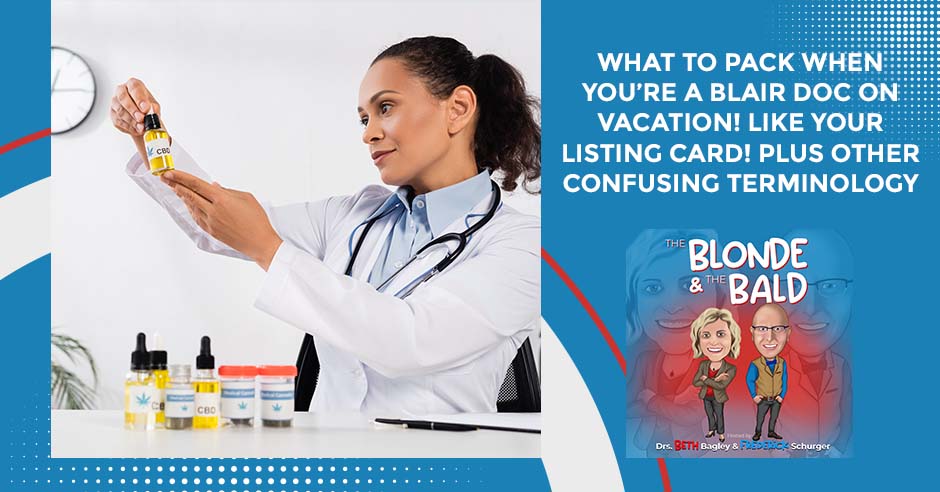
We apologize for the non-extravaganza episode, but knowing how important it is to get a vacation in may also require knowing how to get adjusted when traveling on the road to get the most out of your trip! We cover terms like listings, subluxation, neural structural shift & more in this episode as Dr. Beth Bagley recounts how bad she was feeling while on vacation. Luckily, she knew where to get adjusted!
And yes, many of our patients plan their trips knowing there's a Blair doctor nearby! Check the link below to find one for your next vacation hotspot!!
https://linktr.ee/theblondeandthebald
Listen and read the full blog post here
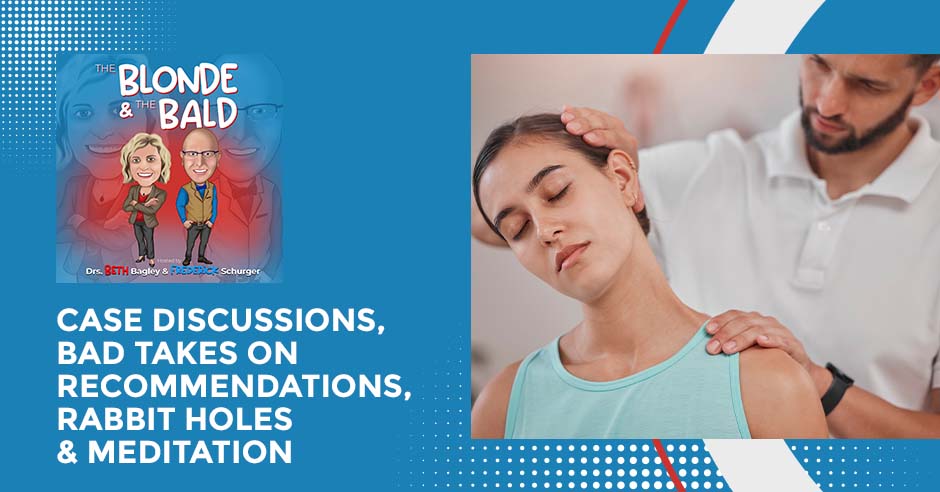
Ready for more Blair chiropractic stories and rabbit holes? In this episode, the docs talk about different cases that they've seen recently including trigeminal neuralgia hydrocephalus and other things. We also get into discussing how you might have received a situation that is completely different than how it was presented to you. This is one of our concerns when we are presenting to a patient to try to keep everything that we share as simple as possible because when we get confused about something, it can really make things worse for all involved. Kudos to you if you're listening to this while walking! And we wrap things up talking about meditation & breathing exercises you can start today.
---
Dr. Bagley, how are you this fine day?
I'm fabulous. How are you?
I am good.
This is number 49, which means we're going to have a big bonanza. It's going to be amazing. We don't even know what we're going to talk about next episode, but it's going to be great.
We'll even plan for it and have some extra special something.
We had a good talk with Philip and that was amazing. That opened my eyes to a couple of things I didn't know. I have already talked to another patient about what Philip was going through and what he's doing on top of his upper surgical care, which is cool. I've had a lot of new patients with some interesting symptoms. There are some things that I think we could go over there. How has your week been?
I've been good and not necessarily different symptoms, but certainly some cases that stand out. Let me start with this. This case that came in was a trigeminal neuralgia case. I've spoken on these in the past. I can't say I've had a trigeminal neuralgia case. I had one that didn't turn out as well as I would have liked. I don't know what else was going on that got her down that rabbit hole.
Generally speaking, trigeminal neuralgia cases do great, except she's got a three-hour drive to get here. She's over in Indiana. I'm racking my brain, “How can we make this easier for her?” I've got some people from that area that she's in driving over sometimes to the office and sometimes over to my Arthur office to save an hour.
I'm calling up Dr. Tim Gurrola in La Porte, Indiana. He was a Gonstead full spine practitioner. For those of you who are unfamiliar with all the chiropractic techniques, Gonstead is one of the more popular techniques out there. It's generally taught at most of the chiropractic schools to some degree or other. There's advanced work involved in getting good at it. It's a full spine technique. He'd been doing that for 20 or 30 years when I ran into him at Palmer while his son was at school who's like, “You got to dad, you got to learn this Blair work.” Dad's doing the Blair work. Tim's comment was, “My case fee isn't as high as it used to be because I don't need as many visits as I used to.”
He was happy about that. He made the funny comment as we were chatting that it was a new patient who'd never been to chiropractic before. They're like, “You did the thing. It got better, but I think it was going to get better on its own,” whereas if someone's been to a chiropractor before who's either maybe another upper cervical doctor or even just a regular chiropractor, the funny thing is they're like, “This is very different. I feel a ton better.”
There's one more category that falls into those views that people have. It's this case that came in to see me for trigeminal neuralgia because she has been through the wringer of the medical profession trying to find anything to give her some relief. Sure enough, we get her head on straight. I just adjusted her, so we don't know how well she's going to do.
She's like, “This feels a whole lot different.” It is the experience of the patient, knowing how bad it can get. I don't want people to get to that point, but unfortunately, they find us and they're like, “You tickled behind my ear a little bit. The headpiece dropped. I don't know if you did a whole lot,” not understanding the amount of work that we've put into making it look super easy.
It feels easy. Blair adjustment is so gentle most of the time. Sometimes, it hurts a little bit because something is tender, but it's not like a traditional chiropractic adjustment or, God forbid, one of those adjustments you see on TikTok where they're yanking people's heads. It's so profound. A patient I had came in earlier this week for his CT scan and his exam. He is the nicest guy, but he's been suffering for three years.
Blair adjustment is so gentle most of the time. Sometimes, it hurts a little bit because something is tender but it's not like a traditional chiropractic adjustment.
He played hockey his whole life. He had three different head injuries in a short amount of span where he hit his head on hard surfaces at work, fell back, and hit three different times hit his head. His body started doing weird stuff. One of the things he just started getting is these terrible chronic headaches. He felt that pressure all the time. He did get a CT scan and they found the hydrocephalus. The brain was under normal pressure. They did a puncture to see if he had any pressure in his lumbar spine. There's no extra pressure. I was like, “That's because the pressure is there and not down there.”
For readers, a normal pressure hydrocephalus is a situation where the cerebral spinal fluid is not in a child. Hydrocephalus is an uncommon finding, but it does happen more frequently because the skull is not connected. Not more or less one piece. It's not one piece, but it's more or less one piece. The head will blow up like a balloon, and they will try to shunt that off. In normal pressure hydrocephalus, maybe it's still within the normal range, but it's enough that it's starting to cause pressure into the soft tissue because liquids or fluids are non-compressible.
That means you can't squish them down and they've got to go somewhere. They can't go into the bone and cause that to expand. It goes into the brain's soft tissue and causes all sorts of problems. Often, there's a stop because the upper cervicals are out of place pulling down on the spinal cord, brainstem, and cerebellar tonsils, causing them to stop to work.
This guy is a smart guy. He started doing research, looking at and seeing different things. He does come across the upper cervical. He came across some of Dr. Scott Rose's work. Scott is his first name. he lives in St. Louis, so he found me, which I'm super grateful for because he's a sweet guy. He got his first adjustment. For doctors reading this, he's got a double PI.
If you're looking at me from the side, my atlas bone should be shifted slightly up like this. It should be at an angle that's towards my nose. For his, when I looked at his atlas, it was just this flat. When I looked at his different ankles and everything, we could see on the ProTrac views that he's got posterior misalignment on both sides, which is not super common, but it's a more common thing now.
I see it because we see so many neurologically compromised people. We see it more than an average population would ever see. When I told him, I was like, “This is a pretty compromised position for this atlas bone. It's putting pressure where it shouldn't be pushing. It makes sense that things are as bad as they were and it makes sense to me, too.” His wife didn't come, but she heard from him what I had said on the first day.
She was so excited. She's like, “I just want my husband back.” I don't know how the whole case is going to go, but I'll keep you guys updated as we go. I'm going to guess he's going to probably want to come on the show because he's so funny. He is such a nice guy. I made two adjustments on him, but the second one was the PI adjustment. He felt weird afterward.
I was like, “That's good.” He felt warm. I was like, “I think it's your brain draining. I don't know for sure if that is, but I have had people have that sensation where they're like draining.” That pressure was starting to relieve. He didn't feel like perfect as he was leaving or anything like that. I wasn't expecting that, but I was excited about all the changes he was feeling as he was resting because it's not how we walked in. All we did was move this tiny little two-ounce bone. It's incredible what we do in. In my meeting, we were talking about capacity blocks, like what's blocking the office from getting bigger. We discussed that maybe quarterly and just talk about, “What can we change?”
One of the things we want to do is remodel a room in the back where my X-ray mission used to be. One of the questions is, “Where are we? Do we have sound philosophy?” Not a lot of healthcare practitioners talk about philosophy, but I think chiropractors do more than physical therapists or something. The philosophy of chiropractic is the whole above-down, inside-out thing. If anything, and I know we're talking about the intelligence of our body, but what's profound about that is where I was comparing what this guy is even feeling and even the cerebral spinal fluid above down. The flow of information. I know there's two-way communication, all that stuff. It's pretty incredible to watch someone change like that. I feel so blessed that we get to do that every day.
This is a good point because most people know chiropractics doing something different than a medical doctor. They don't understand that medicine has a philosophy. The medical philosophy believes that something is inherently wrong. They have to figure out if they either have to give you a pill or some sort of medicine to cause that problem to get better or to make it turn on more, make it turn off less or take out something.
Something has broken down and died. That's where surgeries come in place. Sometimes, there are valid reasons to do that, but oftentimes, and I make this joke, there are times when the orthopedic surgeon wants a new boat. It's not even the orthopedic surgeon that wants a new boat. It is the manager of the orthopedic surgeon unit that says, “We need to do this many surgeries because I want my new boat.” I'm not saying any one particular doc doesn't deserve a new boat. Some of them do.
Sometimes, this is the problem. If you are selling a product or a service, you look at every nail. If everything looks like a nail, you're going to use a hammer every time. The difference between that philosophy of doing a thing and chiropractic can be just as guilty of this because if I look at it and say, “I need many bones to make this kind of money to buy my boat,” and I buy all my kettlebells from all my teaching. That is how I buy my kettlebells. Thankfully, I don't need any new ones. It's going to be at least a year.
The difference between the philosophies in chiropractic is that they focus on, “How is the body healed? What drives the body's healing?” Our philosophy says that everything comes from above, down and inside out at or a very superficial level. In simplest terms, the body heals itself. We understand that the body is a self-healing organism as long as we're alive. What is the thing that is interfering with our body's ability to function and heal? We find that it's the nervous system that is not functioning the way it's supposed to because something is out of place in the upper neck that is driving that problem that is preventing the person from healing.
This gets into the other story that I wanted to share about a new patient who's coming in soon. She went to see a newly graduated doctor. I won't say what city she's practicing in. Unfortunately, I will say she graduated from my alma mater, Palmer College. I understand that not every doctor out of my class, certainly not even upper cervical doctors, has even bought into the philosophy that chiropractic facilitates your body's ability to heal and benefits your nervous system. That is an unfortunate problem in the profession, in the education system, that there are enough people, both teaching and people who are trying to accredit doctors, that would rather see all this philosophy go away and become a part of the medical system, give out drugs and surgery.
Quite honestly, you and I would make a ton more money and knowing some of the things, the procedures that I would do, like what Philip is going through, if I decided I wanted to have a medical degree and go and off and do those procedures and those injections, hands down. I'd be all about it. Unfortunately, that's not what I want. I want to get people's heads on straight so they can go out and do everything they're supposed to do. In this case, this patient calls me up. She is freaked out. I have very little information about her other than she's got some back pain and some other problems. They did take an X-ray and I applaud.
You don't see that as much anymore, but I'm glad they did.
From what I saw, I think she's using a torque release technique.
That can be good. There are some aspects of testing and addressing misalignments.
Based upon what she was telling me, this doctor was a radiology intern. I don't know this doc at all. I'm not saying that the patient understood everything the doctor was trying to get across, but certainly, the patient was freaked out and the doctor told her this, that and the other. I'm looking at it. She was part of the pre-med club for a couple of years, and I'm looking at all these other things.
Do you mean an undergrad, she was part of pre-med?
Exactly.
I was probably part of the pre-med club as an undergrad, too.
Some people know that they're going to do that kind of stuff. My point is the way that they told her, “I can't say every symptom's going to get better.” We can't say that. I'm going to take the patient's word for this. The doctor told her, “This would never get better. The numbness or tingling along the legs is never going to get better.”
What? It's possible it might never get better, but we see that it gets better all the time. I see that it gets better in the afternoon.
This young lady strikes me as a young lady. She doesn't strike me as somebody who's in her 60s or 70s, and situationally, the damage has been done. This is where surgery sometimes comes in.
Sometimes, people need it. Sometimes it's too far gone. There's been too much damage.
This is one of those situations where Dr. Gurrola was talking about where, hopefully, the patient comes in, and we go through all the history. I'm like, “Here's what we're going to do. Here's what it's going to cost,” because that's the other part of it. She doesn't want to start something that's not going to get her better. I'm 100% on board with that. She's freaking out and I'm like, “I got to take a look at stuff,” because something about her experience just scared the heck out of me, but yet I've heard that from other patients before. I'm like, “Maybe this doctor is the best, but she just explained it wrong, and the patient didn't understand because of the white coat.”
You can get freaked out by it. You can mishear things. I feel like if I say something to a patient that freaked them out and then they go to a different doctor who happened to know me or didn't even know me, I almost wish somebody would call me and say, “I want to let you know I've got a patient here that heard that you said this and I want to know what that meant.” He'll be like, “I didn't say that,” or whatever it is.
There's that too. We have to get back to the question of, “How do we communicate to the patients as best as we can and keep it stupid simple or is it simple, stupid.” Sometimes I'm the one who's stupid.
I am, too, sometimes, especially on Thursday nights. The other part of that is that this stuff is serious, though. Subluxation, misalignment or whatever you want to call it is serious. When this happens, your body is moving towards destruction rather than healing. I get telling people that, “You have this going on and that is serious.” To take away someone's hope that they could get better knowing that we are self-healing and are miraculously made and Our bodies can heal. Our job is to help stuck people get unstuck.
Our job is to help stuck people get unstuck.
If you say, “You could get unstuck, but you are never going to get better.” What the heck? I don't even think a medical doctor would say that because it's taking away someone's hope. I don't want to give false hope. Typically, we can see big changes in something like numbness and tingling in a short amount of time and permanent changes in that.
As she was explaining it to me because she didn't understand some of what was going on and the doctor did tell her, “Don't go to somebody who's just going to turn you on on your neck and roll you because that's going to be a problem.” I'm like, “Don't do that.”
Was this a chiropractor who told her that?
This was an actual chiropractor. My concern is, “What else are they doing?” This is the other thing that people should be worried about. We've got some “Influencer” docs in the Blair work. Dr. Drew Hall and Dr. Kevin Pecca are fantastic at doing marketing because they love making TikTok videos. I hate that they love making TikTok videos. I love that they make videos. I hate that it's TikTok.
I try not to consume TikTok. I do make TikTok. Right. You all can find me @DrBethBagley.
If you watch any of Drew Hall’s TikTok, Kevin's are better, in my opinion.
It's all of the same stuff over and over. He is like, “If you're suffering from blah blah blah.” Honestly, he gets a lot of views on that stuff. Between Drew and Kevin Pecca, I have had patients who have started care because they saw one of their TikTok.
Kevin's looks a little bit more nice. Drew is very raw.
The thing about TikTok is people don't necessarily need it to look nice. They just need it to be real. It doesn't have to be full-on production.
This other doctor and I are looking at their website. It feels like they're trying to be an influencer more than they're trying to be a doctor. At the end of the day, Doctors Drew and Kevin are trying to be clinicians who also put out videos as opposed to someone who's trying to be an influencer.
They never want to not be a doctor. They always want to be a doctor.
This is the same for us. We would rather be a doctor all day long. I love doing this and having this conversation with you[MM1] .
I'd rather people just come in and I don't have to market at all. I don't love marketing. I don't hate marketing, but I don't love it. I love seeing people's lives change behind that door over there. To see people's lives change, I have to market. It's a business.
That's part of what we're doing here and we're just getting the word out there so we can share what's going on. This young lady that's coming in once we take a look at her images, I'll be like, “Here are the things that I worry about. If I were your age, these are the big problems. Sometimes we have sunk costs and sometimes things in our body are sunk costs.” We have to work around that. I've got another patient who didn't have any of the jabi jabs, but he still had the heart problems associated with it.
It could have just been from the COVID.
He had COVID about three times. He's got all these health issues.
Does he have a weak weekend immune system before that?
Other than the fact that there were some beverages that he likes and cigars, he was not bad, but there was a lot of stress work-wise. He had several stents put in. There are certain medications you have to take to maintain the patency of those stents so that blood will flow. My dad still regrets getting the one stint put in. They didn't need to do it, but they highly recommended the stent in the widow maker that he had, which was 90% blocked or maybe 70%, whatever it was. It was a big blockage. The upside was, and the reason he didn't have a whole lot of heart damage was because the heart had already made new vessels around the blockage.
Dad is like, “I wish they hadn't done it, but they did it.” I'm not going to fret over it. There are some things that you have to maintain. Otherwise, that thing will block up, which is the unfortunate side effect of getting a stint if the body says, “I don't like this. This shouldn't be here. Let's get rid of it.” It's keeping blood flowing.
Does the body attack it with the immune system?
Yeah. The coating on the outside of it, if I'm not mistaken, prevents it not from being necessarily rejected by the body as much as keeps it from getting stuff clotting it and things like that. That only lasts for so long. Anything in the body that isn't of the body and even stuff of the body will turned over. The body says, “I don't like this and we're going to change this.” That's why there is a medication to deal with the stent.
This young man has been a patient for a couple of years. He's been under upper cervical care for a good long time as well. He's like, “I'm not happy about what happened with the heart attack and everything else, but this is where I am. This is the bare minimum that I have to do to move forward.” He's loving cardio rehab. I think cardio rehab is one of the best things I have ever seen the medical profession figure out.
I honestly wish that every person who is eligible for cardiac rehab could continue it for the rest of their lives because the changes I see in my patients who have had to go through cardiac rehab are so profound, but then it ends. You're rehabbed. First of all, people are afraid that they're going to have another stroke or a heart attack while they're exercising. This puts them in a safe place where if something were to happen, there would be people there who could help.
I wish it were true because these people go through those changes, and most of them don't keep doing it. Most of them don't continue that path. Most of them just go back like, “I'm better.” You can't stop exercising. Many of them are still afraid to go to the gym or even just go for a walk because they're fearful that something bad could happen when that's the opposite.
They need to be out and being active and physically doing things. My dad's heart attack was 2008 or 2009, but he kept on doing the rehab because they offered it and they said, “You can keep on coming in on the regular.” They had it at the hospital. There was a core group that was there all the time. That core group would come in and do some yoga. They would do some other activities at the hospital and then afterward, they'd all sit down and have coffee. When COVID happened, all of that got shut down.
I was listening to someone talking about how we have lost our socializing skills since COVID. COVID puts so much fear into people that we can't interact with others that we don't have. That's a psychological rabbit hole that I don't even want to go down because I know it. We are not islands by any means, and we certainly are not. We are social creatures that need to connect.
This is why, if nothing else, religions have been around in various forms throughout the years to have social interactions. Something that happened during COVID put so much fear in people, and it's not the fear of God. They are not interacting socially as we should. That's a whole other thing. I don't want to go down that rabbit hole, but I just want to get out, go to a gym, and keep active. My dad's got a 2-hour routine that he does at least 3 days a week at the local gym. Some people do continue.
He's the exception. So many people don't.
Two or three days a week, it's yoga, and then, on other days, he's finally getting into strength training. I haven't gotten him to do kettlebells yet, but he's doing sled pools. Dad's a former judge. A lot of those guys are former cops. I know his brother better than I know him. They both had big egos. They were going back and forth putting, “I did 200 on the sled,” and then they put that on the chalkboard. Dad would come over and he said, “ I did 225.” “I did 250.” “I did 250, then 275 for three laps.” I think they got up to 300 or maybe even 325.
For me, I've never pulled that on a sled.
They got to that point.
Were they pushing the sled or were they pulling it with a rope?
I think they were pulling it.
Were they doing that, that one where they pulled like that? No.
I think they had something around their waist.
They were walking with it. It was usually like their legs. I might be able to do that.
You could do it pushing as well. Dad got up to the 303. He beat the police officer's record and they both sort of said, “We have proven that we are both stupid.” I told Dad, “Back it down to 275 and start walking it backward.”
I love that he had a scary thing happen to him and then he made some changes. If we could just convince people to make the changes before the scary thing happens.
If we could just convince people to make the changes before the scary thing happens.
You're spot on there. Remember going through school and I was not an active kid going through school. I was the pudgy kid who I wished had kettlebells because if someone said, “Do this and you'll be strong,” and I'd be like, “I like that,” because I can race against myself or even just having gotten into a weight room, that would've been good. Having something physical and growing up there was the big Arnold Schwarzenegger National fitness thing.
That’s presidential fitness.
I don't think that stuff exists anymore. We're seeing kids who are less and less physically active. Even my buddy's son, while he plays hockey a lot, is given nothing else to do. He will spend more time sitting in front of a TV playing Minecraft or whatever the new fad game is more than anything else. As you're looking that up, I'm going to bet that the presidential fitness test when you and I were going through school is considerably less than what it was back in the Kennedy years.
I seem to recall that one involved a lot of pull-ups. There was some sort of ring thing that you would do overhead. Mm- there was a rope pull where you would pull, you'd climb a rope. There are two stories, almost the old gyms where they would have those, quite honestly. I'm not going to say that pulling yourself up on a rope is a mandatory thing, but that's a lot of upper-body strength. That's strong.
It’s ended in 2013. It was replaced by some with something else. I agree that it started off probably way harder, like everybody gets a trophy at this point. That's probably why it ended. I remember being a kid in gym class, and I am not a super athletic person. Back then, I couldn't even touch my toes. I can now because you have found out that you can improve your flexibility when you work on it. Nobody ever even explained that to me as a kid. When I played basketball, nobody said, “You could do these exercises and improve your vertical. No one told me that.” I just thought I didn't have a good vertical. I might be 6’2 foot, but I don't have a good vertical. Now I'm like, “I could have had. Nobody explained that to me as a kid.” I never knew when I did the sit and reach. Remember that?
I hated that thing.
I couldn't touch my toes worth crap, but I could do it now because I realized that you can improve upon flexibility and you can improve upon your fitness.
A lot of the rehab that I'm teaching patients now after they've been in care for a little bit is all about regaining basically flexibility in the legs and the hips. I was chatting with a patient who was having a lot of hamstring pain. Something was cramping up, and sure enough, she was out of adjustment. I'm showing her a hip hinge and saying, “Add some weight to this.”
It's the reverse deadlift form that I'm recommending. If you want to go find some reverse deadlift forms, I think Ethylene X did a wonderful video talking about it. All you're doing is you're trying to load up and stretch the hamstrings in the quads in this process. This was over in my Arthur office, which was a concrete slab that I'm standing on.
I'm always tight over there. I went to touch my toes as a demonstration. I could touch the floor. I was shocked because I had a workout that morning and everything else, but I'm constantly doing flexibility stuff. About five days a week, I'm good at that, and seven if I have the extra time. Some things you have to do daily to maintain and function the way you're supposed to, like the one young man who needs to take his medications.
His wife is certainly in the healthcare. I don't know if she was a full-on nurse or where she's at in that, but she's like, “Here's your meds and don't say no.” He's like, “I don't say no. I do my rehab at least five days a week.” Sometimes, I'm doing the rehab here in the office, showing people so that I can get my minutes in for the day.
You're not wrong. It's amazing. I will oftentimes show patients with their arms back. I call it the Angels because that's strengthening between the shoulder blades and turning some muscles on that get turned off when you're sitting on your butt in front of a computer screen all day. People don't realize that that's a trauma in itself. This is the first time I've sat. I sat for twenty minutes to eat lunch. This is the second time I've sat. I am blessed. I am so excited to stand all day and bend, twist, and move because the long run of my body is so good for me. I'm not complaining at all.
Whenever we're in seminars, when we're at the Blair conference, it kills me to sit that long. My body doesn't even understand what that is. I get all antsy. I don't know how people do it, but I do know that you can do things daily to help eliminate that stress on your body, which some of the rehab things you're talking about, Wall Angels, there's that thing called the Bruger Stretch. You guys can look at all that. You can comment or shoot us an email and I'll send you all the stretches that we do.
You can do things daily to help eliminate stress from your body.
The sitting is rough. It's a trauma in itself and it's like a repetitive trauma rather than like a car accident, which is an instant trauma. This is a repetitive trauma where you're doing the same thing over and over. If you grabbed your phone and you held it with your shoulder, don't do that. You could do it for like a minute or two. If you're doing it for a minute or two, let me tell you, every time you grab your phone you're doing it. How you do one thing is how you do everything.
Right before we started this, I watched a video, The Godfather Of Kettlebell Stuff, Pavel Tsatsouline, who has been doing some research. One of the things that they found that helps improve cardiac performance is doing effectively a bodyweight lunge uphill. You're not doing a full lunge as much as you are just taking long strides on a hill, climbing up the hill multiple times and apparently, that increases your cardiac output volume while you're doing it. That way, you've got a stronger, more robust heart down the line.
If you're sitting all the time, the heart will not have the demand on it. They're basically saying sitting is the new smoking. At least when people were smoking all the time, they were walking around. They were going outside. I had one buddy who said, “Let's go play some basketball. Hold on a second. I got to light up first.” He's playing basketball with a cigarette.
At least he's moving. He’s probably getting a little Vitamin D. You got the sun hit your face while you're smoking your cigarette.
John Daly does all the golfing with a cigarette and a whiskey and he just pummels everybody else.
My friend Ginger, who used to smoke, was talking about what she misses about smoking. One of them was getting up and getting outside once every hour or two. We should institute movement breaks or sunshine breaks where it might only be five minutes, but getting up from your desk and going outside for five minutes.
First of all, I think it'd make your brain better. Second of all, your body suffers in these positions in front of a computer screen all day. Especially now with people who are mostly still working from home, and I don't have a problem with it. I think it's amazing for lots of people, and it's a resurgence in small towns because you can live in a small town now, have an amazing job, and not have to leave your room.
You can also shop and keep these small towns going because I love small towns. One more thing is that the implementation of that is nothing you can't do by just setting a phone alarm. All you have to do is set an alarm for 90 minutes and it beeps at you. Once you're done with that email or meeting, the next thing you do is get up and walk away from your computer for five minutes.
I think they do this in either Japan or South Korea where they'll be sitting at a computer screen at their desk and all of a sudden, there's a mandatory it's going to shut off. There's nothing you can do for five minutes. You've got to get up 5, 10 minutes or whatever it is. Go for a walk before the computer will let you back in. It improves productivity. There's a whole Pomodoro theory that you take these frequent breaks every so many minutes of working. There's something to it. You get up, go for a walk and go do things. Don't go play on Instagram or TikTok.
Don't take your phone with you.
Don't just get away from things. This goes to the same patient I was talking about earlier, who has a heart condition. He has improved his mindfulness of being in the moment. The more that he is in the moment, the more calm he has been. He said it was a Sikh doctor, but I can't remember what the doctor said exactly was profound. It was about living in the moment and not living for the next moment.
I learned that lesson from when I was doing my kung fu. Shifu would count out in Chinese the next motion that we were going to do or the next rep. Not to anticipate the rep and just wait for the count and then go because that is being in the moment. Meditation for me was like that because I could sit for 20 minutes and sometimes I wanted to sit for 30, but if I had 20 minutes, I set the timer for 20 minutes, knowing that I could always go longer.
I can't go shorter because I've already allocated that time. I can relax and say, “I'm just going to be here. I'm going to try to calm my mind. I'm going to just be aware of what is going around in my breath,” and then that alarm will go off. I said, “I've got this 20 minutes, 10 or 15 or whatever I set the timer for to do nothing more than breathe.” That just helps clean up my head. I'm more aware. I'm more in the moment. I need to do it more. I don't do it as much as I'd like to.
That's the time management. I honestly have sucked at time management. In a good way, I'm busy. I love that I have patience and all the things, but being a business owner, a doctor, and a mentor, I told my team I apologized to them during the meeting. I was like, “I have not been a good leader.” They were all like, “You're fine.” They're all trying to be nice.
I was like, “I appreciate you guys, but I know I'm not living up to my potential.” One of the things I need to do is exactly what you talked about. I need to set aside time every day to breathe, meditate and pray. I need to set aside two hours a week to just do management, and that's just the business end of things. What's happening is I'm trying to do it in between things and I get called. My door is closed. It is a day when I'm not seeing patients or a time I'm not seeing patients. I need no one to bother me for an hour or two so I can get that stuff done because I have list after list of lists and it's like, “Oh my gosh.” I'm going to let you guys know the next episode because I'm going to be better about it. I'm going to do ten minutes because I think that's all my brain can take.
I've been bent over all day adjusting patients and I did get adjusted so everyone calmed down. I'll be fine. My body's working some stuff out. I am going to do a better job. I'm going to set ten-minute times where I breathe, pray, and take that time for myself. I might turn on music because I'm going to be honest, me being alone with my thoughts for ten minutes is scary to me at this point in time because I don't know where my brain's going to go.
That's half the fun of just being quiet and in the moment. You get to find out where your brain's going and you're like, “Come back over here, butterfly.”
I'm so distracted.
This is the biggest problem, and I think this is the bigger problem that we have as a society, is we have so many distractions and so many literal dopamine hits throughout our day. Honestly, I challenge everybody reading this to after you're done reading this, think about the last Instagram post you had from a friend. I've got about 3 or 5 friends who regularly send me posts. Some of them are political. Some of them are funny. Some of them stick with me, but not most of them.
Even when you're watching with something like that, it's minute, but can you be mindful of it to say, “This was worthwhile.” Some things are a funny joke. You need to learn how to tell that joke. Take a moment. No offense, Dr. Bagley, but I was learning blonde jokes because they're funny, and so are the brunette and the redhead ones and the bald ones because they're jokes.
This is fake, so it's okay.
I made it a point. My uncle gave me this sheet of jokes and I read through them multiple times and then I had to learn how to speak them because I was not a good speaker back in high school when he gave me this list of jokes. Even now, if I'm going to practice a speech, there's some stuff that I can do that is extemporaneous, like quite honestly having a conversation like this, but there's a lot of stuff you have to practice.
If you see something good on Instagram, especially something that is uplifting, take a moment and repeat it a couple of times. My favorite, I can't quote it word for word, but the man in the arena comes to mind regularly. That was a Theodore Roosevelt speech. I don't know if that was the speech that he gave as he was bleeding after having been shot by somebody.
That's a great story.
That's for a different episode. It's fun stuff. I challenge people to be more in the moment. Be aware of your surroundings and get your head on straight.
I'm going to do it right now, and I challenge everyone reading to do the same thing. Pick a time on your phone to set a timer that says breathe, pray or meditate. Set a timer and make it go off every day, like 8:00 PM or whatever time that you're done eating and the kids are done. All the things are out of you. You might be sitting there going through Instagram or doing something. When that goes off, you're like, “I’m turning this off. Now is my time to pray.” Whatever you want to do, I'm going to pray. Thank you. I'm going to do that right now.
This is a perfect time to do it as we wrap up and nobody's expecting you at home for a little bit yet.
I'll do that before we leave. My alarm is going to go off at 9:15. That's going to be my time. What a great episode. We were like, “Let's talk about this.” I was like, “Let's just chat because we have good chats,” and you guys don't always get to read them. Now you got to read it and you got to read about some cool new patients. I can't wait to keep you updated with a few of these guys. I'm excited to get some updates about how your new patients are doing.
I need one update from you. How are you doing with the boron?
What boron? I don't have it. I didn't buy it yet because I'm afraid.
Get it. Break down. Don’t let me buy it for you.
I like it when you buy me stuff, but what should I buy again?
Get a pharmaceutical-grade boron.
I'll order it tonight because I want Jason to start taking it, too. Thanks for asking.
We even keep ourselves accountable on the show.
You all do, too.
Now that we've got that taken care of, where are they going to find you?
You can find me at precisionchiropracticstl.com/, TikTok at @DrBethBagley, Instagram and Facebook.
I'm at KeystoneChiroSPI.com, Keystone Chiropractic in Springfield, Illinois. @KeystoneChiro on Instagram. Send me funny stuff if you find me on there. Thanks for joining us for another episode. We'll be back with our 50th episode. Bye.
Have you ever been in so much pain that you’re ready to chop off that body part? Phillip’s struggle with the pain is not the worst of what he went through. He sought out medical doctors from all over the US, in and out of the Veteran Affairs system, to find an answer to get him better. Phillip’s 13-year journey in restoring life changed after his mother’s chiropractor overheard his story and said, “I can help.” Listen to Phillip as he recalls the haunting experience and how the right therapy made a wonderful impact on his healing journey. Tune in to this episode so you won’t miss the incredible journey of Phillip in restoring his life.
Listen and read the full blog post here
Boron has become Dr. Frederick Schurger's new favorite mineral, and after this episode, Dr. Beth Bagley is extra excited about it. It has so many health benefits and is so readily available to us that we don't even know how easy it is to get. Join us as we discuss the benefits of boron and how it can help with joint health, antifungal properties, and even sexual health. Plus, understand how much boron is safe and how much is unsafe because you will be asking that question after you find out where you can get boron in your immediate world. It may even already be in your house!
---
Dr. Bagley, how are you doing?
I am doing well. How are you doing, Dr. Schurger?
I'm doing excellent. We're excited to talk about boron. Honestly, I'm still flabbergasted by the benefits of this little mineral that is probably what we're not getting as much as we need.
I want to know more about it. I'm going to have lots of questions for you. You've done some research and I want to know.
We are depriving you of the conversation we had after the last episode. We had our recap that we do offline. Dr Bagley's comment was, “We should be recording this.” I'm like, “We should have been.” Let's talk about boron. I'm going to start with this. One of the things that I have been fascinated with these past several years is some of these naturally occurring springs that purport to have healing benefits.
One of the things that they have found is that these springs tend to have a higher concentration, which is boron naturally occurring. This isn't how I started down this rabbit hole but it's something that I was looking at. I've been doing it for other health benefits, which we'll get into here in a little bit but I finally had a few moments and I went down the rabbit hole. I'm like, “There are so many benefits to this.” One of the interesting things is everyone's familiar with cytokines.
Maybe not everyone is familiar with cytokines.
Cytokines storm after COVID, which is a more common thing. What we're going to do is go over some general science in how boron seems to be of benefit to helping things out. There are some spicier aspects. Cytokines come later.
Don’t get everybody excited about cytokines and then don't talk about cytokines. We got to talk about cytokines.
Cytokines will be fun. We're going to get into that. Also, some of the benefits that seem to be going on here.
First, what is boron? Is boron an element or a mineral?
Boron is a mineral.
It's a straight element, too. It's the atomic number 5. It has the symbol B, which is one of my favorite letters. Its crystalline form is brittle, dark, lustrous, and metalloid. It's not a metal, is it?
It's a mineral. All minerals are technically metal. Do you have it in a more metal or steel form? Not necessarily. There’s one doctor down in Australia, I believe is where he was, who figured out something if you added a little bit of element of boron to your diet. For him, it was 6 milligrams a day of sodium tetraborate. These names are less important when I say tetraborate. There are three that are all the same thing so when we're looking for this, we'll hit all of that. We have sodium tetraborate, sodium borate, and disodium tetraborate but they're all the same thing when we're getting into this.
He started taking this as a supplement and noticed his arthritis went away. This is how this all started saying, “This might be a dietary supplement that has some benefits.” He was using 55 milligrams of sodium tetraborate decahydrate. These are some fancy words but they're all the same. What he figured out is that when he had these patients on this, their arthritis, especially their chronic arthritis, started to improve.
What they did end up figuring out is we have boron as part of the cellular matrix makeup for our skeletal system. If we don't have enough boron at the joints, those joints start wearing more easily. This is one of those simple supplements that you can take to help if you have an arthritic condition. We'll talk about dosing and how much to take.
It gets interesting and it's like, “No surprise. This is why we don't have boron as a regular supplementation.” You'll hear the other problems with it. This doctor is making these tablets for his patients so much so that he doesn't have time to practice. He approaches a pharmaceutical company and says, “If you can put this in a pill form here, you'll make a bunch of money and you won't have to give patients that toxic, expensive medication that you've been using.”
Why would they want to do something like that?
They killed their bottom line. What happened shortly after this was the Australian Food and Drug Administration and then probably the American one quickly said, “We can't have that.”
“Boron is deadly and toxic. It will kill you.”
Not so much boron is deadly and toxic.
I know, but if we start looking this up, I bet we'll find stuff on that because they're trying to keep people from taking it.
What is sodium tetraborate? What is sodium borate? What is disodium tetraborate? Where do you buy it in the cheapest form but yet as pure as all the other forms? You buy it at the grocery store or supermarket. I picked up a couple of boxes at Menards. It is 20 Mule Borax. It is the same thing. It is mind-blowing.
Is it really the same? That's what I've been looking at. I'm trying to figure out if it's the same.
It says sodium borate. The only thing that I have not had a chance to dive down deep is I've got an old chemical manual somewhere. I can't remember where I've put it but it goes through all of these different minerals. I haven't had a chance to say, “What is the actual difference?” These are common names for Borax. Sodium tetraborate, sodium borate, and disodium tetraborate are all the same. We're not looking to use the amount that you're going to use to clean your laundry as a laundry booster because you don't need that much. Quite honestly, that much is going to be toxic but a little bit, because that's all we need, goes a long way. 10 milligrams of boron will come out of a quarter teaspoon of Borax.
If you took a cup of it, you would probably die.
Let's hit that because we're getting into that. As I've been reading through the public health risks associated with this, why was it considered public health risky? There have been several on this one study that I found and I don't have the reference off the top of my head. It was relevant to public health documents though. Accidental poisonings range from 10 to 88 grams of Borax, which 88% of cases were asymptomatic. You might have some GI distress or some heart and liver stuff going on.
It says, “Large amounts can lead to shock and kidney failure,” but that’s a lot. What if I ate a cup of salt? What would happen to me?
Large amounts of Boron can lead to shock and kidney failure.
That's the thing. I did the math. They figured it out. This is where you have to be careful when you're starting to look at these things. Death has been observed in children and adults exposed to 84 milligrams per kilogram.
That's a lot.
That's where it gets into the crazy stuff because I did the math and figured out that at 84 milligrams per kilogram of boron, it didn't say boric acid or borax, it translates to 2.1 teaspoons per kilogram of body weight. We did the math here. It's about two cups. What's curious about this is table salt has similar toxicity levels as sodium borate.
Yet we're not afraid of table salt. We don't go like, “We got to keep that away.”
In no certain terms, are you going to be consuming anything from teaspoons to tablespoons of salt at a sitting or even using that much? I've got a big large stock pot. I barely put half a cup of salt in for my bone broth when I’m making that. That's a big 20-quart pot. We're talking very small amounts. What's interesting is that there's a number called LD50. That is the amount of a substance that is toxic enough that kill 50% of the people taking it. If you see LD50 in the literature, that's what they're talking about. The amount that you have to get to that level of toxicity is high.
It would be hard to do. Somebody would have to force-feed it or purposely poison someone with that.
The same thing holds true for table salt. I misplaced the article that I was looking for that had that but it said you need a little bit less table salt like half a cup compared to sodium borate or Borax. That's the kicker on this thing.
I have a conspiracy theorist brain and I'm thinking the reason why this is not common knowledge. I know you're going to go through quite a few other things that are helpful. It's not just arthritic pain. The reason I don't know this is because it's another truth that's been kept from us. This should be common knowledge.
What are the things that we do on a daily basis, you and I, as chiropractors, that we know that are going to improve our health and the health of our patients? We take care of ourselves and look at how we become more reliant on ourselves, especially in a world that is deciding that it doesn't want to be reliant on themselves for anything. Most people, given the option, are like, “Wait a second. I can be reliant and do my thing?”
What we're talking about here goes to those people. If you don't feel like you are self-reliant enough, maybe you need a little bit more boron. We're going to talk about how it boosts testosterone in a bit. The benefits of looking to the things that will help you heal and function better will far outweigh waiting for somebody else to try to figure out what's wrong with you.
“No one's coming to save you.” That's one of my mantras sometimes. No one's coming to save me. We have to be our advocates and do the digging. One of the reasons that Dr. Schurger and I love this show is because we do some of the digging and share our thoughts with you. I'm quite excited to start this as a supplement. I get achy. I use my hands all day long. There is probably some arthritis starting to settle in my knees and hands. I'm wondering if this will help.
At the very least, your joints are not as supple as they were years ago. It's funny because I came across a VO2 max as my heart running. I threw some numbers in there off the top of my head because I didn't have all of them but it was based a little bit on my age, height, weight, and then my resting heart rate. There's good data for this test because they've matched it and mapped it properly. Even though at 50, for what I can do in my resting heart rate, my VO2 max is that of a 33-year-old.
I probably could do some more fine-tuning of that and I wouldn't be surprised if I'm in my late twenties, what I can do physically. None of this stuff is the fountain of youth and reversing aging but if it can slow it and keep you strong all the way through, that's the benefit there. Let's hit a couple of other things. 5 to 6 milligrams of Borax is going to be about an eighth of a teaspoon.
None of this is medical advice. You shouldn't do this. You should talk to your chiropractor, naturopath, or medical doctor about this. This is just information.
The site that I found, I'm not going to say that they've got a bunch of great stuff but I found the way that they put together all this information and then I'm going to the research. I'm not just taking the site by what it says alone.
It's like trusting Wikipedia. We don't do one source.
EarthClinic.com/Remedies/Borax.html. That's a starting point. I'm looking at this stuff and I'm like, “What's going on here,” and then I'm like, “What does it say in the research? Does the research support what the website has put together?” I'm quite impressed with the website because it pulled well based on my readings of the research. When we're talking about dosages, we're not talking about dry weight. Back to my comment about minerals, put it in your water. Drink it in your water throughout the day. That's going to get you what you need.
For the boron, if you're using a sodium tetraborate, sodium Borax, you're going to be looking at about an eighth of a teaspoon in water. It doesn't always melt well so you might need warmer water. I put an eighth of a teaspoon in my coffee every morning and then another eighth either in my water before my workout on days that I'm working out or in my lunch coffee that I'll have at that point in time.
How long have you been doing this?
I've been on a sixteenth of a teaspoon for several years.
At that point, are you making a little pinch and doing a little pinch?
No, I had a sixteenth teaspoon. I went and found a set of teaspoons that went down to a sixteenth. I was looking for a thirty-second. At that point in time, I found a milligram scale because it was easier to do that.
You could use a kitchen scale.
Kitchen scales only go to grams. I bought a milligram scale for $10. It was not a fancy one.
What does that look like? Is it like just a pinch?
You are right. It is just a pinch. It is a very small amount. I was taking it a very little bit forever. We've talked about this before. On my 50th birthday, I made the comment to my siblings, “I don't have any pain.” All of them are moaning. That day, I wasn't feeling well for other reasons but it wasn't because my joints hurt or I ached. It was because I was out of sorts and probably out of adjustment.
In general, you're not sitting there talking about what achy thing is hurting you and this and that.
I've got a hip thing that doesn't want to relax but that's more self-imposed than anything else. It was not an arthritic joint issue type of thing. Now that I'm looking at Boron, I'm like, “Maybe that's part of my secret weapon package.” I was saying that was because I was keeping my head on straight, which I'm certain was doing a bunch of good. It's part of it because if everything's in alignment, you're not going to be wearing down joints faster. If I'm also doing this low level for several years, that was certainly of benefit.
I bumped it up to a quarter teaspoon. I had an eighth of a teaspoon later in the day. That was a snow day. I went to a full quarter the following day. I did a workout that I wouldn't say was hard because I'd been doing it for the better part of a month but I felt like I finished my sets better and recovered more easily, not enough to get an extra set in. I was pushing for that. These are kettlebell push presses with both arms so that was harder. It was certainly pushing me in that direction where I was feeling better. Running back to this study here, there was a group of men who were given various doses of boron at different levels. The ones who had the higher dose of boron reported they felt better and stronger.
Isn't there a testosterone connection, too?
Let's go to that one. That's what we're all here for, the fun stuff. This goes back to the cytokines. They were looking at what 10 milligrams of boron, which is a quarter teaspoon, do. They put it in a capsule. I've been putting it in water. I'll talk about why the capsule doesn't make sense. Let's start with what they were measuring. They were measuring sex hormone-binding globulin, high sensitivity CRP, and TNF alpha level. They looked at free testosterone as well as estradiol. We'll come back and hit all of these. TNFA alpha, if I'm not mistaken, is the Tumor Necrosis Factor. That's what they're looking at there.
It is important. That's interesting that they were testing that.
What they found by doing the 6 milligrams of boron is there was a significant decrease in sex hormone binding globulin, a decrease in CRP, which is an inflammation marker, and a decrease in the TNF alpha. That was six hours supplemented when they found that change. After one week of supplementation, plasma-free testosterone increased and plasma estradiol decreased. These are men. They also found that dihydrotestosterone was increased.
Cortisol was up, and we can talk about cortisol in a bit. Vitamin D was also increased. All three of the inflammatory biomarkers decreased after supplementation. Of note, despite decreased pro-inflammatory cytokines, this might be the first human study to show an increased level of free testosterone after boron consumption. This was a 2011 Journal of Trace Elements in Medicine and Biology Study, Volume 25, Issue 1.
Let's talk about these various things. Testosterone is pretty clear. We want to think higher testosterone means you are going to be more virile, virulent, and stronger. Yes and no. We don't have a good measure of utilization of testosterone. You might have a lower testosterone number but be jacked like Jack Reacher without the steroids or with steroids. It might be because you're utilizing all the free testosterone.
However, sex hormone-binding globulin is one of these things that will grab onto testosterone. As men get older, they tend to have that increase. That one and estradiol both will suck up or convert all your free testosterone into either unusable testosterone. You might have a bunch of free testosterone but you can't convert and utilize it for either fat-burning or muscle-building.
At that point, you could even be supplementing your testosterone with a pill, cream, or shot.
With a TRT, yeah.
It might not even help you as much because you can't do anything with it.
Dr. Peter Attia has gone down that rabbit hole well. I was listening to him talk about that. The problem with measuring free T is saying, “How many cars can you have in the parking lot? There's a bunch of cars in the parking lot.” It doesn't tell you, “Are they coming into your business and delivering the goods?” This is where we start asking those questions and what else is going on.
Dihydrotestosterone is not as usable. Vitamin D is elevated. That's a benefit because that means you're able to keep your vitamin D stores as opposed to flushing it out. Higher cortisol is not all bad. Everyone thinks, “Cortisol is going to sit in my belly fat and hips.” There's a special cortisol cycle. It needs to spike in the morning. If it does not spike in the morning properly, you tend to be lethargic throughout the day.
I don't do this but this is why you should not be drinking black coffee or any caffeinated beverage for the first 1.5 hours to 2 hours after waking because your cortisol is doing the waking process. Many people, either beating themselves up through our modern society, haven't gotten the rest so that cortisol spike naturally comes up and then drops. That's how that was. They're not sure how it works but they're seeing that it's working and that it happens fast. That's what I noticed.
You should not be drinking black coffee or any sort of caffeinated beverage for that first hour and a half to two hours after waking because your cortisol is doing the waking process.
They did a baseline blood draw and then did a 6-hour.
2 hours and 6 hours. They saw it at 6 hours. It was 10 milligrams every day with their breakfast and then a seventh day. Quite honestly, for men, there is no reason we should not be doing a quarter teaspoon a day to get that 10 milligrams. A quarter teaspoon of Borax or sodium borate, we're looking to get 10 milligrams of elemental boron. That's where the quarter teaspoon comes in. That's how you figure it out.
They did it in a capsule but I’m taking it straight in water. Dr. Bagley, I saw somebody talking about this. What flavor of soap gives you the heebie-jeebies because you had your mouth washed out with it? Boron or sodium borate is a little bit of a soapy flavor. There's no other way to describe it. It's not bad. This is why I recommend only an eighth of a teaspoon. It disappears in coffee. Depending upon the bitterness of a tea, it might disappear. A lot of these things will recommend taking it and putting it in your water bottle for the day.
They'll do it at a higher concentration and then say, “Take a little bit of that and put it in your water so that the flavor doesn't bother you.” I'm convinced that one of our colleagues who gives me beef as a thank-you has cows that are grazing on forage that's high in boron. Now that I know what it tastes like and I'm putting the pieces together in my head, I can taste that the beef fat in particular has a higher level of boron in it.
You have a very fine palate.
It is a shame that I only want to eat meat and salt.
I was reading top foods high in boron. It's interesting because the first thing they're going to do is juice. They said prune juice is one of the easiest sources of boron available. One cup of prune juice offers as much as 1.43 milligrams of boron. How much were they taking in that study?
The one setting was for healthy joints. Especially if you're arthritic, I would say 5 to 6 milligrams.
You could drink five cups of prune juice and you'll get enough. That's awful. That's where supplementation comes into play.
What's funny is I used to love prunes. My grandfather would always have some. I would go to town on them and in the bathroom.
Nobody wants to hear about your toilet.
It's horrible.
Avocado has about 1.5 milligrams of half-cup serving. We can get some of it in our diet but that's probably not enough. Does that avocado have enough boron in it? I don't know. How was it grown? Was it grown in boron-rich soil? Then yeah, it would probably have it in it. If it's not, it's not going to have it in it.
One of the biggest boron mines is out of California. It was a 20 Mule team that brought them out for the first time when they found this area. It’s that California area and probably going down to Mexico. It came out of a meteorite of all things. It probably has a lot more boron benefits in the soil but like everything else, at least with avocados, it's coming out of a tree. Are they spraying glyphosate on the ground to keep the grasses and weeds down?
Does that bind up all your minerals like everything else that gets bound up by roundup to prevent it from working? It's a thing. It's out there but are you getting enough? If you're in aches and pains, it’s not going to be a detriment to you. Men need to take more because some more than women, there's a benefit. There is a decreasing benefit. They did a rat study and gave something ridiculous. It’s 81 milligrams of boron per kilogram a day. It’s getting close to that 84. That two cups per day of boron created testicular atrophy in rats.
You're not going to be taking that much.
There is such a thing as too much of a good thing, and there we have it. We can over-adjust.
We talk about that all the time, too many adjustments and adjusting someone when they don't need it.
There’s this next study I want to hit. Boron is essential for plant growth. It's used in pesticides because it will kill out a bunch of bugs but it also helps plants grow better. This study here is out of 2009 Cytotechnology. Boric acid is a potential chemoprotective agent against Aflatoxin B1 toxicity in human blood. All the great stuff. It is a very pulmonary and hepatic carcinogen. Its contamination in agricultural products has been a problem for a long time.
They were looking down your way in St. Louis at Sigma Chemical. They got some good aflatoxin and they started with small amounts of boron going through the study and finding our stuff. The antifungal one sticks in my brain better. This one here was not as cleanly defined. The good news is they'll cut these out for us. The worst part about some of these things is when we don't have all the information clearly explained.
They're looking at stuff based on a part per million so you have to redo all the math to figure out how much that would be. They're going to figure out, “How much do we have to do?” They were doing very small amounts anywhere from half a part per million or a quarter of a part per million to twenty parts per million to look at how fast it would take out the aflatoxins. It's protective. That was the bottom line.
Treatment significantly reduced the activities of antioxidants by increasing the aldehyde level by 30% and 50% of blood, whereas the boric acid led to an increased resistance of DNA to oxidative damage induced by aflatoxin. It increases the resistance of DNA to oxidative damage. Boric acid was essentially useful in aflatoxin-intoxicated blood. Thus, the risk of tissue targeting of aflatoxin could be reduced, ensuring early recovery from toxicity.
Long study short, there was a benefit to using boron. They were probably more using this certainly in human blood but they're looking at how can we take tech people. This next one here was using boric acid as a way to get rid of different strains of Candida and isolates of mold. They figured that 2% boron is equal to 20,000 parts per million or 20,000 milligrams per liter. I did the math. It's 20 grams per liter. I made this batch up and was trying it out.
They started with the 2% solution and then diluted it even further. They increased the concentration of how much would kill 50% or 90% of it. That's where this graph is. I believe this first one is the control and this very last one had nothing in it. They added a little bit and all of a sudden, bam. It takes out the Candida very quickly. It has this quick change where it drops down. It’s an amazing little product that was taking out Candida, non-Candida albicans, and Trichophyton. They had two different varieties of that. Aspergillus fumigatus is another one of those funguses that we tend to see in our environment pretty regularly. That's the neat part of it. It's an alkaline solution. It wipes out the yeast.
That has a big implication for people with maybe SIBO or gastrointestinal issues.
That saves the best for last. The last one was looking at Vulvovaginal Candidiasis. It’s yeast infections in women. They looked at a number of case series and case reports. I don't have the full study on this one here. I don't know how you would apply this or they made up a specific cream or something else but the findings suggest that boric acid is a safe alternative economic option for women with recurrent and chronic symptoms of vaginitis when conventional treatment fails because of the involvement of non-albicans Candida, which they found in the other study.
The finding suggests that boron is a safe alternative economic option for women with recurrent and chronic symptoms of vaginitis.
It sounds like this should be the first step and not the last step because all those other things are very toxic.
The other part of this was azole is a common antifungal that a lot of women will take. This suggests that it's beneficial for azole-resistant strains, too. This was more of a review of seven different studies. What they did find as far as negative adverse events for the women is a little bit of vaginal burning sensation in less than 10% of the cases, some water discharge during treatment, and vaginal erythema, which would be red. It’s maybe some inflammation but that's about the extent of it. It’s identified in seven studies.
If you have yeast infections already red and not great, it’s doing all the things already. You could put anything on and it could cause it to burn. That's interesting. It cures everything. It's the cure for all things.
I don't know if it's the cure for all things. If you are having problems in the morning, you go out and say, “I want to chop some wood,” but your wood is not choppable, add some boron. It is so simple. Ladies, if you don't want your spouse or husband to take care of things, hide the boron.
It makes sense that people will feel better. When you're feeling better, your sexual health is better, and all of those things. It affects the hormones. There's so much proof there. I started this show half-convinced but I'm pretty convinced that boron should be one of the things that I add to my supplements. I'm going to try it. I'll get back to you as I'll give myself a month. I don't ever tell patients or people that they should take something unless I've already done it myself when it comes to supplements and things like that. That's one I will work on. I'm going to see what it does. I can't wait to report back.
It is one of those things that I have been very happy with. I'm getting older. Therefore, I've got to start saying, “Maybe I should try some of this.” I noticed I had some Tongkat Ali up here, which is one of those testosterone-boosting supplements. I had decent test results. All of my male hormones were where they're supposed to be but I can't get rid of some of this extra body weight so the question is, “What am I doing wrong?”
Not that I've seen a huge change with the bar on because that's just started but I noticed a change in my workout ability. I switched from 30 seconds to 45 seconds workout. I'm surprised that I don't feel worse to be quite honest. An extra 15 seconds doesn't sound like a whole lot until you realize you were pretty tanked at the end of the first 30 and then you have to do another 15. There seem to be some benefits. Don't dive in double-fisting it. We're talking about a very small amount.
It's a little pinch.
20 Mule Borax has an interesting story about how they found Borax and why the 20 Mule. I was reading the box and looking at the ingredients. It just says sodium borate. I kept on reading. They do say don't ingest. They don't say they sell it at that. What's interesting about that product is the purity of that product is marginally different from the purity of what they consider a pharmaceutical grade. I don't know what that difference is. Can you find Boron on Amazon? Absolutely. That's where I started.
That's where I'm going to start. I have Borax in the house but it freaks me out that something that I've used for cleaning is something I'm going to put in my mouth. I don't want to do that. I will find a supplement. I'm not sure which one. I was looking earlier and I don't know what to take.
I don't think it matters much.
I'd probably take it in pill form. I don't want to taste soap.
Put it in your tea and you won't notice it. It melts pretty fast or put it in a larger bottle. It doesn't taste like soap. It's not soapy soap but probably better.
I like my tea. If it ruins the taste of my tea, I'm going to be honest, I'm not going to do it. I'm going to have to do something because that's my favorite thing. If that tastes good, that's sweet.
The glycine will hide it.
I have been taking it and it's been good. If you have read some of the past episodes and he was talking about glycine, glycine, which is an amino acid, has a similar sweetness to sugar. It's not quite as sweet as sugar but it's similar.
It can be used as a one-to-one replacement for sugar. It's an expensive one-to-one replacement.
I put a spoonful into my tea and it sweetens my tea up. I'm getting some amino acids from it. There are some health benefits like weight loss and sugar metabolism.
Insulin balancing especially. Even though it tastes sweet, it's going to lower your insulin response. Don't tell the vegans but it's technically meat.
It’s powdered meat.
It's awesome. I’m trying to think if there's anything else that I want to cover on Boron.
People, do your research. Don't just listen to us. I say that about everything. There are supplements out there with this in it. The supplements I'm seeing are boron glycinate and stuff like that. I have to look to see what's the best form. I don't know.
As I started going down the rabbit hole, I got to go find that one book. I was hoping that it was here in the office and I didn't find it, which means it's in a box somewhere in my attic. I don't think there's a whole lot of difference between these forms and names. How much do you have to take before it's a problem? If you're pregnant or breastfeeding, maybe not so much. With kids, keep it away. Don't take it dry. That will be unpleasant naturally because it's a weird little salt. All the other health benefits are obvious once you start diving deep and going into things. Dr. Bagley, where are they going to find you when they have questions?
It’s PrecisionChiroSTL.com. I'm on the Westside of St. Louis.
I am at KeystoneChiroSPI.com. Keystone Chiropractic in Springfield, Illinois. We look forward to another episode of the show. Have a good time. If you have any questions or there are any topics you want us to cover, make sure to reach out and ask on either website. We have portals, emails, and contact information there. Make sure you like and subscribe. If you like it, give us a five-star review. If you don't like us, tell us what we can do to improve. Until next time. Have a good one.
The modern medical and food industry has demonized salt as the thing that is going to destroy your kidneys and raise your blood pressure as well as other health issues. But the reality is we absolutely need sodium as part of our diet to keep us healthy and strong, especially for those who are physically active. In this episode, Dr. Beth Bagley and Dr. Frederick Schurger reveal the importance of electrolytes for your health and how potassium and sodium intake help your body. Understanding how to add electrolytes to your day may be the missing part of your health paradigm to improve your health. It may actually be you’re not getting enough potassium in your diet for proper muscle health. Tune in to this conversation and appreciate the value of adding electrolytes to your body.
Listen and read the full blog post here
Have you ever felt numbness in certain areas? Like when you are shampooing your hair and all of a sudden, your arm goes numb? If you have experienced this, then you might find this episode extra insightful. Dr. Beth Bagley and Dr. Frederick Schurger discuss the complexities of Thoracic Outlet Syndrome (TOS), examining the various impacts it can have on your arm, hands, and even back to the head and neck. This boring-sounding diagnosis may be one of the most underappreciated issues of not only neck issues, but also postural issues. They also touch on how being a small business owner without a lot of administrative input helps us save you money on your healthcare needs. Tune in now!
---
Dr. Bagley, how are you doing?
I'm doing fabulous. How are you doing?
I am doing excellent. Folks, welcome to the show. We're getting back to it.
We're talking about feet. We talked about that. We don't go into feet on this show. This is not the Feet Show. That's a whole different channel.
Except everyone who knows me knows that I'd rather not wear shoes because then I have to show you how to do half of the exercises and therapies that I want you to do on your own. I’ve got to take my shoes off to do it anyway, so it's easier.
If you do go see Dr. Schurger and he doesn't have shoes on, yes, he's weird, but he's also doing it for a good reason.
There's a practical purpose to it. In my personal opinion, it helps me with my adjustments. You also won't see Dr. Bagley in a pair of heels.
Never, ever. Not one time.
She does not need them.
I don't. Even if I did want to wear them, I wouldn't either because it would destroy my adjustment in my back. I don't think they're good for us.
Let's talk about stuff and things going on. We have a couple of things we want to cover. Where do you want to start?
Honestly, I love that topic of TOS. TOS is Thoracic Outlet Syndrome. I think we should start off by talking to the readers about what it is, like what Thoracic Outlet Syndrome is. Thoracic means the thorax. Outlet is something coming out and syndrome is something's wrong. They're talking about the area right here in the lower part of the neck where the scalings and the first rib live. There's a lot of people who will start having what we call brachial plexus issues, which is areas coming down the arm. They can get numbness. They can get tingling. They can get weak. If they put their arm up, if they're shampooing their hair, all of a sudden, their arm goes numb or dead.
They can't even get their hands up to shampoo their hair.
That can lead to frozen shoulder and all sorts of things. This diagnosis of Thoracic Outlet Syndrome, it covers all of it. Honestly, I think it might be over-diagnosed. What do you think?
I would probably even think it's underdiagnosed because there are multiple components to this going on. We have nerves coming out at the neck, going behind the collarbone. It's called the clavicle, but most people call it the collarbone, how that drops down and behind before it gets into the arm itself. You certainly have the nerves involved with that. You have the arteries and the veins. In fact, I'm seeing in some of the research that I'm reading that they're actually starting to break out the components of TOS into the nervous component, the arterial component and the venous component.
Depending upon what is going on and what you were experiencing, they're all going to call it TOS at the end of the day because I don't think the diagnosis codes have changed that much. Sometimes, you need to identify this is more of a neurological issue. Is it a circulation issue, either coming or going? The next question is where the problem is. You commented before we started that many carpal tunnel problems are not carpal tunnel problems. They're actually TOS problems. You've seen that. Go ahead and talk about that.
I have actually had quite a few patients come in with what we call radiculopathy. They were diagnosed with carpal tunnel. They got bilateral cuts on their arms and they still have the same problem. Those people, I believe, were misdiagnosed or diagnosed with carpal tunnel, but they also had what we call double crush.
It could be an aspect of thoracic outlet syndrome, but it also could be the outlet of the neck syndrome. If we're coming from the like C4, C5, and C6 areas and if there are misalignments, impingements happening in the neck and the symptoms might be in your hand or arm, but if we don't look all the way up to where it starts from, we're missing a whole big problem.
It could be any joint from the wrist all the way up to the neck or any combination of those. It might not be even one area that is more problematic than another. When we start saying, “Where's the problem?” Sometimes, you have to look at the entire path to figure out where it is. Back in my engineering days, it was not uncommon for us to see a problem on one part of the line that was operating exactly as it was supposed to, but yet something upstream or even downstream, oddly enough, was causing trouble that was causing that one spot to have a little bit of a hiccup.
As it were, the signal or the oscillation frequency of how that part was supposed to work wasn't working in sync with everything else before behind. It's always interesting to take that thought and say, “Is there something else that is involved here that can solve the problem before we need surgery?” Surgery is expensive. It's permanent and it may not solve the problem if it is not where the problem is.
I'm not saying carpal tunnel surgery doesn't work. It absolutely does work for some people if that is the problem. My opinion is we always start with the least invasive procedure first. Maybe it's icing. Maybe that's the first thing you do, or stretching. It should start with that and maybe a low-inflammatory diet and going to chiropractic because we need to check to see what's happening. If there's a problem in the neck or shoulder problem, we pretty much can figure that out.
If none of those things work, and it might be months, it might be 4 or 5 months later that you realize, “None of these things work,” then we go to surgery. If I was having that issue, I would never start with surgery. That would be the end thing. I hope to never have to have something like that. Honestly, I don't think I will because I know the things to do to stop things like carpal tunnel from getting worse or even occurring in the first place. If I know how to do it, then you know how to. All patients can benefit from this.
I'm going to go down a quick list of symptoms that are pretty common with thoracic outlet. We have some paresthesia, like numbness or tingling. All five fingers, fourth and fifth fingers, first and third fingers. You can have a combination or you can have either all 5 or the thumb and the first 2 or the last 2 because they're broken up depending on how the nerves go out. That's a longer dissection, literally, of the brachial plexus.
You're typically going to have the last two fingers having problems. You can have pain across the shoulders, which would be the trapezius supraclavicular pain, which is, again, pain over that collarbone, chest pain, and shoulder and arm pain. Occipital headaches can actually go back because there's a lot of stuff that comes from the shoulder blade back up into the skull as far as attachment points.
Upper extremity pain, upper arm pain, everything gets worse when you raise your arms overhead. This could add to your overhead work if you're doing a lot of overhead work. Basically, pain around that shoulder and rotator cuff area. All of that might have some problems. These pieces might not come together easily, but you start seeing them and you're like, “All of that is related.” There are a number of different things that can be causing problems.
In fact, one thing that's probably missed because these scaling muscles, these are muscles that sit on the front of the neck, the phrenic nerve comes through this as well. That might cause some problems with your breathing. You might feel like you're short of breath because that's the area where these handful of muscles come together. That phrenic nerve drops right through that. It can be pinched.
When people have a phrenic nerve problem, which is C3, C4 or C5, they also can have an increase in anxiety. The reason is that if you can't feel like you breathe, what does that already feel like? That feels like an anxiety attack. If you're even at all prone to anxiety, then this cycle starts stirring. It might be a physical problem that's happening to you, even though if you went to the medical doctor, what would they throw at you?
If you can't feel like you breathe, what that already feels like is an anxiety attack.
There's a pill for your anxiety.
“Here's a pill. Here's an anxiety pill. Here's some Xanax.”
One of the things we should also point out, as we've talked about, is that those lower cervicals, especially C3, we joke about it being the mood bone. Anxiety might be the mood, but it also might be anger.
We renamed it.
Tell me, what did you rename C3?
C1 has that name, Atlas. C2 has a name, Axis. I also call him the dizzy bone because I do think it correlates to dizziness with some of my patients. C3 is called Moody Bob because it was a patient, Bob, who had his C3 out and we were talking about being the mood bone. He goes, “What's the name of C3?” We're like, “It's Moody Bob.”
That's how things get named.
Everybody now knows C3 is Moody Bob.
Those are some of the big ones that always stand out. Where is the problem? Everyone wants to say, “You're only going to have a thoracic outlet right there at the neck.” One of the things that I think people miss, and you might not even notice that you have a low-level thoracic outlet problem until it's been there for a very long time, is when you lose your posture and everything cramps down behind that clavicle. It's having pressure on all of those structures on that brachial plexus, the artery and the vein coming back.
If we lose our posture, we're going to have more problems with our arms in general. What's always curious when they start looking at longevity factors, I haven't seen a good longevity factor that looks at posture. I haven't seen that. I'm not saying it's not out there, but they always look at and say, “People who have better grip strength have better longevity.” Do you get your grip strength thing out and you train that or start saying, “That means I'm going to be strong all the way through.” The latter is probably more the truth of the factor. How much of that is going to be better when you have better posture?
I think that's something that people should be thinking about. If they get diagnosed with thoracic outlet syndrome and they don't know what the answers are, definitely start with chiropractic. Quite honestly, I felt like I was poorly taught this in school. I think it's probably one of the most interesting and relevant diagnoses that chiropractors, in general, not just upper cervical folks, should be addressing because there's so much that it tells us about what's going on in the neck and the shoulders. How do we start turning that around for an individual so that they can start doing better?
What I would find interesting if I was reading right now is somebody's reading saying, “I have bad posture.” Obviously, our first thing is going to be to get to a chiropractor and get adjusted because that's going to be the number one thing that you can do for posture. If your head's on straight, posture is so much easier. Staying in good posture is night and day difference. You can get in good posture.
However, there are still some things that you can do to help posture. One of the things that I have my patients do is called the Brugger Relief Position. That's when you stand up with your feet shoulder-width apart. I always say put your thumbs up to your sides and back so you're going to turn your hands backward so that you're putting your shoulders back and pinching between your shoulder blades with your arms out.
You hold that while breathing. I try to get people to deep belly breathe at that point, if you can learn to do that. It is a skill. Hold that for about 30 seconds. What you're doing is you're stretching your pec muscles, which get tight when we're sitting in front of a computer. You're activating many of your back muscles at the same time. It's a stretch and an exercise at the same time because we're stretching and exercising, turning on things that are turned off, turning off things that have been tight and all pinched up all day.
That's something that I have my patients do multiple times a day if they're in or posture positions like desk work or if they're hairdressers, dental hygienists, or dentists between patients. Honestly, we do that a lot between patients here in the office, too. That's one of the ways that we can put a stretch and exercise in our daily life, and honestly, it helped me get through school because school posture was awful.
I have no doubt about that. It's probably not the way you teach it, but the problem that people will have hearing is, “That means I need to pull my shoulders back without changing how my neck and my upper body are.” What you're describing is not that. A lot of people hear that. There's something different. You're not pulling your shoulders back, but you're lifting your chest up by doing that.
Doing posture positions, you're not just pulling your shoulders back, you're also lifting your chest up.
There are many exercises that can be done and you can hold your breath through the whole thing, but you're not doing them right if you can't breathe through them because you'll have other muscles that need to relax that need to compensate. As you said, getting that upper chest open and stretched can oftentimes be a problem. I’ve been having people lay on a foam roller on their back. So perpendicular to their spine and lay on it. Foam rollers are not just for rolling. They are literally a place to lay on to give you a fulcrum point.
You're saying it like lying it along the spine?
No. Perpendicular.
Across the shoulders?
I would actually bring it down a little bit. What I'm trying to do is bring the middle of the thoracic straighter. I'm trying to get extension. You naturally have a kyphotic curve going forward in the thoracic spine. Basically, it's a forward-moving curve towards your organs. What I'm trying to do is reintroduce a stretch so that you can get into extension. You're never going to reverse it so that it's going in the opposite direction.
The cervical curve can reverse. That's bad. What we're trying to do with the thoracics is stretch it so that you can get into better extension, which will help open up your spine, open up the rib cage, and prevent that from rolling forward. It also will work against Thoracic Outlet Syndrome. I like the idea that you can find a foam roller pretty much anywhere. You can walk into Walmart, Meyer, or any place on the planet and you're going to find a foam roller in the sporting goods area.
What we're trying to do with the thoracic is stretch it so that you can get into better extension, which will help open up your spine and rib cage and prevent thoracic outlet syndrome.
I think that is too thick for the average person to start with. I’ve been buying three-inch PVC pipes, cutting them up and prepping them for patients. Even a one-inch pipe, for some people who have what they call a kyphotic or you're rolled forward, maybe you have the dreaded dowager’s hump and you're trying to figure out how to undo that laying on even a one-inch pipe or even laying flat on the ground.
It might be a lot for someone who has a hump.
You need to work on this slowly, and maybe you're used to having two pillows under your neck. Go down to one pillow. Work yourself so that you can lay flat without that problem. The deep breathing is huge for that. That's where I would start with most people. It's a pain. I'm not going to say that it's not, but if you got yourself in that situation, I'm offering ways to get out of it without drugs and surgery.
When we start talking about surgery related to Thoracic Outlet Syndrome, it is very poorly managed. This one study I'm looking at here basically says improvement fails to occur with severe ongoing burdens for patients. You might get temporary relief with the surgery, but it's not going to be long-lasting.
I actually have a patient. He doesn't come in very often anymore because he does so well. He had surgery to resect a rib for thoracic outlets. This was before he became a patient of mine. I can't tell you one way or another if this would've helped him before, but when he did come in, he was having the Thoracic Outlet Syndrome symptoms again, even after the surgery. When we got his head on straight, it stopped.
That's great.
It's pretty amazing. He could have actually had some pretty severe Thoracic Outlet Syndrome and maybe it wouldn't have stopped if he hadn't had that. There can be something going on in more than one place. I love that we get to do something so minimally invasive yet so effective every day.
One of the best parts about what we do is we get to be our own bosses first. Quite honestly, we're able to offer a service that, as one of my patients said, was so great to be able to help so many people, and yet we're able to offer this service that helps people get better at a fraction of the cost of what a lot of healthcare is out there.
One of my patients was getting a dental implant for a tooth that they had to have removed. We need to charge more. I’m not going to. I want this to be affordable for more people. Once I see the prices, they're paying for one thing, one tooth that there's no nerves going to that tooth. You can see it. I get why people don't want to pull in their smile, but one dental implant costs $5,000 to $6,000, and that's a few years of upper cervical care, if not more.
The work we do, as with the Atlas, the upper cervical is a premium service. I'm not going to pretend it's not. Compared to some of the chiropractors, places like the joint, people will pay more here than they will there. The question I have is, certainly, the dental surgeons have a higher liability insurance to be able to do that. They're working for themselves. I heard one doctor say that opening up a dental office costs roughly $500,000 to $1 million.
Equipment and build out all the things. We do have our CBCT, they also have CBCTs, but they also have much more equipment.
Much more overhead. I saw this stat here. I was scrolling through Instagram here earlier and this picture came up when looking at administrative costs and administrators versus physician growth.
We're thinking probably more hospital-based right now.
From 1970 to 2009, the projections of administrative growth have been just as bad. It has been astronomical for people who are not caring for patients or not seeing patients. When you consider the cost of a physician, you might have a few administrators who are making the same amount as a physician. When you have this many administrators doing all the extra stuff. Administrators are not nursing staff. It is not the people who are doing the healthcare work. You have people literally doing paperwork here in this case. It is no surprise that healthcare has gotten so crazy.
We were actually talking before we started. I don't think physicians should be paid any less. The money they make is well worth it. Honestly, maybe they should be paid a little bit more, if anything.
$443,000 a year for an orthopedic surgeon. I think that's fair.
It's fair, if not low, in general, when they're standing for surgery for 6, 8 hours at a time or more.
Cardiologists sometimes do 12 to 16 hours. Some of the surgeries they're doing are crazy expensive and crazy intense.
The thing about it is that they are making a good living and deserve a good living for that. Healthcare costs are still outrageous. It's not because the nurses and the doctors are making more money. It's not them. It's all of the extra stuff. It's that a Tylenol costs $700, and that's all mostly because of the insurance cabal that has sprung up. We've talked about insurance companies before. I was on a Facebook group. I do consider Medicare an insurance even though it is socialized medicine. Inflation has gone up 10%, 15% in the last few years. It's quite a bit, yet reimbursement for chiropractors has gone down a few dollars for adjustment fees. It doesn't make sense. I don't take insurance. You take a little bit of insurance.
Healthcare costs are still outrageous.
No, we just do Medicare at this point.
We have to do Medicare. As chiropractors, we have to do Medicare.
It’s Federal law.
I’ll follow the law. Even if I think it's not right, I will still follow it. Reimbursements for chiropractors, in general, have gone down, and I believe reimbursements for medical doctors have gone down somewhat, too. Things cost more, so where's the money going? Administration costs and insurance companies are making billions of dollars because they are not non-profit. They are for-profit and they have shareholders. When there are billions of dollars of profit, we should all invest in insurance companies. I'm not going to because I don't want to.
I hate to say it, but it makes good sense. It's a good place to put your money. The bigger thing is we, as small business owners, love our job. If we didn't, we would be back in the corporate world where we both came from. What does it take to be a small business owner? It takes a lot of work. I was listening to one of my podcasts and he was discussing how do you become more prolific at what you do. It's like, “If I had the money, I'd be able to do this.”
Maybe, but if you also had the drive to get the degree to work with somebody to make the money to understand and have a business plan, even if you do that on a shoestring budget, you will get further than waiting for someone to show up and give you the handout that says, “Here it is. Here's the magic loan that you wanted. Here's a grant. No, you got to start doing it and doing the work. The sooner you do the work, the faster you'll get to that point.”
I wholeheartedly think you're correct. If you sit around and wait for the perfect time, place, or anything, you're not going to find it. If you want to start a business, jump in and do it. You're going to make mistakes and those mistakes are going to be expensive. That's the risk, but the rewards are great. If you have a passion for what you do, which both of us do, you will be successful. There's good days and bad days. The good, the bad and the ugly. The good is I'm on my own boss. The bad is if I want to take a vacation, I'm my own boss.
If you have a passion for what you do, you will be successful.
Currently, I do have an associate, Dr. Ladd, who is licensed in the state of Missouri. If I want to take a vacation right now, she could tend to my patients. I don't want to take a vacation right now, but if I did want to, I could. Right now, you don't have an associate, so nobody sees your patients if you took a vacation or a week off. Do you still have to pay rent?
I still have to pay rent.
All of the things. Not only does a small business owner who's a solo practitioner have to take time off not seeing patients, so you're not bringing any income in that week or two weeks or whatever you want to do, but you have to pay all the bills. If you have employees, you still have to pay them. You have to pay for your actual vacation. You get double hit.
Some people call that the golden handcuffs. Yes, you have this beautiful life that you've built. You've helped so many people, but you're handcuffed to your practice or to your business. You could be a plumber, it’s the same exact thing. Hairstylists, same exact thing. That's the service industry. You don't make money unless you are doing what you do.
I think the good, though, is that when you're passionate about what you do, you want to mentor other people to do it. That's one thing I know you've done in the past and I'm currently doing, and I love that. I love teaching either chiropractic intern fledgling chiropractors or new doctors how to run a business, talk to a new patient, or be a doctor. You've learned a lot of that in school, but you don't learn a lot of that in school. You learn how to pass your boards in school.
Unfortunately, that is definitely the case.
I think the good is that I get to choose who I work with. I get to choose who I employ and I get to make my team happen. If my team is not good, I get to change that myself. I always look back at myself as if I have something going wrong, it's me. We were singing this song by Taylor Swift, “It's me. I'm the problem. It's me.” If you're a good leader in your organization, when there is a problem, you first want to look back.
If that's me in the mirror, I could have made a poor hire. It could be that I didn't train this person effectively. It could be that I didn't make myself clear. I'm taking responsibility for any of those things because the buck stops here. If you were starting a new practice now, knowing what you know now, what would you do differently that you didn't do in the beginning?
If you're a good leader in your organization, when there is a problem, the first thing you want to do is look back at yourself in the mirror.
I'd probably change up the layout of my office. I tried to keep my build simple when I moved into this location. What was nice about it was that it had the rooms laid out the way I wanted them to be. I needed a wall put up. I needed a couple of walls, I needed another wall opened up. I made sure that the changes weren't over the top.
Looking back, if somebody's reading that and saying, “I'm starting an office or I'm starting a business,” what would you tell them? You learn a lot of that stuff by doing.
One of the things that I would've done differently, for me, especially coming from the corporate world, you live in a corporate world as an engineer especially, you're like, “The big pie in the sky goal is to get that corner office with the great view.” I’ve got a corner office with a great view.
You do have a great view. You got windows that are wonderful.
It's pretty back there. I’ve had ducks outside the one window on and off for several years. Some days, they come back and they haven't been there in a couple of years. The room for what I need for an adjusting area is too big. I utilize all the space because I have the space, I'm going to utilize it. I would recommend to any new doc starting off, find people who know how to do patient flow, which basically aspires to how long it takes a patient to get into your room and then get out. We're in the middle of winter and everyone's got their coats in their jackets and brings their coats in their jackets and stuff. It does take time.
One of the things that I would do differently, and I have it now, but I have two adjusting rooms. For the longest time, I only had the one adjusting room and the other room was a consult room. That's all it was. It didn't have anything else. I got rid of my consult room and combined my consult space with my imaging space, which is a little crowded with both X-ray systems in there. I’ve changed the spaces up. I’ve changed how I do my process.
I would definitely start with at least two adjusting rooms. I would have a third space, maybe even a fourth space, set up for other professionals. Maybe both those spaces could be occupied by a massage therapist or one massage therapist and another one being someone who does functional nutrition. Give them a space where they can do their work. They’re third-party independent contractors that pay rent.
I think if I were thinking about my office again, this would be my second location. I did get to do it once already. A few things I would choose about location is I would not be near restaurants ever again.
It smells so good, except for when they smoke.
I guess the restaurant next door had a grease fire or something. For a whole week, we had the smell of burnt food in the office. Don't be near restaurants. I didn't consider that. I did, but I was like, “I like this location,” and I made all the excuses. I would never do that again. Also, I'm a big fan of open adjusting areas. Go to some offices and look at the spaces and what they're doing. Do you like the vibe of an open adjusting area? I love it.
I’ve got specific rooms. If I had a space that was conducive to open adjusting, I would still have a barrier between the two tables I'd have. I could go back and forth with the next person. My problem with the open adjusting is when you've got somebody who wants to talk and you need to get to the next patient, you are done with them in the room, they're going to the resting room, or they're going to the front desk to check out or they've already been checked out. You're already going to the next patient to take care of that next patient. I love chatting with my patients. Some days, I have time and some days, I don't.
You never want to make someone feel like you don't care when you do. Sometimes, we have to move along.
Sometimes, you have to tell somebody. It's like, “I have to get to here. I have to get there. I’d love to chat another time. We'll pick up on this.”
If it's something that is clinically valuable, but you don't have time, just say, “I want to set the site. I do not want to rush this conversation. Let's go up front and set up a time for a consultation. I won't charge you extra for it so we can sit down and have that conversation,” and then finding a time that works. First of all, they'll feel good about it.
I think another thing I would do if I were starting my business over is when I'm ramping up, like I'm a brand-new chiropractor and I'm ramping up with new patients, I would, as quickly as possible, as quickly as I could afford it, and if I had taken out a loan, I might do it right away, is hire an assistant. Not even a front desk assistant yet because I wouldn't have enough patients for that yet. I would hire an assistant to help with marketing because it's a hard position to hire for. When you find the right person, it is amazing. Once you are busy with patients, you don't have time for marketing anymore. You have a minuscule amount.
Once you are busy with patients, you won’t have time for marketing.
I'm looking at my marketing schedule right now. Just to have the bandwidth in my brain to focus on that is very difficult.
Trying to switch it back and forth because the clinical and business brains are separate. The business brain works well with the marketing brain. That's part of the business brain. When you're in clinical brain, you don't want to turn it off because you're in the middle of seeing patients. You need that part of your brain turned on. I have to have separate times scheduled for my business brain. Sometimes, it works because I get pulled in seven directions in a day. If you're starting off, schedule your marketing and business time and make that no patient time. Later on, when you have to fill that in with patient care hours, you can hire someone to continue that and your marketing won't fall off.
For the patients who are reading this, they're like, “Doc, this is boring. We don't want to read this,” this is why we're not available sometimes because we actually have to get work done that doesn't involve patients.
That's not fun. Patient care is fun for us. I would rather do it all day long.
Five or six days a week. I’ll come in on Sundays for you. People know this for a fact, but I have to do this other stuff sometimes.
People will look at our schedule and they'll say, “You don't work that much.” Erin says the perfect thing. Erin is our front desk, super CA, super chiropractic assistant. She's amazing. She says, “That's the time the doctor sees patients, but we are in the office a lot more than that.” It's so true. We are having meetings. On Thursdays, I'm here from sun up to way past sundown. That is my choice. I love it. I don't want to change it, but I am not seeing patients the whole time.
One of the other things is if you're reading this and you're a student chiropractor, and you are like, “I want to start my own business, but I'm not ready,” that's where associates come into play. You can do all the things you love to do and let someone else take care of the business stuff because I'm good at it and enjoy it, but not as much as patient care.
I’ve got all the systems set up. I’ve got everything. I just need associates to come in and plug into the system. When they're plugged into the system, you get to grow. You get to make money. You get to see people. You get to change lives and you don't have to do all the gross stuff that we have to do, like payroll taxes.
My wife Jean handed me the quarterly payroll thing to sign. I'm like, “All right, here it is.”
Fortunately, I know what I'm good at and what I'm not good at. One of the things I'm not good at is bookkeeping. I do hire a bookkeeper to do that for me.
That makes good sense. We've got an accountant who takes a look at everything at the end of the quarter to make sure everything's where it should be. We've paid the tax man when they’re due.
It's all part of business. I do think that a good point is why you aren't open 40 hours a week. We work 40 hours a week. We're just not open 40 hours a week.
Don't tell them we work 40 hours a week. It's 60. It's easy.
In the beginning, it was. I can honestly say I don't work 60 hours a week anymore.
It's a little bit less.
I definitely put in 40 hours a week.
There are plenty of weeks where it's 60 or 80 and it's like, “I got to keep on going and plug and plug.” No, there are only so many hours in the day and we've got to utilize those hours to be as effective business entrepreneurs as we can be. We're making good money so that way we can continue being here.
We’ve got to keep the lights on.
Quite honestly, there is satisfaction in doing this work, but at the end of the day, satisfaction does not pay the bills. There's nothing wrong with that. That's the capitalist society. I'm okay with that. The point is if it wasn't satisfying and we didn't make some money at it, we couldn't do it. That's not practical. Your husband, Jason, would love to paint miniature figurines all day long. That is satisfying for him. I know that for a fact.
He'd like to play the games.
He likes to play the games. I don't think he's got the time to do that, either.
He does sometimes. He'd love to do that, but that doesn't pay the bills.
No, it doesn't, unfortunately.
The last thing I wanted to say about the difference, that chart you put up, was the administration costs. Even years ago, when we started practicing, there were still some medical doctors who existed outside of medical conglomerates. There were some that saw patients out of a little office like we have. I don't think I see those much anymore, except for what we call boutique practices.
I think they're coming back.
Why boutique practices work, which is what you do is a lot of them, you pay a yearly fee. They have a cap of how many patients they have on their yearly fee. They might only see 200 or 300 patients in their practice, and everybody pays $2,000 or whatever it ends up being. Guess what happens? They have cut out the administrative fees because they're not working with insurance companies.
I think we can consider our chiropractic offices to be boutique practices as we have also cut out insurance in general. I give people super bills, allowing them to turn stuff into their insurance company and get reimbursement, but I don't have a full-time insurance biller in the back. I don't have the administrative costs.
People are like, “Why don't you take insurance?” I'm like, “It’s because it's a racket,” but I don't usually don't say it like that. They don't allow us to treat our patients like they deserve to be treated. They might say, “You get six visits and if they're not better by then, you don't get any more.” I'm like, “I'm not going to play that game. You're going to get what you need and I'm going to tell you exactly what you need and I'm going to tell you what's working and what's not working.”
I’ll use a great example. I’ve got two couples coming in, and both are seeing great results. The one, they were both holding, and she needed to be adjusted more than her husband. Her husband's doing pretty good. He started about a week later than her. He would have a couple more visits at twice a week. He's doing so good. I don't need to see him twice a week. They're driving far enough. They can come in once a week. It helps them out. Quite honestly, it works out for where they're at. This other couple, the husband started about a week or two later. He's also doing good. He had one more twice a week scheduled.
He's doing great. He's going to come in. We don't need to do twice a week for him and yet she might need a few extra visits. It works out. Why? As she put it, she's got that little bit of a tomboy in her, I would say. She played with the boys and was warned that she shouldn't roughhouse with them the way that they were roughhousing. She decided to do it anyway.
As a result, she's like, “Why am I not holding?” It's like, “Here's why. By your nature, you’re not as strong as the boys. Sure enough, you might need a little bit more care.” We compared it to one of their friends who referred them in and how bad she was for 3 or 4 months before she started turning a corner. Your care needs to be met where you are, not where some bureaucrat has never seen you.
I don't care if they've got an MD behind their name or an RN and that they said, “This is what the plan says.” They are not treating you. They're not taking care of you. They have never sat down with you to understand your condition to do what you're supposed to do. This is why we see administrative costs skyrocketing. You have administrators who, on behalf of the doctors, are trying to get some of this insurance through. There is that aspect.
This is why we see administrative costs skyrocketing because you have administrators who are trying to, on behalf of the doctors, get some of this insurance through.
The insurance companies are trying not to pay you or pay the doctors. It's a fight.
This is why we don't play in that game because Illinois had decent insurance until about 2010 or 2011. We billed insurance until then. Quite honestly, all of a sudden, it all dried up. I looked at how much it cost a patient to come to see me for the initial round of care versus how much their out-of-pocket was to see me. Someone who had insurance versus someone who didn't have insurance. The cost difference was $100. What benefit were we getting for doing all that insurance billing? I don't know because it was a lot of stress. People who bill insurance burn out of that job very fast.
It's awful. Sometimes, you're fighting for pennies. It's ridiculous. It’s not worth it. Our healthcare system is broken. We've talked about it before. We're not going to solve it in this episode. I can tell you that when a doctor, chiropractor, medical doctor or dentist tells you that it's going to cost so much, realize there are other things built into that. Most of us aren't trying to gouge you. There might be some. I can tell you, I'm not trying to gouge you. We try to keep it fair and reasonable so that anyone can afford this.
Sometimes, you have to make some sacrifices. Maybe you're not going out to eat as much or there are some things that you might have to change to get through it, but it's worth it. Honestly, after you've finished the initial phase of care, it's so much easier. You might only be coming in once a month just to get checked. The hardest part is the beginning. Is there anything else you wanted to add to this episode?
I think that is the extent of it. I’ve talked about some of the wins that we've had. The patient, who is going to borrow some of her husband's extra visits, needed to get adjusted extras. She was the one that had the Clydesdale clamping down on her shoulder. Not even there. Not even a pony. She's making progress. It's taking time.
It does. Some people take longer than others. That's okay. Don't give up hope. It is going to help. If the doctor has found a misalignment and we're at least somewhat decent at fixing it, this is incredible work that we can do. Where can they find you, doctor?
I'm at KeystoneChiroSPI.com. Keystone Chiropractic in Springfield, Illinois. Find me on all the Google and all the socials. I'm out there somewhere.
Find me on all things. My web address is precisionchiropracticstl.com/. I am in the Western part of St. Louis County. You can find me on TikTok. I'm going to give my TikTok. @Dr.BethBagley on TikTok because I'm going to try to post more on TikTok. I'm going to do it.
We'll see what happens, but we're not going to get the heat button from them. I'm almost confident. They're like, “Chiropractic? That's not acupuncture.”
You have a good night, sir.
You, too. Folks, we'll see you. We'll be back.
I’ll be here.