
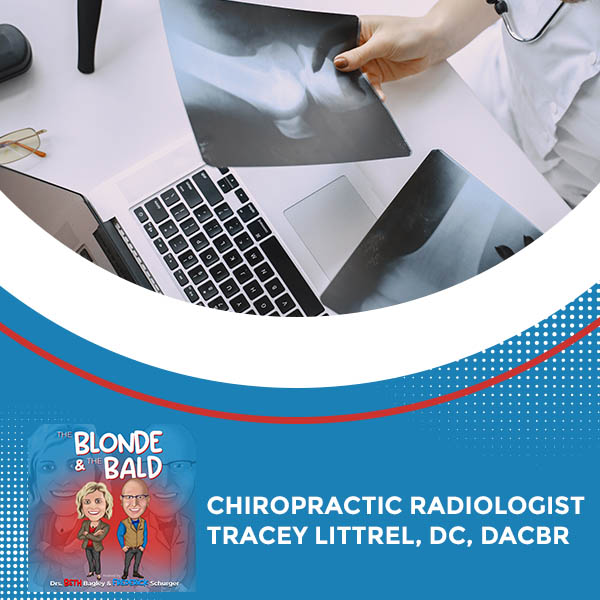
For her first podcast, Dr. Tracey Littrell joins Dr. Frederick Schurger and Dr. Beth Bagley to discuss Dr. Littrell's journey into chiropractic and then ultimately into academia and radiology. Dr. Littrell is a graduate of Purdue University where her future husband introduced her to chiropractic. With a newfound vitality, she pursued her chiropractic education at Palmer College and followed up with a residency in radiology. We take a deep dive that hopefully isn't too technical into chiropractic research, chiropractic education, and radiology that is used in healthcare to make better decisions for patients.
---
In this episode, we have Dr. Tracey Littrell, who has been our radiologist for the past several years, helping us out, trying to make sure that all these cone beam CTs that we take, we don't miss anything that's there because there's so much more information on a CT than there is on an X-ray, that needs a second set of eyes to make sure we don't have any problems. Dr. Tracey, tell us a little bit about yourself and your background. What is a chiropractic radiologist?
I am a chiropractor. It's important that your readers know. You don't get to be a chiropractic radiologist without first becoming a chiropractor. My background is like so many of us in chiropractic. When I was younger, I did not know that I was going to be a chiropractor. Events happen in our lives that lead us in a direction that's unexpected. Mine was not a lifetime but I had many years of low back pain when I was a pediatric and adolescent athlete, not having a lot of knowledge or experience and knowing that athletes are tough and put up with a lot.
I lived with low back pain. No one in my family saw a chiropractor. That wasn't on my radar at all. I went to college. I went to Purdue University in West Lafayette, Indiana to become a developmental psychologist. I wanted to be in healthcare. It seems like a different route but when you take care of patients, that's not the case. It's not a disparate field at all. When I was a student there, I met my now husband. His family went to chiropractors. He probably got tired of me talking about my back. He still married me.
I went to a chiropractor for the first time when I was a junior or senior at Purdue. I share the story with my students because it's important that they understand some of the psychology of the symptoms and symptom management that our patients deal with, even before they get to us. It was six months of care before it hit me that I was not afraid to bend over anymore or reach for something. This is mind-blowing to me because I was 20 or 21 years of age.
I'm going to sound so smart and insightful but I was not at all at the time. It took me many years to realize that I had become back pain and back pain was part of me where you have to own your addictions. I feel like back pain was not my addiction but it was part of my personality. It drove everything. As a young person, I spent an awful lot of time thinking about what I couldn't do. I can't do that because of my back pain.

Six months into care, it hit me like, “I'm not scared anymore.” I used to be so scared of being hurt because I had significant back pain. I changed my course and was like, “I want to do what you do.” I asked more about chiropractic. He was a Palmer grad. He said, “You have to go to Palmer.”I said, “Okay.” I trusted him so much. He changed my life. I wasn't going to consider going any place else. He had a phrase. He would say the oldest, the biggest about Palmer.
One of the reasons I'm telling this story is that I didn't know I was going to be a chiropractor, let alone a chiropractic radiologist. I was on a different route. Many years later, becoming a chiropractor and teaching at Palmer, I got to teach one of his sons. We were halfway or more through the term. This gentleman was talking about where he lived. He mentioned Lafayette and it hit me. He has a common last name. I never put it together that the last name I was seeing in this student was the last name of my first chiropractor. I have taught the offspring of the person of the man who got me into chiropractic.
It makes me tear up. When this student graduated, I accosted his dad as they were walking away from graduating. I don't know if you know or remember what it's like to wear a mortarboard but it's not good for your hair. I had my hair pulled back in this ponytail. I met him and his wife. I introduced myself. It is an alleyway between some buildings. I didn't think I'd get a chance to see him but I was able to tell him, “I got to teach your son. Here's who I am. I don't expect you to remember me but I appreciate the role that you played in my life.”
What you asked me is about how to be a chiropractic radiologist. When I was at Purdue, I was a Psychology major and also minored in Physics. Those go together like peanut butter and headlights. That was an odd pairing but I liked Physics. I wanted some additional science background. I give that as a basis. I got to Palmer. In the fourth trimester, we had Rad Physics. I could not have been more in my element.
I remember coming home to my husband and looking at this book of printed notes. I'm like, “Look at this. I'm going to be able to take apart an X-ray machine.” I could not have been more excited about the idea of this part of it but I still do not understand anything about chiropractic radiology. When I was in the fifth trimester, there was a national conference called the NCLC, the National Legislative Chiropractic Conference that's held in Washington DC every year. This is a chance for representatives from our state and national organizations to come together and lobby our representatives in DC.
As a student, I was able to go to this. We had dinner one night with a group of Palmer people. Across the table was a man I hadn't met yet, Ian McLean, for any of your readers who are certainly Palmer grads but in chiropractic, in general, would recognize that name. I hadn't had a class with him or met him yet. He talked about being a radiologist. That was another pivotal moment where I was like, “Not only can I be a chiropractor but I can also read X-rays.” From that fourth trimester on, I set my sights on being a chiropractic radiologist.
DACBR, for readers, is what we call a chiropractic radiologist. What does that stand for?
It's the Diplomat of the American Chiropractic Board of Radiology. Those are the initials of the designation. We put DC behind our names. Sometimes, people have other initials. DACBR is the indicator that this is a person who has gone through a radiology residency. Those are additional years of training beyond the chiropractic college education. Importantly, they have passed at least two other board examinations to be able to call themselves a chiropractic radiologist or DACBR.
I know some of them who have been in practice and become DACBs and some who don't adjust patients at all anymore. Do you adjust patients at all? Is your primary concern being the radiologist?
It is now. I was in active practice for a while. Both of you got some appreciation for this. When you own your business and you are responsible for yourself and many other people, it's hard to get away. Anybody in healthcare struggles to get away from the practice that they need respite from but to turn over that responsibility. I had the privilege. Even though I was in active practice when I went over into academia, I was part-time as a resident. I got to see patients. I was a staff doctor at the Palmer Clinics for a while.
Once I got out of residency, I did want to take care of patients but I didn't want that job to be full-time for me. Getting into the residency, getting into academia, and teaching physical diagnosis and clinical psychology, I got to do that for a while. There's a full-circle moment. I was going to be a psychologist and teach psychology.
I have been able through COVID and 2021 to do locums tenens work. For my area chiropractors, they sometimes would ask me to come in and cover a few days for them. I am not a grandparent but I feel like that's the best grandparent-like experience. I got to adjust people and do the documentation but I didn't have any of the other responsibilities of running a business.
That’s all the fun parts of being a chiropractor.
I feel like I have the best of the world to go in and take care of patients.
You're still teaching at Palmer College for a full course load.
I have a full course load. I'm in 2 physical diagnosis courses and 2 radiology courses. We teach physical diagnoses 1 and 2. That takes our students through the head-to-toe examinations, history, vital signs, eyes, ears, nose, throat, head and neck, and thyroid. Our second course takes them through the respiratory, lungs, cardiovascular, heart, and abdomen.
There are other courses that teach about neuromuscular skeletal testing, like reflexes and muscle testing. I don't teach in the NMS courses but I teach physical diagnosis. I have one of their first radiology courses called Diagnostic Imaging One. I get to see them. It's not their first Rad course but it's their first diagnostic Rad course. I get them for that. I also get to teach them for their last radiology course in the curriculum, which is chest and abdomen radiology.
You don't get to teach the physics.
I don't. I'm okay with that.
Having an engineering background myself, when I went through the program, I was like, “This is going to be easy and fun.” I said that when they introduced the right-hand rule. The way I learned the right-hand rule in engineering and the way they teach it in school are backward. Once you figure it out, it's like, “They have the body on a slab face up.” I still don't understand why we do it that way.
In many schools, there's an expectation for the professors to do research. Is there an expectation at Palmer?
There is. Let me back off that a little bit. We have a research center. We have faculty and staff, specifically in the research center, hired to do that work. Since the time I started at Palmer as a student, that research center as well as their grant applications and funding has risen. I don't know the numbers but I know that we, as an institution, are applying for grants. We're receiving grants from the Federal government but also from other agencies to engage in research.
We have staff and faculty that are dedicated to that. As an academic faculty person, I am encouraged to engage in research on the level of publication. It’s maybe not traditionally what we think of as research. I'm not performing interventions on controls or subjects. Not that kind of research is for me but my academic research category is to do publications like case studies on some of the interesting cases that come through my practice.
The stuff we're sending in for cone beam readings is like, “This is weird and different. This is something we should be pursuing or looking at. It would be a great place to start doing a research study.” One of the other things that people may be unaware of is that several years ago, a lot of chiropractic schools had their own research departments. That is not the case anymore. Palmer is one of the few that still has a fully staffed research department, which is saying something to Palmer for keeping that on board.
For the institution, it's a luxury to be able to pay people to do this work that's so necessary in our profession.
People like to think, when they hear about research in healthcare, that it's all figured out. That couldn't be further from the truth.
Are you saying the science isn't settled?
It isn't. There have been gatekeepers in the research field for so many years, chiropractic from even publishing or sharing what we found. They changed the rules at one point in time from what we had been doing, which is a more rigorous form of research. It's neat to see that we have that and we are showing that there is efficacy for what we do, as well as huge safety differences between what we do and what the medical profession does. For the best intentions sometimes, things don't go the way that we would like them to. In chiropractic, even the one failed study that didn't pan out the way they wanted to for blood pressure showed that for everyone who got a neck adjustment, there were no serious adverse events.
There's a positive when there isn't what they were hoping to see. Publishing is important. It’s like, “This didn't turn out what we thought but unfortunately, we don't always get to see the things that don't turn out.”
I agree with both of you. You propose a hypothesis and a prediction of what the outcome of the intervention will be. Sometimes, we convince ourselves that what we're doing will create a response. The research that counters our theory is as important as the research that supports our theory. If you're not in research, I feel like it requires a bit of a challenge and discipline to say that the message that you got is the opposite of what you thought it was going to be. It opens up other doors for us in research. I'm a firm believer that if a hypothesis is disproven, that is as valuable as the hypothesis for which we find evidence.
Are there any case studies or some things that you can think of that you've seen on some of your private clients or at school that are interesting, or the readers might find the information beneficial to them?
At the risk of sounding self-serving, my head is steeped in what I'm doing. Doesn't that sound self-centered?
That's to be expected.
I am privileged to be an assistant editor for a journal. I am a peer reviewer for ACC-RAC submissions, American Chiropractic College of Chiropractic Colleges. It’s a research agenda conference. Sometimes, I get asked for a peer review for other journals. I get a sampling of what other people are writing, and predominantly in the case studies.
The case studies are the base level. Those are what start us out and might eventually lead to a controlled clinical trial. That's a challenge but it might happen. In our profession, there's been more of an awakening and an invitation to publish what you're seeing in your offices, not just in academia or the clinic system but in the individual private practitioner's clinic. “What's happening in your clinic? Tell us about that.” I get to read a fair number of case studies.
I'm helping an author write about nutrition in incarcerated populations. This was eye-opening for me. How is that related to chiropractic? On the surface, it might not seem like it is. We talk about somebody who is of poor nutrition, regardless of the reason but specifically in an incarcerated population where cost-saving measures for the penal system are often reflected in poor food choices, a lack of the elements that are necessary, and fresh fruit. For those elements that we need in nutrition, they frequently get packaged food. It's not good quality and nutritionally enough for some of the incarcerated individuals to be healthy on any level.
This proposal for publication looks at the musculoskeletal influences of poor nutrition. How does that affect the patient who is the primary? How might it impact the way that we take care of patients? Here's an obvious one. If you have poor nutrition, your bone density isn't going to be as good as it should be. We all know that, as we age, we are going to lose some bone mass to some degree as a consequence of aging. When we have poor nutrition, that gets amazingly accelerated.
If you have poor nutrition, possibly your bone density isn't going to be as good as it should be now.
Think about an incarcerated population that might not get a lot of physical activity because they are confined, only get out of their cells for 1 hour or 2 a day, and have no opportunities to do weight-bearing activities. It opened my eyes to the cascade of poor health that comes from when you don't have good food available and you don't have the opportunity to maintain your muscle strength and bone health.
I never considered that before but it's eye-opening. Their brains aren't going to work correctly. You have to have nutrition for your brain.
There have been some studies and suggestions that, unfortunately, the way the food is given to institutionalized patients and people in jails and lockups is poor quality because it's based on the food pyramid and what the Federal government has been saying, “This is what we think is what it is.” They throw out a lot of the research saying, “No, you need so much protein. Animal protein isn't all bad for you. It's not going to give you all these problems.”
The question comes down to how much of these people's bad behavior came from the poor nutrition that has been around their lives throughout. They've made poor decisions to put them in there. It gets worse because they can't have choices of what they're going to eat. When we start thinking about brain chemistry, for acetylcholine alone, you need a precursor choline.
If people can't eat eggs for an egg allergy, they need to find some other way to supplement with that. Acetylcholine is one of the more calming brain chemicals that lets your brain relax. If you're wound up, why do fights break out? Why do people have problems? Why do people get extra time when they're in prison? They decided, “I didn't like that guy because I was mad.”
It could be that your brain is dysfunctional because of poor nutrition. I feel like my brain exploded a little bit. When you're helping with the author of a study like that, do you get to co-author? How do you get acknowledged in that process?
I'm thankful that you asked this question because there isn't one correct answer. What I've learned over the last couple of years is your role has to be established right up front. I've got a couple of case studies rolling around in my head and partially written down. I'm going to want help with them. The reason for me is I agree with everything I write. You have to have somebody else who's objective, who doesn't have the skin in the game, and who has less of an invested interest, and that it's published but still wants it to be published.

I'm a fan of co-authorship but I'm a fan of, before that ever starts, that you define what the rules are because there's a lot of misconception, and not just in our field, where a co-author might think that he or she is only going to proofread but the primary author thinks that they're going to be doing the literature search, going online, visiting libraries or getting interlibrary loans.
As an editor, I would not be a co-author because those are mixed roles. I need to remain objective and have the submission blinded to me so it can go through my review and that review of the other assistant editors. The journal that I am an assistant editor for is the Journal of the International Academy of Neuromuscular Skeletal Specialists. It's JIANM. We have a blinded peer review process. Sometimes, I'm one of the peer reviewers as I’m blinded to the authors. I run that through peer review.
I see all versions of it. I see single authors and multiple authors. What I hope is, before they have decided to put pen to paper or fingers to keyboard, they've decided clearly what role each person will play. That also is important in academia. This is a little bit of a side note. Primary authorship is weighted more heavily in terms of your promotion application. If you want to move from a probationary faculty member or an instructor who's passed probation, in terms of academic promotion, our next level would be assistant professor, associate professor, and full professor.
Primary authorship is vital to that progression upward. The secondary authorships, being second, third, and fourth authors, are also considered important. It sits a little bit lower in the basket. I'm glad that you asked that question because people who wish to partner together haven't thought ahead about who's doing what work. Some conflict can result because somebody had an expectation that the other person didn't.
I encountered this. I wrote the article and asked for somebody to review it. I intended to grant co-second authorship for that review but I was confident in what I had. We had a bit of discrepancy about what percentage it should be broken down. I thought that the peers with whom I wanted help were claiming a big slice of the pie. That's important. It is also based on a minor mistake that I made when I was a primary author. I didn't define the role ahead of time.
That crosses over lots of things but it's important.

If we're not going to learn that lesson, I'll continue to make that mistake.
We all do but expectations are in our heads. They have to be said out loud, whether it's a relationship or research.
You think it's writing a paper and there are so many other things going on if you don't say, “Let's sit down and figure this out.” Unfortunately, in the world of Zoom that we have had to live in the past couple of years, the conversation that you would've had about was like, “How much of you know this credit do I get and that credit that you would've had in person?” It gets lost a little bit, especially if they're half a world away and they're not in the same ballpark.
I've got a hard question. If you could wave a magic wand about the situation around research and change something, what gets under your skin? What would you change about the politics of doing research, funding, people, or the type of research?
In full disclosure, I do not work for the research department. I'm research adjacent. I want to promote research and publication within our profession and support my peers in all walks of chiropractic and healthcare who wish to get the message out. I'm not doing that grunt work of grant application, shaking hands, and kissing babies for the political side of it.
There is an awful lot of politics wrapped up in getting grant funding. I'm not feeling sorry or sympathetic to chiropractic. I believe that we've had a bit of a steeper hill to climb. Establishing the legitimacy of what we do needs further research. I acknowledge that. That's why we're not funded as well as some of the other professions in our research.
The other aspects I would like to change specifically within chiropractic, and I'm going to make a broad statement but I fully acknowledge it doesn't apply to everyone, is there seems to be a bit of an epidemic in practitioners who want to publish or talk about their cases. They want to use the word proof. They want to use case studies as proof of something as if one case study would then demonstrate to the rest of the world what some of us have been saying for a long time about whatever, whether it's about a technique, the need for X-rays, or the utility of therapeutic ultrasound, whatever the aspect might be.
As a profession, we have to be realistic. What we need is to build the base of the pyramid with many case studies. Those are put together to become a case series. We can eventually climb that pyramid to a randomized clinical trial. In our field of hands-on interventions, a true blinded or double-blinded study is nearly impossible. We have to accept. We're not going to reach a phase where we can do that out. Maybe computer algorithms and computer models could establish that.
Sometimes some of us want to publish because we are the defense against criticism that we've heard about our profession. If you find that personally motivating, that's good. We have to come to a comfort level of every bit of our experiences that we contribute to the public domain in terms of broadly called research but the evidence for what we do, whether we think it's a negative or a positive outcome, all of that helps build our future and support for what we do.
We've all been doing this long enough to realize that digital imaging alone has been a game changer in terms of the information that we get. If case studies become case series and more narrative research, I hope that we can recognize the connection and that we might develop computer programs that allow us to mock up an adjustment and see that intervention. I would like to take our ego out of our publications. When we're not immediately satisfied, we internalize that. We might think, “Here's the proof.” It's not about proof. It's about evidence and being as objective as possible.
Every case study is, at best, a data point. Everyone is going to get this one immediately. If you get on the scale, you look at that number, and you're unhappy with that number, write it down and walk away. You're not going to be happy with that number but you might be happy with that number. Do it again tomorrow and the day after.
If you are saying, “I'm going to track my calories and change what I'm eating.” You can weigh yourself on Friday morning after Thanksgiving but you're not going to be happy with that number because you ate grandma's pies. You say, “I'm getting back on my regular eating habits.” You see the data go in a different place. It is all data. A case study is a data point. A case series is a little bit better than you could say, “I've seen this trend here. This is why I want to put these cases together.” It says, “This direction makes sense.”
One of my favorite stories that I heard, and I don't know if this is true because I haven't been able to confirm this, but I was sitting in a sophomore engineering class and they were bringing in professors and interviewing them. They were supposed to give a presentation to my class. I remember the professor who came in and said, “Here is why calculus is important. The B2 bomber, the wing design looks cool and futuristic, and UFOe, was at an optimal for the first derivative.” If you understand calculus, that means it's at its peak.
The problem is they never did the second derivative. That's telling you whether or not it's the best peak or the lowest peak. In fact, it was the lowest peak. Science is interesting, and you can figure the stuff out but you don't have the data to do the math to figure out, “Is that a positive or a negative?” In this case, it was a negative but the Federal government decided, “We're going to put billions of dollars into that. Did you check the next thing?” I'm not going to say it doesn't look cool. I'm saying that there are better designs that could have been out there.
It looks cool. It was amazingly intimidating. Who didn't want to get in one of those things? I never walked up next to one of those but they're amazing.
I'd rather get into an SSR 71 and all of the technology that went into that thing because that thing is wicked crazy. The things they figured out were engineering feats but they were able to run data. We have years of engineering to figure out an airplane. Unfortunately, we have not had the scientific approach got lost after Dr. Palmer passed away. Nobody carried on the research for several years. We started saying, “Let's do some research.” There were no funds to do research by modern-day standards, which is huge.
I agree. Everything is about case study. People want to prove something. I joke about the immune study that we did. At the end of the day, I saw ten patients who all had an improved immune response after their adjustment. What can I say definitively? Odds are good. If I adjust somebody, their immune response is going to go up. I can say that. Dr. Bagley can't. She does the same thing that I do and I've trained her.

I didn't do it.
Doc, do you remember some of the fire back and forth and the criticisms of the Bakris blood pressure study?
I don't remember enough in detail. I'm certainly aware of it. I want you to keep going but a good example is the oversimplification of that because that was the title of the headline. Another example of our ego is that we have felt like we are not second place to other healthcare providers but fifteenth place. We're grasping everything that we see as a potential positive and owning it but we're also misinterpreting it. We're writing these inflammatory headlines about proof. I remember some of it.
I would go to a NUCCA conference as a non-NUCCA doc. I was like, “They're going to do it with toggle recoil.” They all laughed and were like, “That's never going to work.” I'm like, “You have no evidence that it's never going to work first.” There was one doctor who did all of these adjustments that brought these blood pressures down. At the end of the day, he was the best in that group of upper cervical docs.
I got on an elevator with him as we were going back up to the conference after lunch. My blood pressure went through the roof standing next to that man. The question becomes does NUCCA improve blood pressure or did Dr. Dick Holt Senior, because of his adjustment and his years of practice, do the job? We have to define that. Sometimes, the ego gets in the way. I was taught by him and I'm like, “Can you clear him out?”
It has to be repeatable. If it's not, we can't claim it as proof. I have a separate question. Both Dr. Schurger and I use CBCT in our office. You, as a radiologist, it's a newer technology for chiropractors to use. CT is not a newer technology for radiologists. What are the differences in visualization for you between a typical CT scan and a CBCT scan?
If you send a patient for a CT of their chest, abdomen, or spine, they are likely to go to an imaging facility and have what's called a fan beam CT. Fan beam CT, which is so nicely named in comparison to the cone beam CT, gives your readers a great idea of the path and the spread of the X-ray. Fan beam CT is quite a bit wider and has a higher ionizing radiation dosage. The consequence of that is it gives us great potential for fine detail.
Fan beam CT has some flexibility in the thickness of the slices. That sounds very aggressive but we're going to shoot this radiation through the patient. As we move the radiation source, we can image the patient in tiny slices. Fan beam CTs aren't the same for every person because they rely on the reason for the study. If I go to the hospital and they think that I have a bowel obstruction, they're going to do an abdominal CT and it's going to give us gorgeous detail of the organs, the bowel, the air within the bowel, and contents of the bowel.
It's also going to give me an excellent view of the vascular structures. It's going to take a lot of ionizing radiation to do that. If they think I have a bowel obstruction, it's appropriate but the abdomen is large. The slice thickness is fairly thick, maybe on the order of about 5 millimeters. We take a 5-millimeter slice. We have a small space in between with no slice and we do another 5 millimeters and another 5 millimeters.
On the other hand, let's say that I have lung cancer of any form. I'm being treated for that and monitored for it. There's a different version of fan beam CT where the slices would be much thinner. If we're trying to monitor a person's response to treatment of their lung cancer, it's important that we take skinny slices through the chest to be able to see if the tumors have grown or regressed.
There's a third order of a CT called spiral CT. In spiral CTs, instead of slicing the patient top to bottom or bottom to top with radiation, the spiral CT is literal. There is an X-ray source that truly spirals around the patient or the patient moves through the spiraling X-ray source, and there are no disruptions to the image. It's a solid exposure for the patient. If I had lung cancer and I was being monitored for a whole bunch of teeny tiny nodules, I would want, at least on occasion, a spiral CT. All of that is leading up to this. Cone beam CT offers us an amazing amount of detail but it does so with less radiation and in a manner that it can conned down to smaller body parts.
It's relatively new to the field of chiropractic but maxillofacial air specialists and orthodontists have been using it for several years. I don't know who we have to thank for bringing it into chiropractic. I'm a little bit ashamed but not globally ashamed of us that we didn't think about incorporating it a bit earlier because of the amazing detail that we can have with not just the teeth but as we focus on the occiput and the rest of the spine. There is a bit of a difference, as you too well know, in the technology. Cone beam CT is not as high resolution as spiral CT or the thinly sliced CT that I was talking about earlier. For the larger structures that we see in the soft tissues, the bony structures in the head and neck region, it's appropriate.
I was talking with one of the manufacturers of not the cone beam that we necessarily have in our office but one that is a little bit more advanced. There's certainly a little bit higher dollar as far as what they're doing but they've been doing one that moves up and down. They figured out, “I can splice these together.” They're figuring out that they can do a much larger array and do the whole body. They're figuring out how to do that.
Once that happens, we're going to see so many changes both in orthopedics and the regular chiropractic field almost immediately and overnight. It's going to be exciting when those changes come in. We have Dr. Jake Hollowell, who was over in Italy when he figured out that cone beam CT would work for what we're doing. He is our pioneer in this work but we've been slowly incorporating it into the Blair offices throughout the country as well as other upper cervical practices. It's exciting to see where that's going.
You brought up a good point about ionizing radiation being significantly less, depending on how you parse the data. I've seen some different studies that even a regular X-ray series and modern X-ray technology are still much better than it was many years ago. I want to get your take because there seems to be this back-and-forth about all ionizing radiation being bad. There seems to be this new approach that suggests we shouldn't get too bent out of shape about when we need to make a clinical decision. Let's get the imaging.
I love the field so much that there's an inherent bias to me, in my opinion. I love X-rays and imaging. I lean towards the pro imaging because I get to see the value of it. On the other hand, I have the responsibility to guard it to make sure that the use of it benefits the patient and whomever the doctor is or the healthcare provider that they see, chiropractic or otherwise, that it is the best fit for the patient.
I was talking to somebody. He works in a hospital system. This was a conversation not related to imaging but he was saying that he virtually never sees X-rays anymore because, working in the hospital system, they might take a chest X-ray but they tend to go right to CT or MRI for predominantly musculoskeletal concerns. I get it if you're in a hospital and you have both of those techniques. The CT and the MRI are going to offer us so much more detail than we can get with an X-ray. His point wasn't that X-ray is bad. It's that he has gotten out of the habit of interpreting those because they're almost always going right to the advanced imaging.
I feel like this is an extension of our conversation about research, where we want to take the answer that fits what we need first. We want to support that answer. Here's what we'll find. In our profession, there are some who want to X-ray every single patient. Therefore, they will find a clinical rationalization for that. There are others who skew the other way. There's no need to do imaging. They're both wrong, to be blunt. There's no reason to take an approach to everybody getting an X-ray or no one gets an X-ray.
If I substitute different procedures, everyone gets a laminectomy and no one gets a laminectomy. We have to be reasonable between. That ionizing radiation has been vilified on many levels and sometimes appropriately. When it was the only tool that we had, we probably overused it. It’s us in healthcare, not just chiropractors. The response to that by some has been, “If it doesn't give us what we need and it doesn't impact the care of the patient, we shouldn't do it.” That's a reasonable approach to this.
This profession and others operate in the extreme of always and never. The judicious use of ionizing radiation is the purview of our profession and others. Don't feel bad about taking it if you think that it's necessary. Why would you think it's necessary? Your education and experience tell you that the entity, condition, and diagnosis that you're looking for will either be confirmed or excluded by taking the X-ray. Substituting anything else in it will be included or excluded on cone beam CT, MRI, or colonoscopy.
In healthcare, we've probably overused ionizing radiation. For those of us who aren't in a hospital system, sometimes we're a bit naïve about how much ionizing radiation patients get because they're seeing other providers. They're getting chest X-rays from their pulmonologist and hand X-rays from their rheumatologist. They're going to a walk-in clinic for suspected fractures. If our patients have chronic illnesses or malignancies, repeated CTs and chest X-rays are the norm.
What I've got my students to do is don't be naïve. What you are going to do with a patient by taking an X-ray might be what is necessary. To oversimplify it, say, “They've crossed my threshold and I'm going to take X-rays on everybody.” That doesn't serve the profession or the patients well. I'm not anti-ionizing radiation. I feel like the pendulum is back in the middle. It's not an all-or-nothing anymore. You know that digital radiology has helped us significantly.
Don't be naive. What you are going to do with a patient might be exactly what is necessary.
This has been the evolution of radiology in general because when B.J. Palmer bought the second radiology machine in the world back in 1910, it was a low-frequency, high-dose machine. I knew a doctor who had one. He would take a couple of pictures. He had to give it away and say, “We're writing this off and chopping this up. It's junk.” I saw two of those in my time in practice.
The one that I have, which was a modern X-ray since the ‘70s but certainly the ‘80s, as the technology was advancing, was a high frequency, low dose machine. Digital has taken it to the next level. The cone beam is taking it to the next level. As technology progressed, when people would go to the shoe store, they put their feet under the fluoroscopy thing and hang out there. They'd burn out their toes because of the radiation dose they had.
I'm glad that's not like that anymore.
There are things that we did. Somedays, I want my flip phone because it would be a whole lot less annoying than this thing. There are a lot of benefits to an iPhone. Some would argue that mine is an archaic piece of junk because it's a 7 instead of 15. Yours tracks you better.
Dr. Littrell, thank you so much for coming on. I feel like I want to go back in time or make myself younger so I can go to Palmer and be one of your students. We could talk for four hours but we won't keep you all day.
I feel the same. You come to my lectures and I'll come to you. We should hang out. We're going to keep bread out of it. This is you and me.
First of all, is there anything that you want to convey to the readers? Second of all, one thing you could give, like a little piece, why it's amazing for someone to come to Palmer and be a student there.
We should have confidence in what we do. I hope every person out there who's taking care of other people has confidence in the decisions that are right for them and their patients. Not to oversimplify but when you're following your head, you’re teaching your experience, and you value that, and you're not second-guessing yourself, you're most likely doing right by that patient.
We should have confidence in what we do.
An offshoot of that is I've learned that the older I get, I have pride in myself and my work. The beneficial part of that is not having too much pride to admit when I'm wrong and not admit when I need help. I would hope that your readers don't get their pride wrapped up in that. It's not an aid to the patient to seek out help.
In healthcare, we're leaders, doers, or fixers but we think we have to do that all ourselves. I couldn't do what I do without having a team around me. A lot of it I do by myself but it is with the support of my family and coworkers. We need to spread that message a bit more. As far as Palmer goes, I'm Palmer loyal. It's a place that I've made my home. I am proud of Palmer. It’s the advances that we made in a long time but a relatively short time that I've been there.
I am very impressed with our academic rigor and continue to do so. With the support that the administration has given us, we always have a little pushback. We have the technology that we need. We are progressive. In some ways, our IT and Center for Teaching and Learning are pushing the faculty to be even more progressive. We're being driven by those who support that technology.
My heart is at Palmer and I am proud to be a Palmer grad. I have clients who graduated from all of our chiropractic colleges. I have pride in all of us. I will not be one who would ever say, “You have to go to XYZ school because that's the only place where you will flourish, grow, or blossom.” For each person who may be considering becoming a chiropractor, you have to find the best fit. If it's Palmer, we're going to welcome you with open arms. If it's Logan, they're going to welcome you with open arms. You have to find the place that fits best for you.
I want you to plug your website so doctors who are reading can find you and start a relationship with you. They can get better reads on their images.
I have a boring website name. It's my last name. It's LittrellRadiology.com. My email is DACBR@Me.com. Fred, I'm an Apple user.
I know it. Same here. I am 100% with you on that Mac stuff because they work.
Dr. Fred, where can they find you?
I'm at KeystoneChiroSPI.com and all the socials in Springfield, Illinois.
I'm in St. Louis, Missouri, PrecisionChiropracticsSTL.com. Dr. Tracey Littrell, it was amazing having you. Thank you so much.
I'm so honored. You are my first interview. You may be my only ever interview.
You'll get called into others. It happens. We'll be back with another episode. You have a great day.

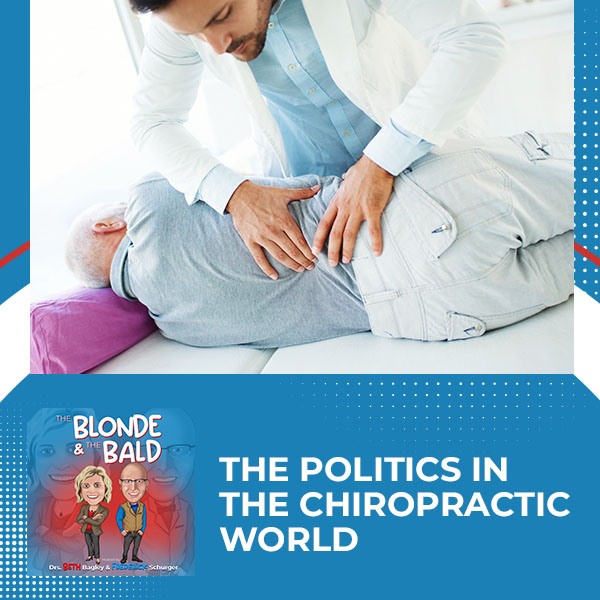
Have you ever wondered why chiropractors and medical doctors don't get along? The answer is much deeper rooted in the political world than you think. In this episode, Dr. Frederick Schurger and Dr. Beth Bagley cover some of the political landscape around Chiropractic and some of the common misconceptions that have been going on over the years. It’s high time to put these again to light, as some of these political issues are still ongoing until today. Tune in and learn what’s going on in the political world of medicine and chiropractic.
---
We are going to go over some interesting ideas and topics. Don't run away because I'm going to say it. We are recording this about a week after all the elections. We are going to talk a little bit about politics but not be political. It is important. It is something for people to understand a little bit about where chiropractic came from. Your grandfather probably went through some things back in the day.
This goes to the state that our world is going through for whatever reason. People don't understand why some people are so passionate about where the world needs to go. Let's back up. Let's talk a little bit about the politics around chiropractic, going back to the 1910s to 1920s when chiropractors were being persecuted for practicing medicine without a license, even though they weren't practicing medicine.
I had a patient ask me, “Why do medical doctors and chiropractors not get along?” I was like, “That is an excellent question but the answer is way longer than I have to talk to you about that.” The truth is it is not true anymore but there was a time when that was true. It was about misinformation. There was a campaign of misinformation.
There were multiple levels of this throughout the years. I mentioned it before but there was a time when there were chiropractic schools as far as you could throw a stone from one school to the next sometimes. There were also medical schools available throughout the country. Now, if you have more than about 2 or 3 medical schools in a state, that is a lot. Some states have more than others, certainly. There was a big change in what was being accepted for medicine. We could go back and forth and talk about Rockefeller but I don't care to. Quite honestly, that is another rabbit hole we don't have time to get into.
Books have been written on that subject.
Back at the turn of the century, there was a large push for medical doctors to try not to have chiropractors get their sick patients because prior to antibiotics, that was a big thing.
As we go through this, know that we were not attacking a medical doctor in 1918. I'm not attacking them. This is what they were taught to do. They were taught to do this in medical school because of the influences of why you were talking Rockefeller but influences of big pharma. It became big pharma all the way starting back then. That was real.
It became a standardization of things. We talk about what is the difference between chiropractic and medicine. It is a field of study that is even separate from something like osteopathy, although osteopaths and medical doctors look very similar in what they are doing. This continued. There was fighting but it wasn't bad until about the 1960s when the American Medical Association made a big push to eliminate chiropractic from the landscape.
That is why the schools did a hard push to say, “No, if you are associating with chiropractic, it is a cult. Chiropractors are this side of the devil. If you associate with the chiropractor, we are not going to give you your hospital privileges. You are not going to have good standing in the community.” They would run out of medical doctors who were siblings to a chiropractor. It was a big issue.
As things go, it wasn't a conspiracy theory. It was real. Wilk suit started in the ‘80s but continued into the ‘90s. My brain says 2001. There was still something going on. It has been a while since I have looked at that but certainly, it started in the ‘80s going into the ‘90s. They had realized there was an active campaign by the American Medical Association to eliminate chiropractic. Thankfully, some people were whistleblowers at that time. For those people who wanted to do a deeper dive, that was Wilk versus the AMA.
The only sad thing is we have a situation where chiropractors and medical doctors still have this. There seems to be this disconnect that is slowly being healed. There is not necessarily an active engagement with chiropractors in medical school unless they reach out from time to time. The flip side of that is even worse. I was talking with a medical doctor who is a patient of mine. She is into functional medicine.
We were talking about the A4M Convention, which is a functional medical meeting that brings all sorts of medical doctors, other doctors and health practitioners into the same room to talk about stuff that is beyond your normal medicine. People don't understand that when they get their labs done and I have said this in other places I might not have talked about on the show yet but there is a range that people go that you fall into that is the “normal.”
The problem is all the people that they are doing medical tests on are sick people. You have the standard deviation or that old bell curve they talk about, within two standard deviations of the people in your community who are getting tested for red blood cells. Anyone underneath the standard deviation twice, which is the end of that bell curve, is sick on either side of the spectrum. Everything in the middle is normal. That is a mathematical term that doesn't translate to what is healthy. Functional medicine looks to a much narrower range that might shift one way or the next that says, “You should be in this range to be functionally well.”
I love this idea. It is great for everyone to understand this better because what is healthy? What are you doing on a day-to-day basis that will make you better? Is it 10,000 steps a day? Is it drinking half your body weight ounces of water? We could go down the list. I love to go to the A4M meeting someday because I'm a numbers geek and I'm fascinated by this stuff.
The problem is we have chiropractors who want to do all of this functional medicine stuff and some of them are doing it well. I hate to say bad things about my colleagues but they don't know how to adjust. if they knew how to adjust like we know how to adjust and get people, they probably wouldn't do the functional medicine because they wouldn't have time.
You and I have both had busy weeks seeing lots of patients. I sat down with one guy at his cholesterol and I said, “Here is your problem with your cholesterol. Retest this in three weeks. It doesn't take a whole lot. Stop eating the bun at McDonald's. Stop eating the fries. Get a bunch of burger patties, have a good time with it and you will be fine.” I know that sounds weird with cholesterol but that is a story for another day. I love this stuff but I rather adjust you, get your body working and tell you, “Don't eat that piece of junk food. It is almost that simple.”
We recorded this back in November 2022, right before Thanksgiving. What does being a chiropractor mean? The things we are trying to protect some of our rights were simply being able to take an X-ray. You are getting your cone beam installed, which is a CT but it is technically an X-ray machine. In some states, they are still a little bit fuzzy on letting us take or utilize a device like this, even though we have been using X-rays since the dawn of the profession.
Even in other countries like Canada, if they are not close to it, they have already taken away X-ray rights in some provinces.
They have had trouble. We want to make sure that doesn't happen here in the USA. We want to make sure that we can physically take a picture to see what is going on with the person and how they are built because it makes a huge difference in how we need to get them adjusted. I had a patient. Her kids have been under care for a while. She was like, “I don't like anyone adjusting my neck.”

She has been seeing a regular chiropractor for a while and she is seeing the kids doing great. She was like, “It is my turn. Come on, Doc. Can I get in this week?” I said, “Sure.” She feels better already. The best part about that one is I put her on the balance scale. She was 20 kilograms off. It was a lot. Afterward, she was within 6. She was like, “I feel straighter.”
You measure people in kilograms, for real.
I do and there is an important reason. Beth, how much do you weigh in kilograms? Do you know?
You are saying, “It is because we don't worry about the weight.” I see what you are saying. You are probably correct. I'm going to try that out. Thank you for that.
Quite honestly, it is because my scales, when they power up, they start up in kilograms. There are two reasons. One, I can be lazy, not have to try to go through it and reset it every time. Two, you don't have to think about the weight. The difference should only be about 1.4 kilograms.
For someone reading who has no idea why we are doing a bilateral weight scale is because your two feet should carry equal weight on both of them when you are standing straight. What happens is someone's leg will start pulling up but you can't stand on a floating leg. What happens is you put more weight on that leg and 20 kilograms is quite a bit.
It was a lot. She was having neck and arm pain but no low back pain at this point. She had it in the past. This wasn't a thing going on at the time. She had adapted to it. I told her, “With this change, she might have some low back pain on the opposite side coming on.”
It tries to rebalance.
Getting back to politics and where chiropractic starts, I don't want to infringe upon a medical doctor. I got some supplements here. Half the reason I carry the supplements I do is because I take these supplements. I get a better discount. If people want them, I send them to a place where they can get them online or buy them from me. I like these things and I play in that functional space for my health. I don't want to infringe upon my medical doctor friends who are going to deep dive. They have the time to spend with a patient to appreciate these things.
This is where I want to be able to protect my rights as a chiropractor doing what we do, not have somebody else trying to do what I do. Whether it be a PT, MD or osteopath, we all can play a role in improving people's health because we have to be responsible for ourselves. The other thing is I don't think people appreciate that they need to be responsible for themselves. They want to give it to somebody else. I was listening to Jordan Peterson and Russell Brand.
Chiropractors like playing in that functional space for health, but they don’t infringe on their medical friends to do the same. This is among a chiropractor’s rights that deserve to be protected.
I watched part of that. I didn't watch the whole thing.
The fifteen-minute video or the clip that I got was interesting because Jordan Peterson is talking about how Moses took the Israelites into the desert in Exodus. One of the things that people around him, I think it was his father-in-law, noticed how much he was being worn down because all the people were coming to him to solve his problems. He ended up being effectively a mini Pharaoh in the desert. What he did is he said, “You need to make it smaller. People can solve their problems at a smaller and more centralized level instead of these hundreds of thousands of people that he had brought out into the desert.” A group of ten can figure out what they need to do to solve a problem a whole lot better than anything else.
Jordan goes on to say, “What do you need to be responsible for?” He was like, “You need to be responsible to your spouse. You need to be responsible and have a job to make a healthy wage. You need to take care of yourself. You need to stay healthy and fit as part of this. You need to have a family. You need to engage in your civic organizations. Join your business organizations and a political party. All of these things are very important.” This was the point he made that I thought was amazing. He said, “Every bit of social responsibility you abdicate will be vacuumed up by a narcissistic tyrant.”
That is where we are at.
People don't appreciate this with their healthcare. This is the beautiful thing about us as chiropractors. We will not take responsibility for your health. We will help guide you along this path but it is not your responsibility to make sure that I'm as healthy as possible. If I show up at your office for a seminar, I might say, “Check and adjust me.” We go down and eat a copious amount of McDonald's. I hate to harp on McDonald's. Maybe I should harp on Arby's. It doesn't matter. Wouldn't that frosty be awesome?
People don't appreciate this with their healthcare, but when you abdicate your own health to somebody else, chiropractors will not take responsibility for your health.
No, I can't imagine. My stomach hurts thinking about it.
It tastes good in the mouth but the rest of the body doesn't love it. I got at least one frosty right here.
I tell people, “If you have a stomach ache. It might be your body is out of alignment or it could be that you eat Doritos all day long. I can't adjust away the Dorito habit.” There has to be an aspect of personal responsibility, whether it comes to your healthcare or the world.
The worst part is if you get yourself far down a path, you have to go down the medical route. There is a time and a place for it. If you have to go down that medical route, how much do you trust the hospital system that you are going to get stuck in that is being run not by the medical doctors but by lawyers and bureaucrats that have more interest in their bottom line than your health and wellbeing? It is pretty scary stuff.
One of my goals with my patients is to keep them out of that system. I don't want you in the system. If you have to be there, I love you and l will pray for you. I will still help you in my office. My goal is to keep as many people out of that system as possible because it leads to one drug, another drug, surgery and another drug where we can solve so much by being in proper alignment, having proper nutrition, enough water and moving our body.
It is great when it is there because I had a patient who had her third child. It was a seventeen-hour labor. Anything longer than about 4 to 6 hours is considered traumatic labor. She had to get induced. They had to give her some Pitocin. She had some additional bleeding afterward. They sewed her up and fixed her up so that she didn't die because it wasn't long ago that women would die in childbirth. This is where the medical system is great. That is their job to fix you when you are in that acute situation. She was so happy to get her head on straight. She was like, “Doc, I went through too much. Put my head on straight so I can take care of my baby.”
It is incredible to see that change. We take care of a lot of pregnant people in our office. With these women, I do see better outcomes with their pregnancy than typical. They talk about their sister. The laborers are short. I calmly tell them. I was like, “If you want to have this baby in the hospital, know that being under care, your labor could be shorter than you are used to than your friends are having. It is a good thing but you need to go to the hospital and get checked out first.
Every now and then, you want the best possible situation in those where you love to have a home birth and no drugs.
That is up to each mom.
Sometimes that works out fine. Other times, you got to go to the hospital. You need that level of healthcare. This is understanding where the different specialties where those of us who are doctors, whether it be a medical doctor, chiropractor, osteopath, peds, gynecologist, you name it, we have roles that we are trying our best to do. We don't want to cross over those roles. That is the extent of where we should end on the politics side of things.
People need to know that there are different specialties where doctors have different roles, and they don't want to cross over those roles.
Do you have any case studies or any miracles that have happened in your office? I got one and I want to talk about it.
Why don't we talk about yours? I have been talking too much.
I saw her for her second appointment. She came in with several years of chronic headaches. Someone referred her in. It is a family member. She got her first adjustment. She said she realized and wondered if this is how normal people feel. I said, “Yes, that is how normal people feel.” She didn't have a migraine or headache. She felt good. She had energy. She got two littles at home. She was able to take care of them and be the mom she wanted to be.
The simple answer was she needed her head on straight and it wasn't. I feel incredibly blessed that I was able to help her, give her that chiropractic adjustment, that Blair adjustment and get her back on track with her health. She got checked. She only had 1 of the 2 vertebrae out that I had to adjust. She didn't need another adjustment but she felt like she did already. She may have overdone it a little bit because she felt good, which I didn't warn her about. I try to tell people, “If you feel fantastic, still don't go crazy. It needs time to heal.”
What most people don't realize is that you can't just go. Those people who have that miraculous change in the first 24 hours and sometimes even less are the ones who need to take it easy more than everybody else. If they push far too fast, it overwhelms the nervous system. We might talk about my kettlebell training routine another time because it is pertinent.
It is interesting. The Russians have figured out physiology better than the rest of us. All the research going into things like heart rate variability and nervous system, the Russians were doing it years ago, knowing how hard they can push, especially their athletes, which would translate to their soldiers. Neurologically, what they could do and when they had to break, pull back to address things. It is curious.
We may talk about that another time simply because it is interesting to think about how that translates. This translates to how hard I can train for the course of six weeks. At the end of that, what else is going on? How does that translate to someone's healing ability through their care and what they can and shouldn't do right off the bat? What we don't know is, conceptually, what is healing. Is it healing of the physical organ? Is it the body as a whole? How much of it is the nervous system trying to catch up and trying to fix everything else?
We could imagine a home renovator being overwhelmed down in Florida with some of those floods and the hurricanes that have come through and how hard it was for them to clean out a house and rebuild it. They can do that with a road within about 2 or 3 weeks that were decimated. I find that it can happen that fast. If only roads in Illinois got repaired that quickly. Missouri might have some better roads.
They are better. I hate when I'm driving to your office. I'm in Missouri and I'm driving across the bridge.
Hopefully, that is going to get all fixed. They have been working on that forever. Those are the big highlights of this episode.
We covered a lot. We got some good information and some wheels turned in on. People say, “Why haven't I heard of chiropractic before?” It is because, for years, it was suppressed. I'm glad to bring it up and at least have conversations around that.

The other side of it is for people to understand they need to be responsible for their health. You cannot help them heal and not go down the road to eating all the junk food. It is like you said, “You can't adjust out of a Dorito habit.” I like that. Dr. Bagley, that is going to call it for us. Here is the crazy thing. You and I are going to see each other after this. We may try to do a recording.
We should do an in-person one.
We will bring some mics. We will see how the audio works out. If people hate it, that is because we are playing things fast and loose with some hardware. We are going to try that with a couple of student doctors that are learning the ropes of this so they can share some of their experiences as well. People appreciate that more.
You can find me @PrecisionChiroSTL. I’m in St. Louis, Missouri.
I'm at KeystoneChiroSPI.com. You can find me in Springfield, Illinois. Thank you so much. We will see you next episode.