
Beekeeping adventures, breast thermography insights, and some unexpected laughs – this episode has it all! Dr. Frederick Schurger and Dr. Beth Bagley dive into the world of bees by exploring the challenges of harvesting honey (and avoiding stings). They discuss how “no pancakes” isn’t just a quirky title, but a nod to lighthearted distractions and deep conversations. Dr. Bagley opens up about her experiences with breast thermography as an alternative to mammograms, while the duo tackles realistic healing expectations for those with degenerative spine conditions. It is a mix of humor, health, and community stories that will leave you buzzing!
Listen and read the full blog post here
What's a nap worth? What's the ideal nap time to recover from your day? Why do we have you rest after an adjustment? These questions were examined and answered today! We also dive into the intricacies of Blair Upper Cervical Work and why more doctors don't do it.
Listen and read the full blog post here
Chiropractic care can be a controversial topic, and some online communities have strong opinions about it. Let's take a look and see what kind of discussions are happening on Reddit on Chiropractic Care. In today's conversation, Dr. Frederick Schurger and Dr. Beth Bagley sifted through the threads to find the truth about chiropractic care. Both doctors agreed that chiropractors need to be mindful of potential risks and refer patients to other specialists when necessary. There's a generally positive attitude towards chiropractic care within the Reddit community. We found the discussions to be interesting and perhaps even surprising. Join Dr. Beth Bagley and Dr. Frederick Schurger to sip more hot tea on chiropractic care.
Listen and read the full blog post here
There are some cases that walk into our offices, and we know they’re going to do great. And not just great, but we can almost see how fast they’re going to get better in the consult. It may look like magic when we do it, but the reality is just that we’ve seen amazing transformations happen like this all the time. Because what we do simply works! We also cover what is called the 3 T’s that lead to neurostructural shifts: thoughts, traumas, and toxins. While trauma may have started the loss of health process, we cover how your mental attitude and chemical situations (often “food”) can just as plainly affect your health.
---
Welcome, everyone, to the show.
How are you doing, Dr. Schurger?
I'm doing excellent. I had a great idea for the show and we're going to do it. We're going to talk about cases that always respond well to care. Some people do not respond well, but generally, they almost always respond well. You're sort of excited to see it because you know it's going to happen.
I'm sorry I'm excited about you not feeling well because of whatever is happening, but I know that you walked in the right door. Usually, they understand. Sometimes they think I'm still a weirdo and that's okay because I am.
We qualify as that because we keep on saying, “There's a little bone underneath your head, and if we fix that everything is going to get better.” Case in point, I had a crane operator come in. He's been operating cranes all his life. He called me on Monday. He was like, “Doc, I hurt my back.” He chopped wood and split wood on his weekends and did something, twisted wrong. Three weeks before, the twisting wrong got his lower back.
Three weeks before, he wakes up with a crick in his neck. Professionally, he needs to look up all day long. As we went through it, he had other injuries and accidents throughout his years. A motorcycle accident when he was very young. I'm like, “I think we're going to get you better.” We got him adjusted immediately because it was his atlas. This might be one of those qualifiers that's because when it's one level, it was a simple misalignment, at least simple by our standards.
By our standards because we see some stuff.
It was his atlas. We get him adjusted and I have him walk around a little bit. He looked at me and was like, “This is real?” He questioned his own senses. After I had done my paperwork check, I watched him stand up to get up out of the front chair with the armrest and his low back caught him. I'd been there. Afterward, he's like, “Doc, this feels awesome. Thank you so much.” On top of all of that, he comes in for his follow-up checkup and he says he slept awesome.
That is such a common thing after getting an upper cervical adjustment. It is some amazing sleep. You wake up almost in the same position you fell asleep in and you wake up refreshed. When you haven't been sleeping well and you get that night, it's amazing.
The last time that you adjusted me, that hour nap or whatever it was, at least it felt long to me. I was like, “We're three-quarters of the way there.”
That's all sorts of stuff going on. You're not one of them, and I'm not either one of those people that doesn't have an uncomplicated misalignment. We've both been complicated.
I used to be and then I decided to get into a couple of car accidents. I like to train and sometimes push myself. I don't push myself through the stupid anymore.
That's smart. I think one of the ones recently that I've had come in, it's a couple of different patients, but one in particular I'm thinking of, has what I call the spot. The spot is not as much the trap but is part of the trap, but a little bit behind the top. It’s this knot that comes on and it's this searing, unrelenting pressure pain that happens.
No matter what they do, they put a tennis ball, hold it, and have people dig in it. It keeps coming back over and over. It feels good when you're pushing on it, but you stop and it hurts again. When I see that, immediately I always look at C2. That doesn't mean it's always C2 because sometimes it's C1, but there's an upper cervical connection between what's happening in the trapezius muscle and the spinal accessory nerves.
That's one of the nerves that comes out of the cranial area and it is affected by the upper cervical spine. When I hear that someone has the spot, I get a little like, “Yee,” because typically, they don't feel better right after the adjustment. About a day later, it starts melting away. I do warn them that it doesn't instantly fix it because it doesn't.
There are some things where we get excited as upper-cervical chiropractors because we see some changes immediately. Some changes take time, some changes take weeks, and some patient changes take months, but for certain things, we typically see changes like this one isn’t about a 24-hour period where they can see a change in that. I pretty much know right away when someone has that, “We got this.” A lot of times they have other things going on too. That's one that I can think of as the trap spot.
Some changes take time. Some changes take weeks or even months. But for certain things, we typically see changes within 24 hours.
A lot of it's that and a lot of it almost feels like it's right between the shoulder blades. They've gone to other chiropractors who say, “Doc, it's here. Work on it down here.”
That's what they want us to adjust low.
Quite honestly, sometimes that's chasing tails.
Just like putting pressure on it. If I massage that muscle, it does feel better but I'm not going to keep massaging that muscle over and over and not get to the root cause. We have to get to the root cause of why that muscle has this giant trigger point in it.
I've got another patient who is not an easy case. She doesn't fall into this category. I will hold her head and move her where she says, "Doc, it's right here.” I'll get right in there and maneuver her atlas into a position where she needs to go. Her head goes up straight in complete relief. I tell her and then she says, "Doc, follow me around for the rest of the day like this.” There are days I've been tempted because she is that tricky of a case to try to figure out like, “How do I get that adjusted so it unlocks.” Knock on wood, there's some wood right there, she hasn't been in a while. Unfortunately, we talked about her so she'll be calling.
That's so true too. I had that experience. It was a patient I hadn't seen in a while and I thought, "I wonder how she's doing?" I was like, "I haven't seen her. I hope she's okay." She was on my schedule in the afternoon and I had no idea. It was one of those things that we can psychically pull them in.
Talking about cases, this one I would consider a complex case until she filled me in on what she's been doing for the past year. She showed up a year and a day ago. It was the last time she was in. That was 362 days because it was a leap year. In any case, she says she's been doing well, but what did she do? She took a medical leave from work. She's been doing all sorts of fun stuff she's been looking for.
She's gotten a couple of medical procedures, including getting her iron level up to where it's supposed to be. I looked at her and I was like, "You've got great vitality. What have you been doing?" Sure enough, aside from getting a couple of proper medical diagnoses and treatments, the biggest thing for her was getting away from work and all the drama and stress that she had at work.
Unfortunately, she's going back here for a couple of weeks. Folks, if you've been going to your chiropractor time and again and they're helping you but not enough, you might need to take a step back and take a look at the rest of your life to see what else is going on because that might be the extra little oomph you need.
If you've been going to your chiropractor time and again and they're helping you but not enough, you might need to take a step back and take a look at the rest of your life to see what else is going on because that might be the extra little oomph you need.
In chiropractic philosophy, we talk about the three T's. What you were talking about is the T is thoughts. What is the emotional stress? What's emotionally draining in your body and all three of these T's that we're going to talk about is what causes your body to go out of normal function and misalignment. What can cause a structural shift in your body?
If I met someone who is going through emotional trauma, one of the things they'll do is they'll hunch forward and protect their body. You'll see that like an emo kid. An emo kid has the hair in their face and then they hunch forward and they're like, “I hate everybody.” They're in a protection posture. That protection posture is an emotional trauma. There is emotional stress that's happening in their body. Emotional stress causes structural stress and misalignments.
The second T is the actual trauma. If you got hit or rear-ended by a car or if I take my phone and I hold it like this over and over again, that's a repetitive trauma. If you put your phone between your shoulder and your ear, and you hold it up with your shoulder, those repetitive traumas can cause misalignments. That's something that patients don't realize they're doing. They could be doing something every day at work, or their computer monitor is too low, or they're using a laptop and they're hunched forward over it and typing on a keyboard attached to the laptop.
I don't mind if you're out and about and you need to use your laptops temporarily, but if you're using a laptop on your actual desk, you need to have a detached keyboard, a detached mouse, and you need to have your laptop up on a stand so that your screen is even with your eyes. That's what we do at our office or at least we do now because we're hurting ourselves leaning forward over a laptop. The third T is toxic stress and that's the stuff that we are in and around and consume. If I drink Pepsi every day or a diet Pepsi, either way, that's a toxic stress whether it's a sugar overload or it's a chemical SHIT storm.
Also, if you decided like you did a couple of weeks ago right after Easter to eat all the stuff, and then realized, “I ate all the stuff. I feel horrible,” switch back to keto, and all of a sudden, everything cleans up immediately. I had one young lady saying, “Doc, I know the storm is coming through today. I can feel it in my joints and my arthritis.” She's a massage therapist and I told her, "If you want to get it better fast within a week, cut out the wheat. You cut out the sugar. You cut out the seed oils. Even if you cut out one of those three, you'll notice a difference almost immediately.”
If you want to get better fast within a week, cut out the wheat, sugar, and seed oils. You'll notice a difference almost immediately.
I was talking about water to a couple of patients and I did a health talk to a bunch of teachers. We talked about water, and I know everyone is tired of hearing about water, but one of the ways that if you're increasing your water is I take a big bottle. I'm holding a 32-ounce bottle. I try to drink three of those a day. Four is good for me, but three, I feel like I've done a good job. If you put a full bottle of water next to your bed, if it’s a big bottle, you drink half of it when you first wake up, do your business, brush your teeth, all the stuff. Before you get into your car, drink the second half of the bottle.
That's a good idea.
Fill it back up with your filtered water, so then you have the second bottle that you're supposed to drink during the day. If you feel like, “I pee too much,” get over it. I said to people saying, “I have to pee too much,” I was like, "It takes 45 seconds. Go pee. It's fine." Some people like if you're a surgeon, you cannot de-scrub and pee all the time. I get it. If you're an elementary school teacher, you cannot leave kids unattended.
Let's be honest with the surgeons. If they're in a pinch, they will do things that we would not do to do ten hours. Let's put it that way.
They scrub out and scrub back in. I don't want to hear about the other stuff.
I don't either.
They have the tools to put a catheter in.
That's what I'm saying.
Now I want to know. If you are a surgeon tuning in to this, please post and tell us if you put a catheter in for 10-hour, 15-hour, or 20-hour surgeries. I want to know. I want to know if that's what you guys do because that's brilliant but gross.
I'm certain somebody does it. I'm certain at least there's a surgeon or surgeons know of somebody who does that more regularly than not.
You can stay hydrated. You drink all you want.
They're doing a 12-hour to 15-hour marathon sometimes with these things so they have to.
First of all, I give it to the surgeons. They are amazing. You can open up the human body, know what everything looks like, take it apart, and put it back together. You guys are crazy awesome. I love it. Second of all, we want to know how you pee.
In any case, let's get back to talking about these cases that we know are going to knock it out of the park.
What have you had recently that’s migraine-related?
That was where I was going. I had a young lady come in on Monday who has been having horrible migraines. I know I'm confusing her with another young lady who came in the previous week with horrible migraines but this one here is an autotech and loves her job. She did it for seven years, but all of a sudden. these migraines got so bad. She had to take a leave of absence. There wasn't a thing that stood out except she was a twin, she was on the bottom, and she was the one who had to do extra work to resuscitate because of where she was positioned.
She's telling me everything and I'm like, “This, that, and the other.” The other one had all brothers for siblings of like a sixth family thing. She's got those tomboy mentalities on the petite side, but everything she has talked about. I'm like, “You’re in good hands. You're in the right place.” She’s been to 2 or 3 chiropractors from Indiana. The third one and the most recent chiropractor is a good friend of Dr. Liz Hafer, who's one of our Blair Docs.
We love Liz. We should have her on the show sometime.
We should. In any case, Liz says, "I'm close. She sends her over there. All these other chiropractors are saying, "I don't know what to do with you. We've done everything we can, but I cannot get you to that next level." Sure enough, she comes on in. She's never been in an actual car accident, but she's had whiplash-style injuries throughout the years.
Her neck is mostly straight, but a little curved at the top. The kicker is her den, so this is a part of C2. Your head and your atlas pivot around what is called the odontoid or the dens of the axis, which if you can imagine, a finger coming up from a vertebra, that's the pivot point. Hers is bent, not quite 45 degrees, but that's how she was describing it when I was looking at it, or at least when she was looking at it. It bent back towards her spinal cord.
Take a screenshot of that. I want to see it.
I will. We might need an MRI if she's not responding well, but I see this and I'm like, "This is exactly why no one has figured this out for you because you have abnormal structure, very well possible from early birth or early childhood because of being a twin.” Now she's got that pushing against her cord. I told her that she should have a banana-shaped curve, but maybe not because of where that's sitting.
We're not going to be so concerned about the curve as much as making sure things are where they're supposed to be. Her head is on straight. We don't need to adjust her and the symptoms start reducing. If we need to take an MRI, we'll see how bad that looks. She's already doing better. She reported back to me. She did have a migraine on Wednesday. It was bad but normally, her migraines take her out for a day and she was able to work through it.
We're not so concerned about the curve as much as making sure things are where they're supposed to be and your head is on straight.
In itself, it is a feat being able to work through a migraine.
There tend to be about three different things that go on with a migraine. There might be a fourth, but the big things are certainly the intensity of the headache, duration, how long it lasts or how you can get it to reduce, and frequency. Those would be the big three that I think are the ones that stand out. If I can get any one of those starting to reduce, we know we're going in the right direction.
Her duration is already down, her intensity is down. She was getting two of these a week. Now we'll find out next week when I see her next because as much as I would have liked to have seen her today, it's a drive. She's coming from Indiana. Still, we're going to get her better. Sure enough, I was very confident. I adjusted her.
Her friend who helped drive her over saw how it balanced. It's funny at the end, her friend is like, “You take care of all of these conditions just by getting that first bone in place? I might have to sign up too.” It's funny to hear that from somebody. I'm not selling other people to what's going on. I'm saying, "You're here as a witness to make sure they feel comfortable that what we're doing here is getting them in the right direction." That was the migraine case. Since last week, I haven't chatted with her to see how she's doing and I get to see both of them on Tuesday. All sorts of fun.
If we can go back from migraines and go, “It’s just.” It's so funny that I put that word in front of it because we see so many complex cases sometimes when it's just one thing.
“It's just a migraine.”
It's headaches. Somebody has tension headaches. It doesn't go full migraine. They're not in bed in a dark room, but there's intense pain in their head. Their eye is halfway closed because it hurts, yet they can work, they can drive, they're not puking, all that stuff but it keeps coming on over and over again, sometimes daily for these people. That was one of my chiropractic stories that I had. I called them an eleven-year headache. I had a headache every day for eleven years of my life. Sometimes it was more intense like a migraine, some days it was a headache and I lived on Advil.
If you find yourself taking Advil, Tylenol, or Aleve multiple times a month, most people with that stuff are taking it daily or multiple times a week, that's not right. Something is not right. Your body is telling you, “Help.” The help that you need is not in a bottle. It's not in a pill. It is in chiropractic care. What we see recently with headaches is normal headaches. It’s still funny that I say words like that, but we know that there's no normal headache, but there would be typical headaches that happen to people. It is that tension headaches.
Some people are like, “I just have sinus headaches or tension headaches.” None of those are normal. An upper cervical alignment can help tension headaches, but it can help sinus headaches too because of the changes in the structures of the face. You've been doing some cool work with the sinuses lately.
There are no normal headaches, but there are these typical headaches like tension and sinus headaches. None of those are normal, but upper cervical alignment can help.
I've been doing a nasal release. This is not upper cervical, butit is in the same vein as the neural disconnect that people are having. If the bones in the skull do not move the way they're supposed to, they will not pump cerebral spinal fluid the way it's supposed to. Things will get stuck or things will get hung up. In the case of the sinuses, things get stuck in that mucus membrane layer that doesn't work.
Funny story. There’s one young lady that I've been taking care of for a little bit now. Every time we do eight passes, the one pass that we get to is way high up towards the sphenoid. Every time we do that one, she's like, “There's a nasty smell up there. I don't know what it is.” As it breaks up and it starts to come out, she's waiting to blow her nose and see like a big old seed. I feel like she's expecting some grapefruit seed to fall out and I'm like, “Probably not.”
Maybe it'll never be anything. A lot of times, those sinuses drain down your throat, not out of your nose.
That would be the case once it finally starts working better. The interesting thing is I do an eye test in the process of figuring that out. I got her looking simply down to the right, so looking over this direction. She gets a moderate pain response setting her eyeballs in that direction. When they happened, that was the worst one today. Sure enough, we did the procedure while she was looking in that direction. It opened up the sinuses and decreased the pain level and intensity as we did that. I would have horrible chronic sinusitis when I go out of adjustment if we let it go that long, and that turns me into misery. Even after getting adjusted, the drainage will stop, but all of the sinuses in my head are inflamed. It takes me at least a day for that to settle out.
How exciting it is that it takes a day for something in your past that was chronic. Now when you get an adjustment, it's like, “I know in a day or two, I'm going to be feeling a lot better." That's incredible. Your body is incredible that it can heal like that.
I'll lose a day. That is the biggest problem I see with it because I lose that time. I'm not productive either with the problem before I get adjusted or after I get adjusted until I feel better. A lot of things fall off the radar. I apologize to people for that as much as I can, but when you feel like crap, you feel like crap.
Dr. Thomas and I both lose words when we're out of alignment. We forget how to say things. I think that's another one that I get excited about when a patient comes in with maybe not a chronic. If it's chronic, we know it's been there a long time, but they've noticed recently that they live in a foggy feeling or a cognitive. They have trouble coming up with words or they have trouble reading and then understanding like comprehension.
If it's a newer thing for them. I love it when I hear that because that's one of the things that people can see the biggest difference quickly. You can have neck pain and we see that it gets well relatively quickly for a lot of people. That's a big deal as doctors look at some very atypical presentation of pain patterns when someone has simple neck pain. it's not simple to them, but it's simple to us.
It hurts when they turn away. They cannot look up as it hurts. We can see some incredible changes but when somebody is cognitively impaired, like what's the reaction time when they're driving, some things can be scary with that. Seeing that change sometimes immediately after the adjustment is cool. You probably have a test for that.
What's curious is I don't and I don't have anything that I like.
I feel like a reaction time test.
Quite honestly, there's a lot more work.
That would be like a study we would have to do.
Dr. John Chung down in Miami has been doing a lot of that with some of the work that he's been doing with patients and such. I think that's going to be a research project he's going to do showing the efficacy of these things.
Probably, we can make a computer model of a click where you could do a 30-second or a two-minute test beforehand or whatever. and then do it after and then see maybe two days later.
They exist. We could do the research study. That stuff exists. What I get excited about is when the patient who has had two car accidents and concussions and had to get on Medicare because she cannot take care of herself. She cannot work. I either get her atlas adjusted, sometimes her C2, and sometimes do the cranial work. I'm giving her direction and she cannot take direction. She's like, “All right, I got to think about this.”
I'm saying, “Push your legs together, push your legs apart.” It takes them a second and they're like, “What did you say?”
You get them adjusted and it's like, “Doc, I have no problems here. Everything is working fine.” This is the problem. Those cases don't hold well. They need a lot of extra support. I lose a day and this one young lady is losing a couple of years. I've joked with her that I would hire her for my front desk in a heartbeat if she was able to be consistent. It's not that it’s not her personal desire that she can be consistent. She cannot be physically consistent because of everything else that is going on when she goes out of adjustment. Life doesn’t work for her.
Life is hard when you're not in alignment. For some people, that is devastating. We went from things that easily get helped with chiropractic. They are hard, but that's just us. Let's think of a lot of people with lower back pain who don't realize the effect that an upper cervical adjustment can have on the lower back.

One of the tests in the Blair technique is something we call a leg length check where someone lays down and we see if their feet line up with each other or they don't line up. If they don't line up with each other, meaning one leg is what we call a “short leg.” I put quotations around the “short leg” when I was saying it because it doesn't mean the leg is short. It means that the hips are pulled up and twisted a little bit.
When you hear the hip complex and back have pulled up and twisted a little bit, that's back pain right there. We're testing for something that causes back pain with the leg length checks. When we do an upper cervical adjustment, the leg lengths become even and people are like, “Why does it help low back pain?”
If the legs have become even, the torquing and the twisting into the hips and lower back have stopped. That's one of the reasons if you don't have low back pain and you get adjusted upper cervical, your back can get sore. It's because those muscles are now working in a different way and it can hurt for a day or two. I do warn people who don't have low back pain that it can hurt a little bit after you get an adjustment and that's normal.
The muscles are shifting. You've got muscles that hadn't been engaged, hadn't needed to work, switched over to needing to work, and vice versa. Other muscles that have been tightened and shortened are trying to lengthen back to where they're supposed to be. You've got a lot of stuff that's shifting in motion almost immediately.
Especially in the first 48 hours to 72 hours, some symptoms can get worse before they get better. It's not unlike going to the gym and working out. After my two-week hiatus from working out regularly, I'm getting back into the swing of things. I think I was exhausted on Sunday when I got back. I skipped my workout on Sunday and I got back to my workout on Tuesday. It felt good. I pushed 38 sets in 30 minutes, so I was pushing. At the end of it, I didn't feel exhausted and did my stuff. Yesterday, I felt fine. Today I wake up and my shoulders and my upper back feel like, "What the heck did I do yesterday?"
Sometimes it takes a little bit of time for that delayed onset muscle shortness to kick in. It's the same principle in working out as it is in healing. Just because I worked out versus I got adjusted or somebody got adjusted for the first time doesn't mean the principles aren't identical, and they are. That's where we have to recognize that if we do something new, it's going to ache a little bit.
One thing popped into my brain in chiropractic that I don't even want to call philosophy. To me, it's not even very scientific because there are not a lot of studies on it. It’s this thing called retracing. I like to call it the healing cycle because our body will ramp up healing, and things are getting good and feeling good, and then something is healing that doesn't feel so good, and we go into what we call a dip. It's like a symptom dip.
When someone is in that certain part of the healing cycle, we can have, “I've had three good days. It's awesome. I've never thought I could feel like this again. Thank you so much, Doc,” and then 2 days or 3 days later they come in and they're like, “I don't know what happened. This is the worst I've ever felt. I don't know if this is working and I'm never going to get well.” I get it because I've been there.
When you know what it feels like to feel good again and then it gets taken away from you, it is devastating. The good news is that if you know what it feels like to feel good again, you can get back there. That’s what the healing cycle is. I call it a roller coaster, and it is an up-and-down. Some occasional patients get all the way better and they’ll be perfect. That is a tiny percentage. Most of us go through ups and downs and that is normal. It's not what we expect.
We do not expect it to be the patient who holds their adjustments right away and everything is perfect. It's going to take time, the healing cycles and these dips as I call them. When people come in, I would warn them or hopefully, I remember to warn them, “Are you in a dip right now? This is what we talked about.” If you are an upper cervical patient and you notice that you are experiencing a dip, tell your doctor about it first of all. Second of all. know that that is so on par with how your body works.
We do not expect everything will be perfect right away when patients have their adjustments. It will take time, healing cycles, and dips.
It's life. Any other cases that we want to share? Those were the big ones for me.
In general, I wanted to bring those up. When we've been talking about this with some of the doctors who are doing some TikToks lately, there has been a complex of cases and these are very complicated ones. Some people are experiencing chronic fatigue. They can have dizziness. They can have headaches, like all the things, but they also have some digestive tract stuff. We're noticing if we look at how the vagus nerve works, it could be a vagus nerve issue on that too. They may or may not have gotten jabbed with something.
We talked about the three T's. We've got toxins as one of them. If we put a toxin in our body, the reaction can be a structural shift. Lots of other reactions can occur as we've discussed, but a structural shift can be the reaction. What we're noticing is that some people are coming in 2 years or 3 years post toxin injection and are having these symptoms that are coming on and it's a lot all at once. The upper cervical is helping with that. We cannot take things out of your body, but what we can do is help your body adapt to the current state that it's in.
We can't take things out of your body, but we can help your body adapt to the current state that it's in.
Adapt to heal past the problems that are there. Dr. Phillip Shallow and I were sharing that a lot of his patients who got the jab ended up needing to get adjusted almost immediately. I didn't put those two pieces together but that often wasn't shared during that time either. In any case, it is what it is and now we know better as we learn more and more. There's more evidence coming out that that was a bad choice.
That was not the best thing that we had done for our health. If you are a person out there who is suffering from some of the easy things we talked about or maybe a complex of things, I want you to know that there is light at the end of the tunnel. There is hope for you. All you have to do is pick up the phone and call one of our offices. You can also text our offices. I don't know if you do text. Do you text at your office?
I do text about three different ways now.
You can text, you can call, and you can shoot us an email. You can comment on one of these and we may see it. You might want to text your email list.
Come out to us directly. It's a little bit better than some of our social shares. Sometimes we're not on those as often.
We'd be busy at the office. We are here to talk, chat about it, and find out if this upper cervical care can help you. If you have a family member that you're thinking about when we're talking about these things, get them this information so that they can do the research, or make them make the appointment if they're close enough to you. We're in St. Louis, Missouri on the west side. Our office is Precision Chiropractic. If you go to our website at PrecisionChiroSTL.com, you can find information about our office and how to get ahold of us.
I sent you a referral because she was having all sorts of sinus problems as I got off the airplane and said, “You need to go see Dr. Bagley.”
I love that, thank you.
I'm at KeystoneChiroSPI.com here at Keystone Chiropractic in Springfield, Illinois. It is a long day and I'm ready to go home and eat some dinner.
We're going to see in St. Louis.
We've got a St. Louis seminar with a bunch of students coming down from Palmer. That's going to be a blast. In any case, folks, thank you so much for tuning in. Make sure you like, subscribe, and leave a five-star review. That's what helps get these episodes shared with people in the public so that they can hear about this. They know that there is a ray of hope in that dark tunnel where they have been suffering for way too long. Unfortunately, as cliche as that sounds, it's the truth when you start meeting these people who have been suffering for as long as they have been. All right, folks. You have a great evening. Dr. Bagley, we will see you tomorrow.
See you.
Ready for more Blair chiropractic stories and rabbit holes? In this episode, the docs talk about different cases that they've seen recently including trigeminal neuralgia hydrocephalus and other things. We also get into discussing how you might have received a situation that is completely different than how it was presented to you. This is one of our concerns when we are presenting to a patient to try to keep everything that we share as simple as possible because when we get confused about something, it can really make things worse for all involved. Kudos to you if you're listening to this while walking! And we wrap things up talking about meditation & breathing exercises you can start today.
---
Dr. Bagley, how are you this fine day?
I'm fabulous. How are you?
I am good.
This is number 49, which means we're going to have a big bonanza. It's going to be amazing. We don't even know what we're going to talk about next episode, but it's going to be great.
We'll even plan for it and have some extra special something.
We had a good talk with Philip and that was amazing. That opened my eyes to a couple of things I didn't know. I have already talked to another patient about what Philip was going through and what he's doing on top of his upper surgical care, which is cool. I've had a lot of new patients with some interesting symptoms. There are some things that I think we could go over there. How has your week been?
I've been good and not necessarily different symptoms, but certainly some cases that stand out. Let me start with this. This case that came in was a trigeminal neuralgia case. I've spoken on these in the past. I can't say I've had a trigeminal neuralgia case. I had one that didn't turn out as well as I would have liked. I don't know what else was going on that got her down that rabbit hole.
Generally speaking, trigeminal neuralgia cases do great, except she's got a three-hour drive to get here. She's over in Indiana. I'm racking my brain, “How can we make this easier for her?” I've got some people from that area that she's in driving over sometimes to the office and sometimes over to my Arthur office to save an hour.
I'm calling up Dr. Tim Gurrola in La Porte, Indiana. He was a Gonstead full spine practitioner. For those of you who are unfamiliar with all the chiropractic techniques, Gonstead is one of the more popular techniques out there. It's generally taught at most of the chiropractic schools to some degree or other. There's advanced work involved in getting good at it. It's a full spine technique. He'd been doing that for 20 or 30 years when I ran into him at Palmer while his son was at school who's like, “You got to dad, you got to learn this Blair work.” Dad's doing the Blair work. Tim's comment was, “My case fee isn't as high as it used to be because I don't need as many visits as I used to.”
He was happy about that. He made the funny comment as we were chatting that it was a new patient who'd never been to chiropractic before. They're like, “You did the thing. It got better, but I think it was going to get better on its own,” whereas if someone's been to a chiropractor before who's either maybe another upper cervical doctor or even just a regular chiropractor, the funny thing is they're like, “This is very different. I feel a ton better.”
There's one more category that falls into those views that people have. It's this case that came in to see me for trigeminal neuralgia because she has been through the wringer of the medical profession trying to find anything to give her some relief. Sure enough, we get her head on straight. I just adjusted her, so we don't know how well she's going to do.
She's like, “This feels a whole lot different.” It is the experience of the patient, knowing how bad it can get. I don't want people to get to that point, but unfortunately, they find us and they're like, “You tickled behind my ear a little bit. The headpiece dropped. I don't know if you did a whole lot,” not understanding the amount of work that we've put into making it look super easy.
It feels easy. Blair adjustment is so gentle most of the time. Sometimes, it hurts a little bit because something is tender, but it's not like a traditional chiropractic adjustment or, God forbid, one of those adjustments you see on TikTok where they're yanking people's heads. It's so profound. A patient I had came in earlier this week for his CT scan and his exam. He is the nicest guy, but he's been suffering for three years.
Blair adjustment is so gentle most of the time. Sometimes, it hurts a little bit because something is tender but it's not like a traditional chiropractic adjustment.
He played hockey his whole life. He had three different head injuries in a short amount of span where he hit his head on hard surfaces at work, fell back, and hit three different times hit his head. His body started doing weird stuff. One of the things he just started getting is these terrible chronic headaches. He felt that pressure all the time. He did get a CT scan and they found the hydrocephalus. The brain was under normal pressure. They did a puncture to see if he had any pressure in his lumbar spine. There's no extra pressure. I was like, “That's because the pressure is there and not down there.”
For readers, a normal pressure hydrocephalus is a situation where the cerebral spinal fluid is not in a child. Hydrocephalus is an uncommon finding, but it does happen more frequently because the skull is not connected. Not more or less one piece. It's not one piece, but it's more or less one piece. The head will blow up like a balloon, and they will try to shunt that off. In normal pressure hydrocephalus, maybe it's still within the normal range, but it's enough that it's starting to cause pressure into the soft tissue because liquids or fluids are non-compressible.
That means you can't squish them down and they've got to go somewhere. They can't go into the bone and cause that to expand. It goes into the brain's soft tissue and causes all sorts of problems. Often, there's a stop because the upper cervicals are out of place pulling down on the spinal cord, brainstem, and cerebellar tonsils, causing them to stop to work.
This guy is a smart guy. He started doing research, looking at and seeing different things. He does come across the upper cervical. He came across some of Dr. Scott Rose's work. Scott is his first name. he lives in St. Louis, so he found me, which I'm super grateful for because he's a sweet guy. He got his first adjustment. For doctors reading this, he's got a double PI.
If you're looking at me from the side, my atlas bone should be shifted slightly up like this. It should be at an angle that's towards my nose. For his, when I looked at his atlas, it was just this flat. When I looked at his different ankles and everything, we could see on the ProTrac views that he's got posterior misalignment on both sides, which is not super common, but it's a more common thing now.
I see it because we see so many neurologically compromised people. We see it more than an average population would ever see. When I told him, I was like, “This is a pretty compromised position for this atlas bone. It's putting pressure where it shouldn't be pushing. It makes sense that things are as bad as they were and it makes sense to me, too.” His wife didn't come, but she heard from him what I had said on the first day.
She was so excited. She's like, “I just want my husband back.” I don't know how the whole case is going to go, but I'll keep you guys updated as we go. I'm going to guess he's going to probably want to come on the show because he's so funny. He is such a nice guy. I made two adjustments on him, but the second one was the PI adjustment. He felt weird afterward.
I was like, “That's good.” He felt warm. I was like, “I think it's your brain draining. I don't know for sure if that is, but I have had people have that sensation where they're like draining.” That pressure was starting to relieve. He didn't feel like perfect as he was leaving or anything like that. I wasn't expecting that, but I was excited about all the changes he was feeling as he was resting because it's not how we walked in. All we did was move this tiny little two-ounce bone. It's incredible what we do in. In my meeting, we were talking about capacity blocks, like what's blocking the office from getting bigger. We discussed that maybe quarterly and just talk about, “What can we change?”
One of the things we want to do is remodel a room in the back where my X-ray mission used to be. One of the questions is, “Where are we? Do we have sound philosophy?” Not a lot of healthcare practitioners talk about philosophy, but I think chiropractors do more than physical therapists or something. The philosophy of chiropractic is the whole above-down, inside-out thing. If anything, and I know we're talking about the intelligence of our body, but what's profound about that is where I was comparing what this guy is even feeling and even the cerebral spinal fluid above down. The flow of information. I know there's two-way communication, all that stuff. It's pretty incredible to watch someone change like that. I feel so blessed that we get to do that every day.
This is a good point because most people know chiropractics doing something different than a medical doctor. They don't understand that medicine has a philosophy. The medical philosophy believes that something is inherently wrong. They have to figure out if they either have to give you a pill or some sort of medicine to cause that problem to get better or to make it turn on more, make it turn off less or take out something.
Something has broken down and died. That's where surgeries come in place. Sometimes, there are valid reasons to do that, but oftentimes, and I make this joke, there are times when the orthopedic surgeon wants a new boat. It's not even the orthopedic surgeon that wants a new boat. It is the manager of the orthopedic surgeon unit that says, “We need to do this many surgeries because I want my new boat.” I'm not saying any one particular doc doesn't deserve a new boat. Some of them do.
Sometimes, this is the problem. If you are selling a product or a service, you look at every nail. If everything looks like a nail, you're going to use a hammer every time. The difference between that philosophy of doing a thing and chiropractic can be just as guilty of this because if I look at it and say, “I need many bones to make this kind of money to buy my boat,” and I buy all my kettlebells from all my teaching. That is how I buy my kettlebells. Thankfully, I don't need any new ones. It's going to be at least a year.
The difference between the philosophies in chiropractic is that they focus on, “How is the body healed? What drives the body's healing?” Our philosophy says that everything comes from above, down and inside out at or a very superficial level. In simplest terms, the body heals itself. We understand that the body is a self-healing organism as long as we're alive. What is the thing that is interfering with our body's ability to function and heal? We find that it's the nervous system that is not functioning the way it's supposed to because something is out of place in the upper neck that is driving that problem that is preventing the person from healing.
This gets into the other story that I wanted to share about a new patient who's coming in soon. She went to see a newly graduated doctor. I won't say what city she's practicing in. Unfortunately, I will say she graduated from my alma mater, Palmer College. I understand that not every doctor out of my class, certainly not even upper cervical doctors, has even bought into the philosophy that chiropractic facilitates your body's ability to heal and benefits your nervous system. That is an unfortunate problem in the profession, in the education system, that there are enough people, both teaching and people who are trying to accredit doctors, that would rather see all this philosophy go away and become a part of the medical system, give out drugs and surgery.
Quite honestly, you and I would make a ton more money and knowing some of the things, the procedures that I would do, like what Philip is going through, if I decided I wanted to have a medical degree and go and off and do those procedures and those injections, hands down. I'd be all about it. Unfortunately, that's not what I want. I want to get people's heads on straight so they can go out and do everything they're supposed to do. In this case, this patient calls me up. She is freaked out. I have very little information about her other than she's got some back pain and some other problems. They did take an X-ray and I applaud.
You don't see that as much anymore, but I'm glad they did.
From what I saw, I think she's using a torque release technique.
That can be good. There are some aspects of testing and addressing misalignments.
Based upon what she was telling me, this doctor was a radiology intern. I don't know this doc at all. I'm not saying that the patient understood everything the doctor was trying to get across, but certainly, the patient was freaked out and the doctor told her this, that and the other. I'm looking at it. She was part of the pre-med club for a couple of years, and I'm looking at all these other things.
Do you mean an undergrad, she was part of pre-med?
Exactly.
I was probably part of the pre-med club as an undergrad, too.
Some people know that they're going to do that kind of stuff. My point is the way that they told her, “I can't say every symptom's going to get better.” We can't say that. I'm going to take the patient's word for this. The doctor told her, “This would never get better. The numbness or tingling along the legs is never going to get better.”
What? It's possible it might never get better, but we see that it gets better all the time. I see that it gets better in the afternoon.
This young lady strikes me as a young lady. She doesn't strike me as somebody who's in her 60s or 70s, and situationally, the damage has been done. This is where surgery sometimes comes in.
Sometimes, people need it. Sometimes it's too far gone. There's been too much damage.
This is one of those situations where Dr. Gurrola was talking about where, hopefully, the patient comes in, and we go through all the history. I'm like, “Here's what we're going to do. Here's what it's going to cost,” because that's the other part of it. She doesn't want to start something that's not going to get her better. I'm 100% on board with that. She's freaking out and I'm like, “I got to take a look at stuff,” because something about her experience just scared the heck out of me, but yet I've heard that from other patients before. I'm like, “Maybe this doctor is the best, but she just explained it wrong, and the patient didn't understand because of the white coat.”
You can get freaked out by it. You can mishear things. I feel like if I say something to a patient that freaked them out and then they go to a different doctor who happened to know me or didn't even know me, I almost wish somebody would call me and say, “I want to let you know I've got a patient here that heard that you said this and I want to know what that meant.” He'll be like, “I didn't say that,” or whatever it is.
There's that too. We have to get back to the question of, “How do we communicate to the patients as best as we can and keep it stupid simple or is it simple, stupid.” Sometimes I'm the one who's stupid.
I am, too, sometimes, especially on Thursday nights. The other part of that is that this stuff is serious, though. Subluxation, misalignment or whatever you want to call it is serious. When this happens, your body is moving towards destruction rather than healing. I get telling people that, “You have this going on and that is serious.” To take away someone's hope that they could get better knowing that we are self-healing and are miraculously made and Our bodies can heal. Our job is to help stuck people get unstuck.
Our job is to help stuck people get unstuck.
If you say, “You could get unstuck, but you are never going to get better.” What the heck? I don't even think a medical doctor would say that because it's taking away someone's hope. I don't want to give false hope. Typically, we can see big changes in something like numbness and tingling in a short amount of time and permanent changes in that.
As she was explaining it to me because she didn't understand some of what was going on and the doctor did tell her, “Don't go to somebody who's just going to turn you on on your neck and roll you because that's going to be a problem.” I'm like, “Don't do that.”
Was this a chiropractor who told her that?
This was an actual chiropractor. My concern is, “What else are they doing?” This is the other thing that people should be worried about. We've got some “Influencer” docs in the Blair work. Dr. Drew Hall and Dr. Kevin Pecca are fantastic at doing marketing because they love making TikTok videos. I hate that they love making TikTok videos. I love that they make videos. I hate that it's TikTok.
I try not to consume TikTok. I do make TikTok. Right. You all can find me @DrBethBagley.
If you watch any of Drew Hall’s TikTok, Kevin's are better, in my opinion.
It's all of the same stuff over and over. He is like, “If you're suffering from blah blah blah.” Honestly, he gets a lot of views on that stuff. Between Drew and Kevin Pecca, I have had patients who have started care because they saw one of their TikTok.
Kevin's looks a little bit more nice. Drew is very raw.
The thing about TikTok is people don't necessarily need it to look nice. They just need it to be real. It doesn't have to be full-on production.
This other doctor and I are looking at their website. It feels like they're trying to be an influencer more than they're trying to be a doctor. At the end of the day, Doctors Drew and Kevin are trying to be clinicians who also put out videos as opposed to someone who's trying to be an influencer.
They never want to not be a doctor. They always want to be a doctor.
This is the same for us. We would rather be a doctor all day long. I love doing this and having this conversation with you[MM1] .
I'd rather people just come in and I don't have to market at all. I don't love marketing. I don't hate marketing, but I don't love it. I love seeing people's lives change behind that door over there. To see people's lives change, I have to market. It's a business.
That's part of what we're doing here and we're just getting the word out there so we can share what's going on. This young lady that's coming in once we take a look at her images, I'll be like, “Here are the things that I worry about. If I were your age, these are the big problems. Sometimes we have sunk costs and sometimes things in our body are sunk costs.” We have to work around that. I've got another patient who didn't have any of the jabi jabs, but he still had the heart problems associated with it.
It could have just been from the COVID.
He had COVID about three times. He's got all these health issues.
Does he have a weak weekend immune system before that?
Other than the fact that there were some beverages that he likes and cigars, he was not bad, but there was a lot of stress work-wise. He had several stents put in. There are certain medications you have to take to maintain the patency of those stents so that blood will flow. My dad still regrets getting the one stint put in. They didn't need to do it, but they highly recommended the stent in the widow maker that he had, which was 90% blocked or maybe 70%, whatever it was. It was a big blockage. The upside was, and the reason he didn't have a whole lot of heart damage was because the heart had already made new vessels around the blockage.
Dad is like, “I wish they hadn't done it, but they did it.” I'm not going to fret over it. There are some things that you have to maintain. Otherwise, that thing will block up, which is the unfortunate side effect of getting a stint if the body says, “I don't like this. This shouldn't be here. Let's get rid of it.” It's keeping blood flowing.
Does the body attack it with the immune system?
Yeah. The coating on the outside of it, if I'm not mistaken, prevents it not from being necessarily rejected by the body as much as keeps it from getting stuff clotting it and things like that. That only lasts for so long. Anything in the body that isn't of the body and even stuff of the body will turned over. The body says, “I don't like this and we're going to change this.” That's why there is a medication to deal with the stent.
This young man has been a patient for a couple of years. He's been under upper cervical care for a good long time as well. He's like, “I'm not happy about what happened with the heart attack and everything else, but this is where I am. This is the bare minimum that I have to do to move forward.” He's loving cardio rehab. I think cardio rehab is one of the best things I have ever seen the medical profession figure out.
I honestly wish that every person who is eligible for cardiac rehab could continue it for the rest of their lives because the changes I see in my patients who have had to go through cardiac rehab are so profound, but then it ends. You're rehabbed. First of all, people are afraid that they're going to have another stroke or a heart attack while they're exercising. This puts them in a safe place where if something were to happen, there would be people there who could help.
I wish it were true because these people go through those changes, and most of them don't keep doing it. Most of them don't continue that path. Most of them just go back like, “I'm better.” You can't stop exercising. Many of them are still afraid to go to the gym or even just go for a walk because they're fearful that something bad could happen when that's the opposite.
They need to be out and being active and physically doing things. My dad's heart attack was 2008 or 2009, but he kept on doing the rehab because they offered it and they said, “You can keep on coming in on the regular.” They had it at the hospital. There was a core group that was there all the time. That core group would come in and do some yoga. They would do some other activities at the hospital and then afterward, they'd all sit down and have coffee. When COVID happened, all of that got shut down.
I was listening to someone talking about how we have lost our socializing skills since COVID. COVID puts so much fear into people that we can't interact with others that we don't have. That's a psychological rabbit hole that I don't even want to go down because I know it. We are not islands by any means, and we certainly are not. We are social creatures that need to connect.
This is why, if nothing else, religions have been around in various forms throughout the years to have social interactions. Something that happened during COVID put so much fear in people, and it's not the fear of God. They are not interacting socially as we should. That's a whole other thing. I don't want to go down that rabbit hole, but I just want to get out, go to a gym, and keep active. My dad's got a 2-hour routine that he does at least 3 days a week at the local gym. Some people do continue.
He's the exception. So many people don't.
Two or three days a week, it's yoga, and then, on other days, he's finally getting into strength training. I haven't gotten him to do kettlebells yet, but he's doing sled pools. Dad's a former judge. A lot of those guys are former cops. I know his brother better than I know him. They both had big egos. They were going back and forth putting, “I did 200 on the sled,” and then they put that on the chalkboard. Dad would come over and he said, “ I did 225.” “I did 250.” “I did 250, then 275 for three laps.” I think they got up to 300 or maybe even 325.
For me, I've never pulled that on a sled.
They got to that point.
Were they pushing the sled or were they pulling it with a rope?
I think they were pulling it.
Were they doing that, that one where they pulled like that? No.
I think they had something around their waist.
They were walking with it. It was usually like their legs. I might be able to do that.
You could do it pushing as well. Dad got up to the 303. He beat the police officer's record and they both sort of said, “We have proven that we are both stupid.” I told Dad, “Back it down to 275 and start walking it backward.”
I love that he had a scary thing happen to him and then he made some changes. If we could just convince people to make the changes before the scary thing happens.
If we could just convince people to make the changes before the scary thing happens.
You're spot on there. Remember going through school and I was not an active kid going through school. I was the pudgy kid who I wished had kettlebells because if someone said, “Do this and you'll be strong,” and I'd be like, “I like that,” because I can race against myself or even just having gotten into a weight room, that would've been good. Having something physical and growing up there was the big Arnold Schwarzenegger National fitness thing.
That’s presidential fitness.
I don't think that stuff exists anymore. We're seeing kids who are less and less physically active. Even my buddy's son, while he plays hockey a lot, is given nothing else to do. He will spend more time sitting in front of a TV playing Minecraft or whatever the new fad game is more than anything else. As you're looking that up, I'm going to bet that the presidential fitness test when you and I were going through school is considerably less than what it was back in the Kennedy years.
I seem to recall that one involved a lot of pull-ups. There was some sort of ring thing that you would do overhead. Mm- there was a rope pull where you would pull, you'd climb a rope. There are two stories, almost the old gyms where they would have those, quite honestly. I'm not going to say that pulling yourself up on a rope is a mandatory thing, but that's a lot of upper-body strength. That's strong.
It’s ended in 2013. It was replaced by some with something else. I agree that it started off probably way harder, like everybody gets a trophy at this point. That's probably why it ended. I remember being a kid in gym class, and I am not a super athletic person. Back then, I couldn't even touch my toes. I can now because you have found out that you can improve your flexibility when you work on it. Nobody ever even explained that to me as a kid. When I played basketball, nobody said, “You could do these exercises and improve your vertical. No one told me that.” I just thought I didn't have a good vertical. I might be 6’2 foot, but I don't have a good vertical. Now I'm like, “I could have had. Nobody explained that to me as a kid.” I never knew when I did the sit and reach. Remember that?
I hated that thing.
I couldn't touch my toes worth crap, but I could do it now because I realized that you can improve upon flexibility and you can improve upon your fitness.
A lot of the rehab that I'm teaching patients now after they've been in care for a little bit is all about regaining basically flexibility in the legs and the hips. I was chatting with a patient who was having a lot of hamstring pain. Something was cramping up, and sure enough, she was out of adjustment. I'm showing her a hip hinge and saying, “Add some weight to this.”
It's the reverse deadlift form that I'm recommending. If you want to go find some reverse deadlift forms, I think Ethylene X did a wonderful video talking about it. All you're doing is you're trying to load up and stretch the hamstrings in the quads in this process. This was over in my Arthur office, which was a concrete slab that I'm standing on.
I'm always tight over there. I went to touch my toes as a demonstration. I could touch the floor. I was shocked because I had a workout that morning and everything else, but I'm constantly doing flexibility stuff. About five days a week, I'm good at that, and seven if I have the extra time. Some things you have to do daily to maintain and function the way you're supposed to, like the one young man who needs to take his medications.
His wife is certainly in the healthcare. I don't know if she was a full-on nurse or where she's at in that, but she's like, “Here's your meds and don't say no.” He's like, “I don't say no. I do my rehab at least five days a week.” Sometimes, I'm doing the rehab here in the office, showing people so that I can get my minutes in for the day.
You're not wrong. It's amazing. I will oftentimes show patients with their arms back. I call it the Angels because that's strengthening between the shoulder blades and turning some muscles on that get turned off when you're sitting on your butt in front of a computer screen all day. People don't realize that that's a trauma in itself. This is the first time I've sat. I sat for twenty minutes to eat lunch. This is the second time I've sat. I am blessed. I am so excited to stand all day and bend, twist, and move because the long run of my body is so good for me. I'm not complaining at all.
Whenever we're in seminars, when we're at the Blair conference, it kills me to sit that long. My body doesn't even understand what that is. I get all antsy. I don't know how people do it, but I do know that you can do things daily to help eliminate that stress on your body, which some of the rehab things you're talking about, Wall Angels, there's that thing called the Bruger Stretch. You guys can look at all that. You can comment or shoot us an email and I'll send you all the stretches that we do.
You can do things daily to help eliminate stress from your body.
The sitting is rough. It's a trauma in itself and it's like a repetitive trauma rather than like a car accident, which is an instant trauma. This is a repetitive trauma where you're doing the same thing over and over. If you grabbed your phone and you held it with your shoulder, don't do that. You could do it for like a minute or two. If you're doing it for a minute or two, let me tell you, every time you grab your phone you're doing it. How you do one thing is how you do everything.
Right before we started this, I watched a video, The Godfather Of Kettlebell Stuff, Pavel Tsatsouline, who has been doing some research. One of the things that they found that helps improve cardiac performance is doing effectively a bodyweight lunge uphill. You're not doing a full lunge as much as you are just taking long strides on a hill, climbing up the hill multiple times and apparently, that increases your cardiac output volume while you're doing it. That way, you've got a stronger, more robust heart down the line.
If you're sitting all the time, the heart will not have the demand on it. They're basically saying sitting is the new smoking. At least when people were smoking all the time, they were walking around. They were going outside. I had one buddy who said, “Let's go play some basketball. Hold on a second. I got to light up first.” He's playing basketball with a cigarette.
At least he's moving. He’s probably getting a little Vitamin D. You got the sun hit your face while you're smoking your cigarette.
John Daly does all the golfing with a cigarette and a whiskey and he just pummels everybody else.
My friend Ginger, who used to smoke, was talking about what she misses about smoking. One of them was getting up and getting outside once every hour or two. We should institute movement breaks or sunshine breaks where it might only be five minutes, but getting up from your desk and going outside for five minutes.
First of all, I think it'd make your brain better. Second of all, your body suffers in these positions in front of a computer screen all day. Especially now with people who are mostly still working from home, and I don't have a problem with it. I think it's amazing for lots of people, and it's a resurgence in small towns because you can live in a small town now, have an amazing job, and not have to leave your room.
You can also shop and keep these small towns going because I love small towns. One more thing is that the implementation of that is nothing you can't do by just setting a phone alarm. All you have to do is set an alarm for 90 minutes and it beeps at you. Once you're done with that email or meeting, the next thing you do is get up and walk away from your computer for five minutes.
I think they do this in either Japan or South Korea where they'll be sitting at a computer screen at their desk and all of a sudden, there's a mandatory it's going to shut off. There's nothing you can do for five minutes. You've got to get up 5, 10 minutes or whatever it is. Go for a walk before the computer will let you back in. It improves productivity. There's a whole Pomodoro theory that you take these frequent breaks every so many minutes of working. There's something to it. You get up, go for a walk and go do things. Don't go play on Instagram or TikTok.
Don't take your phone with you.
Don't just get away from things. This goes to the same patient I was talking about earlier, who has a heart condition. He has improved his mindfulness of being in the moment. The more that he is in the moment, the more calm he has been. He said it was a Sikh doctor, but I can't remember what the doctor said exactly was profound. It was about living in the moment and not living for the next moment.
I learned that lesson from when I was doing my kung fu. Shifu would count out in Chinese the next motion that we were going to do or the next rep. Not to anticipate the rep and just wait for the count and then go because that is being in the moment. Meditation for me was like that because I could sit for 20 minutes and sometimes I wanted to sit for 30, but if I had 20 minutes, I set the timer for 20 minutes, knowing that I could always go longer.
I can't go shorter because I've already allocated that time. I can relax and say, “I'm just going to be here. I'm going to try to calm my mind. I'm going to just be aware of what is going around in my breath,” and then that alarm will go off. I said, “I've got this 20 minutes, 10 or 15 or whatever I set the timer for to do nothing more than breathe.” That just helps clean up my head. I'm more aware. I'm more in the moment. I need to do it more. I don't do it as much as I'd like to.
That's the time management. I honestly have sucked at time management. In a good way, I'm busy. I love that I have patience and all the things, but being a business owner, a doctor, and a mentor, I told my team I apologized to them during the meeting. I was like, “I have not been a good leader.” They were all like, “You're fine.” They're all trying to be nice.
I was like, “I appreciate you guys, but I know I'm not living up to my potential.” One of the things I need to do is exactly what you talked about. I need to set aside time every day to breathe, meditate and pray. I need to set aside two hours a week to just do management, and that's just the business end of things. What's happening is I'm trying to do it in between things and I get called. My door is closed. It is a day when I'm not seeing patients or a time I'm not seeing patients. I need no one to bother me for an hour or two so I can get that stuff done because I have list after list of lists and it's like, “Oh my gosh.” I'm going to let you guys know the next episode because I'm going to be better about it. I'm going to do ten minutes because I think that's all my brain can take.
I've been bent over all day adjusting patients and I did get adjusted so everyone calmed down. I'll be fine. My body's working some stuff out. I am going to do a better job. I'm going to set ten-minute times where I breathe, pray, and take that time for myself. I might turn on music because I'm going to be honest, me being alone with my thoughts for ten minutes is scary to me at this point in time because I don't know where my brain's going to go.
That's half the fun of just being quiet and in the moment. You get to find out where your brain's going and you're like, “Come back over here, butterfly.”
I'm so distracted.
This is the biggest problem, and I think this is the bigger problem that we have as a society, is we have so many distractions and so many literal dopamine hits throughout our day. Honestly, I challenge everybody reading this to after you're done reading this, think about the last Instagram post you had from a friend. I've got about 3 or 5 friends who regularly send me posts. Some of them are political. Some of them are funny. Some of them stick with me, but not most of them.
Even when you're watching with something like that, it's minute, but can you be mindful of it to say, “This was worthwhile.” Some things are a funny joke. You need to learn how to tell that joke. Take a moment. No offense, Dr. Bagley, but I was learning blonde jokes because they're funny, and so are the brunette and the redhead ones and the bald ones because they're jokes.
This is fake, so it's okay.
I made it a point. My uncle gave me this sheet of jokes and I read through them multiple times and then I had to learn how to speak them because I was not a good speaker back in high school when he gave me this list of jokes. Even now, if I'm going to practice a speech, there's some stuff that I can do that is extemporaneous, like quite honestly having a conversation like this, but there's a lot of stuff you have to practice.
If you see something good on Instagram, especially something that is uplifting, take a moment and repeat it a couple of times. My favorite, I can't quote it word for word, but the man in the arena comes to mind regularly. That was a Theodore Roosevelt speech. I don't know if that was the speech that he gave as he was bleeding after having been shot by somebody.
That's a great story.
That's for a different episode. It's fun stuff. I challenge people to be more in the moment. Be aware of your surroundings and get your head on straight.
I'm going to do it right now, and I challenge everyone reading to do the same thing. Pick a time on your phone to set a timer that says breathe, pray or meditate. Set a timer and make it go off every day, like 8:00 PM or whatever time that you're done eating and the kids are done. All the things are out of you. You might be sitting there going through Instagram or doing something. When that goes off, you're like, “I’m turning this off. Now is my time to pray.” Whatever you want to do, I'm going to pray. Thank you. I'm going to do that right now.
This is a perfect time to do it as we wrap up and nobody's expecting you at home for a little bit yet.
I'll do that before we leave. My alarm is going to go off at 9:15. That's going to be my time. What a great episode. We were like, “Let's talk about this.” I was like, “Let's just chat because we have good chats,” and you guys don't always get to read them. Now you got to read it and you got to read about some cool new patients. I can't wait to keep you updated with a few of these guys. I'm excited to get some updates about how your new patients are doing.
I need one update from you. How are you doing with the boron?
What boron? I don't have it. I didn't buy it yet because I'm afraid.
Get it. Break down. Don’t let me buy it for you.
I like it when you buy me stuff, but what should I buy again?
Get a pharmaceutical-grade boron.
I'll order it tonight because I want Jason to start taking it, too. Thanks for asking.
We even keep ourselves accountable on the show.
You all do, too.
Now that we've got that taken care of, where are they going to find you?
You can find me at precisionchiropracticstl.com/, TikTok at @DrBethBagley, Instagram and Facebook.
I'm at KeystoneChiroSPI.com, Keystone Chiropractic in Springfield, Illinois. @KeystoneChiro on Instagram. Send me funny stuff if you find me on there. Thanks for joining us for another episode. We'll be back with our 50th episode. Bye.
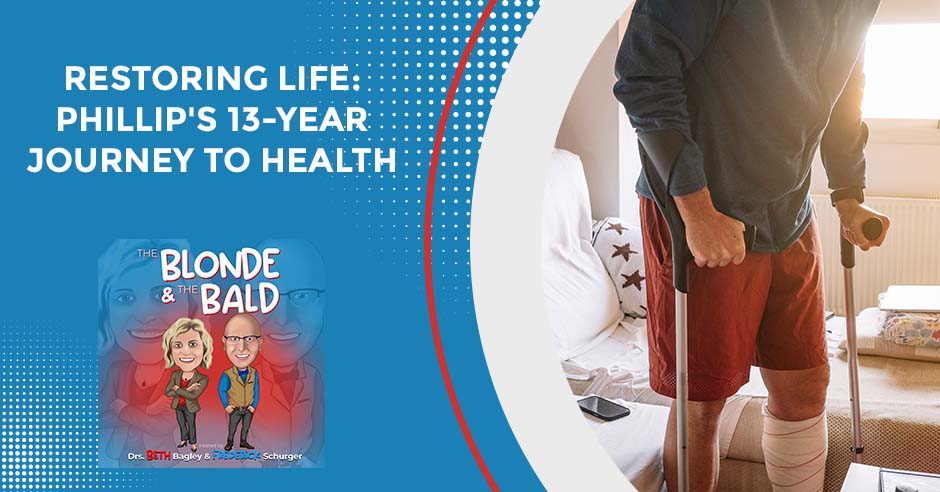
Have you ever been in so much pain that you’re ready to chop off that body part? Phillip’s struggle with the pain is not the worst of what he went through. He sought out medical doctors from all over the US, in and out of the Veteran Affairs system, to find an answer to get him better. Phillip’s 13-year journey in restoring life changed after his mother’s chiropractor overheard his story and said, “I can help.” Listen to Phillip as he recalls the haunting experience and how the right therapy made a wonderful impact on his healing journey. Tune in to this episode so you won’t miss the incredible journey of Phillip in restoring his life.
Listen and read the full blog post here

Just as random as today’s weather changes, this summer brought us even more randomness! Dr. Frederick Schurger and Dr. Beth Bagley are not the ones to pass this up by literally talking about anything under the sun within their practices. From power outages, internet issues, barometer changes, workouts, and more, we explore how these various factors affect patients in different ways. Tune in for some good laughs, fun stories, and some deep insights on chiropractic as we make sense of the randomness that kept us on our toes this season. Join Drs. Schurger and Bagley for another random episode during this summer break.
---
Welcome to the show.
Everyone just missed. Go ahead, say it again without the one thing that we didn't want recorded.
All of it, you don’t want to be recorded. There were words that were not allowed on some sites. I would have had to blur out the simple I made with my fingers on YouTube, but none of that was towards Dr. Schurger. That was a hell of a day.
Those happen and quite honestly, it's been one of those weeks. My first half of the week was busy. The second half hasn't been as bad, but before, I did a pseudo-show with Dwayne Hoskins over at Titronics. For those of you who are unfamiliar, he is one of the lead sales and research in marketing for the instrument that we use to measure the temperature on the back of people. They have a new product out that is cloud-based.
My biggest reason to go cloud-based for everything is simply security because we are small businesses as chiropractors. Eventually, it's not a matter of if. It's a matter of when we are going to have a data attack on us. We want to make sure that data is safe and HIPAA compliant. I remember when HIPPA was being rolled out and I have gone through an OSHA compliance thing. You have probably gone through OSHA compliance when you were back in the industry.
I was going to say I remember how to do it for chiropractic, but back in back in Monsanto days.
It's the same thing. It's like, “Sit down your rules and your rigs and show that you are doing your rules and regs. You are accommodating by your processes.” HIPPA is very similar, except for there's also a level of security. I worry that we don't have this stuff as protective, which is why I have gone to extreme lengths to get it protected to make sure that it's as secure as possible. That's one of the pushes I have going toward a cloud platform. There are a lot of reasons not to go to a cloud platform.
There are.
The security alone outweighs that message.
Honestly, the Titronics is for any chiropractor who has been reading. I do recommend the Titronics cloud system. First of all, giving them a monthly fee is not that much money to help support them because they help support us. I'm always about that and helping another small business succeed with a small monthly fee. It runs faster.
Honestly, I was having trouble because of the server base. It was a computer in my office that it would cue back to. It wasn't the computer I was scanning off of. I was having trouble. It was taking a long time for the patient to load and now it happens very quickly. It's less glitchy. The only issue we have had is when our internet goes down, but I have a lot more issues when our internet goes down, like our phones don't work. All sorts of stuff.
This is the worst part about technology is we are so mild in the muck of it. You have two questions on your mind. What happens when it goes down, but does anything work when it goes down? The other half of it is in my brain because I see a lot of Amish patients. It’s like, “My power went out.” They are like, “How'd that go for you, Doc?” “I wasn't too bad. It was like camping.” I do like my air conditioning. They laughed a little bit at that and we lucked out that it was pleasant weather when we lost power.
Speaking of weather and power outages, have you noticed that certain patients will react to other changes? I'm going to say two of them and see if you can add any. I have got migraines that react to weather changes and vertigo. Do you have any other patients that have things?
I have a great one. It was probably back in January. They were threatening a bad snowstorm the next day. One of my nuns was brought in by one of her caretakers and she made the comment. When the snowstorm came in the week before, she felt every bit of it because it was in her knees. The threat that they were making was that there was going to be a major snowstorm the next day, which never transpired. She's like, “No, we are not going to get a snowstorm.” I felt one day before, this one here, my knees are fine. I have more reliability in faith and her knees of an impending storm than I do have of the weather forecast.
We should make her own YouTube channel and focus on, “How are your knees feeling today, sister?”
That would be so funny. It would be one of those best channels ever, and it would probably be more predictive for the locals. One of the things that I would say that's going on is I bought a couple of barometers to see what is going on with that. I have got a barometer in the middle of the office. It's inside compared to outside. You do still have those changes throughout the building when you get a weather change, and you can see it.
What I find curious is there are people who have weather-change problems, but I don't know if it is a matter of a big pressure change or the speed of the pressure change that seems to be the factor there. People with arthritis can feel that heavier pressure is present a little bit more acutely. I bought it for my Meniere's cases, and I never saw it. I asked them questions and I was like, “I had a bad case.” I'm like, “That needle didn't move over the weekend.” It's a lot of questions that don't make sense. I think there is a component there but I don't know what the component is. It would be nice if it was more obvious.
We have had a couple of our patients using this app and earplug thing called WeatherX. I just downloaded that. These earplugs are not expensive, which I love, in comparison to regular earplugs there, but they are only $18 or $15 or something. They are specialized earplugs that help mitigate the pressure changes that people feel in their ears. It's got the barometric pressure. It is decreasing now by 0.12 and tomorrow it's going to be increasing but it will ding and tell you when you need to put your earplugs in. I have got a couple. My patients are trying it out because I was like, “Try this out. See if it helps.” Two of them say that they have noticed it helping with their migraines. It's another option for people who notice that there are big changes in the head symptoms, migraine, headache, or vertigo symptoms.
It makes sense because of the sensors of our body. Everyone thinks of the five senses and there's something more like a dozen when we start looking at the pressure sensors, especially inside our body. We have barrel receptors that know. The ducks and the geese have baroreceptors and all the birds that fly south for the winter. They have barrel receptors to know when they need to start flying because the storms are coming. We don't have them as attuned to that, for one reason or another, but we still have sensors like that. All of these things could be related.
It could be triggering for people.
Where do people tend to feel that pressure? It's in the inner ears because if you have ever flown on a plane.
Even going up and down in an elevator. It’s a ton of building. You can feel that.
If you have bad ear congestion, I was telling another patient about the situation I had. I was flying out to San Diego. We stopped in Colorado. I acclimate up there, and I'm up in an airplane, and then San Diego's sea level. It is probably the most agonizing pain I ever had. I thought I was going to go to the ER because I was going to have blood coming down my ears. I probably was wearing a white shirt that day, too. That would have been bad for the shirt and my vest. Thankfully, that didn't happen.
Thanks for all the visuals of that.
I know. It's wonderful that. I’m sitting on the airplane. I'm trying to get my jaw to move at my ears to pop at all because the pressure felt like it was going to explode. I'm preparing myself. It's like, “We are going to get me off the plane. Someone is going to notice the blood. We are going to call the ER and get someone to figure out what's going on and all of this stuff here. This is going to be fun.” Thankfully, it didn't. I got adjusted by the great Jessica Lee down there. She came in special for me, and then I got into an Uber and whacked my head immediately.
It’s not how it goes. That made me think of something. Do you know how kids are more prone to ear infections than adults? What's the direction of the ear canal in adults?
It's more downward.
Adults are more prone to ear infections because their ear canal is more downward.
For the kids are more cloggy.
They don't change as much because the heads are big but the head hasn't fully developed. Those eustachian tubes finally dropped down so they can drain properly as we get older.
The same thing for a baby or a child on an airplane is going to be more prone to having extreme pain in their ears, probably for the same reason. As you were saying, if there's a child or an adult that has ear infections or your complaints going on, this is one of the reasons that chiropractic is so amazing is because that atlas bone, what we talked about all the time that top bone in the neck, is so close to the eustachian tube. If we took a 3D image of where the eustachian tube and the atlas are, you can, I would say, have physical pressure because of the swelling and stuff around the atlas on the eustachian tube, not to mention the dysfunction that happens in the ear because of neurologically.
You have the other component where there's an actual little muscle that is attached to that eustachian tube that if the atlas is out of place and now you have got everything else to twist. That muscle is not going to be functioning the way it's supposed to be mechanically and structurally. Everything is going to be in the wrong position and that muscle is going to say, “I find where I'm at,” but it's causing a blockage until everything gets corrected. Once that happens, life is better for people.
Also, parents who have had babies have frequent ear infections. These babies are miserable. They keep getting put on antibiotics. The ear infections keep coming back because the problem isn't that they need any antibiotics. The problem is that there's dysfunction and how the tubes work.
Everybody else on the plane gets the benefit of the kid being healthy and not screaming their heads off. It's a real win-win situation all the way around.
Still, get your kids checked.
Give the card to your favorite upper cervical practitioner to those screaming parents and say, “I know it. I get it. Go see this doctor. They will help you.”
I have a new patient. I just got her first adjustment and she says, “Do you check kids? Are kids coming here too?” I was like, “Yes, kids of all ages. We had a toddler in here. Sometimes I have babies in here.” I had three teenage boys all the same time. They were separate entities. Two of them knew each other. I love that I had three teenage boys all the same time. All of them driving age that came in. Their parents gave them permission to come in because that doesn't happen very often, especially for, teenage boys. They don't typically take care of themselves or think about that stuff.
All three of them had parents or loved ones who said, “The reason you are constantly popping your neck is that this is happening. Come and see Dr. Bagley or whatever. However, they came in.” It's cool that at that moment, I had three unrelated teenage boys that were all resting. 1 had a head adjustment, but 2 of them were resting. One is the son of a chiropractor who sends him in here because she wants that specialized care for him, which is cool, too. That's probably the best compliment a chiropractor can get, is when a chiropractor sends their kid to see you.
The best compliment a chiropractor can get is when a chiropractor sends their kid to see you.
Even they are coming in for themselves and they don't practice what we do. I have several of those. It is neat to see the kids coming in and they get it, especially boys. You got to tell them, “You are going to hurt yourself lifting in the weight room if you don't have your head on straight.” They are like, “I get it. I don't want to break myself.”
They don't. Boys are rough and tough. I’m not saying girls can't be too but tend to be a little crazier.
Honestly, with boys, we have to remember if it's not falling off it's not a problem. I don't care what part I'm talking about isn't falling off. Girls, you go through a whole different thing starting through puberty and you have to be extra careful about things. You are already taking care of your health. I was probably 24 when I started realizing I needed to do something about my health. I saw my grandparents and some of my cousins.
I took a hard look and I said, “I cannot let myself get into that situation.” That's when I started eating healthier. I started cleaning up my diet. I did all of the things. It still took me 2 or 3 years to find chiropractic but it didn't dawn on me where I was going. Sometimes, you can look at your older aunts and uncles and say, “That's not the direction I want to go,” and let them be the role models that they are supposed to be for you. That's a big one right there all the way around.
I had a patient that came in. It was a referral. It's an opposite referral, what I mean by that is a wife comes in first and then refers her husband in because that's how that usually works. This time it was a husband that's been patient for us for years then he sent his wife in. She had back pain that wasn't going away, unrelenting.
She tried all the things and he finally was like, “Go see her,” and she did. She wasn’t mad about it. She just didn't know until he said it. It was good that he opened his mouth and said, “Go see my chiropractor.” She came in and it was back pain. She didn't have neck pain, but where did I adjust her neck? I didn't touch her back. The next time she came in, she was 100% better. Honestly, does everybody get better 100% with 1 adjustment in their back? No, but I was so happy to hear that.
Especially those back pain cases that aren't a hot disc or a 60-year-old. I see those get better.
She is retirement age, so she is older but she's healthy. She takes good care of herself. One of the things that happens is rebound happen. She lost her adjustment and her back started hurting. That's one thing that I like to point out to people, is that when you first start care, sometimes it feels like you feel like a$1 million after an adjustment. That's incredible. We celebrate that but I was like to warn people as it's a roller coaster and a marathon. Not a sprint.
There's going to be times when you feel great then times when it feels like the rug got pulled out from under you and you are hurting so bad. That's okay too. That is part of the process of healing and it's up and down. That happens with all sorts of healing. Not just chiropractic care. If somebody had gotten a broken arm, it might feel good one day and the next day, it's achy type of thing even though it's still healing, so cycles of healing.
It's one of those things that some people will get, I wouldn't say she was upset. She was upset but I have had patients in the past being upset that they are not getting better anymore. I'm letting you know if you are one of those people out there who is struggling and having ups and downs in your chiropractic care. That's so normal. Not everybody is that miracle that feels good forever.
We are all going to hit a plateau in our healing process. You cannot push and push always gets better and better. At a certain point in time, you have got to sit back and coast and let everything work the way it's supposed to before it can move to the next level. Before it's ready to make another transition for better and more strong healing. I wish we had a better way to understand that and describe it. For working out, it's just a matter of understanding that you will train so much.
We're all going to hit a plateau in our healing process. You cannot push and push and always get better and better. At a certain point in time, you've got to sit back and let everything work the way it's supposed to before it can move to the next level.
That's a great example. Let's use Olympic athletes as an example. They will train not for something coming down 2 weeks out but oftentimes, 4 years out or 2 years out for a meet. They will start training in a fashion that slowly builds up their strength, agility, and function over not a month but several months. Sometimes up to a year. I remember a good friend of ours, I want to call him Dr. Keith Wassung. He is an honorary chiropractor.
He probably knows more than most chiropractors but he was a powerlifter for the Navy. He had an amazing record and skillset when he was doing that. His doctor was Reagan's doctor back in the day to put things in perspective. His training routine and he still does some level of that now. He starts training in January and continues training through the year through November. December is his time off.
He likes to share that his November, while they are doing all their shopping, his wife and daughters love to do Black Friday sales. Keith picks up a spot in the food court where that's home base. The girls are out shopping then they want to drop off a package before we go into the next shop. They dropping it off with him. He's sitting down and writing out his game plan. Reviewing what got him to that part of the end of the year and what he wants to do going forward.
He used that strategy for weightlifting and powerlifting. He went through a bunch of weight loss stuff for himself as well. How does he plot out that strategy? When we start thinking that life is not a sprint. None of life is a sprint. Neither is healing. Even a sprinter for the Olympics is going to train for several years with the goal of qualifying for the Olympics and then going for the gold. That is a process that doesn't happen overnight. I got two new kettlebells for my birthday. They are nice.
How heavy are they?
They are only 28 kilograms a piece which is 62 pounds a piece.
You got two of them?
That's the exercise. That's the program. I'm doing. One day, I do use one and the other day, I used both. We won't talk about how badly my quads hurt from doing squats.
I have to say one other thing. I worked out with my trainer, me, and my girls. We should have run sometime. She's an awesome person. My trainer’s named Natalie Coomer and she's in the St. Louis area. She trains women only. She had this cool exercise which was awful, too. It's always awful, but I was proud of doing it. One of the things she had us work out which I had never done before was she had us work out our psoas muscle.
We were in almost like a half-sit-up position holding a weight on our chest and squeezing into it, and then we lifted 1 leg at a time for 30 seconds or so. By the end of it, you are burning. We did it a couple of times. When I was getting into the car, I was lifting my leg into the car because it hurt so bad.
It feels so good when it works.
Honestly, I told a couple of patients because they saw me walking weirdly. They are like, “What's wrong, Doc?” I was like, “I worked out with a new trainer and I can't move my legs.” She’s trying to turn certain muscles on because we are going to do this running exercise but I thought that was incredible because we know all about how the psoas. It’s the connection between the lower half and the upper half of the body. It's wonderful when it's working right and terrible when it's working wrong.
Psoas, in case you are reading and want to look it up, it starts with a P. The next exercise she did with us was we ran up a giant hill ten times. She had to do this cool thing where we had a clipboard at the top of the hill and every time, we completed one run up the hill. We wrote a thought like what we were thinking. It went from like, “This sucks. I can't do it,” to, “I'm proud of myself. I completed it.”
It's a cool thought process, but the coolest part about this and that it goes toward healing and everything. I love that she did this for us, that is when we got to the bottom of the hill. We would walk down the bottom of the hill. It was like was a HIIT interval time. By the time you are at the bottom of the hill, you are breathing is somewhat coming back down to normal. She goes, “Don't turn around and look at the hill until you are ready to go back up it again.” She had us continue to look down and couldn't stay there as long as we wanted to but when it was time to go, turned turn and went. You didn't turn and contemplate the hill in front of you.
Way to go, Natalie, because that was so incredible for my twins to enlist. It was even for me, who's done lots of self-help and all the things but physically doing it. When you contemplate, overthink an action, and overthink something that’s coming up and it comes with healing or even getting up the phone to call a new chiropractor, therapist, or doctor even if you know you need to do it. Your brain is like, “What if I don't like them?” Stop the what-ifs. Pick up the phone and call somebody to get the help you need.
It's funny because a while ago, I came down and I got adjusted by you. I still didn't feel great. I was off.
Are you saying I didn't do my job right?
You did, but I was still healing. I was unable to work out for the better part of a week and a half.
That’s rough for you.
It was. I didn't work out for one week. The bell that I normally do for my warm-up felt too heavy, which is always my reason not to work out that day. I still ordered new bells. That's the funny part about that. There was a little bit of apprehension as I picked up these two new bells. What's funny is 62 pounds, it's a little heavier than what I had been using, which is 53 pounds. It doesn't sound like a huge jump. It isn't, but it still felt daunting.
My kettlebell snatched what I was supposed to do on Tuesdays. I'm like, “I don't know if I can do this.” It was only the first time I had been using A) This style of bell and B) That weight. For a while now, I had done 30 reps aside with the 53-pound kettlebell. I said, “I'm only doing three reps. I bet I can do three reps,” which is nice because this thing then builds up from there. Again, it was that same hill. It's like, “I can do this,” and I did it. I ripped up my hand. A nice little remnant of a blood blister. I got one of the other hand too.
It looks like the stigmata.
Stigmata would be down in your wrist. This is my kettlebell stigmata.
In some movies, they have done it wrong in the past.
I know, but in any case, as I said, it's my sacrifice.
Not as powerful as Jesus, but it's fine.
It's the second best thing that I can do to make sure that I am as strong as I have to be because, after 28, I'm going to need a pair of 32s. I have owned a 32 for a while. I can't push that overhead. I can do a Turkish get-up with it. I can do a Turkish get-up with 88 pounds without a problem, but with overhead pressing from what they call the clean position or the rack position to overhead. Something is not connecting as far as strength-wise. I don't know what it is. I haven't been able to figure it out.
Maybe it's because you had a birthday.
That's why I bought the new bells. No, I feel stronger than ever. When you are 50 years old, you look as good as you will not.
You do look great. A happy belated birthday, Dr. Schurger.
Thank you.
That's a big deal, hitting the big 50.
This is only a third of my way there. Again, how do you plan for that bigger and longer thing? Why did at 25 I realize I needed to do something with my health because somewhere in my brain said, “You are going to make it to 150,” and I'm like, “Okay.”
That’s your thing. You want to make it 150.
Be as strong and active as I am now. People are like, “Doc, you are crazy. Why are you doing it this way?” It's like, “I make some sacrifices but they are not things that are beneficial in the long run.” Jean surprised me. The best birthday cake ever. I did not know and I was still not feeling great. The birthday cake made it better.
Birthday cakes make everything better.
It does. I still have a slice left. It will be gone when this is posted, but I still have a slice left after doing another round of snatches and probably more stigmata.
Tearing up somewhere over your hands. Your hands, I call these my money makers. I take good care of my hands. I don't do anything that's going to hurt them. It sounded like you are doing some stuff that's going to hurt your hands.
No, these are just making them stronger.
Be careful.
I always am.
What does a chiropractor do, especially a chiropractor that doesn't have an associate or anything? What would you do if you were hurt to the point where you couldn't practice for a little bit? Maybe not forever, but for a temporary disability.
First, I'd be living at your house until you got me working better.
That's true.
I would do that, then I come back.
A couple of weeks, and that's the same thing I would say. We would take a couple of weeks off and make sure that we are back on track.
A funny story, Dr. Matthias, who sadly passed. He practiced in the area. He was an upper cervical doc. He'd been practicing for many years. I won't say that he was as healthy as he could have been, but he didn't miss a day. He was always in adjustment. He had a couple of people who worked on him. He did the orthospinology technique. In a real pinch, he taught his wife how to adjust him with an instrument then he was working out in his shed. When I say shed, it was one of the nicest workshops I have ever seen. A big old barn.
He was climbing down a ladder from an upper level when the ladder slipped. I can't remember what it was. I don't remember if it came back off the wall or if it slipped backward underneath. Either way, he falls. Doc is not doing good. I get the call that he's not doing good and I have been adjusting him a little bit at this point. He walks in.
I can still remember him walking in with I want to say he either had two canes. Maybe he had a walker that day because he was that laid up. My phone was always already ringing off the hook with referrals from him because he couldn't practice. I'm like, “This is it. I'm going to start seeing Doc’s patients.” I adjusted him and he's already feeling better. He comes in a little bit later that week. He went from a walker to canes, and then the following week, he's back in business. It was the absolute worst thing I could have done for my practice because I didn't get all of his patients right then and there. I know it’s horrible. I have them now. They have been coming to me since he retired and then passed away, unfortunately.
That's proof positive that when you put effort into your health. If I have a patient who's been coming to see me for years, it happens that a car accident or an injury happens, I do feel they get better faster because they have already invested so much in their ability to heal then we get them back on track.
I have had several people who have been regular patients who get in a car accident and I'm on the fence whether or not I need to even run it as a PI case and use their insurance.
It’s going to take a couple of adjustments.
I have had cases where they have been a regular and then they get in a car accident. The car accident compounds other problems and they are a complete mess. I have those cases, too.
I have got one now.
They are no fun. We love them to death and we help them.
I feel so bad for her. She was doing so great for years and the stupid whiplash injury. Folks, stop texting when driving.
It's not worth it, but there are cases. I have had several where they get a small fender bender. We adjust them once or twice, and then they are back to it. It's like nothing.
That's what we hope will happen with everyone. Sometimes it throws people for a loop and they get new misalignments and extra problems. That patient I sent that to Dr. Blake who used to work here. She started doing acupuncture full-time. I sent her to start doing some acupuncture. It's helping the upper cervical that we have been doing. The acupuncture might be helping her hold her adjustments a little bit better.
There are a lot of modalities that you can use to clean that stuff up. We have talked about a clean diet, improving other activities being physically active, and going for a walk. These little things will all pay towards the end of improving your health and function. There's no one thing. I can get my atlas adjusted but it's not going to help me lift those kettlebells unless I lift the kettlebells. It's not going to help you get up the hill if you are not ready to go up that hill again. It is one of those things where we have to understand that all of these parts and pieces are intertwined. There's much going on. Nature is a grand thing. We just need to be appreciative of what we have and how all these things work. There's a season as the song goes.
Nature is nature. It is a grand thing and we just need to be appreciative of what we have and how all these things work.
For everything, there is a season.
We need to understand that's part and parcel of healing and getting better. Speaking of seasons, by the time this gets posted, it will be hunting season.
Does that mean it will be fall? My favorite season of all.
It will be. You probably want your pumpkin spice stuff.
You know I am a basic girl. I love you some pumpkin spice. I'm already drinking my pumpkin spice tea. I drink it all year round.
You need to get some of the Timcast.
You know I don't do coffee anymore.
Cast Brew has an all-year-round pumpkin spice blend now. For the hunters, be mindful that you might benefit from getting your head on straight before you go out there. Two things, one, if you are a bow hunter, recognize that, as you probably are aware, you have a very dominant side as you are hunting and pulling that bow back and that can cause some imbalances. Hopefully, you are balancing that out with some other stuff. As I'm learning bow, hunting is a push-pull. For me, the left hand is pushing and the right hand is pulling. As I'm starting to get into pistol shooting, the right hand is a push and the left hand is a pull. It's the opposite. There's the balance and when I relax, I can hit the target.
Again, it's understanding and appreciating that because if you are sitting and you have got your bow drawn, that full draw and you are waiting as that deer, buck, or elk is sitting in front of you. You are waiting for that right shot. That's a lot of stress on your body in an extended position. Hopefully, it will pay off, but it might cause your atlas to be out of place. Your next shot may not be as good. The same thing for rifles. You are sometimes in an odd position while you are doing that.
For a long period, waiting too on a stand or a blind. The story I have is a couple of years ago. This burly man came in and he was hurting. He loves to hunt. It was hunting season, so I didn't see him as often. He should come in because it was hunting season. That is no excuse for you to miss your chiropractic care.
It's the hunting season, but that is no excuse for you to miss your chiropractic care.
Tag out first and then get in for your appointments.
Don't miss your appointments. That's all I'm going to say. He came in and it was already in the middle of the season. He was sitting in his deer stand. He knew his sight and how far he could see. He came in to get his adjustments done, and he said, “Could this help me see better?” I go, “Funny you may say that but it can because there are muscles in your eyes and all sorts of things neurologically that can be changed by an upper cervical misalignment or alignment.” He goes, “I can see down to the end of my sight line now where it used to start getting blurry much closer.” I say, “That's incredible.” He only started coming in when he couldn't see as far down.
The beautiful thing is for those people who are like, “Where's the science behind this?” The Carrick Institute did a study on this where they were looking at the shrinking blind spot. We have a blind spot on the back of our retina where the optical nerve comes in. There's a spot where the nerves come in and all the rods and cones that make up the back of your eye. They are not there. Supposedly, your blind spot is a consistent size all the time.
What was interesting is Carrick did a pre and post-study of adjusting. I don't remember what level got adjusted somewhere in the neck. What they found is they were able to see that the blind spots would shrink. There's some computer-aided design they were able to say, “This is where I don't see stuff.” The blind spot shrunk 20%. It was significant. It's a big amount.
The better you have your head on straight, the better your eyesight will be. The better everything functions. Funny aside, I have been hating my prescription now. This is the prescription that I have had since I was 15 or 16. As of late, it has been painful to wear so I want to take it off throughout the day more. I'm not even doing the Andrew Huberman walk for twenty minutes first thing in the morning at dawn to help with the eyeballs. Something is doing better, so I have got to go get an eye checkup and see what's going on with that.
The better you have your head on straight, the better your eyesight will be, the better everything functions.
My question is, how do you go get an eye checkup? This is what I'm going to tell you. You start by making an appointment and then you go. Just do it. In the morning, set of phone alarm to call and make the appointment, and then you will do it. That's the same for whoever is reading this show now, being like, “I don't know if I want to.” Whether it's with one of us or another upper cervical doctor in your area, just make that appointment.
Let's clarify. As soon as you make the appointment, you have got the appointment schedule. Make an appointment with your upper cervical doctor to get checked before your eye appointment so that you have the optimal level of visual acuity so that when they check your eyes, you get the best thing. I like to find a doctor or an optometrist who has been trained in something called NORA, which I'm going to butcher it. I want to say it's neuro-optometrists something, but anyway. That's what they are doing.
Neuro-Optometric Rehabilitation Association.
That's it. I knew I was going to butcher it but these doctors are trained optometrists. They are like every other optometrist except for us with the upper cervical. We went through all the chiropractic school then we started looking at these more neurological things. We looked at the atlas and how all of these pieces have a more profound effect on the body. These optometrists are trained in such a way that they are looking to make sure you have the right prescription for your eyeballs that will affect how your body works.
It's more than how well you can see because most people are seated in a chair doing the vision analysis. The problem is I don't sit in my chair all day long. I stand a lot, walk a lot, and move around, and that changes my prescription and the center of gravity of my body. Mine drops significantly when I have got the right prescription in.
It's funny because if anybody asks, I will demonstrate, but you can pick a spot on me and try to push me over with finger pressure. I will take my glasses off. You can push the same spot with less pressure and I will generally try not to fall over, but you will push me over. It is amazing how much it settles down to a more comfortable spot. Again, my eyeballs haven't been happy lately. I need to do something about that.
Make the appointment.
I will.
If you have to come down here, you can always stay with me.
I got a guy in Peoria that I go to visit.
I always like a reason for you to come down so I can get a good adjustment, too. If you have anything else for this episode, Doctor? I think we did a lot of random. We are going to call this the random episode.
The only problem is this is their second random episode in a row.
They were good. We had good stuff.
We did have a lot of good stuff and unfortunately, we have been on a hiatus these past couple of weeks because we have had other things going on in our world.
We call it summer break.
It is our summer break as we start to get the next round of episodes in the books. In any case, we will be back with another episode. Hopefully, we will have something more organized. If you are interested in a topic, certainly send us an email.
I will post it. Let us know.
We appreciate that and five-star reviews. That helps the algorithm. The five-star reviews we will start looking at them as they start rolling in. I haven't looked to see if we have any, to be quite honest. If you are doing it, I will read the five-star reviews as best as I can. We will share and, hopefully, get more people to share the show because as much as we love doing this, this is about getting people well and changing people's lives. Dr. Bagley, where are they going to find you?
I am in St. Louis, Missouri. You can find me at precisionchiropracticstl.com/.
Sounds great, and I'm at KeystoneChiroSPI.com in Springfield, Illinois. That's it. It’s been a long day.
You, guys, have a good one.

Have you ever wondered if you should get your child adjusted? If you've ever pondered whether chiropractic adjustments are suitable for your little ones, this is the definitive discussion you've been waiting for. Today, Dr. Beth Bagley and Dr. Frederick Schurger delve into the wonders of Chiropractic, with a special focus on the life-changing benefits of upper cervical care for children. This episode is a journey into unlocking your child's health potential without resorting to drugs or surgery. You'll be amazed to learn how even seemingly unrelated health issues in adulthood can often be traced back to untreated childhood traumas. Don't we all wish we could turn back time and have those issues addressed sooner? Whether your child is facing specific health challenges, or you simply want to ensure their well-being, this episode is your gateway to nurturing your child's health potential from the early years. Join us now!
---
Dr. Bagley, how are you doing?
I'm great. How are you doing, Dr. Schurger?
I'm doing excellent. Welcome to The Blonde & The Bald, Episode 25. We've got to this point very quickly and easily probably because we like to talk, we like to talk to each other, and we've got great stories or at least you do and I sometimes have a good story that I can interject.
When we were discussing what we wanted to talk about, what came to mind is kids under chiropractic care. A lot of times people are surprised when I have a baby, a toddler, or children in the office and they're getting checked. They're like, "Are they here with their parents?" They get checked too. We get questions like that. I wanted to bring up common things that happen to kids that could cause subluxation or a misalignment in the neck.
Let's go back one step. Even before that, I was asked a similar question. I've got a patient. He and his wife have seven kids. He said three are adopted. He said, "How young can we start them?" I'm like, "Let them be born first and bring them on over as soon as mom feels leaving the house." That's usually how we like to start, because where is that first trauma? It's oftentimes birth. One of the arguments is about women have a higher pain tolerance and that's why women give birth and not men because we would be like, "What comes out from what?"
"We want to push out of what?"
Anyways, I saw a picture of what 10 centimeters dilated is.
It's unbelievable what the human body can do when properly aligned.
That makes a difference, doesn't it?
We talk about the first trauma. Even on a so-called normal birth. We're talking about a vaginal birth where the mom's pushing the baby. There's no intervention on the baby. The baby just comes out. There's still stress on the neck. This is natural stress. A baby's body is meant to take some of these compressive forces. What a baby's body isn't meant to do is the distracted forces. That's when we get into the interventions that happen. Again, interventions are necessary. I thank God for C-sections and these interventions. We've saved babies' and mothers' lives doing these.
A lot of times, what we're missing is who's checking this child afterward. Their Apgar score is okay after twenty minutes. Great, glad about it. Two days later, when the baby can't turn their head or tilt to the side, we have something called torticollis. The baby doesn't latch correctly, or three months down the line, this baby keeps getting ear infections. People aren't checking what happened with the destructive, pulled-apart forces that happened to the baby when an intervention like vacuum suction, assisted birth, or forceps, which they occasionally still do, and C-section births.
Let's start with a C-section birth because that's one I know a lot about because I was a C-section baby. I don't remember it. I don't know if that's pretty common but I do know what a C-section looks like. If you've never seen what a C-section looks like, I highly recommend not to look because it's awful. If you're interested, you can find videos on the internet.
Again, they put the sheet up because it's pretty awful. They're doing it fast. They're cutting the smallest hole possible, unless it's an emergency, on the mom, and then they're reaching inside to the baby's head if that's what they can grab, which usually it is. They're distracting the head up pulling out of mom. Typically, the OB's fingers are around the occiput of the baby's head. They're around the head.
Those destructive forces are not what the baby was meant to hold. Typically, they pull the baby out until they can usually get an arm, and then they'll pull by the arm. Sometimes I've seen them where they pull the whole baby out by their head. Babies are resilient and maybe that baby's fine, but for a lot of people, that is their first misalignment. I think that was mine.
That's very well possible. This sounds very gruesome, so we're not advocating for this. There was a doctor that did a study looking at a bunch of stillborn babies. Again, this is gruesome. Here's your trigger warning. The question in mind was, "How much force does it take to either decapitate a baby's head from the body?" They did this test on stillborn children probably back in the 40s and 50s before some of the rules and regulations that exist now came about. That would either cause a decapitation of the baby, which would be the extreme case, or at the very least, a tearing of the spinal cord.
We would call it internal decapitation.
Either way, you're not coming back from either one of those situations. You've got these spring force pulls. Again, I'm sorry because I'm quoting this off the top of my head. It's been years since I've looked at that stat in particular. They were saying that the force was around 110 pounds of pulling pressure to create that kind of decapitation situation. The doctor figures this out in the morgue, and then goes around to all of the OB-GYN docs who are delivering babies and said, "Here, pull it 110 just to get a feel of what it was." He then asks them, "Compared to that, how much more are you pulling to deliver a baby?" It was commonly said that they were pulling much more. How much, they didn't test that out.
They could potentially, but still, the question becomes, "Where is that dividing point?" This is why natural birth is ideal. There are two categories, a normal non-traumatic birth, and a traumatic birth type situation. We need to come back and revisit Apgar because it's been a long time since I've looked at that number. I think it's a 15-point number and you want a higher Apgar score if I'm not mistaken.
The Apgar score is based on a total score of 1 to 10. The higher the score, the better the baby is doing. After birth, a score of 7, 8, or 9 is normal and it's a sign that the newborn is in good health.
That's what we're looking for. Do you have a description of what are some of the things they're looking for? I know a cyanotic baby or blue baby would be something.
Respiration, crying, reflexes, irritability, pulse, heart rate, skin color, and muscle tone.
You want to see all of those things. Skin color would be an indication of cyanotic, blue, or not getting enough oxygen. What constitutes a normal birth and when does it become a traumatic situation where there's been a lot of stress on baby and mama, to be quite honest? A C-section is automatically a traumatic birth.
A C-section is automatically a traumatic birth.
This might trigger people too. When we use the word normal, just know we're not saying that you're abnormal because you had a C-section. I was born with a C-section. For many people, that's a route they take, it's a choice, and sometimes it's not a choice.
I'm the oldest of my family and my mom did not want to have a C-section, and I was breached the week before. I'm right here, casual because I like gravity. I already knew where gravity was. I didn't want to be upside down. She walked for the entire week until I turned. She had six of us and she didn't have to have any surgical interventions for us kids. I wasn't even the biggest one. My brother Joe, who's number five, was big.
For my mom, this was 1981. She was an old mom. She was 33 years old. That was considered an old mom back then. Just because she was old, they wouldn't let her have a vaginal birth. They didn't give her a choice. They said, "You have to have a C-section." We've come a long way since then, maybe not far enough, but still.
There are mothers in their 40s and 50s that are giving birth sometimes for the first time, which is crazy, but it is a different world than it was back in the ‘80s, that's for sure. I don’t know about your mom in your delivery, but for mine, Mom and I were in the hospital for about five days. By the time my brother Joe came out in '86, it was like, "You're okay? Nothing's wrong? Go home." She fought for an overnight for one of them. Either Joe or Jim, one of the last two, she's like, "No, I'm staying."
"I need a moment to rest."
There were 4 or 5 of us at home.
If you've had a C-section birth or you were born that way, you're not abnormal. When we say normal, we're talking about vaginal, how the body was meant to do its thing. I do agree every C-section birth is a trauma to the baby and the mom because it's cutting on the mom. It's something that we need to talk about. We need to check these babies that were born that way. They might be fine.
Honestly, most babies I check are fine, but when they're not, we check to see how their body is functioning because they can't tell us that they hurt. They might be upset or something, but they can't tell us that they're hurt. We can see symmetry or asymmetries in their face and we can check leg lengths on babies, which is pretty cool.
Sometimes it's leg lengths. I was taught at one point in time to check the muscles in their lower back. If they're tight on one side, usually that's the side that's drawing up that would normally be a short leg for people. You can then see. You can turn their head left and right like we would do for an adult, and we can feel that melt as they turn their head from one side to the other. That dials us into which side we need to be looking at, at the very least, as a starting point. Oftentimes, especially as a baby, that first adjustment is a push.
It's so gentle.
All of a sudden, they relax because that's all they needed.
They relax and poop.
One of my favorite stories is this. I don't know who told me this because I didn't hear it from the doctor himself who shared this story. This was Virgil Strang who used to teach at Palmer College for a while. He was president up there and he would always wear a three-piece suit all the time, even throughout the office when he was practicing. He was a Toggle HIO Upper Cervical guy in his practice, but he said, "If you want to practice with children, you have to understand that they are going to burp on you and puke up. They're going to poop on you and they're probably going to pee on you." Sure enough, he adjusts the baby and the baby does all three on his three-piece suit. I understand why a lot of docs like to wear scrubs or very simple clothes.
Why do we adjust or check babies? If we catch a child before their body has processing problems with the misalignment that has occurred, you'll start seeing, "My baby crawls weird. She just uses one leg. That's super cute." No. A chiropractor looks at that and goes, "Why is that baby just pushing off with one leg? Something's not right."
That's 6 or 7 months down the line. I could say even sooner when they're not sleeping right, they're not latching to mom for nursing, or they are not pooping right. My buddy's son didn't latch for seven months. That seems right, so she never let down. That never happened. What was the next thing? He wouldn't sleep. He was colicky to the nth degree. Mom and Dad weren't sleeping either, and they had to drive him around the block until he would calm down. I've told this story before in the show. If they stopped or something stopped them on the way back, he'd be back up and up all night. They figured out a system to do it. "Quite honestly, tonight by 9:30, I'm going to be tired. I don't want to leave the house."
Parents shouldn't have to do that.
They were doing this at 10:30 or 11:00 at night.
Honestly, most babies should be asleep by 8:30.
If not, 7:30.
They sleep a long time or they're supposed to. Some of them will get up to feed once.
These are the early things. It shouldn't be thought that these are a problem, to begin with, but then, later on, they start crawling weirdly, "Isn't that cute?"
Every picture you take of this child, they're so cute with their head turned, but they're always turning the same way.
It's always stuck.
That's not cute.
I've got a lot of Amish patients. The first thing I ask the mother is, "How are they nursing on both sides?" Oftentimes, this can be a bigger problem.
They like one side only.
Mom doesn't like that because Mom needs a break.
That's because they'll have problems turning their head. On one side, it's uncomfortable, so the baby's like, "I'm uncomfortable on this side. I don't want to eat like this.”
Also, indigestion and the list goes on. The immune system stuff starts kicking in as early as a couple of months because ear infections will have the potential to plague a child for their entire life. Not to say that any intervention is going to get an ear infection away. Let's talk facts here as far as ear infections go. When a child has an ear infection, it doesn't matter if you give them the best chiropractic adjustment ever, antibiotics that don't work because most of your infections are viral, to begin with, or an antiviral. It's going to take about 2 to 3 days, usually maybe 4, the offset for the inflammation to die down on its own.
What a lot of the literature is suggesting is, any intervention is not going to solve the problem. It's going to make the parents feel better when they can give the child an antibiotic. The problem, the research shows that a child who's given an antibiotic for the ear infection will have monthly ear infections or at least more frequent ear infections right off the bat. Whereas a child that is adjusted, and the one study, they had over 1,000 participants that were looking at these two situations. The children that only got adjusted had very few. They still had them from time to time. There are still bugs and viruses.
Research shows that a child who's given an antibiotic for the ear infection will have monthly ear or at least more frequent ear infections.
Kids get viruses. Kids get ear infections sometimes, but it shouldn't be to the point where we're considering putting tubes in this child's ears.
Generally, when they're under good chiropractic care, that starts to reduce significantly. Whereas even the kids who are just under antibiotic care tend to have them very frequently. Even the kids who had antibiotics early on, and then chiropractic still have a little bit of frequency because something in that antibiotic has wiped out some protective mechanism that would have kept that virus at bay.
It begs questions. It gets back to the hygiene hypothesis as to whether or not there are some bugs in our system that we should be having and trying to proliferate, which is why probiotics are so popular these days. The Ortho Molecular has sixteen different probiotic mixes. Lots of stuff going on in those early days and that's just immune function going on.
If we fast forward, I want to get to some older kid's stuff because we could talk about babies for the entire show, but let's move forward.
Quite honestly, some people won't realize this until their kids are about 5, 6, 7, 9, or 10, and then you start seeing, "Why can't Johnny sit still in school?"
A lot of times, adults will be like, "I have back pain. I have neck pain." As a chiropractor, I help people with back pain and neck pain. I remove a subluxation, their body can function well, and the pain tends to go away. Love that, great. Parents will be like, "My kid's fine. He doesn't have any pain." Why is he below reading level? Your kid's not dumb. Your kid just can't concentrate."
Why can this kid not concentrate? Maybe when he was born, his head was ripped to the side or maybe some other things have happened. One of the common things that I see in my office is trampoline entries. Trampolines are super fun. Kids love them. You get two kids going and they smack each other's head, or they hit the side of the trampoline.
Now, you have trampoline parks where they do all sorts of stupid things. There was one mother. Her son was playing with some of his older cousins. He's fearless. He was up on the trampoline and his mom heard about some of the stuff that they were doing because he's 1 and they're 4 or 5. They're getting him to bounce higher. Mom's like, " I don't think you're going to be allowed to play a trampoline with the boys anymore without me there because there's a certain point where you will find ways to go over that fence."
If there is one.
There are all sorts of problems. There are lots of fun. I'm not eager to try to hop on a trampoline anytime soon.
As adults, our bodies can't handle that. Kids are resilient. They're fabulous. Some kid could smack another kid's head and be fine, but another kid just because of how they're made their genetics, the way they hit the exact wrong place at the exact wrong time with the exact wrong head tilt. Now we have a structural shift. That kid maybe cries, and then, "Rub some dirt in it. They're fine." Maybe they're not. Kids can have injuries that can cause problems later in life, even if they don't have pain right now.
We have to remember that size of a child's head is 75% of what the adult head will be.
It's a big old melon head.
Their body has not gone into the adult full adult size yet.
It's a watermelon on a stick.
If they're going to have some trauma to the head or even to the body, it could potentially cause a pseudo whiplash that is going to cause all sorts of other problems. I'm thinking off the top of my head. One boy, when he came in, was 7 then. He's in his 20s this 2023. He had a reverse cervical curve. His head was so far forward. I took a new set of X-rays maybe about 3 or 4 months out, but his curve went back to a normal curve afterward. His grades went up. He was better focused. He's a boy. Let's be honest.
Boys are never going to be super focused like that. That's not how young men are made. They're not meant to sit still.
One of the arguments about the modern school is well-suited for young ladies and not for young men. It's a different paradigm shift. There are different needs. We start seeing things. I had another young boy who was big. This is the other thing we have to remember. What constitutes traumatic birth? Long birth. Anything past 4 to 6 hours is a long birth. That's a lot of pushing on a baby. A petite mother with a big baby, that's also going to be rough because you're pushing a melon out.
You don't notice it until several years later. The next day, Mom kept him home because he still wasn't feeling great. He says, "Mom, why aren't the letters blurry anymore?" His adjustment helped his eyes get back to where it's supposed to be. They were starting to read together. There are so many weird little things that can go on that make childhood miserable.
There are so many weird little things that can go on that just make childhood miserable.
They don't have the words to express it yet. If they've always seen double or something like that, it's normal for them.
If this blue pen looked orange to you your entire life, you'd have a hard time believing that this was anything but orange or you'd start thinking that everything that is orange looks this color until something got reclassified in your brain. Your entire experience of the world as your neurons are forming and creating your body, we lose more neurons in the first four years of life than we end up keeping long term.
Your body is trying to utilize all of this stuff and it's setting up your entire body. Your body's able to function so that you can be a strong contributor to society. People like being around you and you survive childhood. If problems like these don't get checked and addressed certainly by chiropractic, they're going to get addressed in other fashions and it's going to be some medication. What's the common number of medications given to an adult? I don't even know. I haven't looked at the statistics lately.
It's not uncommon for people who have at least three medications going into early adulthood. Certainly, into the high school years or teenage years. Many people are on multiple medications already. That's causing other problems. I'm jumping, I'm trying to create a path from early childhood into adulthood because I heard a statistic that suggested that young men are at a significantly high level of contemplating suicide. If not, having it. They aren't able to make connections with friends. I can't say what particular thing is causing that, but I'm going, to be honest, they're medications are not helping that.
Almost 25% of people under 18 are on medication. The last statistic goes through 2018. That's been a little bit under 25%, but that's been pretty tip.
Is that one or is that multiple?
It doesn't give us. It's just on a prescription drug. I'm sure there are other ones, the stats. If we go 18 to 44, it looks around 30%. 45 to 64, we're at 70%. 65-plus, we're in the 80% of people that are on at least one prescription drug.
The question in that under-18 group, I would think birth control would be considered part of that. The question is, 1) Birth control is considered a prescription drug. 2) How many of those people don't report birth control prescription drugs in that age category? Who's reporting this statistic is the people who are looking at the medications directly.
I'm looking at asthma medications. That's another thing. Asthma can be related to a structural shift in the spine too. The point of this conversation in general is why do we want to check kids when there's seemingly nothing going on with them? The reason I have a passion for it is because we call June, Kid's Month. Kids get out of school. We promote that we will check kids for free this June 2023. What that means is if a kid hasn't come in before or if they have, we do a leg length check, do a scan up the back of their neck, and tell the parent, "Yes, I see something going on," or, "No, I don't see anything going on."
Out of the kids that have never started chiropractic care, the majority of them I check is okay. I'll be like, "Let's check them in a year again. This kid does not need an adjustment. The kid looks good." 1 or 2 out of 6 that I check have a huge structural shift and the parent has no idea. I show the parent the leg links. I show the parent the scan, and I say, "I am so glad you let me check your child because this is where they're at and this is where they're going to. We can intervene right now and make an impact."
Honestly, unlike adults, because we are all broken for many years, kids don't need as much care as an adult. I might only need to adjust them a couple of times in the first couple of months, and I love that. That's why I'm so passionate because if we check them now, they won't have to suffer like I suffered. You suffered. I don’t want that for them.
For many years, kids don't need as much care as an adult.
The one I didn't bring up was bedwetting.
That's a big one.
That's a common one. I suffered from that growing up. When I had my concussion in my snowmobiling accident, this prescription, which is almost the identical prescription that I had 6 to 9 months after that concussion. Who knows? I'm still waiting for my vision to revert back to normal, but maybe I should stay off my phone for that one. I agree. With adults, a couple of times a week to make sure they're working right. With kids, we need to check them once a month sometimes unless there's something wrong. Unless there's something more neurologically significant. The asthma kids and the seizure kids.
I'm going to say this in case somebody's tuning in like, "What about this?" It was paroxysmal fever disorder. Is that what it is?
That rings a bell.
It was this kid who would get these random fevers. He's probably in high school or even college now, but he would not be sick. There would be no virus or anything, but he would get this giant fever and the only way he would get out of it is to start taking prednisone. Somewhere on the internet, someone posted something about how their kid was helped by an upper cervical doctor. She found me. This was years ago. The kid went from being out of school 2 or 3 times a month to this happening in the hospital sometimes. After one adjustment, this kid stopped having the fever. We kept checking him and he was holding. I was like, "Finally."
You’re doing good.
We're doing good. I was like, "Maybe in six months, let's check him again or if we notice symptoms coming back." I've been in this location for years. He's come in once or twice to get checked. He holds his adjustment well, which is awesome. That's the cool part about it. Where would he have been if his mom wouldn't have done that research? It's called periodic fever syndrome, by the way.
I had a young man bring his son in who was probably 2 or 3. The son couldn't play outside. Can you imagine being 2 or 3 years old and not being allowed to play outside? If you get too hot, you're going to break down in a seizure. I adjusted this boy. He didn't have any problems, especially as it got hot. About three weeks later, he had no problems playing outside in the sun. He didn't have the seizures anymore.
I checked up with the dad maybe about five years later. We'd lost contact along the way. They moved out of the area for a bit. I checked up with the dad and he said, "I haven't had a problem since. Thanks." There's more going on than just saying, "They're not sick." No. Losing childhoods. Losing years. This is something that we all have to realize as we come out of 2020 and everything that's been going on in the past years. Children have lost time. They have significantly lost time.
This is something that we all have to realize as we come out of 2020 and everything that's been going on the past couple of years: children have lost time. They have significantly lost time.
There's some developmental stuff that's going to be weird over the next few years. My brother was telling me about his kindergarten class and they were all bad. Any individual one, they're going to be fine. As a whole, they were all bad. He had a hard time with them because their paradigm and what they understand about how to interact with the world is weird. Certainly, some of that is the nature of the lockdowns, the masks, and that kind of stuff. How much of it is other health issues that are going on?
Just the chronic stress of what was happening, especially at the beginning of 2020, the kids felt it too. As adults, we tried to keep our kids safe from that feeling and that stress, but it went right into them. Chronic and repeated stress will affect neurologically how a kid is. Add a subluxation to that or maybe that causes a subluxation, that misalignment. These kids have a rough time.
To take any time away from a child, quite honestly, a cardinal sin is what comes to mind.
It's disgusting.
We need to let children have every opportunity to have the best possible lives they can have. That's why we're here. That's why we do what we do. That's why we love seeing kids. Like I said, I like to get them in as soon as possible, and then make sure mom's doing good too.
If somebody's like, "Who's the youngest patient you ever adjusted?" I was like, "About four hours old."
I've had a couple of days old. Most of them have been a couple of days old because it's a matter of, how soon does Mom want to get out of the house?
Some of us will go to them. I'm not against that. I don't do a lot of house calls. I have for people that have been stuck in places, but I will do that for a baby.
Yes. I don't disagree with that. They're a whole lot easier to figure out than an adult.
We don't need a special table to adjust them. We both utilize a side posture toggle table that has a little clicking headpiece on it. It's pretty necessary. We have ones that we can take with us places, like headpieces, but that's not great. Our tables are very necessary for the type of adjusting we do. For babies, not so much because we just use a little finger touch and we can get it into place.
Babies are easier. Young kids are easy. My only problem is kids love me between 0 and 6 months, then something flips from 6 months to about 2 years. I've got one young man. He is just over two and he is not happy to see me. I check him as quickly as possible with Mom and Dad helping out. Last time, I'm like, "You're good." His tears are still coming, "I'm good? I'm good. Goodbye."
You never know. That's just their age. Sometimes when we poke at something, it's not comfortable for them.
It's so painful.
They relate that as, "Last time, that doctor poked me. It hurt a little bit. I don't want to get poked again." I get it. They don't understand that we're trying to help them. There's a little stranger danger, not a fun time in the toddler years when we see patients. I love the babies. I still love those little kids too, but they sometimes don't want to be there. Right around 2 and a half to 3, for me, those kids start loving me again. I know that we go into a little cycle.
For me, that 6 months to 24 months, they want nothing to do with me. Afterward, I remember one boy, who holds like a champ. I don't think I've had to adjust him for years. Early on, it was pulling teeth. He did not like me. He's been holding for years.
He doesn't like you so much that his atlas is holding in place.
Sometimes I'm okay with that obstinate attitude. In any case, that's a great place for us to wrap up. Dr. Bagley, where can they find you?
They can find me in St. Louis, Missouri. We're on the West Side. You can find our website at PrecisionChiroSTL.com.
I am at Keystone Chiropractic in Springfield, Illinois, KeystoneChiroSPI.com. We're on all the socials as well. We will be back. We might have a slight hiccup in our weekly publications here. For those people who are like, "Where did you go?"
We'll call it summer break.
It might not be that long, but just so you're aware that is sort of a game plan we might take 1 week or 2 off before we get back on the road, but I suspect we're going to have several episodes coming out. As I said, this should come out in July 2023, I believe, and then we're going to be back in late July, or early August if we're not back within a week. We'll figure that out. Don't worry about it. Enjoy.
Don't miss us too much.
Do not. We'll see you soon.