

A condition marked by chronic, widespread joint and muscle pain without inflammation, fibromyalgia is a mysterious condition. So how can one know if they have fibromyalgia, and what can they do to ease the pain? Joining Dr. Frederick Schurger and Dr. Beth Bagley today is Kathy Suta, one of Dr. Bagley’s patients. Kathy shares the rollercoaster of a journey she's been on for the past several years and how she's gotten better since starting care with Dr. Bagley. You may be having a similar experience, so tune in to learn more about fibromyalgia and its symptoms, and to know what you can do to help get rid of the pain.
Listen and read the full blog post here
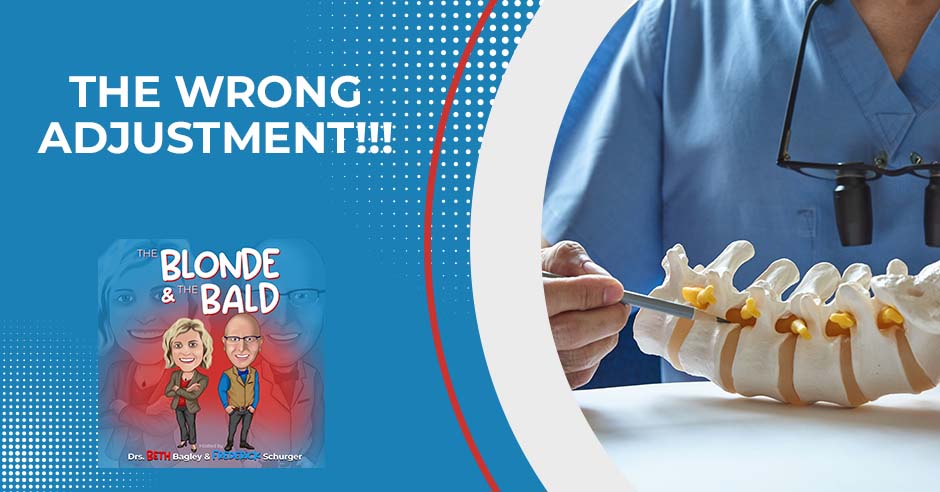
People make mistakes, but as Chiropractors, our goal is not to make those mistakes. Why? Because a mistake can be life-threatening. In this episode, Dr. Frederick Schurger and Dr. Beth Bagley share some experiences of seeing the wrong adjustments made and how they were corrected. They dive deep into the use of technology, explaining how X-rays can be an important tool in Chiropractic. Listen for more stories of anomalies done in Chiropractic and learn from them today.
Listen and read the full blog post here
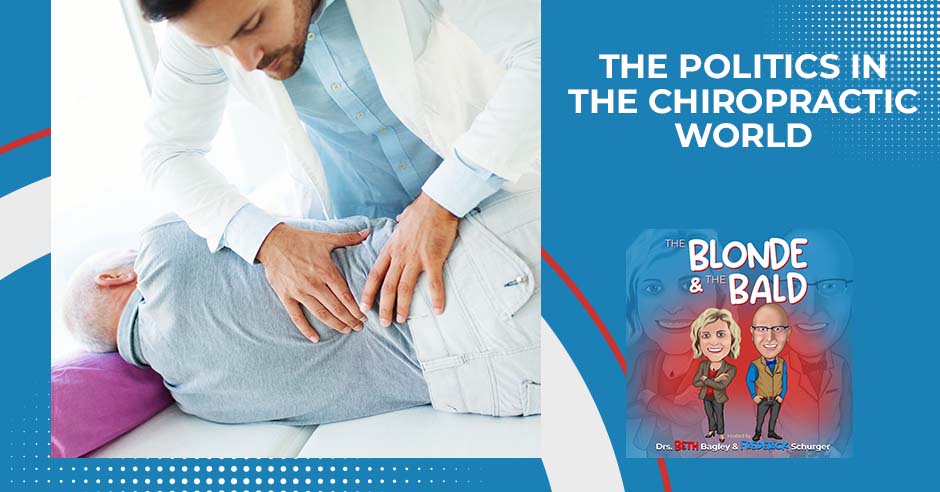
Have you ever wondered why chiropractors and medical doctors don't get along? The answer is much deeper rooted in the political world than you think. In this episode, Dr. Frederick Schurger and Dr. Beth Bagley cover some of the political landscape around Chiropractic and some of the common misconceptions that have been going on over the years. It’s high time to put these again to light, as some of these political issues are still ongoing until today. Tune in and learn what’s going on in the political world of medicine and chiropractic.
---
We are going to go over some interesting ideas and topics. Don't run away because I'm going to say it. We are recording this about a week after all the elections. We are going to talk a little bit about politics but not be political. It is important. It is something for people to understand a little bit about where chiropractic came from. Your grandfather probably went through some things back in the day.
This goes to the state that our world is going through for whatever reason. People don't understand why some people are so passionate about where the world needs to go. Let's back up. Let's talk a little bit about the politics around chiropractic, going back to the 1910s to 1920s when chiropractors were being persecuted for practicing medicine without a license, even though they weren't practicing medicine.
I had a patient ask me, “Why do medical doctors and chiropractors not get along?” I was like, “That is an excellent question but the answer is way longer than I have to talk to you about that.” The truth is it is not true anymore but there was a time when that was true. It was about misinformation. There was a campaign of misinformation.
There were multiple levels of this throughout the years. I mentioned it before but there was a time when there were chiropractic schools as far as you could throw a stone from one school to the next sometimes. There were also medical schools available throughout the country. Now, if you have more than about 2 or 3 medical schools in a state, that is a lot. Some states have more than others, certainly. There was a big change in what was being accepted for medicine. We could go back and forth and talk about Rockefeller but I don't care to. Quite honestly, that is another rabbit hole we don't have time to get into.
Books have been written on that subject.
Back at the turn of the century, there was a large push for medical doctors to try not to have chiropractors get their sick patients because prior to antibiotics, that was a big thing.
As we go through this, know that we were not attacking a medical doctor in 1918. I'm not attacking them. This is what they were taught to do. They were taught to do this in medical school because of the influences of why you were talking Rockefeller but influences of big pharma. It became big pharma all the way starting back then. That was real.
It became a standardization of things. We talk about what is the difference between chiropractic and medicine. It is a field of study that is even separate from something like osteopathy, although osteopaths and medical doctors look very similar in what they are doing. This continued. There was fighting but it wasn't bad until about the 1960s when the American Medical Association made a big push to eliminate chiropractic from the landscape.
That is why the schools did a hard push to say, “No, if you are associating with chiropractic, it is a cult. Chiropractors are this side of the devil. If you associate with the chiropractor, we are not going to give you your hospital privileges. You are not going to have good standing in the community.” They would run out of medical doctors who were siblings to a chiropractor. It was a big issue.
As things go, it wasn't a conspiracy theory. It was real. Wilk suit started in the ‘80s but continued into the ‘90s. My brain says 2001. There was still something going on. It has been a while since I have looked at that but certainly, it started in the ‘80s going into the ‘90s. They had realized there was an active campaign by the American Medical Association to eliminate chiropractic. Thankfully, some people were whistleblowers at that time. For those people who wanted to do a deeper dive, that was Wilk versus the AMA.
The only sad thing is we have a situation where chiropractors and medical doctors still have this. There seems to be this disconnect that is slowly being healed. There is not necessarily an active engagement with chiropractors in medical school unless they reach out from time to time. The flip side of that is even worse. I was talking with a medical doctor who is a patient of mine. She is into functional medicine.
We were talking about the A4M Convention, which is a functional medical meeting that brings all sorts of medical doctors, other doctors and health practitioners into the same room to talk about stuff that is beyond your normal medicine. People don't understand that when they get their labs done and I have said this in other places I might not have talked about on the show yet but there is a range that people go that you fall into that is the “normal.”
The problem is all the people that they are doing medical tests on are sick people. You have the standard deviation or that old bell curve they talk about, within two standard deviations of the people in your community who are getting tested for red blood cells. Anyone underneath the standard deviation twice, which is the end of that bell curve, is sick on either side of the spectrum. Everything in the middle is normal. That is a mathematical term that doesn't translate to what is healthy. Functional medicine looks to a much narrower range that might shift one way or the next that says, “You should be in this range to be functionally well.”
I love this idea. It is great for everyone to understand this better because what is healthy? What are you doing on a day-to-day basis that will make you better? Is it 10,000 steps a day? Is it drinking half your body weight ounces of water? We could go down the list. I love to go to the A4M meeting someday because I'm a numbers geek and I'm fascinated by this stuff.
The problem is we have chiropractors who want to do all of this functional medicine stuff and some of them are doing it well. I hate to say bad things about my colleagues but they don't know how to adjust. if they knew how to adjust like we know how to adjust and get people, they probably wouldn't do the functional medicine because they wouldn't have time.
You and I have both had busy weeks seeing lots of patients. I sat down with one guy at his cholesterol and I said, “Here is your problem with your cholesterol. Retest this in three weeks. It doesn't take a whole lot. Stop eating the bun at McDonald's. Stop eating the fries. Get a bunch of burger patties, have a good time with it and you will be fine.” I know that sounds weird with cholesterol but that is a story for another day. I love this stuff but I rather adjust you, get your body working and tell you, “Don't eat that piece of junk food. It is almost that simple.”
We recorded this back in November 2022, right before Thanksgiving. What does being a chiropractor mean? The things we are trying to protect some of our rights were simply being able to take an X-ray. You are getting your cone beam installed, which is a CT but it is technically an X-ray machine. In some states, they are still a little bit fuzzy on letting us take or utilize a device like this, even though we have been using X-rays since the dawn of the profession.
Even in other countries like Canada, if they are not close to it, they have already taken away X-ray rights in some provinces.
They have had trouble. We want to make sure that doesn't happen here in the USA. We want to make sure that we can physically take a picture to see what is going on with the person and how they are built because it makes a huge difference in how we need to get them adjusted. I had a patient. Her kids have been under care for a while. She was like, “I don't like anyone adjusting my neck.”
She has been seeing a regular chiropractor for a while and she is seeing the kids doing great. She was like, “It is my turn. Come on, Doc. Can I get in this week?” I said, “Sure.” She feels better already. The best part about that one is I put her on the balance scale. She was 20 kilograms off. It was a lot. Afterward, she was within 6. She was like, “I feel straighter.”
You measure people in kilograms, for real.
I do and there is an important reason. Beth, how much do you weigh in kilograms? Do you know?
You are saying, “It is because we don't worry about the weight.” I see what you are saying. You are probably correct. I'm going to try that out. Thank you for that.
Quite honestly, it is because my scales, when they power up, they start up in kilograms. There are two reasons. One, I can be lazy, not have to try to go through it and reset it every time. Two, you don't have to think about the weight. The difference should only be about 1.4 kilograms.
For someone reading who has no idea why we are doing a bilateral weight scale is because your two feet should carry equal weight on both of them when you are standing straight. What happens is someone's leg will start pulling up but you can't stand on a floating leg. What happens is you put more weight on that leg and 20 kilograms is quite a bit.
It was a lot. She was having neck and arm pain but no low back pain at this point. She had it in the past. This wasn't a thing going on at the time. She had adapted to it. I told her, “With this change, she might have some low back pain on the opposite side coming on.”
It tries to rebalance.
Getting back to politics and where chiropractic starts, I don't want to infringe upon a medical doctor. I got some supplements here. Half the reason I carry the supplements I do is because I take these supplements. I get a better discount. If people want them, I send them to a place where they can get them online or buy them from me. I like these things and I play in that functional space for my health. I don't want to infringe upon my medical doctor friends who are going to deep dive. They have the time to spend with a patient to appreciate these things.
This is where I want to be able to protect my rights as a chiropractor doing what we do, not have somebody else trying to do what I do. Whether it be a PT, MD or osteopath, we all can play a role in improving people's health because we have to be responsible for ourselves. The other thing is I don't think people appreciate that they need to be responsible for themselves. They want to give it to somebody else. I was listening to Jordan Peterson and Russell Brand.
Chiropractors like playing in that functional space for health, but they don’t infringe on their medical friends to do the same. This is among a chiropractor’s rights that deserve to be protected.
I watched part of that. I didn't watch the whole thing.
The fifteen-minute video or the clip that I got was interesting because Jordan Peterson is talking about how Moses took the Israelites into the desert in Exodus. One of the things that people around him, I think it was his father-in-law, noticed how much he was being worn down because all the people were coming to him to solve his problems. He ended up being effectively a mini Pharaoh in the desert. What he did is he said, “You need to make it smaller. People can solve their problems at a smaller and more centralized level instead of these hundreds of thousands of people that he had brought out into the desert.” A group of ten can figure out what they need to do to solve a problem a whole lot better than anything else.
Jordan goes on to say, “What do you need to be responsible for?” He was like, “You need to be responsible to your spouse. You need to be responsible and have a job to make a healthy wage. You need to take care of yourself. You need to stay healthy and fit as part of this. You need to have a family. You need to engage in your civic organizations. Join your business organizations and a political party. All of these things are very important.” This was the point he made that I thought was amazing. He said, “Every bit of social responsibility you abdicate will be vacuumed up by a narcissistic tyrant.”
That is where we are at.
People don't appreciate this with their healthcare. This is the beautiful thing about us as chiropractors. We will not take responsibility for your health. We will help guide you along this path but it is not your responsibility to make sure that I'm as healthy as possible. If I show up at your office for a seminar, I might say, “Check and adjust me.” We go down and eat a copious amount of McDonald's. I hate to harp on McDonald's. Maybe I should harp on Arby's. It doesn't matter. Wouldn't that frosty be awesome?
People don't appreciate this with their healthcare, but when you abdicate your own health to somebody else, chiropractors will not take responsibility for your health.
No, I can't imagine. My stomach hurts thinking about it.
It tastes good in the mouth but the rest of the body doesn't love it. I got at least one frosty right here.
I tell people, “If you have a stomach ache. It might be your body is out of alignment or it could be that you eat Doritos all day long. I can't adjust away the Dorito habit.” There has to be an aspect of personal responsibility, whether it comes to your healthcare or the world.
The worst part is if you get yourself far down a path, you have to go down the medical route. There is a time and a place for it. If you have to go down that medical route, how much do you trust the hospital system that you are going to get stuck in that is being run not by the medical doctors but by lawyers and bureaucrats that have more interest in their bottom line than your health and wellbeing? It is pretty scary stuff.
One of my goals with my patients is to keep them out of that system. I don't want you in the system. If you have to be there, I love you and l will pray for you. I will still help you in my office. My goal is to keep as many people out of that system as possible because it leads to one drug, another drug, surgery and another drug where we can solve so much by being in proper alignment, having proper nutrition, enough water and moving our body.
It is great when it is there because I had a patient who had her third child. It was a seventeen-hour labor. Anything longer than about 4 to 6 hours is considered traumatic labor. She had to get induced. They had to give her some Pitocin. She had some additional bleeding afterward. They sewed her up and fixed her up so that she didn't die because it wasn't long ago that women would die in childbirth. This is where the medical system is great. That is their job to fix you when you are in that acute situation. She was so happy to get her head on straight. She was like, “Doc, I went through too much. Put my head on straight so I can take care of my baby.”
It is incredible to see that change. We take care of a lot of pregnant people in our office. With these women, I do see better outcomes with their pregnancy than typical. They talk about their sister. The laborers are short. I calmly tell them. I was like, “If you want to have this baby in the hospital, know that being under care, your labor could be shorter than you are used to than your friends are having. It is a good thing but you need to go to the hospital and get checked out first.
Every now and then, you want the best possible situation in those where you love to have a home birth and no drugs.
That is up to each mom.
Sometimes that works out fine. Other times, you got to go to the hospital. You need that level of healthcare. This is understanding where the different specialties where those of us who are doctors, whether it be a medical doctor, chiropractor, osteopath, peds, gynecologist, you name it, we have roles that we are trying our best to do. We don't want to cross over those roles. That is the extent of where we should end on the politics side of things.
People need to know that there are different specialties where doctors have different roles, and they don't want to cross over those roles.
Do you have any case studies or any miracles that have happened in your office? I got one and I want to talk about it.
Why don't we talk about yours? I have been talking too much.
I saw her for her second appointment. She came in with several years of chronic headaches. Someone referred her in. It is a family member. She got her first adjustment. She said she realized and wondered if this is how normal people feel. I said, “Yes, that is how normal people feel.” She didn't have a migraine or headache. She felt good. She had energy. She got two littles at home. She was able to take care of them and be the mom she wanted to be.
The simple answer was she needed her head on straight and it wasn't. I feel incredibly blessed that I was able to help her, give her that chiropractic adjustment, that Blair adjustment and get her back on track with her health. She got checked. She only had 1 of the 2 vertebrae out that I had to adjust. She didn't need another adjustment but she felt like she did already. She may have overdone it a little bit because she felt good, which I didn't warn her about. I try to tell people, “If you feel fantastic, still don't go crazy. It needs time to heal.”
What most people don't realize is that you can't just go. Those people who have that miraculous change in the first 24 hours and sometimes even less are the ones who need to take it easy more than everybody else. If they push far too fast, it overwhelms the nervous system. We might talk about my kettlebell training routine another time because it is pertinent.
It is interesting. The Russians have figured out physiology better than the rest of us. All the research going into things like heart rate variability and nervous system, the Russians were doing it years ago, knowing how hard they can push, especially their athletes, which would translate to their soldiers. Neurologically, what they could do and when they had to break, pull back to address things. It is curious.
We may talk about that another time simply because it is interesting to think about how that translates. This translates to how hard I can train for the course of six weeks. At the end of that, what else is going on? How does that translate to someone's healing ability through their care and what they can and shouldn't do right off the bat? What we don't know is, conceptually, what is healing. Is it healing of the physical organ? Is it the body as a whole? How much of it is the nervous system trying to catch up and trying to fix everything else?
We could imagine a home renovator being overwhelmed down in Florida with some of those floods and the hurricanes that have come through and how hard it was for them to clean out a house and rebuild it. They can do that with a road within about 2 or 3 weeks that were decimated. I find that it can happen that fast. If only roads in Illinois got repaired that quickly. Missouri might have some better roads.
They are better. I hate when I'm driving to your office. I'm in Missouri and I'm driving across the bridge.
Hopefully, that is going to get all fixed. They have been working on that forever. Those are the big highlights of this episode.
We covered a lot. We got some good information and some wheels turned in on. People say, “Why haven't I heard of chiropractic before?” It is because, for years, it was suppressed. I'm glad to bring it up and at least have conversations around that.
The other side of it is for people to understand they need to be responsible for their health. You cannot help them heal and not go down the road to eating all the junk food. It is like you said, “You can't adjust out of a Dorito habit.” I like that. Dr. Bagley, that is going to call it for us. Here is the crazy thing. You and I are going to see each other after this. We may try to do a recording.
We should do an in-person one.
We will bring some mics. We will see how the audio works out. If people hate it, that is because we are playing things fast and loose with some hardware. We are going to try that with a couple of student doctors that are learning the ropes of this so they can share some of their experiences as well. People appreciate that more.
You can find me @PrecisionChiroSTL. I’m in St. Louis, Missouri.
I'm at KeystoneChiroSPI.com. You can find me in Springfield, Illinois. Thank you so much. We will see you next episode.
Welcome to The Blonde & The Bald, the podcast that showcases the amazing healing wonders of Blair chiropractic. Join Drs. Beth Bagley and Frederick Schurger as they discuss how their practices in the Midwest are using the latest science and cutting-edge technology to provide state-of-the-art chiropractic care. If you have ever been skeptical about chiropractic, these two doctors were probably even more skeptical than you are! What changed their mind and propelled them to the career that they have now? Join them as they introduce themselves in this episode and give us a sneak peek of what’s to come on the show. Tune in as they share their takeaways from the recent Blair conference, as well as their thoughts on the latest scientific and technological breakthroughs in the field.
---
This is going to be the inaugural show of the blonde and the bald.
Which one is bald?
In my first year, I was blonde. Apparently, in our family, the blonde went too bald very frequently.
At least you have a nicely shaped head. If I went bald, it would be not pretty.
Let's not go there and not even want to dare. Speaking of dares and things, what we might do, inadvertently, let's talk about the Blair Conference. What I'm thinking of what we'll do on this show, before we get them out there, we're going to do a bunch. That way we've got a bunch in the can already so as the holidays come in, we can be more relaxed if some of these will be lives. We should talk about certainly stuff that's topical as far as health in the world and tell people a little bit about ourselves and our own experiences. We'll do that on future ones. We got back from the Blair Conference. It was a great and beautiful weekend.
There were some things that, honestly, I was glad I was there. Many times, you go to a conference or spend all that time and money and you're like, “I should have stayed home.” I felt the opposite. I thought I got much good information, not just science stuff, but business stuff. It was incredible for me. I've got many action steps that I've already taken, which makes me feel completely overwhelmed. The biggest one for me, because it meant a lot to me for my own health, was the radiologist that came. She came and talked about the relationship between the jaw airway and the neck. All of a sudden, I've had a couple of dentists try to explain that to me through the years. I got it and I was like, “Sure,” but all of a sudden, I was enthralled in this entire two-hour presentation.
It was a full thing. I enjoyed it myself.
Dr. Dania Tamimi. It says that she's a chiropractor, which she's not.
She's a dental radiologist. She was from Saudi Arabia. She was fantastic. I know I'm going to take her Radiology course. It's an expensive class compared to what we typically come across, but the wealth of knowledge that she has is highly in demand.
We got the tip of the iceberg with those conversations she had. For readers, I wanted to go over a couple of the things that I wrote down. We know this. One of them was like we have discs in our neck, but there's a disc in the jaw. When people open, it's supposed to move with it. When people get the clicking, that means the disc is doing something weird then there's a breakdown of the jaw that happens.
There's a restructuring of the jaw, which is what we see a lot. People have already had this restructuring process go on. It was cool to hear her talk about it because the jaw is important to life because we talk, breath, chew and all the things. The body has the technology that it's made so well that it will restructure to still allow people to have somewhat of a functioning jaw even when it's damaged.
It's not just that. Unlike the discs in our spine, once the degeneration process starts, that damage is done. It's a scar on the spine, as Dr. Matthew Richardson likes to call it down in Palmer, Florida. I'm throwing names out and patients reading are going to be like, “Who? Do I care?” No, but the important part here is that, unlike our spine where we can't have those discs regenerate or at least they can't completely reheal, TMJ can, given the right circumstances and opportunities on its own. It is miraculous when you think about it. It's very exciting in those regards.
One more thing I wanted to bring up is that people at home can do this too. She did this test where you can see the relationship between the neck and the jaw where you put your teeth, don't clench them, but put them barely together and then shake your head. You can feel your teeth at the top and bottom move when you're moving your head because it is connected. As chiropractors, we're going to be like, “Here is more important.” A TMJ dentist is going to say, “Here is more important.” The truth is, who cares? They're both important.
Sometimes you got to work on both. The way I like to think about it is if your head is your garage and your TMJ, your jaw is your garage door, and your atlas is your foundation, sometimes because the atlas is off, the foundation is off, the bite will be off. You've seen some of these springs on these garage doors. If they jam up wrong, it's going to cause that house to move off the foundation incorrectly. It could even damage the foundation. You've got this back and forth between these things that need to be addressed and handled delicately, and truthfully by people who are truly experts and have studied this area for a very long time.
If your head is your garage and your jaw is your garage door, your atlas is your foundation.
That was my first takeaway, which I liked. Some other people that came, we had, Dr. Simon Senzon. I've read his stuff before and I've seen videos of him talking before, but I've never seen him in person. He has done such great things for our profession.
He's a chiropractor, got his Master's and now he's finishing up his PhD thesis. That was the juxtaposition juxtaposed. That was the crux of what he was presenting. What he had discovered by looking at all of the research that exists within chiropractic is a handful of papers that do not support themselves. They should not be from a peer-reviewing process, the process that we have in society that says good science follows these things here and the objectiveness of that science falls into certain guidelines.
He found eighteen papers that were outside before that should never have been approved. The two scary parts to that are many of the people who wrote those eighteen papers are writing the same papers. It's not like we have eighteen different people. We might have seven different people contributing and everybody else is referencing those papers. This is like this Alzheimer's thing that's popped up in the news media where they had a research that says, “It's the tau protein that we're looking at. This is the problem that we got to solve.” It was a complete lie. It was fabricated research. Unfortunately, the same thing happens for chiropractic.
That one is 17 or 18 years of research. Since then, it has been done based on this fabricated lie. How many millions of people have been affected by that? Where there are offering medications to try to fix something that's not the broken part?
They've seen time again and again that this is Alzheimer's. It didn't work out properly, then they said, “Let's try it anyways because it showed to be a little promising,” and yet what are the side effects from some of these drugs? Some of these drugs are nasty. We won't get into some of the side effects.
We could do a whole show on that.
We might have to come back to that.
It's kind of a poison. You've got one study and then all of these other studies say, “This is what I'm referencing,” but if that study was done poorly or, now all of these other studies are tainted and then studies that they are done against that they're tainted. That can happen in any profession, but it happened in the chiropractic profession.
This is where we've got to be careful because now we're starting to say, “What research is invalidated by those papers?” That's one aspect. I've got one patient who's going down the entire upper cervical chiropractic rabbit hole. He's loving this. He's getting excited. One of the other things that Dr. Senzon has done is he's gone through all of these chiropractic green books. I've got The Bigness Of The Fellow Within. This thing is one of my favorites. I'd love to say one time, we're going to read something out of this, but it would drive people batty.
He went through all of the green books, categorized them and has not only figured out how our history got us to where we are, but also, started to dispel some of the myths about why chiropractic did what it did. A lot of people are like, “This subluxation has no meaning,” and yet, getting back to these eighteen fatally flawed papers, they are saying, “Subluxation isn't something we should be using. Describe what is going on here in the upper neck.”
“I think I prefer using either atlas displacement complex or neuro structural shift because it's easier to understand.” In reality, these subluxations are supported by our literature. If we did some research to start to unpack what that is, we start figuring out what's going on as far as people's ability to function, heal and work the way they're supposed to, which goes into that one crazy guy in his presentation. The one with the cowbell.
Is that you?
That's me.
What you're saying is you want me to segue into the research project that you did in the paper that came out that has been published.
I already told you all about that. That's on another show. What were your takeaways from my presentation on that? What did you think?
You had done it before for me because we've been in done seminars together. I did know a lot about it and I've read the paper. In general, it was cool to see that there is a correlation between a specific upper cervical or cranial cervical junction adjustment and an immune response. Not just with our technique, which is the Blair technique, but with other specific upper cervical techniques too. There is more research to be done and my biggest takeaway is we need to know more.
I've been thinking about different ways that we can go back and redo parts of the study to figure out what our next game plans need to be so we can figure out how the response. It is because the study showed that within 30 minutes of getting adjusted, your innate immune system that attacks viruses and pathogens, as soon as they come into your nose, mouth or eyes, there's an immediate response to improving that function. After weeks, it drops back down to some new baseline. We don't know if that means anything. We don't know what the path of that curve is. That's the interesting part of that. I'm excited about it. It's something that we have known.
There was that Spanish flu back in the 1900s. Chiropractic hospitals had a better survivability rate than chiropractic and osteopathic hospitals, which suggests something tied to manipulative therapies because osteopaths were doing manipulative therapies back in the day. We had a better outcome, less mortality, and less people dying than the medical hospitals at that time.
There was also some correlation possibly between the introduction of aspirin at that time. If you look into it, in the chiropractic hospitals, they weren't doing sure aspirin therapy. It might not have been aspirin, but it was something like that could have also created poorer outcomes for them. It was the combination.
Sometimes, the best outcome is doing nothing. That scares people because the body is an amazing thing and able to heal itself.
Are you done touting how amazing you are?
I've got it in other places. If people want to ask to see it, I'll send them to those places.
We can do a whole show on it. Moving on. We had some discussions about the newer technology for chiropractors called CBCT. I don't have one yet, but I'm getting one. You already have one. Can you explain what CBCT means?
CBCT stands for Cone-Beam CT because it's a Computerized Tomography or CT. What's neat about the CBCT is it's able to take a picture and create a 3D image of your entire spine head skull, the whole nine yards, in about 20 to 30 seconds and you're out of the seat. It is a very exciting technology. Previously with an X-ray, we can take some nice digital pictures, but we weren't getting 3D. What the Blair technique has always been about is how we adjust our X-rays to take what we would call an oblique film, but basically to start looking at the body from a more 3D standpoint, and taking a picture of the joint. Now we can see it all in one piece, which is exciting.
I'm excited that you're going to be getting one down there very soon. That's awesome. It is a lower dose of radiation than even what we were taking previously for X-rays. It is very safe and fast. Patients love it because, within about five minutes, I can show them their skull and their head. We can look around it and see what's going on. We can see the degeneration. We can even put layers on top of it that show a little bit of their skin so they can see where their skin is. They can even see their nose.
It's fantastic. I love the technology because it's made my life much easier, to be able to see what's available, how we need to address it, and how we're going to adjust patients. Some people have big old what we call asteroids. It is sitting in front of their atlas, and we've got to figure out a different way to adjust them. In fact, I've got one young man who I adjust but I can't get to his atlas. I have to adapt my technique to adjust him and keep him doing well. I'm excited. You’ll going to love it when you get it.
The X-rays we take in the Blair analysis are time-consuming and hard to get right. I'm not against them, but it's hard, especially since I'm teaching the younger generation how to do it. There are less chances of messing up doing CBCT. The analysis is still time-consuming, but the actual taking of the imaging, I'm excited for that to be much better in the office. That's going to help us with time management too.
It allows us to be able to say, “I don't like that angle. I can shift this angle a little bit.” Now I see it from that perspective.
It’s all on the same image file. You don't have to retake anything. If somebody was to ask you, “CT, I've heard that's a lot of radiation,” what would you say?
This is where cone-beam technology is going to be the next generation. It already is the next generation of CT. When you're getting a CT, chest or head X-ray, it is more akin to that original X-ray technology where it's coming straight across. The cone-beam is literally creating a cone of information that is coming from the source out to where a plate as it were catches all the information through the skull, which has always been X-ray technology. You have your source over here, your plate or whatever it is that catches the information. On plain film X-ray, it was creating a hologram. Now we're catching all that, but because of the way that it's sending the information over and recording it, it requires much less radiation.
That’s incredible.
It is. From 100 years ago, when X-rays first came out, that was a high dose of radiation.
The technicians would get cancer.
People who were in there might get a burn because it took a minute to set that entire thing. Now, it's twenty seconds to go all the way around the patient, which is the longer it takes, the better resolution you get. I've got a twenty-second picture that's already at a low dose because of the way the technology works, that it's a fraction of the time and dosage compared to what other CTs have been in the past.
In comparison, I'm looking at a radiation dose chart. Is this about the same amount of radiation you get on an airplane flight from New York to LA?
I think that still holds up pretty well.
I saw it was between 10 to 40 and that's 40. That background radiation you'd get on a day living your life is already at ten.
Where we're at here is much less compared to somebody living up on top of Colorado, which is much higher. People living up there are not having any problems. They're smoking more pot. They're not having problems like that.
In general, what we're saying is that whether you're getting dental X-rays, regular X-rays or the CBCT, the technology that exists now creates such a small dose that we're no longer in a dangerous zone for anyone.
It is advanced so much, with the ways that they have been able to figure out how to make it more efficient. In comparison, our X-ray units needed 220 power. It's comparable to what some dryers and washers have needed in the past. The CBCT unit, the whole thing, can be plugged into a wall socket. To put it in perspective, this thing has got a lot of electronics going on in there and it still runs off out of a wall socket.
It's unbelievable to me. I'm excited. One of the other parts of going to a conference like that is networking, talking to your fellow doctors, and having good conversations. I love my Blair family. I get to see my family once a year to go to this conference and it's incredible. I get to see you more than once a year, thank goodness since we're about two hours apart, but for a lot of people, that's the only time we get to see them in person.
We had some good times. I got to go out to dinner with the three Liz’s.
I was one of them. I go by Beth though. Don't call me Liz.
The three Elizabeths. Because you were Beth, Lundy was Beth and Liz is Liz. I don't get to see Dr. Lundy once a year. I don't get to see Dr. Hafer. I'm lucky if I can see her twice a year.
Speaking of Liz Hafer, did you see her post on Facebook?
No. Did she pass?
She did. Now she has Dr. Sugar, you have a diplomat in Craniocervical Junction. Dr. Liz is now part of your club.
I was part of the inaugural class that started in 2013. The research paper that we did was a bunch of diplomats. I finished that in 2015 and Dr. Hafer finished that for herself. As a funny aside, we sat down for the Instructor Summit, Thursday night before the conference. I said, “I'm going to sit down here,” then Dr. Mychal Beebe and her husband, Dr. Tyler Evans, Dan Judge and Dr. Ian Bulow all sat down in a row on one side of the table. Dr. Hafer was on the other side and we made the joke. It's like, “Only DCCJP is over on this side. You can't be over there. You stay over there. You haven't passed yet.”
Now she can come to that side of the table. On the other hand, I am far away from that table. I'm not planning to come to that table anytime soon.
We have other plans to keep you busy. We might have close to a dozen DCCJPs in the Blair Society. We are well represented in that group because we've been forward-thinking on that. I'm excited. I think we've got about maybe 60 to 80 or somewhere in that ballpark after three classes. It's exciting. We've got a couple of others. Dr. Steinberg and Dr. Beard are planning on doing it sometime here in the near future. It'll be good for them. What else do we want to talk about?
I was thinking one of the things we could do is because we get to see miracles in our office every week. I say miracles, but it's science. We know what's happening, but it feels like a miracle because the healing is powerful and sometimes quick. I wanted to go over one case study in my office. This young lady came in with pretty severe vertigo episodes about twice a week. She's a nurse. She does a lot of bending, lifting, and twisting. She’s young. She’s in her early 30s, if not late 20s and it was affecting her life.
She went to an ENT. They gave her the normal Meclizine and one other thing, maybe steroids. I pretty much said, “Good luck.” The truth is I'm not blaming the ENTs. They don't know what we know. What we know is that when the top bone of the neck has a shift in it, it can cause problems with the vestibular system. The vestibular system is what keeps us steady. When you have ever maybe partake in drinking alcohol, that will affect the vestibular system.
That's why you see people fail with vertigo. They're standing and they start going because they're starting to have vertigo. They don't know where they are in space. Vertigo is pretty debilitating because you'll start seeing nystagmus where the eyes start twitching like this and they're spinning. They don't know how to rewrite themselves. Sometimes, for some people, vertigo can last for hours. They can be vomiting and it's awful. She didn't have it that bad, but it was affecting her ability to do her job as a nurse.
She came in and within the first week, instead of having two vertigo episodes, she only had one in two weeks. She was pretty excited because she could tell a difference. Ever since that last vertigo episode, she has had zero vertigo episodes. She's doing better holding her adjustments. She does work nights and it's a hard job. She may not hold it as well as some people, but she is doing excellent and she's ecstatic. Letting people out there know, if you've had vertigo, find a Blair upper cervical chiropractor. It's incredible. It changes lives. If there's no Blair upper cervical chiropractor available in your area, contact an upper cervical chiropractor.
If you have vertigo, find a Blair upper cervical chiropractor. It will change your life.
We've seen such great responses there. In fact, Dr. Berkhan, who forwarded all of Meniere's research that got a lot of this vertigo or Meniere's cases into our offices, his office has been closed because they did road work in front of his office. He took the advantage of that time to get some surgery done on his shoulder, which thankfully he's doing better now. He was telling me when we were at the Blair Conference. I was chatting with him on the phone.
He wasn't at the Blair conference.
That's why. He's been working twelve-hour days. He's starting to get back into the office. Oftentimes, he's probably still working and seeing patients for another hour or two. He's been getting people better. It is amazing what we can find and help people within those regards. In fact, I was thinking about, “What's my patient that I wanted to share?”
He's vertigo or Meniere's. He's got some other weird stuff from his time in the military that we're slowly getting him out of, and he's doing better and better every day. I'm hoping that he's able to get back to doing some work on his own so that he doesn't have such problems with it. When he gets adjusted, his body doesn't want to go six different ways as it tries to go through the healing process and fix everything in sight. It's always fun. We see so many changes.
I was talking with the father of one of my patients. He brought three of his daughters. They got checked and adjusted. All three have been holding steady since their first adjustment. They're not giving me any information. I asked dad, “How are the girls doing? What's your take on them?” He's like, “They're doing much better. They're clear, sharper focused and working better.” I think we had two migraines and the third one had a foot problem like dad did. I fixed his foot problem by putting his head on straight. He is like, “We're going to get that one too.” It is amazing the stuff that's connected. We don't even understand what happened.
Sometimes you can put it together, but honestly, sometimes I will tell people, “I don't even care how this helped, but I'm glad it did.”
Some days, it makes sense and some days, I'm like, “I'm tracing it. I understand the anatomy. I don't see where these two come together. It's one person,” and we get that one person functioning, healing and working the way we're supposed to.
That's why we have a passion for what we do. Honestly, it's hard what we do. Running a business is hard and all of things. We could make a lot more money doing other things, but I would never change what we do for anything because I get to see many people get their lives back and their health on track. If you don't have your health, you don't have anything.
If you don't have your health, you don't have anything.
We will definitely be talking about your past life and my past life before we got into chiropractic in the future.
I'll be open. I don't mind. Lastly, I want to say is, if somebody sees this show and there's somewhere to comment like you see on Facebook and you want to know something, there is a topic that you're like, “What does that mean? Does this help with this or anything?” We're always happy to answer questions. I like when this is an open dialogue. I'm hoping that at some point we can maybe bring a patient on and interview them. I can think of a few patients that wouldn't mind Zooming with us and talking about their experiences with this incredible healthcare that we love. We take it for granted a lot because we see things get better. We come to find out that doesn't happen in a lot of offices.
It doesn't. Even some days, it doesn't help when we don't get better or if we have a problem, we're in a pinch. I don't mind sharing that sometimes I'm in a pinch more often than I care to admit.
It's hard being a doctor for everybody else. We wouldn’t even doctor ourselves.
That's a good spot for us to wrap it up. In the meantime, people can find me at KeystoneChiroSpi.com. What's your website?
precisionchiropracticstl.com/.
Everyone will come and find us and we're going to have some fun with this show over the next several weeks, months to maybe even years. We'll see how far we go. We'll talk later.