
There's been weird discussions about biohacking lately, and a lot of people in the Chiropractic community don't realize that Chiropractic IS the best biohack out there. Drs. Beth Bagley and Frederick Schurger cover what is going on that actually supports how Chiropractic completes a lot of what most Biohackers would say are the top 8-10 items that qualify as biohacking. Whether or not you consider yourself a biohacker, see how you can benefit from chiropractic care from longevity to strength & from improved immune function to overall well-being.
---
Dr. Bagley, how are you?
I am well. How are you doing, Dr. Schurger?
I am doing excellent. I have had a good week.
I heard you ate 300 grams of protein.
I did.
I ate 400 grams of protein. I'm better. It was closer to 40.
That's the problem.
It was not a good protein day for me, but I'm glad it was a good protein day for you.
When I stepped on the scale, it was only one pound up. I'm not unhappy with that change.
The increase in protein leads us to what we're going to talk about, which is something called biohacking.
Dr. Bagley, the question, and this is going to be the title of the episode because people will already have seen it, but the question is, what is the best biohacking? Why is it chiropractic? I sat down, and I've had a couple of people talking about this. What's this big deal that people don't think chiropractic is biohacking? Chiropractic was probably one of the first bio hacks that was properly introduced.
BJ Palmer was the original biohacker. He was such an innovator in our profession but in awesome things.
Our chiropractic in radio and printing. He was printing X-ray. The list goes on. That's one example of somebody who has gone through and, because of what he was doing for his health, was able to take that to a new level for many people. It's been this weird back and forth. People are like, “Isn't chiropractic biohacking?” It is.
I love the Brave browser. For those of you who haven't been paying attention, the Brave browser is one of the cleaner browsers out there. None of the browsers is great for hiding all your information and making sure you don't get messed up. I asked it and did a search. What are the best reasons to biohack? The AI-generated list is eight items that I would generally agree with. These are the benefits of biohacking. I'm going to hit down the list, go back, and hit each one of these individually.
I have an aside that has nothing to do with what we're talking about. I'm the color commentator for the night. My mom bought a new computer. She, who is not great at computers, said, “I want to put the Brave browser on.” I was like, “My mom knows some stuff.” It’s a new computer, Windows. I was helping her do it. I downloaded it from Brave.com and tried to install it.
We love Windows and Bill Gates because he is the ultimate biohacker or biokiller. It's fine. I know it's not him, but the company has made it hard to install applications that are not Windows-approved. I looked up three different ways to change the settings, and I had to go back to work at that point, but I still couldn't figure it out. I was working on it for twenty minutes and still could not install it. I could download the app, but I couldn’t install it on her computer.
This is a several-year problem that I thought was solved because Bill Gates, with his Internet Explorer, killed the Netscape browser, which was a superior browser to the Internet Explorer. He made it almost near impossible. They're revisiting that.
It made me mad. I was like, “There is going to be a way that I can do it.” For someone her age who's not computer savvy, this is going to be another half an hour of me trying to find the setting because everywhere that the internet says it is, they've moved it.
That's the best way to use Internet Explorer to download any other browser.
It's not even the Internet. It's called Microsoft Edge.
That's what it is now, along with all the problems with Microsoft. Back to biohacking, we've got eight bullet points we're going to go through and explain why each one of these and some of this crossover. It’s only six items in reality.
I'm going to read the disclaimer here. First of all, because we're talking about it, it doesn't mean you should do it. Talk to your doctor about this.
If AI generates an answer, check it.
It could be right or wrong.
It could be completely fabricated.
The first thing it says is that biohacking is a practice that involves using various techniques and methods to optimize one's physical and mental well-being. Some of the best reasons to biohack include, and here we start with our list.
Improving health is number one.
That's why going to biohack to not. That's the point of it.
Number two is enhancing cognitive function. Number three is increasing energy and vitality. Number four is reducing stress and anxiety. Number five is extending lifespan.
That’s a big one. A lot of people talk about that.
That's becoming more popular for various reasons.
I'm going to download my consciousness into the internet and live forever.
Number six is optimizing physical performance. Seven is improving mental clarity and focus. The final one is enhancing creativity and innovation. I can see how enhancing creativity and innovation will fall under cognitive function. That mental clarity and focus also fall under cognitive function. You can see where these overlap.
Improving health right off the bat, we do this day in, day out, in chiropractic. This doesn't necessarily directly impact those of us who do something like blare up or cervical. Eliminating aches and pains is improving one's health. As you have more pain, you have a problem where nerves that fire and wire together. Those pain receptors are overwhelming your nervous system. That's a major problem.
Improving health is a win for the weak. It wasn't even my patient. It is Dr. Thomas's patient, but I got to see her. She's on her second or third visit. She goes, “I am feeling so much better.” I was like, “That's great.” She was excited and bubbly about it.” She goes, “I've also noticed at this time of night, my tinnitus would be terrible. I don't have it at all.” I said, “That is exciting.”
I told her out loud that there are different types of tinnitus. Some respond well to this type of care, and some don't. I said, “I'm excited that yours seems to be responding.” I can't imagine it because I have some form of tinnitus from the injury. Having that high-pitched squealing is when it's that loud. That's a biohack. It’s like, “How do I get rid of tinnitus?” One of them is chiropractic. I love that. Do you have any wins that you had?
I do, but I'm going to bring it in at a different point here on the list.
I'll allow it.
Other things that improve your health is improving your immune function. I'm looking at neuroimmune function. They found that eighteen found a significant effect on immune markers out of 21. It’s 86% of the pieces and parts of the studies that they looked at that found a significant effect on your immune function when you're under chiropractic care. It’s not necessarily talking about what we do directly because what we do directly shows a direct impact on our secretory IgA. It’s a significant improvement and increase in that immediate time after an adjustment within 30 minutes.
Let's break that down for someone who doesn't know what any of that is. IgA is an immunoglobulin, which is a clump of proteins.
Secretory IgA is your frontline defense for your immune system.
It's going to find bad guys.
We have two immune systems technically running in our body. It's more than that. There's some back-and-forth playing with it. We have the innate immune system, which is all our mucus membranes and our gut. If someone sneezes in your face, your innate immune system is what's going to fight off those bugs if they are toxic or a problem.
That's the first line of defense. Secretory means you're secreting it and how you guys tested it with saliva.
Secretory IgA is the most abundant immunoglobulin in the body. This is significant and impactful. It tells us that this study here was looking at other immune markers. I don't believe they looked at secretory IgA. They published this study at about the same time we did. Secretory IgA has a spike right off the bat. It goes up as soon as you get exposed to something that is toxic or noxious to your body. Within a couple of days, it drops back down. It's the one that learns. The other immune system is the adaptive one.
I had to google it, sorry.
No, that's fine. Sometimes, every word doesn't sit in our brains, especially after a long day of work. The adaptive immune system learns from what the innate immune system is finding. They talk back and forth. From this, we are able to develop long-term immunity to things. This is why there was this back and forth about, unlike every disease we've ever come into in mankind. COVID, having it once, does not show immunity to it in the future. There were some lesser degrees, but that's a Coronavirus problem that is less a COVID problem. Coronaviruses are changing rapidly.
This is why it is impossible to get a vaccine for Coronavirus.
That's neither here nor there. We're talking about improving health. When you get adjusted right off the bat, your secretory IgA and your innate immune system increase their function to levels to deal with whatever's going on in your body. If you have an infection, a cut, a bruise, or anything where the body would be numbly coming in to work on, it's going to make an improvement to that. It's going to fight off the baddies and communicate to that adaptive immune system.
This was a study done with upper cervical chiropractors.
The secretory IgA was done solely with upper cervical chiropractors. I was one of those doctors. I can definitively say that when I adjust someone, the odds are good that their secretory IgA increases because all ten of my patients showed an increase.
The aside is we also hear that from our patients. Teachers start coming in, and they don't get sick the whole year, whereas they get sick left and right. When that kid coughs in their face, IgA is working to be the frontline of defense so that they no longer have the baddies in them as much, and they can fight it off faster or completely. Reason number one chiropractic is the ultimate biohack is it increases health with immune system function.
The next point was enhancing cognitive function. For all of these points, we could probably go on. I will drone on and on.
I'm going to try to stop you.
The second one is enhancing cognitive function and improving their ability to function and do other things. The one study that I pulled up because I remembered it was improving in signs and symptoms of ADHD and functional outcomes in four children receiving torque release chiropractic. It wasn't a lot of kids. We had a handful of children in this group. Their symptoms improved by an average of 17%. For functional status improved, on average, by 23%. General well-being improved on average by 21%. We see ADHD kids all the time. All of a sudden, they were having problems in school, and their grades went up.
It's cool to see that. One thing I tell parents is, “Adults tend to feel pain when they misline.” Not everybody will feel pain, but we tend to. Kids exhibit more. Some of them will have pain. I'm not saying they don't. A lot of them will exhibit behavior changes rather than pain. That could be anything from concentration issues to insomnia. Kids sleep and concentrate better. They also have fewer outbursts, like anger issues. We can see a ton of stuff like that. It's amazing.
I had one young man. His grandfather brought him in because he was doing poorly in school, but yet, you are talking with the kid. You knew he was smart. Both he and his brother, who had bad asthma, were sharp as tacks. The older one was having a hard time in school. His cervical curve was in the wrong direction.
It should be a banana shape. If it's not a banana shape, it is in the wrong direction.
He was one of my first patients to have that curve turn around almost immediately, which was exciting. e started doing better in school. Talking about wins, I've got a concussion case. She's been on disability for a year now. We've met Kelly. We've talked to Kelly in the past, but she's had trouble being functionally present when she's sharing her story or trying to make it into the office. She was having a rough week. She's been doing better.
I'm hoping we broke through on something with upper cervical work and the NRT. It’s the nasal release work that I'm doing now. She was more clear and responsive. She understood. The room was physically brighter to her because she could perceive things better. I was excited to see that change in her after working on her. I'm hoping that continues on. I had another case. She was the one who prompted how we worked on Kelly. She was having some trouble. We unlock some stuff for her. I'm hoping that's going to help her hold her adjustment better. That's enhancing cognitive function.
One more thing for my own personal cognitive function. When I am in need of a chiropractic adjustment, I know it before pain comes on because of my cognitive function decline. It's not that I can't talk to people, but it'll take me longer to come up with the words. Everyone forgets a word here and there. We forgot adaptive, but it's different than that. It's easy words. My brain goes past the word. I have to run around and find it again. When I read, I will read a paragraph and forget what I read. I'll have to read it again.
I remember as a kid, that's what I had to do a lot. I was a smart kid. I got all A's. It took me forever to read. I would learn more by people talking to me and writing down notes. To this day, I don't learn by reading well without taking notes with it. If I'm making an adjustment, I can read a paragraph and understand it immediately unless it's something you wrote.
That's fair because sometimes I have to reread what I write to see if I wrote it right. I'm with you on that. I always use the analogy of Charlie from Flowers from Algernon after he got his big smart brain medication and how it slowly went into that cognitive decline down the line. We've talked about that with a couple of different movies that have come out. The most disturbing one is Lawnmower Man. Don't watch number two. If you have not seen Lawnmower Man, it is worth watching.
I introduced my kids to Idiocracy. There are a lot of like things we say. It's like one of those pop culture references. I was like, “Now you understand why we say that.” It doesn't hold up great because it's hokey. Are we living in idiocracy now?
The funny thing is they didn't think Crocs were going to last. That's why they chose Crocs. They hadn't taken over the market.
The next biohack I see is increasing energy and vitality.
I've got a list of things that are going to help with that. It’s diet and exercise, but sleep patterns are a big part of this because most people don't consider how much better life is when you get 6 to 8, but more like 7 to 9 hours of sleep every night. If you are in pain, you don't get sleep. It doesn't happen. I have many patients that are coming in. They're telling me, “If I get any straight sleep, it's 3 to 4 hours tops.
Most people don't consider how much better life is when you get six to nine hours of sleep every night.
Sometimes, you have a physical problem that is preventing you from getting a good night's sleep. People wake up in the middle of the night to use the restroom, especially as we get older. That's one problem. The bigger problem is if that's not the main issue and other things are waking you up, you are not getting restorative, recuperative functional sleep that is keeping you healthy and vital.
I always bring things back to me.
It’s all about you.
Most things are about me. As a child, I had chronic insomnia. I would lay next to my sister's bed, poke her, and say, “Sarah, how do you fall asleep?” She could fall asleep like that. I had that continuing since I was in my early twenties. I found the upper cervical got adjusted. It was not long until I realized I was sleeping. It took me 10 to 15 minutes to fall asleep. Not two hours to fall asleep. That affects all things when you sleep well. If you can biohack your sleep, you're right. Why is chiropractic the ultimate biohack? It affects sleep. Most of our patients will say, “After I got that adjustment, I had the best night of sleep in my life. I was like, “Yeah. That's awesome.”
It's not uncommon. Last time, I was down, and you adjusted me. It's not uncommon for people to rest for 20 to 30 minutes after their adjustment in nice recliners or on a comfortable little bench-style bed. It's not uncommon to have people snoring away after they get adjusted. It's fantastic when it happens. This is why I tell people, “Snoring is optional. That might be a little bit of a warning.” Sometimes, they complain when I come to get them up after twenty minutes. They’re like, “Doc, can I stay?” I've had some people who I've let rest for about an hour and a half because I was able to work it into my schedule that I didn't need that extra resting chair.
It's one of the better benefits of chiropractic. As you start sleeping, you have a better recovery. All of these biohacking devices that Oura ring, Apple Watch, the Garmin, and all these things that track sleep oftentimes start showing improvements, and they tell you how hard you can push your day based upon how well you slept. Let's go on to reducing stress and anxiety. How about you sleep better through the night? There is a lot of overlap on these items.
One of the better benefits of chiropractic is as you start to sleep, you have better recovery.
One of the reasons people don't sleep a lot of time is there are circular thought processes happening because of anxiety and stress. They keep thinking, “I've got this. I've got that.” One of my hacks is I keep a pad and paper next to my bed. If something comes to my mind, which it often does, I write it down and let that one go because I know I can pick that up in the morning. That's something you guys can use. I’m bringing it back to me. I had panic attacks before chiropractic care. I do not have panic attacks anymore.
We've talked about the mood bone and the C3 involved. C3 can influence your diaphragm's function. The atlas and the vagus nerve have an intimate connection there. Because of that intimate connection, the vagus controls your breathing and your heart rate. If your heart rate is way high, you cannot control your breath. One of the common things to help reduce stress and anxiety is meditation and deep breathing, which all tie into that autonomic function.
One of the autonomic markers that they're using now to measure how that is balanced is something called HRV or heart rate variability. It's not a heart thing. It's not a heart rate thing. It's a variability that is controlled by the nervous system. The more variability you have, the better off you are. You start talking to the biohackers because everyone's got some HRV metric that they're looking at. Deep sleep, meditation, and deep breathing help you with that marker.
When people are stuck in that fight or flight or that sympathetic dominance and chiropractic, what would I tell patients, and I’m bringing it back to, is simplicity is when we're out of balance, and our parasympathetic and sympathetic are not balancing like they should balance each other. Chiropractic adjustment helps that balance. I see it in patients.
I have this one new patient who is stressed and anxious. After her adjustments, she's able to breathe better and talk clearer. They're not perfect yet, but they go down. I'm excited to meet her again in a month when she's been under care longer. That anxiety is real and horrendous when you have that anxiety or constant fear struggle happening in your brain. There's no reason for it. If you're getting chased by a bear, you're supposed to have anxiety. It's supposed to make your heart rate speed up so you can run or fight because you would fight.
I would fight.
I know you would. I'd let you fight, and I would run.
This is what happens in the world.
I'll accept you as the champion and fight the bear for us. When you constantly feel like you're being chased by a bear, that is not a way to live. That is a way to have your heart feel like it's going to beat out of your chest and not be able to sleep at night. Chiropractic, being the ultimate biohack, we see it daily that anxiety and stress. We can't get rid of stress. We can't make that go away. We can help your body handle stress better with the chiropractic adjustment.
Getting to the bears chasing you in the woods is the ultimate sympathetic dominance type of situation. What we understand about our lifestyles in modern Western society is that we live in a sympathetic, dominant state. We never have the ability to properly relax into that parasympathetic state, which is to rest, digest, and heal. We have two states in our body. We have healing, growing, and adapting, which is that parasympathetic state. We have breaking down and dying, which is the sympathetic state.
We need a sympathetic state for survival.
It wakes us up. It's what makes our workouts beneficial for building muscle because we're breaking down and dying in that shortened period to make us stronger afterward. This is why when you start looking at the research, talking about long workouts, you're losing your benefit after about 35 to 40 minutes tops, maybe an hour for some people. Thirty minutes is all you need to stress the body and say, “All right.” I can walk away and won't be completely wiped out. If you've ever done a workout that took you an hour and you couldn't move it for a day, you overdid it. It is the same concept going on.
Let's skip down to optimizing physical performance, and we'll come back to the next one.
Let's do that one next.
We all put strength training and cardio flexibility into optimizing physical performance. When people biohack, like hiring a personal trainer, it’s awesome. What can make your personal training and kettlebell swings more effective is having your body in balance. If it's not in balance, you can hurt yourself. You will not get an effective workout because you are not utilizing your muscles in a balanced way. There's bringing back to chiropractic. Everything comes back to chiropractic.
What's the website that we show to patients?
That full-body picture is going to be a good picture to examine because that's going to be the one we want to take a look at. You should be able to share now. This imbalance that we start to see is because when the atlas goes out of place, the brain has to keep the head level.
Our eyes and ears are responding to the horizon and gravity because of how things are pulling. If our head and that atlas are shifted out of place, we can bang on the lower back here all day long for that lower back pain that you have. Oftentimes, those are hot low backs. We go to the top, adjust the atlas, and everything balances out. Everything starts to come back to where it's supposed to be. If it's in that out-of-balance state, you've got some muscles that are going to be more tight and contracted on one side.
I see this regularly. I would love to see this taking a little bit more study with gym goers. How well is their bench press staying balanced in alignment versus out of alignment? I started watching people in the gym. This was before COVID. I noticed how off-balance the bar was. It’s always something that I felt with my CDO brain. The bar should be balanced because I want to get both sides of the muscles to hypertrophy ideally and strengthen together. People are out of balance. You can't figure out why one side is growing bigger, and the other side is taking its time. Will it ever be perfect? No, but it'll be better. You won't injure yourself as easily.
You can still injure yourself.
I've done it. I was out of adjustment. That's how that works. We get you functioning better by getting everything balanced. After my first chiropractic adjustment, I took several months to get good at kung fu.
I warn my golfers because that's such a precise thing that they do. If you're a good golfer, your swing got it lined in. You've got it perfect for you, but if you have back pain or you’re having a problem, you know you need chiropractic care. It can sometimes change your golf swing in the long run. It will change it for the better. In the short term, you can have some bad games.
You need to learn how to practice how you're going to hit the ball. This goes for any sport when you're in alignment versus out of alignment. A lot of people who are athletic start to notice when they're out of adjustment faster than anybody else would because they are highly tuned to their bodies already. I saw Dr. Shiloh. She's like, “Yeah, it's not right.” She knows because she's athletic and in tune with her body. She knew it was off.
We have patients like that. I've got one who is in tune with her body. She can tell me which bones are out of place. She's right.
Some people are sensitive. Everyone, no.
I'm not good at telling you which side or what bone. Sometimes, I can tell something's not right, but I can't tell you exactly what's wrong. That's why I trust my doctors.
This is why when Dr. Schuler checked me, we joked about it because my C4 was out. That's the one that she adjusted when I told her the listing that I wanted to be adjusted. I told her the wrong listing. That's on me. She adjusted it perfectly right. This screwed me up for about a month. This is why it's important to have the right listing. This is why it's important that we take new pictures periodically to make sure something hasn't changed.
The next one that we have is extending lifespan.
This one is interesting. They believe that certain techniques and methods can help extend their lifespan by optimizing their health, reducing oxidative stress, and promoting cellular regeneration. I want to talk about this interesting concept of telomeres. In our DNA, we have these strands of nucleic acids.
It's the end of the DNA.
The telomere is the end of the DNA, which is an odd little repeating string at the end. Back in 1953, Leonard Hayflick, a PhD anatomy professor at the University of California in San Francisco, discovered that human cells divided about 50 times and died. This is what he called the Hayflick limit. He continued to research. Several years ago, scientists discovered the reason for the Hayflick limit was something called a telomere. These are short caps of DNA at the end of a chromosome. Each time the cell divides, the telomere shortens a little bit.
What that does is that it allows the way the cell division happens. Something has to give, and they do it at the end of the chain. You have all these telomeres, which are the same thing over again. The telomeres shorten over time, and they become potentially these scent cells that are all the rage. This is why people talk about fasting to have the body gobble up these scent cells that are not healing, growing, and contributing. Ideally, they could be cleaned out. They said that the telomere link has been proposed as a marker of biological aging. Psychological stress could affect cell aging through at least three non-mutually exclusive pathways: Immune cell function or distribution, oxidative stress, and telomere activity.
If you guys ever look up a president on his first day in office and his president on his last day of office, there have been 4 or 8 years in between. That person has aged so much.
You see a lot of gray hair in those individuals as long as they don't color it. Here's the funny thing. I realize that my siblings aren't living their best lives by being fully under chiropractic care because I'm the oldest of them, and I don't have gray hair on my body. An interesting study was conducted by Christopher Fedor, who is part of the chiropractic biophysics group. Matt McCoy was on this paper. What they did is they looked at a telomere sequence of DNA nucleotides. It's TTAGGG. That's the repeating sequence at the end.
They did a blood test. You can get these telomere tests to see what your biological age is because you can do all of these biohacking things to extend your telomere length. They did one of the tests for this young lady. She had five months of care. It’s a different chiropractic technique than what we practiced, but it's similar.
Five months of care encompassing 36 visits. The patient reported being virtually pain-free and had been able to sleep through the night without having to go to the bathroom to urinate. This report documents the successful outcome of a 35-year-old with neck and mid-back pain and nocturnal polyuria, as well as unhealthy spinal alignment, posture, and autonomic dysfunction.
She's not sleeping well through the night. She has to go to the bathroom multiple times throughout the night. They measured pre and post-telomere length. What they found at the end is they had an 8.23% increase in telomere length over a five-month period under chiropractic care. This is one case. This is not definitive, but this is big stuff.
The case suggests that for the first time, cervical spinal alignment and posture may be directly related to telomere length, which is health longevity. That correction thereof may have a directly related effect on health longevity, as represented by telomere length. It is cool. There's no control group. There's no long-term follow-up. There are problems with this, but this was an interesting study that examined the meat and potatoes of canned chiropractic adjustments in care benefit assembly liver markers, which has not been studied and has not been compared to chiropractic. The short answer is yes, which is exciting.
Cervical spinal alignment and posture may be directly related to telomere length, which is health longevity.
I would love for our profession to do a large study on that.
I would love to see even a small study with a case series or do 50 patients to see what that looks like under upper cervical care because we've got the secretory IgA study. We need something similar to that to look at in that vein. The next one is improving mental clarity and focus.
I feel like we've already gone over that one.
This is why I look at that one.
One thing we haven't talked about is the no tropic and the brain enhancement, like supplements. Some people take mushrooms.
There's chaga and lion's mane. There are all sorts of different things out there that we could argue we have forgotten about for the past 100 years since the inception of modern medicine came along. In fact, because of the inception of modern medicine, a lot of things were herbal homeopathic. I saw something on homeopathic that said, “There is a validation for them reducing to what apparently looks like water of a toxic substance.”
There's something to that. Some days, research is like that. You find something that's interesting, and it's like, “I got to go get back to that.” Life gets busy. Neotropics is an interesting word that might simply mean magnesium. It's a mineral that should be in our soil that we should be getting from our food. Because of things like diphosphate that bind magnesium well in the soil, we don't get the amount of magnesium we should be having.
That is all over the radio here in Missouri. There's something that's going through our state to ban glyphosate because it started here.
Bayer Monsanto is still majorly headquartered there.
I don't know if it's called headquarters anymore, but there's a lot. I’m not saying anything bad to my patients that work for them. I used to work for them back in the day. I hope it does get passed. I don't think that that chemical should be sprayed anywhere near anything that we eat or drink.
What's the one about atrazine that I came across?
That gay frog.
If you have an Alex Jones Was Right jar, you might have a lot of money in that jar. Atrazine is owned by a company whose parent company apparently is Chinese. I'm going to leave that there. With all this brain training, meditation, and neurotrophic for clarity and focus, I think the world of meditation. I need to do it more. I've been out of practice. When I do it, everything gets better.
Neotropics might be as simple as something like magnesium that I've got behind me here that I take every night to get better sleep. I'm tracking that heart rate variability, that autonomic function based on what the Oura ring tells me. When I've missed my magnesium at dinner, it's at least 2 or 3 points lower than it could be or should be.
If you're going to bed at 10:00 or 11:00, take it with your dinner.
I take it with dinner. I'll finish dinner. There's a wind down with the dogs. I’m getting them fed and getting them their treat. They'll go outside after I feed them. I'll get up, fill up my water glass, and grab it. I've got it sitting next to the water to take it.
I tend to take it about half an hour before I go to bed.
I've taken it right before bed. I would take it with dinner or right thereabouts because I have found that I will get to bed more easily and quickly. I won't pull the temper tantrum.
You're like, “I'm not tired. I can read for a little bit. I've got some research to do.” You're like, “No, I'm going to bed.”
The NeuroMag that I take helps you say, “I'm done. I’ll go to bed.” Opposed to, “I'm going to lay back here. I'm going to close my eyes.”
I’m going to give it to Jason. I don't know if he's been taking it because he is terrible about that. Jason is my husband, for those who are reading who don't know. He is that person. He will read, and he's fine. He'll halfway fall asleep. I'm like, “Go to bed.”
It's horrible. My dad is the same way. We'll visit with him. He'll have Dr. Paul. That's the one he likes. He's a vet up in Michigan. The guy is wild. He's fantastic. Dad will fall asleep watching, and he's watched all the episodes. He's watching them again for background noise. He'll be working on a Sudoku puzzle, and the next thing you know, his head will fall forward.
This is terrible for your neck.
I had adjusted him that day. He's usually a little bit better afterward. We wonder why he's out of adjustment. It's beneficial. Does magnesium glyconate work? Probably.
That's what I use.
There's some back and forth in the research, but I double up because I find the benefit of both. One is quick across the blood-brain barrier, the NeuroMag, whereas the Glyconate might be a slower crossing. In fact, when we were joking about 300 grams of protein, the one guy that I was watching prompted me to say, “Let's try it.” It is Thomas Lauer, who's a great biohacker. He's got fantastic information on YouTube, but he was pointing out this.
He was pointing out an interesting idea that maybe mixing 300 grams of whey protein is a bad idea. Whey protein right after your workout, you get that quick uptake of protein might be a good idea, and back it with some meat protein later on so that you have that slower burn down the way. It’s the same thing with magnesium. I'm going to guess when they start figuring out how that's working. They'll say the mag team crosses fast, and the Glyconate crosses a little bit slower. A slow burn gets you better sleep throughout the night.
The last one, we're skipping it because it's enhancing creativity and innovation. That has to do with all of the mental clarity, focus, and meditation.
It was talking about heart rate variability and using auricular vagal nerve stimulation. There are three different things going on here. One of the things that is happening is that as you improve your vagal tone, your cerebral blood flow improves. As you improve your cervical curve and have your head better over your shoulders, you increase that cerebral blood flow coming up through the carotids. As you start moving forward, the jugulars are having a harder time draining the blood flow out of the brain and getting rid of all the waste.
I would suspect there is a limit to how well between having your head over your shoulders and stretching forward that even though it won't collapse the carotids, it will start to cause them to be stretched and elongated across the artery so that you don't get a normal flow of blood going to the brain. Those are a couple of things that stand out.
If you're in fight or flight, there's no chance you can be creative. If you're being chased by a bear, it is not a good time to write a song about love. It doesn't happen. Helping people balance their nervous system will increase the person's ability to be creative. We see that in our office where someone who's an artist gets depressed because they're no longer creating art. They start getting adjusted. They can start creating again, and depression goes away, which is amazing. It makes my chiropractor's heart happy.
Helping people balance their nervous system will increase the person's ability to be creative.
This reminds me of a story that I was sharing with another patient when I was out in Dr. Hall's office in Los Angeles. He had a young lady as a patient. You could tell she was a good salesperson. She was happy when she was in alignment, but she had gone out to California to find her dream of music and songwriting. Unfortunately, the community she would've gone into is sex, drugs, and rock and roll. She got caught up in that. She was a little depressive. That ended up pushing her down into a dark place.
He took her on as a patient. Within several years of me leaving that office, she was recording. Her music career was doing something more than where she had been. She was married and had a young child at that point in time. By doing that much, she was able to turn her life around so that she could properly say, “I don't need the drugs and alcohol. I can do this without this crutch.” A lot of people are depressed.
On that note, the ultimate biohack is chiropractic. Where can they find you, Dr. Schurger?
I'm in Springfield, Illinois. KeystoneChiroSPI.com and Keystone Chiro in a lot of the socials. Find us.
I am in the West part of St. Louis. We're at PrecisionChiropraticSTL.com. You can find me on TikTok. One of my videos went viral. I got 19,000 views. That's the most I've ever had. Find me on TikTok, @DrBethBagley. Find us on all the socials, like, and subscribe. We will see you next time.
Bye, folks. Have a good one.
Bringing a child into this world is one of the most fulfilling things a couple can do, and yet there are so many pitfalls when being pregnant, including getting pregnant! With many couples starting later in life to start a family, there are things you need to do to improve your health (both mother & father) to have a good experience. Chiropractic care can help with that. Whether you’re just getting started or further along in your pregnancy, we cover it in this episode so you can bring that new life into this world as easy as possible!
Listen and read the full blog post here
One of the central tenets of Chiropractic is that you can heal your body without drugs. Another central tenet of health care in modern society is consent for medication. But did you know that you are being given a medication that you likely did not consent to? And it’s not as effective as it’s reported. That’s fluoride for you. One of the four Halide ions on our periodic table, and it doesn’t help that three of them can disrupt your normal health. Join Drs. Frederick Schurger and Beth Bagley discuss the science of fluoride and ways to improve your dental health and overall health without it.
---
Welcome, folks, to the show. I’m Dr. Schurger.
I’m Dr. Beth Bagley. How are you doing, Dr. Schurger?
I’m doing excellent .
We’re going to talk about fluoride. Fluoride is one of those things that a lot of people don’t think about. It’s one of those things that us healthcare practitioners do think about.
It’s in the toothpaste.
It’s like, “It’s good for my teeth.” That’s one of the things we want to discuss, what, where, how, and why. What’s the history of this? Why more natural healthcare practitioners don’t agree with the fact that fluoride is forced upon people? I’ll explain that in a little bit. We discussed an outline where we would start talking about the history of fluoride. I’m going to go over that shortly because there’s a whole book on the history of fluoride.
Quickly, the history of water fluoridation started in the early 1900s in Colorado. A dentist noticed that people were getting these brown and white dots on their teeth, but those same people had fewer dental caries or cavities. He started thinking, “What’s the difference?” They realized that there was a natural source of fluoride in that. Tap water is more like groundwater. It’s untreated water. This is the early 1900s.
Studies were put together later on in the 1920s and 1930s, and a lot of them were poorly put together. They decided that we’re going to come up with this thing that says, “Fluoride reduces tooth decay.” Maybe to a tiny extent, it does, but what we’re here to tell you is that the negative consequences of that far outweigh the positive consequences of swallowing fluoride every day. I wish I had regular toothpaste, but I do not. Read the back of your toothpaste. It says, “Call poison control if you eat it.”
If you swallow it.
It says, “Do not swallow toothpaste,” which is why little kids are given non-fluoride toothpaste a lot of times. They can’t help but swallow it because they don’t understand. Yet, what have they put in our drinking water? They’ve put things in the drinking water that help. I’m not going to say that it doesn’t because the tiny amount of chlorine they put into the drinking water does reduce the chances of people getting these waterborne illnesses that killed millions of people. That I’m not against, but I don’t necessarily want to consume it either. It’s easy to get rid of chlorine in your water. A Brita filter will do it mostly. You could even let your water sit out. Have you ever had a fish tank?
A long time ago.
When I’ve had a fish tank, they were like, “Let the water sit out before you put it in the fish tank for 24 hours, 48 hours, or something and then dump it in.” The chlorine will off gas and mostly come out of the water and it won’t kill your fish.
That’s good to know.
Fluoride doesn’t come out of the water, so they put fluoride in our water. Let’s talk about what happened there. This happened throughout many countries, not just in the United States. On January 25th, 1945, Grand Rapids, Michigan was the first town to be artificially fluoridated. Meaning, they put the chemical in there.
This is right after World War II?
Yes. The article that I’m getting this from is Nature.com. It’s not saying negative things about fluoride. It’s the history of it. It’s interesting because it’s from England and it’s calling it a scheme. In the United States, a scheme is a bad thing. There, it’s called a number of tests or pilot schemes. I was like, “This sounds funny,” because it is a scheme.
They noticed maybe some reduction in dental caries. The most common reason that anybody will say is, “Fluoride is helpful.” They were saying, “It helps your teeth,” so we started fluoridating the water everywhere. One of the reasons I have a problem with that is it’s a medication. We’re medicating the public. Let’s say everybody is a little depressed in the United States. It’s like, “Let’s throw some Zoloft in the water too. A lot of people have high blood pressure, so we might as well put some high blood pressure medicine in there too.”
You might be thinking, “That’s ridiculous. They would never do that.” This is a medication that they’re putting in the water. It’s a chemical that causes changes in the body. If it was a chemical you are putting on your teeth like a toothbrush and spitting it out, at least that’s on your teeth. This, we’re swallowing the water. If we’re swallowing the water, then it goes into our body. One of the most common side effects that they see from this that they will agree that happens is dental fluorosis, which is interesting.
Those are brown spots, right?
Yeah. They can be brown, but typically here with this type of fluoride, it’s white spots. You’ll see them on your kids’ teeth. When they smile, all of a sudden, you’ll see all these white spots. They almost look thick. They’re not thick, but they look like little spots. That’s too much fluoride that they’re getting. It’s interesting.
That is what was happening in Colorado when that dentist first found it. He’s like, “There’s something going on. There’s spotting of the teeth.” It’s a different fluoride than what they’re using to put into the water supply. That’s fascinating.
The safety of fluoride is interesting because they’ll say, “It’s perfectly safe,” especially at these low numbers. I could take an aspirin and it’s going to affect our bodies completely differently. Maybe it’s safe for some people but not safe for others. We’ll talk about how to get it out of your water, but if you can’t afford something to take it out of your water, you have no choice but to drink it. That’s where I have a problem. It’s when people have no choice but to consume something I consider a medication or a chemical that can change how your body works. Let’s talk about the reasons it’s good. One reason it’s good is that it slightly decreases the rate of tooth decay. That’s it.
How slight?
That’s 2% or something. I don’t know. It’s really low. It’s not enough. It’s safe and effective. If water fluoridation has a benefit, it’s a minimal one. Large-scale studies from the United States have found little practical or statistical difference in tooth decay rates among children living in fluoridated versus non-fluoridated areas. Additional data compiled by the WHO, which is my favorite organization, shows that tooth decay rates have declined as rapidly in non-fluoridated Western countries as they have in fluoridated Western countries. We have improved how we care for our teeth.
Do you have the Australia study?
If you have it up, go for it.
This is one of those things that I came across years ago talking about what reduces dental caries. It’s exactly that research you mentioned that says people who have fluoridated water and people who don’t have fluoridated water in modern Western society don’t see a significant difference. The reason is that apparently in the ‘60s or probably ‘70s in Australia, they were starting to roll it out, but there were certainly areas that didn’t even have processed city water. Everything was on a well in some of these places in Australia. What the dentists did was they went out into these rural communities with boxes of toothbrushes and got them to start brushing their teeth.
No toothpaste even?
They didn’t even have toothpaste. That’s the thing. They could get toothbrushes, but they couldn’t get fluoridated toothpaste. They had them brushing their teeth regularly and they still saw a decrease in dental caries, cavities, and everything else. There are big questions.
The WHO who I don’t trust as far as I could throw them, they have the study that I’m looking at. It’s saying Iceland decreased more at not being non-fluoridated than the United States decreased and being fluoridated. We can say that these studies have been done and fluoridation is not necessary.
It’s not pushing the needle, at least not in that way.
Exactly. We’re going to talk about the other direction? Where does this fluoride come from? Is it like, “I have fluoride and I’m going to dump it into the water.” It’s interesting.
Colorado naturally has high levels of it in their well water. Pennsylvania also had pretty high levels that were naturally occurring.
It was from being in the environment.
They weren’t seeing other health issues, which I’m certain we’re going to get into.
Although, we did see the fluorosis. The main chemicals used to fluoridate drinking water are known as silicofluorides. They sound so beautiful, like hydrofluorosilicic acid and sodium fluorosilicate. Cyclical fluorides are not pharmaceutical-grade fluoride products. They are unprocessed industrial byproducts of the phosphate fertilizer industry. In the fertilizer industry that is making all this fertilizer, there is a byproduct. It is these hydrofluorosilicic acids. Since these silicofluorides undergo no purification procedures, they contain elevated levels of arsenic, which is good for your body.
How do we get that out?
More so than any other water treatment chemical in addition. Research suggests that the addition of silicofluorides to water risks a factor for elevated lead exposure, particularly among residents who live in homes with old pipes. It can seep lead out of your pipe and put blood into your water. We are putting a byproduct of the fertilizer industry in our water because they can’t get rid of it. It is toxic waste, yet they’ve repurposed it, put a stamp of approval on it, and are dumping it in our water. That’s interesting. I don’t want that.
Should we call this episode Arsenic and Old Waste?
I don’t know. Do we not want to call it fluoride?
It might be the subtitle. The Benefits and Dangers of Fluoride: Arsenic and Old Waste.
If you’re a reader and you’re like, “Another thing I can’t have,” I feel that. When you start going down a health journey and you start learning things, it feels like everything’s out to kill you, and it’s the truth.
When you start going down a health journey and you start learning things, it feels like everything's out to kill you.
There’s a lot of stuff that’s bad out there.
You’re finding out that you turn on your tap and there’s toxic waste in your water. It’s at a very low part per million. It is a tiny bit, but if I took a little tiny piece of poop, put it in water, diluted it, and then handed it to you, would you drink it?
I’m going to be hard-pressed. I’m going to say no.
It’s super diluted, but it’s one part per million of poop.
I’ve been thinking about this because we’ve got an older dog and sometimes, I’ve got to clean up after him in the house. Generally, they’re well-formed. I don’t have to have any problems with it. What is pink eye except for a little bit of you didn’t clean your hand as well as it’s supposed to and you scratched your eye? You’ve then got a little bit of waste, and all of a sudden, you’ve got an infection in your eyeball that’s not supposed to be there.
my house, we call it the poo eye. If you got the poo eye, you don’t wash your hands.
That’s exactly what it is.
It can also be viral. Not every pink eye is poo eye, but it could be poo eye.
That’s all it takes. It takes a little bit.
We dilute the poo water and say, “It’s fine. I’ll drink it.” You would be like, “I’d prefer something without poop in it please.” That’s how I feel about fluoride in my water. It is a toxic waste that was added. All I can say is I’m not perfect about it, but I do filter my water. We’ll talk about how we have to do that because it’s not a Brita filter, unfortunately. It’s not as simple as the carbon filter. It doesn’t come out of that.
Let’s talk about why we are so upset about it and what else it does in the body. There are so many things. We could do a whole episode on one of these topics. Some of them can cause painful, stiff joints, aching bones, and thyroid issues. There’s so much information on how it decreases IQ. That’s interesting to me. because that's the development of kids. If it’s lowering the IQ of our children, out of anything that scares the crap out of me, it’s that. We’re 2 to 3 generations into fluoridated water. I can attest, in the United States at least, that we’re not any smarter than we were many years ago.
We might be closer to 4 or 5 generations in.
If you think about it, my mom was born when they first started fluoridating water.
Your kids are the third generation.
That’s why I say three because that’s right around it. It depends on how far the generations go. If somebody with low IQ and low IQ has a baby, it’s more low IQ. Forced fluoridation lowers your IQ, affects your brain, and disrupts your sleep. You get less healthy REM sleep. These are all studies that you can look up. Everyone can see them.
You can say, “That was funded by blah.” Most of the positive fluoride studies are funded by those who want to fluoridate the water, which is bad guys. You follow the money. It is the people who want to get rid of the toxic waste and the people who want to calm the population down because there is some aspect of fluoridation that makes you complacent. That’s when I said, “What if we take antidepressants or give everyone antidepressants?”
We already did.
We are. You drink it and you’re like, “Everything’s fine.” You’ll accept authority, changes, and communism. I know I’m going down a rabbit hole here, but this is all part of a big scheme on how to control a nation and control the world. The cool thing though is if you find out about it, it’s never too late to lower your dose of fluoride.
I’m not going to say I’m at zero fluoride because I go out to eat and I drink water at restaurants. I don’t always have my trusty bottle with me. I try to, but I don’t always. When I take a shower, I am not using filtered water. I do not have a whole house filter. My family has this thing called a reverse osmosis system. Reverse osmosis is one of the only ways to get rid of fluoride. There are a couple of other fancy filters that can do it too, but a reverse osmosis system is something you have to buy, put in your house, and then also maintain. It’s not an easy process, but, to me, it’s worth it. My water tastes fabulous.
Isn’t that cool how much better it tastes when it is filtered properly?
It’s clean. When I taste water out of a tap or a drinking fountain because I’m out and about, I’m like, “Ugh.” It tastes bad, but it could be all in my head. Everyone’s been there when they’re traveling and they drink the water in another town and how it tastes differently. That’s because there are different chemicals in the water. It could be a different type of fluoride. It could be extra chlorine. It could be that sulfur is in that water. You are going to have different flavors of water. What you can do is get a reverse osmosis system and your water will be pretty much H2O. Is it perfect? I’m sure it’s not, but pretty much H2O. Meaning, it has no chemicals. One of the issues with that though then is it has no electrolytes in it at all.
You add a little bit of salt as we’ve discussed. The other way to do it if you really want to get fancy is to do vapor distillation.
That was the other way I was going to say.
I haven’t seen a vapor distiller that doesn’t seem way too expensive.
I’m not going to do that. My reverse osmosis system was under $1,000 and it takes $150 a year to buy the filters and stuff. It’s crazy expensive when you’re thinking you’re paying for water, but it’s worth it to my family because I don’t want my kids to have lower IQs. I don’t want to be complacent. I want my brain to function. One of the other things was the calcification of the pineal gland. Do you know anything about that? I haven’t looked that one up.
I’ve seen that and heard of that repeatedly. Some of the stuff that I’ve seen on the pineal gland is that it is connected to your higher power, your higher source, or your desire to believe in something bigger than yourself. That’s always been a question mark. I haven’t delved down that rabbit hole either. That’s one of the big things that I understood about it.
One of the things we should question, especially in a world where we have decided to move away from religion so rapidly after thousands of years of having it, is as I was discussing with somebody else, we might have said, “We’ve evolved past that point. We don’t need religion.” We see in the world we live in that people will grab onto any idea that feels like it’s part of their tribe. It really looks like a religion in many cases, often to the point of being a cult and you can’t question the authority of the cult.
Different studies indicated that pineal gland calcification was significantly associated with age, sex, low altitudes, low sunlight exposure, which would be not enough Vitamin D, ethnicity, light, cell phone use, and then fluoride intake. This is a study that is on a government page and does say fluoride use. There are probably twelve other disorders and problems that fluoride caused that I’m not going to go over. I’ll let you guys look it up.
What did you find on the thyroid when you were going through that? One of the interesting stories that I had heard regularly on fluoride and thyroid was that fluoride comes in and mimics iodine. Chlorine, bromine, fluoride, and iodine are all halides, which makes them very special from an elemental perspective. That’s because all of their outer rings in the atoms are completely filled. They’re a stable element.
When they get introduced into the body, the body is looking at this matching connection where it’s looking for iodine and iodide. Those two can be swapped out with any other halide if you’re consuming a bunch of halides. One of the arguments as to why we have thyroid problems is not so much that we don’t have enough iodine, which is a problem in the Midwest especially, but certainly in more than the Midwest.
T hey stopped using iodized flour, which was an anti-caking agent for the same reason. It’s because they thought we were having too much iodine. We started bringing fluoride into the system, which also competes for iodine and iodide. There’s a big problem there and a big question as to whether we were over-prescribing iodine. Did we have too much iodine in our flours that we use bromine? That is also not necessarily better for you. As a consequence of that, is that why we have so many thyroid problems in society?
This study that was on Thyroid.org said these data suggest that people residing in regions with drinking water fluoridation have a higher risk of developing hypothyroidism rather than those living where there isn’t. It raises concerns. I see hypothyroidism in so many of my patients. They come in and they are already on thyroid medications.
People residing in regions with drinking water fluoridation have a higher risk of developing hypothyroidism.
If you had your thyroid removed because of cancer or something, you have to be on thyroid medication or you will die. You have to be on thyroid medication for the rest of your life. When we take the CBCTs and we’re looking at an X-ray of the neck, we can see calcification of the thyroid so often. Does that have to do with water fluoridation? I really don’t know.
That colleague of ours, Dr. Jason Zablotney, our good friend, his dad’s a pharmacist. He has a local pharmacy in the town that they grew up in. Jason told me the story that his dad related. They had been fluoride-free as far as the water up until a certain point in time. As soon as they made the switch to put fluoride in the water in that community, he started filling many more scripts for hypothyroidism.
There you go. Does that tell us for sure? No. That’s not a study. It’s not double-blind placebo-controlled, but it makes sense to me.
It makes you ask the questions, and nobody else is asking the question. If no one is asking the question to say, “What about this? I see this,” we come out with expert ideas. Certainly, when it comes to putting your head on straight, we are the experts through and through, and then patients ask us about these questions.
The show is a great place for us to say, “Go check out this episode if you have questions about that.” These are things that we dive into regularly and people ask us questions about. That way, we can share it here in this show. We can focus on getting your head on straight. If the experts in these fields aren’t asking these questions, then somebody needs to. If you can’t question the experts, are you really dealing with science? That’s what science is.
No. What is it on the other side? It’s a cult. It’s not science. If you can’t question it, it is a cult mentality. That’s what we dealt with in the last few years with the COVID debacle. If you asked a question, that means you’re a communist or you’re a grandma killer.
You’re a denier. You’re like, “I thought science was about asking questions.”
100%. We come to putting fluoride directly on your teeth with fluoridated toothpaste. Our family does not use fluoridated toothpaste because I still think it’s toxic. I do use toothpaste. There are different types out there that’s natural toothpaste or non-fluoridated toothpaste. I’ve gone through lots through the years. I was in chiropractic school when I started doing research on this. It exploded my brain like lots of things have over the years. I first started off using Tom’s toothpaste. It was a very common toothpaste back then. It doesn’t really have anything in it except some xylitol, which is good for teeth. It wasn’t that great.
When Tom’s came out, it had baking soda. In fact, prior to toothpaste having fluoride in it, the ingredient they put in there to help buffer your teeth was all an electron donor, which is what they’re saying that baking soda does that as well and always has. How much is the toothpaste bottle compared to a large bag of baking soda?
At Costco, I always get a big old thing because I use it in my laundry. You can get it super cheap.
It’s $12 or $13 for the big 10-pound bag. It’s a nice little kettlebell bag.
That’s not a bad idea. We are using a toothpaste brand called Boka. They started selling it at Target, but it was online when I first bought it. It’s got something called nano-hydroxyapatite. I first started reading about that a few years ago. They’ve been using that chemical in Japan for many years. It’s more natural with what our teeth are made out of. You’re adding the same stuff that your enamels are made out of to your teeth.
I don’t swallow it either. What they tell you to do is brush your teeth with it and spit, but don’t rinse your mouth out. You want to keep it on your teeth to sit. That’s what we do in our family. I don’t see a big difference in how many cavities we got before and after. All I know is I feel good about putting it on my teeth. I don’t feel like I’m putting something in my mouth that’s going to kill me. I have read enough studies that show that that’s a perfectly inert substance that won’t hurt you even if you did swallow it.
I’ve been using hydroxyapatite material. It’s a powder from an online guy called VanMan. H e’s got a great powder. Do you know what they don’t complain about when you’re getting on an airplane? A bag of powder. They’re looking for liquids, not powder, and certainly not hydroxyapatite.
They’re looking for some powder. Drug dogs will come and be like, “What’s in that bag?”
The only downside to using a tooth powder is you need a wet toothbrush. I brush my teeth in the shower because it’s been a habit I’ve done throughout the years. I get a longer shower in hot water. It’s sometimes cold but generally hot. When I do that, what I generally would’ve done is I would’ve done a dry brush and then I would’ve gotten in and flossed, and then I brush with some sort of tooth product. It could be toothpaste or whatnot.
What I’m finding with the tooth powder is the hydroxyapatite is all gone but it does deposit between the teeth and I have a harder time flossing afterwards. I’ve got to be careful because sometimes, I want to re-floss one more time. Sure enough, if I’ve brushed my teeth with that, I’ll be stuck. I’m like, “Come on.” I’m using one of those floss picks, so I can’t pull it through. I have to pull it back out between the teeth. It’s a downside, but quite honestly, it’s not bad.
I have noticed since I’ve started using this, some of the tooth pain that I would occasionally have that would require me to do an oil-pulling type procedure, I needed less of that. Something’s happening. I like it. It’s of high value. All will come in time and we’ll see what it needs. It seems like it’s doing pretty good for my teeth. There are options out there for people who are like, “Do I have a fluoride problem?” Probably. They’re like, “How can I fix it?” Do this. Tooth powders might cost you $20 upfront, but they will last you the better part of at least a year if not two because you don’t need a lot.
I’ve used tooth powders in the past. They’re a little messy, but they do last quite a while until one of your kids knocks it on the ground. That was the last time I bought it. I read that there is fluoridated salt in Europe. They fluoridated some of the salts in Spain, France, Switzerland, Netherlands, Germany, Austria, Slovakia, and the Czech Republic.
That’s weird. Why would you fluoridate it and not iodize it?
I don’t know if it’s all still going on. If you’re in Europe, it is something to realize that table salt might be fluoridated.
Don’t be all about ordering special salt from Europe.
There are some people who talk about Alzheimer’s disease and cancer. There are all sorts of ways that you could look at this that could cause things like that. I don’t have a ton of information on that other than no matter what, I’m against fluoride in water. I’m against putting extra fluoride in your body.
It doesn’t need to be there. It’s not showing a significant improvement in what it was intended to do officially, which is to prevent dental caries. The best thing to do to keep your teeth healthy is to brush regularly, a couple of times a day.
Do that and maybe floss occasionally or every day. You can use what we have, which is the hydroxyapatite toothpaste if you want an extra boost. You could brush with a dry brush and still have a good result. The brushing of the teeth is really the thing that helps the most.
Kevin Stock posted something about dental caries. He said too few dentists know that cavities are a sign of nutritional imbalance. It’s too many carbohydrates and too few vitamins and minerals. Correcting the imbalance requires reducing grains and sugars and increasing nutrient-dense bioavailable animal foods.
Harvard scientists came out saying that you must have meat in your diet because there are some nutrients for your health, including brain health, that you can only get in meat. We’ve known that for a while. We’ve finally got a Harvard scientist getting on board with the message because they’ve got a big vegan research center up there. They also have some people who are studying the carnivore diet too. That’s exciting.
That’s good.
That might tell us some stuff.
A couple of places if you want to learn more about, first of all, fluoride is the Fluoride Action Network. You can go onto Google and type that in. You’ll find them. They’ve been trying to fight forced water fluoridation for years. They do some good work. I really like what they have to say. What you were talking about, Weston A. Price, have you ever studied him?
Yeah. I looked at him a little bit. My wife, Jeanne, looked at him more.
If you go to the Weston A. Price Foundation, you can learn about him and his work. He was a dentist. He found out that people with fewer cavities and straighter teeth ate a diet that was consistent with more of a traditional diet of their people. If you were in Africa, you would eat what you could grow in the ground and kill. You would eat that. These people would have beautiful teeth. The minute you took those same people out and put them on a standard American or Western diet, their teeth would go to hell and their kids’ teeth would go to hell.
It’s interesting because we are seeing this in the modern world where aboriginal folks down in Australia are taken off of their traditional diet. They really like some of the stuff the Westerners bring in
Soda’s delicious. It’s so good.
There’s some cornmeal thing that they really like because it’s super sweet. It tastes awesome except for it’s causing diabetes. You can see it in the different populations almost immediately by looking at them and how they’ve put on all these pounds and tooth decay, which we’re talking about, compared to the ones that are still in their traditional lifestyle.
That’s where I think the carnivore diet, the keto, and the paleo come in. It’s getting humans back to a more traditional diet like what our ancestors ate. Our ancestors would probably kill an animal and eat until they’re stuffed. Maybe the next day, they eat a little bit and then do not eat for a day or two because they don’t have anything except for a couple of berries they found on the back.
We really screwed up our health with what we’re doing to our population. The biggest reason why I am against water fluoridation is that it’s forced. They tell you it’s good for you and it’s not. Do some research. I’m sorry if it blew your minds a little bit. Also, know that we’ve all been there. We went down this rabbit hole years ago, and then we made decisions in our families not to continue that path and get bottled water. You can get bottled water too. I don’t like water in big plastic containers, but at my work, that’s what we have. We have a big plastic container because I don’t have a reverse osmosis system at work.
We've really screwed up our health with what we're doing to our population.
You’re saying a plastic water container, the big five-gallon ones that have been properly filled with filtered water?
The big five-gallon ones, not the little ones.
Generally, those containers are much more robust plastic.
They’re BPA low. Typically, they get cleaned and refilled, and they’re not sitting in a hot truck for seventeen days. They get on a truck and leave the truck the same day.
The small little bottles that you get at the store are probably tap water.
Even if they’re not, they’ve been sitting in plastic for months.
What if you’re parched and that’s all you’ve got access to?
It’s better than nothing. I’m not going to go into the desert and not drink a bottle of water because it’s in a plastic bottle.
Exactly. This is why having some sort of stainless bottle is important. I was reading about copper. Copper has been stupidly expensive in the past couple of decades. T his is why we use copper tubing. It’s antimicrobial naturally. I’m surprised I haven’t seen somebody selling copper water bottles that effectively are antimicrobial for your drinking water. It’s not going to take care of the fluoride or the chlorine, but it’s certainly one of those benefits.
It looks cool.
It better.
I’m all about looking cool. That’s what I like.
That’s fair.
I don’t have anything else on fluoride, but I do want the folks who are reading to not get overwhelmed and also leave a comment. Share. Like it. Send us questions. Contact us in our office. If you hate this, don’t contact us. We don’t need to hear about it.
Somebody on YouTube will say, “This is horrible advice. Stay in your lane.”
This is my lane. I have to drink it. Every single human’s lane is water. If you want clean drinking water, people have fought wars over it. I’ll fight this war.
We fight more wars over water and our water rights .
We’re going to be talking in the next few episodes about statins and things like radiculopathy, which is the numbness down an arm or into the leg pain. We’ve got lots of other fun topics. If you have a topic that you want to read about, shoot us an email or leave us a comment and we will think about it.
Find me at KeystoneChiroSPI.com. I am Keystone Chiropractic in Springfield, Illinois.
I’m at Precision Chiropractic in St. Louis, Missouri. You can find me at precisionchiropracticstl.com/.
Thanks for tuning in. We will see you soon.
Bye.
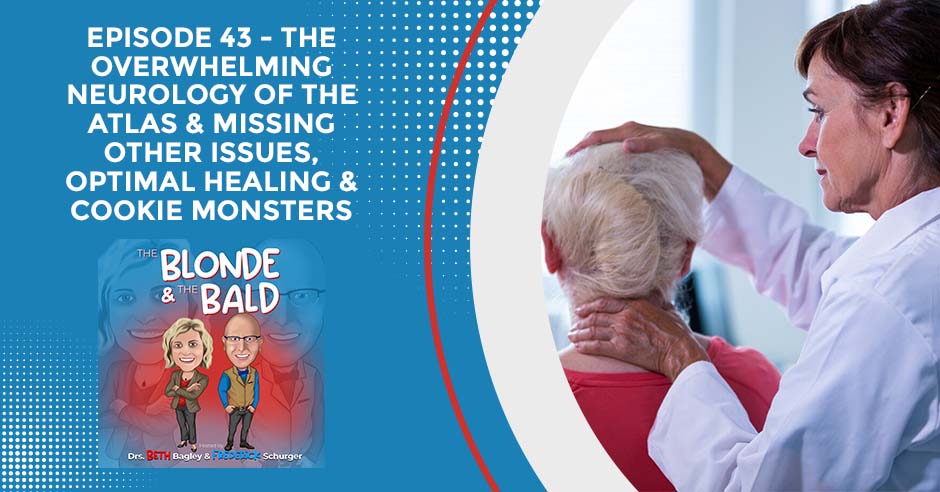
Drs. Bagley and Schurger discuss their findings regarding how often most people will come in with a lower cervical problem that has been hidden by the Atlas problem. This is a great discussion regarding how sometimes it takes a couple of extra visits to really dial in all the healthcare needs that a person has. We also discuss how we’re trying to get you back to optimal health as quickly as possible. And stick around to hear how we stuffed our faces over the holiday.
---
How are you doing?
I am doing good. It is our first recorded episode of 2024. We have had a crazy week already, both of us. This is going to be a little bit disjointed. We have a little bit of a plan for what we want to talk about, but quite honestly, it's 6:20. Dr. Bagley texted me saying, “I put the last one down to rest and I was getting one up.” Honestly, I'm yawning already.
We are going to get our second wind. We are going to kick butt on this episode because all of you need some of this information. Some of you have no idea. Your life is going to change after tuning in to this episode.
Let's address the elephant in the room. Why am I exhausted? I know you're as busy as I am. This is the first day that I had a morning shift, but I think I’ve had 4 new patients in 2 days out of the blue. I'm managing all of that myself. I have people who are saying, “I need to go see Dr. Schurger.” A lot of them just moved to the area and they said, “I think this upper cervical stuff might be for me.”
I love that. I'm never going to complain about being busy or not being able to breathe for a second. I love being busy. It was simple. I'm also the type of doctor who doesn't like when too many people are waiting in the waiting room because it makes me nervous. Second of all, I don't like going to a doctor's office and waiting for a long time.
There are certain professions where it has to happen, like OB-GYN, they could have been called when a thing happens and I get it. In a chiropractic office, we should be able to manage patients effectively. I had people waiting in the waiting room for longer than I liked, maybe 15 to 20 minutes past their appointment time. I hated it. Apologies to any of you that I made you do that. A whole bunch of people had hurt themselves after the holidays.
Can you imagine that?
It was great to see some of them, but you also need to take better care of yourself.
I was the same way. I had one of those new patients start at 1:30, but I was starting my afternoon at 2:30. She took longer than expected because she's a complex PI case from an auto accident. I walked up and everybody was either a hair late or a hair early. By 3:15, I had a full waiting room as I was getting everybody back and forth between the two rooms. I didn't get to my notes until the end of the evening because I was like, “We'll take care of notes at the end.” It saves me about a minute per person.
Still, I don't think I stopped moving until 5:30 or 6:00. I took a nap and then had to get more work done because some of these people were coming in the next day to get their first adjustment. Sure enough, the one young lady is doing much better from getting that first adjustment after that car accident. She's as tall as you. She might be taller. What's funny is I was joking that she might be able to stand herself up straight and hit 6’3”. She said 6’2.5” is the tallest.
I didn't measure her before we adjusted her, but the machine measures 72, but it takes an inch out automatically. She was at 73 after her adjustment and she came out of the resting room and said, “Everything is brighter.” I'm pretty excited. I think she's going to do great. Time will tell, of course. I’m always curious to see how many people have messed themselves up over the break.
I was on vacation officially between Christmas and New Year's. We get back into town on Friday afternoon at 4:30, and at 5:00, I have a half dozen patients waiting for me, including one who's a regular who got in a car accident earlier that week. It's been busy and it's wonderful. I like this. One of my nuns who works in a hospital system commented, “Doc, you want to see 50 people a day?” I'm like, “Yes, I do.” I was enjoying that extra busy afternoon. It was a great opportunity.
One of the things that I thought about was when you have a husband and wife or two family members come in together. One of them starts doing well and fast for care. The other one is a slow changer and everybody is different. I had to have that heart-to-heart conversation with the wife and I was like, “I know your husband is one of those types of getting an adjustment,” and miracle changes. All these changes. His vision is better, his night vision is better, his headaches are pretty much gone and they were constant, and his range of motion is better.
He's a truck driver. Not that it's not important for everyone, but driving a truck at night, you need all of your senses and big trucks too. She manages the business but also is a mom and her symptoms are changing a little bit, but not much change. It's not like better. It's not like, “I feel great.” She feels icky still. That's one of those hard conversations and saying, “It's okay.” You can't ever compare apples to oranges. You can't compare yourself to your husband or anybody else because everybody’s journey is different.
Everybody's journey is different.
You’re starting in different places.
Sometimes, people take longer to heal. I was one of those people. I did see some immediate changes, but it was a good four months before I realized how much better I was. Anyway, that's my little win and story about how it's okay for it to take time.
I see those very regularly. Sometimes, one spouse will notice a change and the other one won't. The worst is when they both notice it. The one says, “I'm not sure if it's a change,” and they play it down. It's like, “Did you have this problem last week?” “Yeah, I suppose. I could do everything that I was supposed to do.” You also have the situation where the wife comes in and she's like, “Doc, something's still not right. Something lower hadn't cleared out yet.”
She was complaining and she had a first rib that was out of place and hadn't released. Give it a week. It probably would've taken care of itself, but it might have knocked her out one more time. I said, “We'll do a little bit of a tap on that,” and that helped her out. She's still complaining about her husband. She's like, “Doc, I don't think he got them clear because he's still snoring.” I'm like, “I’ll keep on looking. I’ll keep on doing my best,” but sometimes these things take a little bit more time. There are other factors that we aren't adding to the equation here that might be playing into the symptoms that we're seeing at the time.
One of the questions, and we talked about this, is if somebody comes in and needs a C1 adjustment and then the next day or two days later, they come in and need a different adjustment like C2. Why does that happen?
I think there are layers. I joke that we are like ogres. We have different layers, like an onion.
Maybe like a trifle. Why can't it be a trifle? Everybody likes a trifle.
That is a good reference. We should start using trifle now. I like that better. We have different things going on at any given time. There are two different ways to approach this. The first way is that we have injury A that we are healing through over time, and this doesn't necessarily get into C1 and then a couple of weeks later, at C2.
This gets into the way the atlas had gone out as we'd been adjusting them from the right and then, 4 or 5 months down the road, that adjustment from the right wasn't clearing them out. You take a new picture and you're like, “I have a new angle. We are going to have a better adjustment on the left.” Sure enough, we adjust them on the left.
It’s a very similar adjustment in regards to how they have gone out of place, but it is a big change for how we are approaching it. We've probably healed past one injury and now we have a new injury. It’s not something that happened recently, but an older injury that is now surfacing to a new need to get fixed. That's one way to approach that.
Sometimes we'll have a situation where they’re like, “Doc, something is lingering.” We went in there, and we checked it and did not find anything. We look for a couple of visits and then all of a sudden, it pops up. What I think is we have two things going on. One, neurologically, the atlas is a prime. I don't know whether or not the doctors are primed for it or whether or not the body recognizes that the atlas has a huge component to the healing process.
So much so that if the atlas is out of place and the others aren't to a similar level of impairment, it’s not the right word but it's close, then maybe both of them will show up, the atlas and the axis or the atlas and C3. Generally, what I suspect is the atlas being out of place overwhelms the nervous system so much that even those C2, C3, or C4, maybe not all three of those, but one of those might still be a problem.
It's so overs shined by the atlas that unless the atlas is properly back in alignment and staying there, those others don't show up to any significant degree. Whether or not that is a situation where the body says, “I'm ready to address those lower ones,” because that other injury has finally come up to the surface or because it is overshadowed still by something of the atlas not being as clear as we would like it to be.
I'm so glad you brought this up the way you did and that we haven't pre-talked about this because I feel the same way. I don't think this is taught. They don't discuss it the way we're discussing it here. You're 100% on track with it because I see the same thing in my office where C1 is blazing out and I can't see anything else. They could have seven other misalignments, but I can only see that because C1 is so impaired or impairing the nervous system, we have to adjust it.
We adjust it. Late links will come back to even and the scan clears out, but those other things are still there and they're still present and we neurologically can't see it until C1 is stabilized. I do explain that to my patients in a very similar way as you do. I don't have a double-blind placebo-controlled study that says that that's correct. Considering I see it in the same way that you're seeing it and 2 different doctors in 2 different states, we're on the right track with that.
There are a couple of things to think about here and the reason that it's not discussed amongst the techniques is largely because it's very observational at this point in time. We understand there's not a chiropractor on the planet who adjusts the spine. Let's be specific. There are a lot of chiropractors on the planet who do nutrition and acupuncture. If they ever adjusted a spine, the last spine they adjusted was in the clinic as a student. They did not take it out to their practice. I'm talking about chiropractors who adjust the spine. If you ask any of them where are they going to adjust, gun to their head, they have one segment to adjust to get someone better, they're always going to say atlas because they know that that has the greatest impact.
We understand that and that is something that we can address. What we don't understand is whether there are hierarchies along the spine that may be more important than we should be looking at. Certainly, the Gonstead folks who do a more full spine approach, when you start talking to some of the guys who are teaching and understanding what Dr. Gonstead had figured out, you might see using the thermography breakpoint analysis, multiple spots showing up. Maybe you'll see an L5, L4, T1, T5, C7, and C2; maybe all of those will show up.
You might only choose 3 of them and you're not going to choose 4 and 5 because they're too close to each other. You might choose 5, you might choose 1 of those thoracics or maybe that lower cervical and then C2. They like to keep them spread out because they believe that that is having a neurological impact that is maybe too much for the body to handle if you want to take care of all of them.
We can all say that the atlas has this high priority. This comes back to what the doctors are looking for. Most doctors practicing upper cervical chiropractic think, “What's going on with the atlas today?” Whereas those of us who practice the Blair work certainly have a strong look towards the atlas. We at least acknowledge that those lower ones might have some involvement day in and day out.
How does one segment shine another and how many people have been trained to be sensitive enough to feel, “Something else is out and I know what my atlas feels like.” Case in point. One of my concussion cases was a military Marine. I need to have him on the show sometime soon. He's fantastic. He's been doing some injection work with a doctor down in Myrtle Beach. He's super excited about how much it's changed.
Normally, his atlas is out, and we changed how we adjusted his atlas, which is completely new for him. He got back. He flew down there over the holiday, came back, and said, “Doc, something is off. It's not my atlas or at least it's something different.” Sure enough, his axis was out of place. I adjust his axis and he is like, “Yeah, that's the one.” If I could have seen more non-atlas patient adjustments, most of them were axis. I saw a lot, I’ll be honest.
Me too. I don't know what the holidays did to people but I did.
Maybe everybody relaxed over the holidays and their atlas were able to settle.
I have a lot of atlas holding, but then also a lot of weird stuff today too.
I concur. I am right there with you on that. It begs the question, what is the body available to heal? One of the worst comments, not towards me and my practice, but one of the comments that I had, I ran into somebody randomly. We were talking shop and he knew that I was a chiropractor. The comment that was made was, “The thing I don't like about chiropractors is they don't get all of the segments that need to be adjusted and I have to come back for another visit.”
I thought about that for a second and I know that's not the case, but why isn't that the case, and what else is going on and how do we explain it to patients? This has been at least a decade running through my brain. How do we address the person who thinks that we're not doing everything we can on that visit as opposed to addressing the fact that we've done everything that can be done on that visit?
We also have to give the body a chance to heal. That's what I feel like it's the instant fix mentality of I take a pill and I feel better. Chiropractic does not fit into that peg. That's a square peg and a round hole. It doesn't fit. The way I explain it is like, “Doc, I don't think you got it.” I'm like, “You are in alignment at this point. Your body is catching up with that. You can't feel it immediately. It's not an instant fix.” I say, “I wish it was an instant fix. If I could snap my fingers and make you feel 100%, I would do that, but that's not how our bodies work and it's okay. I bet tomorrow, you will be feeling a little bit better. If I do more at this point, I will hurt you. I'm not going to do that.”
It's the instant fix mentality of "I take a pill, I feel better." Chiropractic does not fit into that.
The other way to think about this is if you go into the gym and you say, “I'm going to bench the bar plus four plates. Can you do that? Maybe you can bench the bar.”
There are those wooden plates.
If you want to bench 225, can you do that first? If you can't do that, where do you have to start? You have to start somewhere lesser. Can you even do the bar? Do you have good form on the bar? Everything is a progression in life, even getting adjusted. I'm all about what the fastest and shortest distance between two points is. How can you do things smarter and more efficiently to get from point A to point B?
In our case, I want to move from not being healthy to being healthy and moving in that direction. What's the fastest way? Getting your atlas checked and adjusted is going to be the fastest way. Maybe we'll have a couple of corrections in between. There are so many things that we have to learn about their paths. Some paths are better than others. I have about three different ways that I can get down to your office. Two of them Google suggests. I look at that and I'm like, “I don't need to take a 3-hour tour to get down to your office in 2.” Google likes to do that. Have you noticed that?
Yes, I have because it took me in a weird way.
It's like, “Why are you making me want to take an extra 45 minutes?” “It's the eco-friendly route.”
I'm like, “No. It’s me being in the carless. It's my eco-friendly.”
It's understanding that we're trying to figure out the shortest point for people to get from point A to point B as efficiently as possible.
We're trying to figure out the shortest route for people to get from point A to point B as efficiently as possible.
Know that we want that for you. We want you to get well quickly, and the quicker the better, and feel well. We want you to not get well but feel well. We want both. There are some chiropractors or doctors who might string people along and make bad decisions that way. When you meet someone, you know if they have integrity or not. You can feel it coming off of them.
I know you have integrity and I try my hardest to have integrity with that. I never ask people to come in more than I think they should. I'm the first one to decrease this care frequency if they're holding longer periods of time. I don't need to see as often, but sometimes it takes more work with certain people and a certain problem.
If you have a new injury, let's say you lifted a box wrong. A lot of people are taking the Christmas decorations down and carrying tubs of stuff down the stairs. I had multiple of those injuries. It's an injury. If you've pushed your ankle, you don't expect it to feel good after a day. It'll take a week or multiple weeks, depending on how bad the injury is. When you hurt your back, neck, spine, or vertebra, it could be very quick or it could take time too. Those soft tissue injuries that surround a misalignment take time to heal.
The adjustment itself, although it’s very quick and easy for us because it's relatively painless, starts in motion the healing. We get to say, “It's going to take some time. It's not time to go run a marathon on this. You need to take the time to heal.” A lot of people don't take that time to heal. They go immediately back to the gym or immediately to lifting things. That reinjures the same problem over and over again.
I have another patient who has been a student for the past couple of years, but his college career is not going in the direction he wanted it to go. He's also getting into a bunch of courses that don't appeal to him the way they wanted to. He's back to work. He's working as a laborer, making good money, and doing work. Now he's going from needing to get checked and adjusted once every 3 or 4 weeks to “Maybe we should get you in every 2,” because he's doing all this extra work and he's more physically active.
He changed what he was doing. That change then consequently gets him in a situation where he's like, “I need to take care of my body just like I take care of any other of my tools and make sure my head is on straight.” He was saying that in the past two days, he's having a migraine. He texted me, “Doc, when's my next appointment?” I'm like, “If you didn't get texted today to tell you that you have an appointment today, we probably should schedule you for today since you're asking to get an appointment for today.”
That's always a fun text that's like, “When's my next appointment?” “If you're texting me, it's today.”
That is accurate. We're not doing magic pills that immediately change symptoms. We're not talking about things that happen overnight with minimal problems. Let's also address some of the supplements that are going on. We've talked about magnesium in the past as being something good for people. A lot of people will notice an immediate improvement in sleep by taking magnesium before bed. It’s so fast. It’s amazing.
It's a good sleep too. It doesn't feel like a drug sleep. Sometimes, even melatonin will feel like a drug sleep to me. I'm taking magnesium glycinate before bed. I know you take a different type.
I take a malate glycinate, something else, plus magnesium 3 and 8. I'm technically taking four different forms.
I take all the magnesium all the time.
The crazy thing is Tuesday night, I was good about it. I was good about it Monday night and felt good for those days. Not that I didn't feel good waking up this morning, but I know I forgot to take them last night. Sure enough, my recovery was down. Not that I'm feeling tired and didn't give my best, but I can feel I will go to bed early tonight or, at the very least, fall asleep in front of the TV faster.
Don't tell people that. That is bad.
No. I'm in my recliner and I'm in a good posture. I turn off the TV. The other thing that I'm going to point out since I’ve put these out, is Omega-3s. This is another one of those things that are going to take a long time to see benefits. I shouldn't say a long time. You might get a quick benefit early on.
It might lower inflammation pretty quickly.
I think the inflammation is what's going to take some time. You might notice your skin looking better by taking it.
I got a skin thing with that. Here's one of my secrets. When you go on vacation and get a sunburn or a sunburn in general, I triple up on Omega-3s. I take maybe two twice a day or 2 or 3 times a day. Typically, it's one pill that you take and the sunburn gets better so much faster. Don't get sunburn in general, but sometimes it happens.
Interestingly, the standard process has a product called Cataplex F. I'm like, “What is in this product?” It is an essential fatty acid. Fish oils. It's the same thing. It's not a fish oil capsule from standard, but it's trying to deliver that same fatty acid profile that helps say, “Bring this into the cell properly.” Understanding that a lot of sunburns are simply an imbalance of Vitamin D to your body's mineral content in the cells because Vitamin D doesn't care whether or not the minerals are in your gut or your cells. It's pulling all of the minerals into the bloodstream when you get that high exposure. If you can force them back into the cells, you have less of a problem with that burn as well.
Is that one of the things that you would also take an extra dose of Vitamin D after getting sun exposure like that or not?
No, definitely not because you had the dose of Vitamin D. You don't need more Vitamin D at that point in time. You need something else to counter that. As you said about the fish oils, I like Cataplex F. Of course, my first choice so that I don't have any problems with this is the carnivore diet. Quite honestly, since I’ve been on the carnivore diet, I don't burn. It is surprisingly a solution. Everyone is like, “What's the best superfood?” It's beef.
Funny story, talking about meat. We got done with the holidays. At Christmas time, normally, we haven't had everyone coming back for a while. It was the first time that all the siblings were at the house, plus all the grandchildren. It was a wild time. My brother Dave doesn't come to the family gatherings as much. I don't know. Dave's angry.
I did make a comment to his wife that I don't think I’ve seen them in what feels like a decade, but it's certainly been two years. Anyway, I made this brisket. I'm experimenting with times and have him try it because I’ve already tasted it and wanted to get his opinion. He takes a piece and he’s like, “It’s good.” That's high praise from Dave.
We were all like, “That was the best thing ever.” They complain about me telling my sister that she didn't temper her chocolate turtles properly because they're melting in my fingers. I'm like, “I know.” They're giving me grief because I'm bringing up the fact that she didn't do them right. As I kept on stuffing my face full of chocolate turtles because they were so good,
That's the thing. Over the holidays, we sometimes indulge in our sweets or something like that. What I did was threw all that crap away. There was still stuff left in the pantry and now it's gone. Now I have my meat and vegetables. I know you don't eat the vegetables. I'm sorry to say the V word in front of you.
I'm okay. I will not die.
I'm back on my meat and vegetables and I feel so much better.
It's so fast. The crazy thing is this. Did you notice how, in the first couple of days, you were craving the stuff that you had thrown away? It is addicting. Our food supply is designed. Designed is the right word. I don't want to say it's poison, but it's poison.
It's designed to be an addictive poison.
One of my patients was complaining about her fibromyalgia, but she went to a place called Ollie's. Are you familiar with that?
Yeah. We have one right by my house now.
That might've been the one she went to. She walks in there and sees Boston Cream Pop-Tarts.
They're probably almost out of date, by the way, because that's what Ollie's about. It’s stuff that's about to go out of date.
The other side of it is I'm like, “That's pure diabetes.” I miss Boston cream donuts, but not that much.
I can't have Pop-Tarts in my house because I freaking love them. If I had one day where I was like, “I'm going to eat whatever I want,” you put all of the things in front of me, like all of the brownies and cookies and Pop-Tarts is one of them, like a strawberry Pop-Tart or cherry Pop-Tart, I'm all over that one. It's a chemical storm that my body craves once I eat one. It's a package of two serving sizes. Of course, you eat the second one. How much do you suffer after that too? Let's say you've been eating well for a week now or for 3 or 4 weeks.
That one moment where you're like, “I'm going to eat this Pop-Tart,” you have a choice at that point. You can eat it and say, “That's the one thing I'm going to do and I'm right back to where I'm supposed to be.” You can do that. Now you've turned on that center in your brain that says, “Just one more and one more thing.” You start craving that. You know those four other Pop-Tarts are sitting in the back of the pantry. It’s just one box. It's like cigarettes. You have one more and then you go another pack, another pack and then you're back to addiction.
The worst part is that in about a week or two after this episode gets released, Girl Scout cookies will be everywhere.
It's Girl Scout cookie time. It is happening.
Here's the worst part. Realize that a serving size of Thin Mints isn't two cookies. It is one sleeve. It is the whole sleeve. There are two servings in that box and it's a sleeve of Thin Mints. You all know that that is a true statement because it is that addicting.
You eat two and you may even put them in the freezer because they're delicious in the freezer. You will go back to that freezer and go back and back. At some point, you'll be out of cookies and you'll be sad. You're also going to be sitting in your soul, and then your knees are going to start to hurt when you go up and down the stairs. That's me because the inflammation levels go straight up. What do you do when you go to the grocery store? You buy more of that crap because now you've started the cycle again. Don't do it. If you want to support the Girl Scouts, you do not have to buy their cookies. You can buy cookies for servicemen or overseas service people.
Just write them a check. I write them a check because all they're looking to do is they're going looking to do their jamborees or their trips or whatever. We don't need to feed a cookie industry and literal cookie monsters.
A good name for the show should be Cookie Monsters.
We'll talk about Cookie Monster. The other problem was that my sister-in-law knows that I love seven-layer bars and makes them gluten-free. She had these cute little plates, the square plates. She had different cookies on them. On both of the plates, she had two of them on the table. I could pick the one that had a few of them. What she was doing was coming in with this square tin 9 x 9 tray and putting it back.
About the second time that I saw her bringing that tray out, I'm like, “No. Michelle, you're going to put that right here in front of me so that I don't have to reach and you don't have to keep on filling up the plate,” because I knew I was going to eat those things until they were gone or until I decided that I was done with them. Somehow, at 8:00, done. My brain said, “I’ve had enough. I had already had a pound of ground beef earlier. I made sure to eat a bunch of chicken at dinner. I prioritized protein.
The entire week I'm over at my dad's, I expected that brisket to last me a couple of days. It was gone that night because that's how good the brisket was. It wasn't just Dave and I that liked the brisket, but Dad had three hams. Instead of doing the packet glaze with all sorts of extra chemicals and garbage in it, we put butter and honey together on it.
You guys make your own honey, don't you?
We do. The bees make the honey. We harvest it.
I know, but you harvest the honey.
We did that, and honestly, every time that I had a chance to eat ham, I ate ham. I ran some numbers. Jean had bought me a couple of chuck roasts because I was out of beef and I knew I needed beef daily in my diet. She gets these two-and-a-half-pound chuck roasts. I smoke both of them. I proceed to eat one on one day and then the next, the next. I'm probably also eating a pound or more of ham on those same days. I probably put down anywhere close to 4,000 calories of meat. All of that protein is protein and my body says, “You're fine.” I'm still a little bit higher as far as the scale.
I want to put a little disclaimer. You are not necessarily trying to lose any weight at this point. You're trying to maintain and build muscle, correct?
I would like to lose some body fat at this point. The new program I'm on is doing that.
I'm saying for people tuning in, you do not need 4,000 calories of protein. You, personally but that person tuning in probably does not need 4,000 calories of meat in a day unless you're an elite athlete.
No, because I was listening to a guy down in New Zealand. What's his name? He was on John Baker's Carnivore podcast. He said he did about a couple of weeks’ worth of 6,500 calories a day of beef, just red meat. He lost 15 pounds. I'm thinking I might have to try that because, quite honestly, I'm also trying to build muscle.
How many ounces of beef would that be?
I’ll look at what the math was from last week that I did.
I know there's fat and stuff like that.
We use chuck roast because chuck roast is probably the best bang for your buck when you go to the grocery store for that. Folks, also bear in mind that I was probably walking anywhere from 10,000 to 15,000 steps. There was a lot of chainsawing and wood chopping going on.
I’ve chopped no wood this year.
Everyone has their own. Thirty-six ounces of Chuck Roast is 3,300 calories.
How many did you say?
Thirty-six. Two and a little bit more pounds. Thirty-two ounces is 2 pounds. Thirty-six is 2 pounds, 4 ounces.
We're looking at about 5 pounds of meat for the 6,000 calories. I don't think I could do it, doc.
You have to work up to it. I don't think you can do this. If you go over to Dali's across the street, get 2 pounds of brisket and work your way through that with coleslaw. You need to have their coleslaw. The coleslaw will help cut some of that fat.
You told me that vegetables are trying to kill me.
They are, but coleslaw will help you eat the brisket. There is a balance for some of these things. Some things need a little bit of vegetables so that you can eat more meat.
You have weird rules. I don't know if I believe all of them, but I think you might BS-ing some people here.
I didn’t say I'm always a carnivore. I'm saying I'm mostly carnivore and if when people are like, “Doc, where are we going to go eat?” I'm like, “I don't care. Just find me a place that has beef.” I was thinking about this at lunch. The next time we are looking at steakhouses, my rule will be who has a 2-pound ribeye on their menu. I won't care who it is. That's where I want to eat.
Let's put that away. That's a lot of meat.
It is. I like a lot of meat.
I think that should be the name of the show.
I thought the show was going to be Cookie Monster.
No. I like a lot of meat.
It's probably going to be Cookie Monster. Folks, you'll know because you'll see it before you hear about this. I think that's a good place for us to end because I need to go get some bacon and some eggs.
I'm starting to get slap-happy.
Dr. Bagley, where are they going to find you?
Precision Chiropractic. We are on the West side of St. Louis. You can find me at PrecisionChiroSTL.com.
I'm glad I'm not too far from where you're at as far as the slap-happy either. I'm at KeystoneChiroSPI.com. Keystone Chiropractic in Springfield, Illinois. Folks, make sure you like, subscribe, and hit that thumbs-up button. Tell people about it. Share the show because, quite honestly, I'm hearing weird things about the algorithms not sharing stuff. This is a health show. This is not sponsored by any of the pharmaceutical companies.
I don't want them to sponsor us. I think we should be sponsored by Merck.
Of course, I heard an alternative news podcast that I was listening to sponsored by ABC and I'm like, “They will take that money.” Folks, you have a good one. We'll be back for another episode. Have a good one.
For her first podcast, Dr. Tracey Littrell joins Dr. Frederick Schurger and Dr. Beth Bagley to discuss Dr. Littrell's journey into chiropractic and then ultimately into academia and radiology. Dr. Littrell is a graduate of Purdue University where her future husband introduced her to chiropractic. With a newfound vitality, she pursued her chiropractic education at Palmer College and followed up with a residency in radiology. We take a deep dive that hopefully isn't too technical into chiropractic research, chiropractic education, and radiology that is used in healthcare to make better decisions for patients.
---
In this episode, we have Dr. Tracey Littrell, who has been our radiologist for the past several years, helping us out, trying to make sure that all these cone beam CTs that we take, we don't miss anything that's there because there's so much more information on a CT than there is on an X-ray, that needs a second set of eyes to make sure we don't have any problems. Dr. Tracey, tell us a little bit about yourself and your background. What is a chiropractic radiologist?
I am a chiropractor. It's important that your readers know. You don't get to be a chiropractic radiologist without first becoming a chiropractor. My background is like so many of us in chiropractic. When I was younger, I did not know that I was going to be a chiropractor. Events happen in our lives that lead us in a direction that's unexpected. Mine was not a lifetime but I had many years of low back pain when I was a pediatric and adolescent athlete, not having a lot of knowledge or experience and knowing that athletes are tough and put up with a lot.
I lived with low back pain. No one in my family saw a chiropractor. That wasn't on my radar at all. I went to college. I went to Purdue University in West Lafayette, Indiana to become a developmental psychologist. I wanted to be in healthcare. It seems like a different route but when you take care of patients, that's not the case. It's not a disparate field at all. When I was a student there, I met my now husband. His family went to chiropractors. He probably got tired of me talking about my back. He still married me.
I went to a chiropractor for the first time when I was a junior or senior at Purdue. I share the story with my students because it's important that they understand some of the psychology of the symptoms and symptom management that our patients deal with, even before they get to us. It was six months of care before it hit me that I was not afraid to bend over anymore or reach for something. This is mind-blowing to me because I was 20 or 21 years of age.
I'm going to sound so smart and insightful but I was not at all at the time. It took me many years to realize that I had become back pain and back pain was part of me where you have to own your addictions. I feel like back pain was not my addiction but it was part of my personality. It drove everything. As a young person, I spent an awful lot of time thinking about what I couldn't do. I can't do that because of my back pain.
Six months into care, it hit me like, “I'm not scared anymore.” I used to be so scared of being hurt because I had significant back pain. I changed my course and was like, “I want to do what you do.” I asked more about chiropractic. He was a Palmer grad. He said, “You have to go to Palmer.”I said, “Okay.” I trusted him so much. He changed my life. I wasn't going to consider going any place else. He had a phrase. He would say the oldest, the biggest about Palmer.
One of the reasons I'm telling this story is that I didn't know I was going to be a chiropractor, let alone a chiropractic radiologist. I was on a different route. Many years later, becoming a chiropractor and teaching at Palmer, I got to teach one of his sons. We were halfway or more through the term. This gentleman was talking about where he lived. He mentioned Lafayette and it hit me. He has a common last name. I never put it together that the last name I was seeing in this student was the last name of my first chiropractor. I have taught the offspring of the person of the man who got me into chiropractic.
It makes me tear up. When this student graduated, I accosted his dad as they were walking away from graduating. I don't know if you know or remember what it's like to wear a mortarboard but it's not good for your hair. I had my hair pulled back in this ponytail. I met him and his wife. I introduced myself. It is an alleyway between some buildings. I didn't think I'd get a chance to see him but I was able to tell him, “I got to teach your son. Here's who I am. I don't expect you to remember me but I appreciate the role that you played in my life.”
What you asked me is about how to be a chiropractic radiologist. When I was at Purdue, I was a Psychology major and also minored in Physics. Those go together like peanut butter and headlights. That was an odd pairing but I liked Physics. I wanted some additional science background. I give that as a basis. I got to Palmer. In the fourth trimester, we had Rad Physics. I could not have been more in my element.
I remember coming home to my husband and looking at this book of printed notes. I'm like, “Look at this. I'm going to be able to take apart an X-ray machine.” I could not have been more excited about the idea of this part of it but I still do not understand anything about chiropractic radiology. When I was in the fifth trimester, there was a national conference called the NCLC, the National Legislative Chiropractic Conference that's held in Washington DC every year. This is a chance for representatives from our state and national organizations to come together and lobby our representatives in DC.
As a student, I was able to go to this. We had dinner one night with a group of Palmer people. Across the table was a man I hadn't met yet, Ian McLean, for any of your readers who are certainly Palmer grads but in chiropractic, in general, would recognize that name. I hadn't had a class with him or met him yet. He talked about being a radiologist. That was another pivotal moment where I was like, “Not only can I be a chiropractor but I can also read X-rays.” From that fourth trimester on, I set my sights on being a chiropractic radiologist.
DACBR, for readers, is what we call a chiropractic radiologist. What does that stand for?
It's the Diplomat of the American Chiropractic Board of Radiology. Those are the initials of the designation. We put DC behind our names. Sometimes, people have other initials. DACBR is the indicator that this is a person who has gone through a radiology residency. Those are additional years of training beyond the chiropractic college education. Importantly, they have passed at least two other board examinations to be able to call themselves a chiropractic radiologist or DACBR.
I know some of them who have been in practice and become DACBs and some who don't adjust patients at all anymore. Do you adjust patients at all? Is your primary concern being the radiologist?
It is now. I was in active practice for a while. Both of you got some appreciation for this. When you own your business and you are responsible for yourself and many other people, it's hard to get away. Anybody in healthcare struggles to get away from the practice that they need respite from but to turn over that responsibility. I had the privilege. Even though I was in active practice when I went over into academia, I was part-time as a resident. I got to see patients. I was a staff doctor at the Palmer Clinics for a while.
Once I got out of residency, I did want to take care of patients but I didn't want that job to be full-time for me. Getting into the residency, getting into academia, and teaching physical diagnosis and clinical psychology, I got to do that for a while. There's a full-circle moment. I was going to be a psychologist and teach psychology.
I have been able through COVID and 2021 to do locums tenens work. For my area chiropractors, they sometimes would ask me to come in and cover a few days for them. I am not a grandparent but I feel like that's the best grandparent-like experience. I got to adjust people and do the documentation but I didn't have any of the other responsibilities of running a business.
That’s all the fun parts of being a chiropractor.
I feel like I have the best of the world to go in and take care of patients.
You're still teaching at Palmer College for a full course load.
I have a full course load. I'm in 2 physical diagnosis courses and 2 radiology courses. We teach physical diagnoses 1 and 2. That takes our students through the head-to-toe examinations, history, vital signs, eyes, ears, nose, throat, head and neck, and thyroid. Our second course takes them through the respiratory, lungs, cardiovascular, heart, and abdomen.
There are other courses that teach about neuromuscular skeletal testing, like reflexes and muscle testing. I don't teach in the NMS courses but I teach physical diagnosis. I have one of their first radiology courses called Diagnostic Imaging One. I get to see them. It's not their first Rad course but it's their first diagnostic Rad course. I get them for that. I also get to teach them for their last radiology course in the curriculum, which is chest and abdomen radiology.
You don't get to teach the physics.
I don't. I'm okay with that.
Having an engineering background myself, when I went through the program, I was like, “This is going to be easy and fun.” I said that when they introduced the right-hand rule. The way I learned the right-hand rule in engineering and the way they teach it in school are backward. Once you figure it out, it's like, “They have the body on a slab face up.” I still don't understand why we do it that way.
In many schools, there's an expectation for the professors to do research. Is there an expectation at Palmer?
There is. Let me back off that a little bit. We have a research center. We have faculty and staff, specifically in the research center, hired to do that work. Since the time I started at Palmer as a student, that research center as well as their grant applications and funding has risen. I don't know the numbers but I know that we, as an institution, are applying for grants. We're receiving grants from the Federal government but also from other agencies to engage in research.
We have staff and faculty that are dedicated to that. As an academic faculty person, I am encouraged to engage in research on the level of publication. It’s maybe not traditionally what we think of as research. I'm not performing interventions on controls or subjects. Not that kind of research is for me but my academic research category is to do publications like case studies on some of the interesting cases that come through my practice.
The stuff we're sending in for cone beam readings is like, “This is weird and different. This is something we should be pursuing or looking at. It would be a great place to start doing a research study.” One of the other things that people may be unaware of is that several years ago, a lot of chiropractic schools had their own research departments. That is not the case anymore. Palmer is one of the few that still has a fully staffed research department, which is saying something to Palmer for keeping that on board.
For the institution, it's a luxury to be able to pay people to do this work that's so necessary in our profession.
People like to think, when they hear about research in healthcare, that it's all figured out. That couldn't be further from the truth.
Are you saying the science isn't settled?
It isn't. There have been gatekeepers in the research field for so many years, chiropractic from even publishing or sharing what we found. They changed the rules at one point in time from what we had been doing, which is a more rigorous form of research. It's neat to see that we have that and we are showing that there is efficacy for what we do, as well as huge safety differences between what we do and what the medical profession does. For the best intentions sometimes, things don't go the way that we would like them to. In chiropractic, even the one failed study that didn't pan out the way they wanted to for blood pressure showed that for everyone who got a neck adjustment, there were no serious adverse events.
There's a positive when there isn't what they were hoping to see. Publishing is important. It’s like, “This didn't turn out what we thought but unfortunately, we don't always get to see the things that don't turn out.”
I agree with both of you. You propose a hypothesis and a prediction of what the outcome of the intervention will be. Sometimes, we convince ourselves that what we're doing will create a response. The research that counters our theory is as important as the research that supports our theory. If you're not in research, I feel like it requires a bit of a challenge and discipline to say that the message that you got is the opposite of what you thought it was going to be. It opens up other doors for us in research. I'm a firm believer that if a hypothesis is disproven, that is as valuable as the hypothesis for which we find evidence.
Are there any case studies or some things that you can think of that you've seen on some of your private clients or at school that are interesting, or the readers might find the information beneficial to them?
At the risk of sounding self-serving, my head is steeped in what I'm doing. Doesn't that sound self-centered?
That's to be expected.
I am privileged to be an assistant editor for a journal. I am a peer reviewer for ACC-RAC submissions, American Chiropractic College of Chiropractic Colleges. It’s a research agenda conference. Sometimes, I get asked for a peer review for other journals. I get a sampling of what other people are writing, and predominantly in the case studies.
The case studies are the base level. Those are what start us out and might eventually lead to a controlled clinical trial. That's a challenge but it might happen. In our profession, there's been more of an awakening and an invitation to publish what you're seeing in your offices, not just in academia or the clinic system but in the individual private practitioner's clinic. “What's happening in your clinic? Tell us about that.” I get to read a fair number of case studies.
I'm helping an author write about nutrition in incarcerated populations. This was eye-opening for me. How is that related to chiropractic? On the surface, it might not seem like it is. We talk about somebody who is of poor nutrition, regardless of the reason but specifically in an incarcerated population where cost-saving measures for the penal system are often reflected in poor food choices, a lack of the elements that are necessary, and fresh fruit. For those elements that we need in nutrition, they frequently get packaged food. It's not good quality and nutritionally enough for some of the incarcerated individuals to be healthy on any level.
This proposal for publication looks at the musculoskeletal influences of poor nutrition. How does that affect the patient who is the primary? How might it impact the way that we take care of patients? Here's an obvious one. If you have poor nutrition, your bone density isn't going to be as good as it should be. We all know that, as we age, we are going to lose some bone mass to some degree as a consequence of aging. When we have poor nutrition, that gets amazingly accelerated.
If you have poor nutrition, possibly your bone density isn't going to be as good as it should be now.
Think about an incarcerated population that might not get a lot of physical activity because they are confined, only get out of their cells for 1 hour or 2 a day, and have no opportunities to do weight-bearing activities. It opened my eyes to the cascade of poor health that comes from when you don't have good food available and you don't have the opportunity to maintain your muscle strength and bone health.
I never considered that before but it's eye-opening. Their brains aren't going to work correctly. You have to have nutrition for your brain.
There have been some studies and suggestions that, unfortunately, the way the food is given to institutionalized patients and people in jails and lockups is poor quality because it's based on the food pyramid and what the Federal government has been saying, “This is what we think is what it is.” They throw out a lot of the research saying, “No, you need so much protein. Animal protein isn't all bad for you. It's not going to give you all these problems.”
The question comes down to how much of these people's bad behavior came from the poor nutrition that has been around their lives throughout. They've made poor decisions to put them in there. It gets worse because they can't have choices of what they're going to eat. When we start thinking about brain chemistry, for acetylcholine alone, you need a precursor choline.
If people can't eat eggs for an egg allergy, they need to find some other way to supplement with that. Acetylcholine is one of the more calming brain chemicals that lets your brain relax. If you're wound up, why do fights break out? Why do people have problems? Why do people get extra time when they're in prison? They decided, “I didn't like that guy because I was mad.”
It could be that your brain is dysfunctional because of poor nutrition. I feel like my brain exploded a little bit. When you're helping with the author of a study like that, do you get to co-author? How do you get acknowledged in that process?
I'm thankful that you asked this question because there isn't one correct answer. What I've learned over the last couple of years is your role has to be established right up front. I've got a couple of case studies rolling around in my head and partially written down. I'm going to want help with them. The reason for me is I agree with everything I write. You have to have somebody else who's objective, who doesn't have the skin in the game, and who has less of an invested interest, and that it's published but still wants it to be published.
I'm a fan of co-authorship but I'm a fan of, before that ever starts, that you define what the rules are because there's a lot of misconception, and not just in our field, where a co-author might think that he or she is only going to proofread but the primary author thinks that they're going to be doing the literature search, going online, visiting libraries or getting interlibrary loans.
As an editor, I would not be a co-author because those are mixed roles. I need to remain objective and have the submission blinded to me so it can go through my review and that review of the other assistant editors. The journal that I am an assistant editor for is the Journal of the International Academy of Neuromuscular Skeletal Specialists. It's JIANM. We have a blinded peer review process. Sometimes, I'm one of the peer reviewers as I’m blinded to the authors. I run that through peer review.
I see all versions of it. I see single authors and multiple authors. What I hope is, before they have decided to put pen to paper or fingers to keyboard, they've decided clearly what role each person will play. That also is important in academia. This is a little bit of a side note. Primary authorship is weighted more heavily in terms of your promotion application. If you want to move from a probationary faculty member or an instructor who's passed probation, in terms of academic promotion, our next level would be assistant professor, associate professor, and full professor.
Primary authorship is vital to that progression upward. The secondary authorships, being second, third, and fourth authors, are also considered important. It sits a little bit lower in the basket. I'm glad that you asked that question because people who wish to partner together haven't thought ahead about who's doing what work. Some conflict can result because somebody had an expectation that the other person didn't.
I encountered this. I wrote the article and asked for somebody to review it. I intended to grant co-second authorship for that review but I was confident in what I had. We had a bit of discrepancy about what percentage it should be broken down. I thought that the peers with whom I wanted help were claiming a big slice of the pie. That's important. It is also based on a minor mistake that I made when I was a primary author. I didn't define the role ahead of time.
That crosses over lots of things but it's important.
If we're not going to learn that lesson, I'll continue to make that mistake.
We all do but expectations are in our heads. They have to be said out loud, whether it's a relationship or research.
You think it's writing a paper and there are so many other things going on if you don't say, “Let's sit down and figure this out.” Unfortunately, in the world of Zoom that we have had to live in the past couple of years, the conversation that you would've had about was like, “How much of you know this credit do I get and that credit that you would've had in person?” It gets lost a little bit, especially if they're half a world away and they're not in the same ballpark.
I've got a hard question. If you could wave a magic wand about the situation around research and change something, what gets under your skin? What would you change about the politics of doing research, funding, people, or the type of research?
In full disclosure, I do not work for the research department. I'm research adjacent. I want to promote research and publication within our profession and support my peers in all walks of chiropractic and healthcare who wish to get the message out. I'm not doing that grunt work of grant application, shaking hands, and kissing babies for the political side of it.
There is an awful lot of politics wrapped up in getting grant funding. I'm not feeling sorry or sympathetic to chiropractic. I believe that we've had a bit of a steeper hill to climb. Establishing the legitimacy of what we do needs further research. I acknowledge that. That's why we're not funded as well as some of the other professions in our research.
The other aspects I would like to change specifically within chiropractic, and I'm going to make a broad statement but I fully acknowledge it doesn't apply to everyone, is there seems to be a bit of an epidemic in practitioners who want to publish or talk about their cases. They want to use the word proof. They want to use case studies as proof of something as if one case study would then demonstrate to the rest of the world what some of us have been saying for a long time about whatever, whether it's about a technique, the need for X-rays, or the utility of therapeutic ultrasound, whatever the aspect might be.
As a profession, we have to be realistic. What we need is to build the base of the pyramid with many case studies. Those are put together to become a case series. We can eventually climb that pyramid to a randomized clinical trial. In our field of hands-on interventions, a true blinded or double-blinded study is nearly impossible. We have to accept. We're not going to reach a phase where we can do that out. Maybe computer algorithms and computer models could establish that.
Sometimes some of us want to publish because we are the defense against criticism that we've heard about our profession. If you find that personally motivating, that's good. We have to come to a comfort level of every bit of our experiences that we contribute to the public domain in terms of broadly called research but the evidence for what we do, whether we think it's a negative or a positive outcome, all of that helps build our future and support for what we do.
We've all been doing this long enough to realize that digital imaging alone has been a game changer in terms of the information that we get. If case studies become case series and more narrative research, I hope that we can recognize the connection and that we might develop computer programs that allow us to mock up an adjustment and see that intervention. I would like to take our ego out of our publications. When we're not immediately satisfied, we internalize that. We might think, “Here's the proof.” It's not about proof. It's about evidence and being as objective as possible.
Every case study is, at best, a data point. Everyone is going to get this one immediately. If you get on the scale, you look at that number, and you're unhappy with that number, write it down and walk away. You're not going to be happy with that number but you might be happy with that number. Do it again tomorrow and the day after.
If you are saying, “I'm going to track my calories and change what I'm eating.” You can weigh yourself on Friday morning after Thanksgiving but you're not going to be happy with that number because you ate grandma's pies. You say, “I'm getting back on my regular eating habits.” You see the data go in a different place. It is all data. A case study is a data point. A case series is a little bit better than you could say, “I've seen this trend here. This is why I want to put these cases together.” It says, “This direction makes sense.”
One of my favorite stories that I heard, and I don't know if this is true because I haven't been able to confirm this, but I was sitting in a sophomore engineering class and they were bringing in professors and interviewing them. They were supposed to give a presentation to my class. I remember the professor who came in and said, “Here is why calculus is important. The B2 bomber, the wing design looks cool and futuristic, and UFOe, was at an optimal for the first derivative.” If you understand calculus, that means it's at its peak.
The problem is they never did the second derivative. That's telling you whether or not it's the best peak or the lowest peak. In fact, it was the lowest peak. Science is interesting, and you can figure the stuff out but you don't have the data to do the math to figure out, “Is that a positive or a negative?” In this case, it was a negative but the Federal government decided, “We're going to put billions of dollars into that. Did you check the next thing?” I'm not going to say it doesn't look cool. I'm saying that there are better designs that could have been out there.
It looks cool. It was amazingly intimidating. Who didn't want to get in one of those things? I never walked up next to one of those but they're amazing.
I'd rather get into an SSR 71 and all of the technology that went into that thing because that thing is wicked crazy. The things they figured out were engineering feats but they were able to run data. We have years of engineering to figure out an airplane. Unfortunately, we have not had the scientific approach got lost after Dr. Palmer passed away. Nobody carried on the research for several years. We started saying, “Let's do some research.” There were no funds to do research by modern-day standards, which is huge.
I agree. Everything is about case study. People want to prove something. I joke about the immune study that we did. At the end of the day, I saw ten patients who all had an improved immune response after their adjustment. What can I say definitively? Odds are good. If I adjust somebody, their immune response is going to go up. I can say that. Dr. Bagley can't. She does the same thing that I do and I've trained her.
I didn't do it.
Doc, do you remember some of the fire back and forth and the criticisms of the Bakris blood pressure study?
I don't remember enough in detail. I'm certainly aware of it. I want you to keep going but a good example is the oversimplification of that because that was the title of the headline. Another example of our ego is that we have felt like we are not second place to other healthcare providers but fifteenth place. We're grasping everything that we see as a potential positive and owning it but we're also misinterpreting it. We're writing these inflammatory headlines about proof. I remember some of it.
I would go to a NUCCA conference as a non-NUCCA doc. I was like, “They're going to do it with toggle recoil.” They all laughed and were like, “That's never going to work.” I'm like, “You have no evidence that it's never going to work first.” There was one doctor who did all of these adjustments that brought these blood pressures down. At the end of the day, he was the best in that group of upper cervical docs.
I got on an elevator with him as we were going back up to the conference after lunch. My blood pressure went through the roof standing next to that man. The question becomes does NUCCA improve blood pressure or did Dr. Dick Holt Senior, because of his adjustment and his years of practice, do the job? We have to define that. Sometimes, the ego gets in the way. I was taught by him and I'm like, “Can you clear him out?”
It has to be repeatable. If it's not, we can't claim it as proof. I have a separate question. Both Dr. Schurger and I use CBCT in our office. You, as a radiologist, it's a newer technology for chiropractors to use. CT is not a newer technology for radiologists. What are the differences in visualization for you between a typical CT scan and a CBCT scan?
If you send a patient for a CT of their chest, abdomen, or spine, they are likely to go to an imaging facility and have what's called a fan beam CT. Fan beam CT, which is so nicely named in comparison to the cone beam CT, gives your readers a great idea of the path and the spread of the X-ray. Fan beam CT is quite a bit wider and has a higher ionizing radiation dosage. The consequence of that is it gives us great potential for fine detail.
Fan beam CT has some flexibility in the thickness of the slices. That sounds very aggressive but we're going to shoot this radiation through the patient. As we move the radiation source, we can image the patient in tiny slices. Fan beam CTs aren't the same for every person because they rely on the reason for the study. If I go to the hospital and they think that I have a bowel obstruction, they're going to do an abdominal CT and it's going to give us gorgeous detail of the organs, the bowel, the air within the bowel, and contents of the bowel.
It's also going to give me an excellent view of the vascular structures. It's going to take a lot of ionizing radiation to do that. If they think I have a bowel obstruction, it's appropriate but the abdomen is large. The slice thickness is fairly thick, maybe on the order of about 5 millimeters. We take a 5-millimeter slice. We have a small space in between with no slice and we do another 5 millimeters and another 5 millimeters.
On the other hand, let's say that I have lung cancer of any form. I'm being treated for that and monitored for it. There's a different version of fan beam CT where the slices would be much thinner. If we're trying to monitor a person's response to treatment of their lung cancer, it's important that we take skinny slices through the chest to be able to see if the tumors have grown or regressed.
There's a third order of a CT called spiral CT. In spiral CTs, instead of slicing the patient top to bottom or bottom to top with radiation, the spiral CT is literal. There is an X-ray source that truly spirals around the patient or the patient moves through the spiraling X-ray source, and there are no disruptions to the image. It's a solid exposure for the patient. If I had lung cancer and I was being monitored for a whole bunch of teeny tiny nodules, I would want, at least on occasion, a spiral CT. All of that is leading up to this. Cone beam CT offers us an amazing amount of detail but it does so with less radiation and in a manner that it can conned down to smaller body parts.
It's relatively new to the field of chiropractic but maxillofacial air specialists and orthodontists have been using it for several years. I don't know who we have to thank for bringing it into chiropractic. I'm a little bit ashamed but not globally ashamed of us that we didn't think about incorporating it a bit earlier because of the amazing detail that we can have with not just the teeth but as we focus on the occiput and the rest of the spine. There is a bit of a difference, as you too well know, in the technology. Cone beam CT is not as high resolution as spiral CT or the thinly sliced CT that I was talking about earlier. For the larger structures that we see in the soft tissues, the bony structures in the head and neck region, it's appropriate.
I was talking with one of the manufacturers of not the cone beam that we necessarily have in our office but one that is a little bit more advanced. There's certainly a little bit higher dollar as far as what they're doing but they've been doing one that moves up and down. They figured out, “I can splice these together.” They're figuring out that they can do a much larger array and do the whole body. They're figuring out how to do that.
Once that happens, we're going to see so many changes both in orthopedics and the regular chiropractic field almost immediately and overnight. It's going to be exciting when those changes come in. We have Dr. Jake Hollowell, who was over in Italy when he figured out that cone beam CT would work for what we're doing. He is our pioneer in this work but we've been slowly incorporating it into the Blair offices throughout the country as well as other upper cervical practices. It's exciting to see where that's going.
You brought up a good point about ionizing radiation being significantly less, depending on how you parse the data. I've seen some different studies that even a regular X-ray series and modern X-ray technology are still much better than it was many years ago. I want to get your take because there seems to be this back-and-forth about all ionizing radiation being bad. There seems to be this new approach that suggests we shouldn't get too bent out of shape about when we need to make a clinical decision. Let's get the imaging.
I love the field so much that there's an inherent bias to me, in my opinion. I love X-rays and imaging. I lean towards the pro imaging because I get to see the value of it. On the other hand, I have the responsibility to guard it to make sure that the use of it benefits the patient and whomever the doctor is or the healthcare provider that they see, chiropractic or otherwise, that it is the best fit for the patient.
I was talking to somebody. He works in a hospital system. This was a conversation not related to imaging but he was saying that he virtually never sees X-rays anymore because, working in the hospital system, they might take a chest X-ray but they tend to go right to CT or MRI for predominantly musculoskeletal concerns. I get it if you're in a hospital and you have both of those techniques. The CT and the MRI are going to offer us so much more detail than we can get with an X-ray. His point wasn't that X-ray is bad. It's that he has gotten out of the habit of interpreting those because they're almost always going right to the advanced imaging.
I feel like this is an extension of our conversation about research, where we want to take the answer that fits what we need first. We want to support that answer. Here's what we'll find. In our profession, there are some who want to X-ray every single patient. Therefore, they will find a clinical rationalization for that. There are others who skew the other way. There's no need to do imaging. They're both wrong, to be blunt. There's no reason to take an approach to everybody getting an X-ray or no one gets an X-ray.
If I substitute different procedures, everyone gets a laminectomy and no one gets a laminectomy. We have to be reasonable between. That ionizing radiation has been vilified on many levels and sometimes appropriately. When it was the only tool that we had, we probably overused it. It’s us in healthcare, not just chiropractors. The response to that by some has been, “If it doesn't give us what we need and it doesn't impact the care of the patient, we shouldn't do it.” That's a reasonable approach to this.
This profession and others operate in the extreme of always and never. The judicious use of ionizing radiation is the purview of our profession and others. Don't feel bad about taking it if you think that it's necessary. Why would you think it's necessary? Your education and experience tell you that the entity, condition, and diagnosis that you're looking for will either be confirmed or excluded by taking the X-ray. Substituting anything else in it will be included or excluded on cone beam CT, MRI, or colonoscopy.
In healthcare, we've probably overused ionizing radiation. For those of us who aren't in a hospital system, sometimes we're a bit naïve about how much ionizing radiation patients get because they're seeing other providers. They're getting chest X-rays from their pulmonologist and hand X-rays from their rheumatologist. They're going to a walk-in clinic for suspected fractures. If our patients have chronic illnesses or malignancies, repeated CTs and chest X-rays are the norm.
What I've got my students to do is don't be naïve. What you are going to do with a patient by taking an X-ray might be what is necessary. To oversimplify it, say, “They've crossed my threshold and I'm going to take X-rays on everybody.” That doesn't serve the profession or the patients well. I'm not anti-ionizing radiation. I feel like the pendulum is back in the middle. It's not an all-or-nothing anymore. You know that digital radiology has helped us significantly.
Don't be naive. What you are going to do with a patient might be exactly what is necessary.
This has been the evolution of radiology in general because when B.J. Palmer bought the second radiology machine in the world back in 1910, it was a low-frequency, high-dose machine. I knew a doctor who had one. He would take a couple of pictures. He had to give it away and say, “We're writing this off and chopping this up. It's junk.” I saw two of those in my time in practice.
The one that I have, which was a modern X-ray since the ‘70s but certainly the ‘80s, as the technology was advancing, was a high frequency, low dose machine. Digital has taken it to the next level. The cone beam is taking it to the next level. As technology progressed, when people would go to the shoe store, they put their feet under the fluoroscopy thing and hang out there. They'd burn out their toes because of the radiation dose they had.
I'm glad that's not like that anymore.
There are things that we did. Somedays, I want my flip phone because it would be a whole lot less annoying than this thing. There are a lot of benefits to an iPhone. Some would argue that mine is an archaic piece of junk because it's a 7 instead of 15. Yours tracks you better.
Dr. Littrell, thank you so much for coming on. I feel like I want to go back in time or make myself younger so I can go to Palmer and be one of your students. We could talk for four hours but we won't keep you all day.
I feel the same. You come to my lectures and I'll come to you. We should hang out. We're going to keep bread out of it. This is you and me.
First of all, is there anything that you want to convey to the readers? Second of all, one thing you could give, like a little piece, why it's amazing for someone to come to Palmer and be a student there.
We should have confidence in what we do. I hope every person out there who's taking care of other people has confidence in the decisions that are right for them and their patients. Not to oversimplify but when you're following your head, you’re teaching your experience, and you value that, and you're not second-guessing yourself, you're most likely doing right by that patient.
We should have confidence in what we do.
An offshoot of that is I've learned that the older I get, I have pride in myself and my work. The beneficial part of that is not having too much pride to admit when I'm wrong and not admit when I need help. I would hope that your readers don't get their pride wrapped up in that. It's not an aid to the patient to seek out help.
In healthcare, we're leaders, doers, or fixers but we think we have to do that all ourselves. I couldn't do what I do without having a team around me. A lot of it I do by myself but it is with the support of my family and coworkers. We need to spread that message a bit more. As far as Palmer goes, I'm Palmer loyal. It's a place that I've made my home. I am proud of Palmer. It’s the advances that we made in a long time but a relatively short time that I've been there.
I am very impressed with our academic rigor and continue to do so. With the support that the administration has given us, we always have a little pushback. We have the technology that we need. We are progressive. In some ways, our IT and Center for Teaching and Learning are pushing the faculty to be even more progressive. We're being driven by those who support that technology.
My heart is at Palmer and I am proud to be a Palmer grad. I have clients who graduated from all of our chiropractic colleges. I have pride in all of us. I will not be one who would ever say, “You have to go to XYZ school because that's the only place where you will flourish, grow, or blossom.” For each person who may be considering becoming a chiropractor, you have to find the best fit. If it's Palmer, we're going to welcome you with open arms. If it's Logan, they're going to welcome you with open arms. You have to find the place that fits best for you.
I want you to plug your website so doctors who are reading can find you and start a relationship with you. They can get better reads on their images.
I have a boring website name. It's my last name. It's LittrellRadiology.com. My email is DACBR@Me.com. Fred, I'm an Apple user.
I know it. Same here. I am 100% with you on that Mac stuff because they work.
Dr. Fred, where can they find you?
I'm at KeystoneChiroSPI.com and all the socials in Springfield, Illinois.
I'm in St. Louis, Missouri, PrecisionChiropracticsSTL.com. Dr. Tracey Littrell, it was amazing having you. Thank you so much.
I'm so honored. You are my first interview. You may be my only ever interview.
You'll get called into others. It happens. We'll be back with another episode. You have a great day.
What was initially thought of as a case of poison ivy symptoms was later discovered to be an irritation in the C2 nerve. And no, it’s not from the allergenic plant. Drs. Frederick Schurger and Beth Bagley discuss how sensitive the head can be when the zombie virus of chickenpox, a.k.a. shingles, irritates the C2 nerve route as it moves up into the head in the occipital nerve. In this episode, they take us into this particular case and how they treat the patient through chiropractic. And, as we all should view the news skeptically, they talk about aliens in the same light. Tune in to this conversation as they take you from chickenpox back from the dead to the extraterrestrial!
Listen and read the full blog post here
Dr. Frederick Schurger and Dr. Beth Bagley had patients this week that didn't need steroid shots for their aches & pains after their atlas was adjusted. They discuss the strengths of the Blair Upper Cervical work. Many Upper Cervical chiropractors do not adjust segments in the middle of the neck, but Dr. Frederick Schurger and Dr. Beth Bagley do. They also have a bit of business talk because they are running a business & need to keep the lights on. Finally, they gave a quick overview of the Upper Cervical safety study that shows how safe this work is, as well as the level of satisfaction of the patients. Dive into today's conversation with Dr. Frederick Schurger and Dr. Beth Bagley!
We're having a good time. The show is getting out there. People are reading, and we appreciate everyone for signing up on the socials. Make sure that you like and subscribe.
It helps us so much.
Give us a five-star review, bits and pieces that get people to know about these things because there are so many problems in the world that can be solved by moving a little 2-ounce bone underneath your head. We're going to start with a couple of patient testimonials. First, I talked about this one where he's been reluctant to come in as a patient for about five years that his wife has been coming in. He’s an engineer. He’s very mechanical and methodical. Except when it comes to his health, he's like, "No. That's fine. I've had fusions. I'm good. I don't need it anymore."
One time, he came in, bent over, ready to get a bunch of steroid shots. He comes in again. They get here a little bit early because they got to get back home for a class. While he's here, he gets a call from the hospital saying, "We need to reschedule you. You had a 2:00 appointment." It was about 2:30 when they walked into my door, and this was for the shots.
His wife is like, "You're not going to get those shots." He's like, "I don't think so." He was holding his adjustment. He's like, "I'm feeling pretty good, doing the exercises that I'm supposed to be doing." I'm not saying that there's no time and place for steroid shots. There is, but quite honestly, I'm very excited that he was doing great and considering not needing them, at least at this time.
I've got a similar story. This lady started coming in. She was a referral from another patient. It’s the typical back pain, neck pain, some neurological things going on in her head and neck, and some pretty intense knee pain. It's always funny because, in my opinion, that's how the body prioritizes things that get well fast. We don't have control over it. As doctors, we would love control over it, but we do not have control over it.
She's doing well. She was holding her C2 adjustment. She needed a lower one, but last time, she told me something all of a sudden after the first adjustment. She thought it was a fluke, so she didn't even say it after the first one. Her knee pain went away, and she was waiting for it to come back. It hasn't come back. She's also canceling steroid shots for her knee, and I thought that was amazing.
It's fantastic to hear that. For the medical doctor out there who does all the shots, and that's your bread and butter, I'm sorry, we won't take them all, believe me.
We won't. There are some patients that might need it to help them to survive. We get it.
I heard the craziest thing from one of my long-term patients. She's been with me for a while. Her knee has been giving her grief. She got some shots to get a little bit longer. Her mother, who was suffering from Alzheimer's, had passed away. She'd been a caregiver for her, so she's able to take care of herself and get this surgery. She knew she'd be laid up if her mom was still around, so she finally did that. The shots helped keep her moving so she could take care of her mom.
I've never heard this phrase used clinically, but she had end-stage osteoarthritis. I've never heard of that, but he says, "We needed to do this surgery and take care of this knee for you because that's how bad it was." I don't know what end-stage arthritis is, but that sounds bad. Anything longer than that sounds like a fusion.
Where does it go after the end stage? It's not death. You hear end-stage cancer. One of my patients jokes because he doesn't have back pain anymore. He used to say he had stage five back cancer when his back hurt. He's a little dramatic.
That's a little bit over the top. I would concur. In getting onto our next topic, I have another patient who was hurting so badly. We got back from a trip down to Little Rock, Arkansas. His wife's like, "David needs to get in badly." I'm like, "Okay." I'd seen him a couple of times. He had something land on his head at a job site. He comes in, and sure enough, his atlas and C3 were out of place. Only a week earlier do I take new pictures of him, and I find that C3 is out of place, so we adjust that. He was back holding his adjustment for the first time in a very long time. He's then out. Atlas and C3 were fixed. They're back and he's holding again. It's working in the right direction.
I'm going to write up a paper. You and I might have to do this jointly because if you've got enough cases, it'll be a case series, is what I'm thinking. One of the things that we do differently in the Blair work than other upper cervical docs do is we focus not only on the atlas. It's two parts. We look at the atlas and the lower cervical as individual pieces. Not only are we addressing these pieces a little bit differently than some of the other orthogonal upper cervical techniques do. They do address them, but it's not in the same fashion. We look at them individually and anatomically differently than those other techniques do. Sometimes that's the missing link for the patient to get better.
I often see C3 and sometimes C5 as randomly one of the ones that could be holding someone back. Three different patients who don't normally have a C2 or C3 misalignment. It could be C2 or C3, but they all were coming in, and it was hard for them to turn their head. When they turned it, they would get the stabbing pain in, I call it the spot, which is right where the trap sits. It's pretty much right between the shoulder and the neck, towards the back but above the shoulder blade. Not that I like when people are hurting ever, but I like to adjust that one because it's so quick. It's not all the time that it's quick. Sometimes it takes 1 day or 2, but at least the range of motion change is pretty quick where they can turn their heads again and they're like, "I think you got it." I was like, "I know."
The first time that I had my C2 go out was right after my sister's wedding. I've told this story before. My brother and I were not horsing around. We were just going down to the pond to go swimming. It was not even a crazy dive. It was very controlled. I swam in high school, so my form is okay. I don't swim a whole lot anymore. I'm doing a very easy breaststroke over to the sandbar. I come on up and I'm locked up as if someone took a screwdriver between my shoulder blades. That was uncomfortable. It took me a month before I had an old-time doc say, "This number two here, let me get that for you." That changed my perspective on all of this.
It's funny because Dr. Drew Hall, who's down in Sarasota, Florida, sent a patient my way who winters down there but she happens to live in Springfield. She's like, "My number twos need to go back into place." She'd been to upper cervical care under a different upper cervical technique, one of the orthospinology folks here in town. It worked, but it didn't take it to the next level or the last step that she needed to get her well and keep her well. It's so curious how these people fall into our laps for better or worse.
I do think in a perfect world that the body is working exactly like it's supposed to be and then there's an atlas subluxation. When we move atlas in a perfect world from top to bottom, everything is restored. I meet a lot of people who don't live in the perfect world.
I live in that perfect world, and I have yet to figure out what that absolute place is. It is a real trick to address these things. In the perfect world and the world that was years ago, we did not have nearly the severity of injuries and accidents that we have available to us. We have a smorgasbord of ways to hurt ourselves. The thought in my head, going back to talking about whiplash and concussions, is that we get this weird buckling of the joints along the way where one will go one direction forward, and the other one will go backward. It goes through this back and forth, forward and backward, which means left to right.
Ideally, in a simple injury situation, everything is going to go either to the right or to the left. You're going to be cocked around like this, as opposed to some weird back and forth that causes things to buckle in odd places. That's more of what we're dealing with, modern injuries and accidents. Gay for modernity.
When we talk about modern injuries and accidents, maybe it's even longer than 40 or 50 years. In high-speed collisions, a couple of things that are going better is that we used to have the seat belts, and then the seat ended here. People's heads would whip all the way back over the seat. We've got a headrest. People sometimes think headrests are there for comfort. No, they're here to stop your head from whipping back. You can still get a whiplash even with them, but it's better. That's the other thing, making sure your headrest is up high enough above your head.
People sometimes think headrests are there for comfort. They're here to stop your head from whipping back.
You and I have a problem because even in larger trucks and vehicles, it still only gets to maybe right at the back part.
If you're tall, you need it as far up as it goes because it's not for your comfort. It's to stop your head from whipping over it. The tendency is that if you get hit hard enough, you'll lift in your seat and still go somewhat back. Do your best to make sure it's high enough.
The other thing to think about is the way cars are built now compared to many years ago. This goes back to my time in automotive plants and engineering. We used to have bumpers on cars. We don't have bumpers on cars anymore. Everything is that plastic fascia. It is foam-filled. There is a piece of foam back there, or behind that you never see. You won't see that piece of foam if you're in an accident. They'll see it at the auto body shop. That piece of foam if they pull that off and it disintegrates, which is what it's supposed to do, they have to replace that piece of foam before they put your car back together.
With an old-style bumper, there was a cylinder that also needed to be replaced. It was designed to explode. You would hit, and that cylinder would pop out of place to deflect the energy that was coming into the spot, except those things were expensive to replace. That's why they got rid of them because there's got to be a more cost-effective way for a collision.
At what cost? It's not the cost of fixing the car. It's the cost of damage to the tissue in your body, which is why we see these more problematic. There are lots of concerns and things. Consequently, we've seen more reverse curves. Instead of seeing that nice C-shaped curve, we see an S-shaped curve because you've got this back-and-forth motion.
Your neck is supposed to have, I call it, a banana. The circular part of the banana faces forward. That's what it's supposed to do. When it happens, it straightens out, so we need it curved. My goal for anyone isn't to get the curve back. There are some chiropractic techniques whose goal is the curve back. I want structural integrity, and I want your body to be functioning as good as possible. If it’s with a curve, your body will do it. If it's without a curve, I'm okay with that too. I do like seeing curves. It's great, but I'm not going to force a curve to come into somebody's body.
This comes back to those lower cervicals that need to be addressed, sometimes individually. Sometimes the atlas will bring that all together, and the curve comes back overnight. I've seen a negative forward positioning reverse back to a normal curve in young children and some adults. People that have been in car accidents, we're going to be working on that forever, trying to get those joints to work back to where they're supposed to be.
Speaking of injuries that I'm seeing from things, I've noticed some interesting ones. In spring, there are gardening injuries, about twelve of those. People are overdoing it in the garden, coming in and annihilating either back, neck, or both. The other thing is pickleball. Do you guys have pickleball there?
They do. I have yet to play. I have several patients who swear by it.
They love it. It will keep us in business. Guys, keep playing pickleball when you are a little old. You maybe haven't worked out in a long time, you go play pickleball and you give it your all. I'm laughing with them because they know they're doing it to themselves. We are seeing some pickleball injuries. I've only seen it played. I've never played it either, but it looks fun.
It’s with any of these sports and anyone getting back into activity. It’s not that we had a long winter. We had a very short and mild winter and a long pollen season. We're coming right into summer 2023. Thankfully, we're getting a couple of reprieve days with the rain in the cold. It is coming right on in, and it's going to be a hot one.
I want to talk about being a business owner. I have this thought process. There might be some people out there who are maybe thinking about being chiropractors or being in the service industry. I have a couple of things that come to my mind about when you're renting a location because you rent also. I rent in a location that's right next to a sushi restaurant on one side and a dry cleaner on the other side, but they don't do actual dry cleaning either. That's just a place where they take it out, dry clean, and bring it back. I don't want dry cleaners right next to me because there are lots of chemicals. It's a place for people to pick up and drop off.
That's why they've done it in this fashion because the EPA rules are probably so ridiculous that they said, "We have one large warehouse building that we have to worry about, and these are the drop-off places." I am so amazed at how fast they do all of that. I will drop off stuff because I've got a place like that down the road. I know they do the same thing. Yet, I've got my dry cleaning back in the afternoon if I drop it off by the right time. They're very fast.
The last thing is, right next to them is Subway, which is one of the healthiest places you can eat. No, I'm being facetious. Everyone knows what the smell of Subway is. If you're going through an airport, you know there's a Subway coming up. Like a Cinnabon, you know what Subway smells like. You walk into Subway, and you're like, "Definitely Subway."
What happens when Subway's fan breaks? Do you know what else smells like Subway? My office. Every time they're baking bread, it smells like Subway in here. It's not good. I could tell when they were baking the cookies. I even knew when they were cutting the onions. Their fan just got fixed. That's why it's at the top of my mind.
What I wanted to talk about is why all of these tiny things matter when you're starting a business seems so overwhelming. What's cool is that you deal with the stuff when it comes up. If somebody out there is wanting to start a business, know that you don't have to figure all of it out all at once. That's overwhelming when you try to think of it like that, but it's one step at a time. That's the same thing as building chiropractic practices. You meet one patient at a time. We change the lives of these people one at a time. What's so cool is that's how any service-type business, whether you're a CPA, works. We have the coolest job, though, out of all of them.
Equivocal, I'm finally fed up with my EHR system or Electronics Health Records.
That's the computers that the doctor would use to take the records and the servers.
All my nurses, billing stuff, and talking back and forth with patients, I haven't liked it for a while. I finally said, "I'm motivated. I'm going to make this stuff happen." To your point, there's going to be a lot of work. It's going to take a while for me to get everything put together, and it switched. However, it's a pain point of understanding that you don't have to know how to do everything right off the bat. You don't have to do everything immediately.
It's funny because I talked to another colleague of ours. She doesn't do a cervical, but she's a patient. She was making the same comment. She's like, "I'm done with that company." She's got this same billing stuff system I've got. We're both going to the same new system because we're like, “We’re tired of this. We've heard so many good things about the other system. It's time.” Sometimes you say, "I'm going to do a little bit today, a little bit tomorrow, and the next day." Before you know it, it's done.
This applies to not just business but everything in life. The best time to plant a tree was years ago. The next best time is now. If there's a thing to be done, you've got to start chiseling away at it, especially if it's giving you pain points that are preventing you or your staff. In my case, my spouse. My wife helps me out with some of the billing. I see her spreading over this thing every month that she has to do pretty much by hand. She's got a system down.
If I can hit a button, it automatically emails to the patient. I don't have to worry about the printing. We may still print for some but I don't have to do all the extra work for it. The Amish people would be the exception because they don't have insurance. That would be the difference there. It's all the little things, and it's getting under care. I don't want to start because once I start, I'm not going to stop.
I'm afraid to meet a new doctor because you've had bad experiences with doctors in the past.
I had a potential patient come in here. He's like, "Doc, you're doing all the right things." He saw how I was dressed. He says, "I like how you're dressed. I like the way you talk and say things. I don't want to pay for a new exam in X-ray." Anywhere between the $300 to $500 range is a very common price for a new exam in X-ray in an upper cervical office. That's a price tag. You're paying for the expertise, and he wasn't comfortable with that.
That's a lot of work.
It is. We make it look effortless, mind you. We put a lot of work and effort into making sure we figure out exactly how each segment's built, how they are out of place, how we're going to put them back into place, and knowing what not to touch too to understand that about a patient. He's like, "Doc, I've been under care forever. I like what you're doing. You're in that Palmer Method family. That might mean something different."
He wasn't comfortable with what I was recommending to start. I said, "I've got somebody for you. If you don't like him and you don't get better with him, he is going to send you right back over here because he understands what I do and how it's different." These are all the little pieces, but you got to start and figure out, "Is this the right path?"
Valuing yourself too. If the transmission in your car goes out and you need your car to get to work, you're going to pay $2,000 and find a way to pay it. It sucks. I wish you didn't have to spend it, but you're going to find a way because you value your car to get to work. How much more important is your body than your car? Infinitely. I do think insurance has ruined a lot of people. People think insurance should pay for everything. I wish it did. That would be amazing, but it doesn't, especially doctors, not just upper cervical doctors.
Medical doctors are getting out of the game.
Tons of doctors are, and because the insurance companies are only out for themselves and not out for you, the consumer. Value yourself as much as you do a car transmission. If you needed a tooth taken out and you're not going to have dental insurance that pays for that fake implant, that's another $3,000 right there. You want to smile and not have people stare at you, so you're going to pay that $3,000 for an implant. Could you survive without it? Absolutely. You could survive without your car.
I'm going to tell you, if your nervous system and body are breaking down, you're going to be so much happier that you spent that money now versus waiting when it's time for surgery. You're never the same after surgery. It's never exactly what you want it to be. It might be better than where you are right this moment, but it doesn't get you well. It cuts out the pieces that are broken.
You don't need a car. You can get around on the bus system or you can bike, but what is your quality of life? What are you capable of doing or not? Somebody came in and said, "Doc, I hate it when I can't think straight. Get my head on straight." That's what we did. It's funny because we're close in price tags as far as our rates. It might be somewhere in that $2,000 to $2,500 for an initial plan of care to make sure you're stable, and then it's less. Maintain that.
The initial phase of care for anything, hopefully, most chiropractic offices, but mine and yours are more expensive. Honestly, once I hear about what people are spending on dental care, I keep going, "I need to raise my prices." I'm not going to do it based on that. I want the care that I'm offering to people to be accessible to lots of people but I also need to keep the lights on in my office.
We have our expenses and bills. We won't talk about inflation because I don't understand that.
It's bad. That's what hurts me because people's paychecks aren't going up, but all the prices are going up. I haven't raised my prices yet, but I probably should.
Let's ask two questions. 1) Is upper cervical care better than regular chiropractic care? I've got a study for this. 2) Are there any risks associated with upper cervical? Let's hit this research paper and then wrap it up.
I'm going to answer because you're looking that up. Do I think upper cervical care is better? It's different. I almost put it on a different level than chiropractic care. Conventional chiropractic care, although amazing, and some of my best friends in the whole world are conventional chiropractors. They know what I do. I don't want to call upper cervical chiropractic, chiropractic. It is chiropractic, I know but it's different.
It is a different step of what chiropractic was developing, and it still is one of the more advanced ways to address the human frame and the anatomy of our body. Let's go through this study real quick. What are the risks of chiropractic? Back in 2011, Dr. Kirk Erickson and a couple of others did this study, where they collected data from over 1,000 patients. We had 88 doctors or so in this study.
It's a pretty large study considering upper cervical as a smaller community. I do get this question from people. "Can chiropractic cause a stroke? Can this hurt me?" I love answering it because there are multiples but this study especially.
This study, in particular, drives this home because the first step here is we've got the symptomatic reactions being either intense or serious. What do these mean? A symptomatic reaction is a new symptom or a worsening of an existing symptom by more than 30% following UCCC as an upper cervical adjustment. They defined intense as anything above eight. Anything that was a serious adverse event is a life-threatening reaction or hospitalization.
An asymptomatic reaction is a new symptom or a worsening of an existing symptom by more than 30% following UCCC as an upper cervical adjustment.
We had 83 doctors in this study and over 1,000 cases. This was only upper cervical. Most of these were atlas or axis combined. We had 338 patients out of the 1,000 that met that symptomatic reaction. That had an increase. Only 5% of 56 patients had an intense change. In earlier studies that were done by Rubenstein, he used adverse events. This was general chiropractic that most people are familiar with. Unfortunately, I'm going to use the term "rack them, crack them." They would've had a 56% compared to 13%.
You can get sometimes really sore, especially after the first upper cervical adjustment. We explained that to a patient. I get excited when you get sore because I know your body is responding. It's awesome.
The difference is 31% had a change for the increase in pain and discomfort, whereas most people think.
It's diversified from what you see on TikTok and YouTube.
That was at 56%. Half of that population had that.
That's a lot. I wouldn't have thought about that.
For the intense, the over 8, they would've had almost 3 times. Fit 13% versus 5%, which is no serious adverse events occurred in all these 1,000 patients. Of the 83 doctors, many who had been practicing for 20, 30, 40, or 50 years have over 5 million career adjustments without ever having a serious adverse event. Not to say that it can't happen or will never happen, but that's a lot of doctors, patients, and adjustments. Here's the upside. We don't tend to adjust every time you come on in. We can spread those visits out further. If there is a risk, however small, it is even smaller when we don't need to do it as much.
One of the risks when people talk about stroke and chiropractic is when the doctors or chiropractors twist the neck. There is an artery called the vertebral artery that has the potential that usually the patient already has an event in progress and has neck pain because of it. The doctor twists their neck and makes it worse, which is not great. A stroke can occur, and it's awful. We never ever want anything like that to happen. What's cool about almost all of the upper cervical techniques that are done is there is no twisting of the neck. Even if somebody did have an event in progress, God forbid, this wouldn't make it worse. Hopefully, we would see the warning signs and send them to the ER.
For the symptoms, the common reactions that people were having, tiredness or fatigue, was the highest. It's the radiating pain or shooting pain. Neck pain was up there at 5%. Dizziness was under 5%. I see that one more commonly because what's happening is we're increasing blood flow to the brain. All that's happening. That could be part of the headache as well associated with dehydration.
I see tiredness or fatigue of more than 10% after the first adjustment. We worry people about it. Maybe they don't complain about it or they just go to sleep. I also hear people having the best night's sleep of their lives for their first adjustment. I love that.
That is very common. Patient satisfaction in this survey was 91%. In the same Rubenstein study, they had a smaller group but still a large and good group of 77%.
That's still fantastic. That's why I'm saying these doctors are doing good work. First of all, if you've read the previous episodes, we've had personal experiences with why we chose this. When people come into the office, if they have a subluxation or a misalignment that is causing nervous distress, I expect them to get well. I am surprised if they're not getting well, and I'm trying to figure out why.
I've got one who's not responding as well as possible. We're coming to that point where she's still having problems. I changed some stuff up and we're going to see where she's at. She's like, "We've been doing this for 3 or 4 months, doc. I'm still not seeing stuff." I'm like, "No. We've got to reevaluate stuff." I might say, "We're going to take the month of June off. You go play a bunch of golf. Come back in July and then we're going to double-check stuff. I want to see how you're doing." She plays golf, maybe newer to golf but maybe she'll notice that her golf game gets worse. There's something else that has crept back in because sometimes the change is so subtle and gradual that you don't even notice it.
Sometimes it's like a switch. More likely, it's a subtle change over time. When we reevaluate and we're like, "You had this," they're like, "I forgot I had that." I love when you forget about it. That's great.
I've got this last table here that we're going to go over very briefly. Most of these people were coming in with some neck pain dysfunction. A good number two, almost coming right in behind it was low back pain. We see good results with that. Number three was headaches. Some mid-back pain and some upper or lower arms and legs. Fibromyalgia was a small component. This was general. As patients walk into the office, they present it.
Most patients are going to have neck pain and back pain.
That's what's drawing people into any chiropractic office though, but we do see a lot of fibromyalgia. This equilibrium would be a balance of your type of things like vertigo. TMJ is common.
We see a lot of those.
Facial pain would be that trigeminal neuralgia we talked about a couple of episodes ago. We'll talk about the blood pressure study at another time. I want to find the second follow-up study. A couple of other things. Only six people came in for wellness care probably because they were a family member of another patient. In any case, that is what that is. It's great to know that not 91% of patients were happy in this study.
They’re highly satisfied with their chiropractic care in an upper cervical office. That's what we feel. We feel the love. We love the love. It's incredible. Whoever's reading out there, I want that for you. Find an upper cervical doctor and get checked. Worst-case scenario, they'll check you and say you're fine. What if there is something going on? You can live a healthier and better life by getting your neck checked. Do it. Invest in yourself. You are more important than a transmission.
You can live a healthier and better life by getting your neck checked. Do it and invest in yourself. You are more important than a transmission.
That will wrap it up for this episode. That's a better place than we did where we went depressing. Dr. Bagley, where can they find you?
You can find me in St. Louis, Missouri. We're on the Westside. We are at precisionchiropracticstl.com/.
I am in Springfield, Illinois at KeystoneChiroSPI.com. You can find us on all the socials. Search for that.
Click around, and you'll find us.
That is it. Make sure you like, subscribe, and share with your friends. Maybe they'll read this and be like, "I need to go find one of these upper cervical doctors." If you're not in our locales, let us know, and we will help you find somebody in your locale.
We’re happy to.
Have a wonderful evening, day, or night. We will see you for another episode of the show.
Take care.
Dr. Bagley’s patient experiences periodic headaches thinking it is normal. It was not! Phillip shares his harrowing story about recovering from Trigeminal Neuralgia. Then Dr. Schurger goes full-on nerd on the trigeminal nucleus, with Dr. Bagley reigning him in. Then they wrap up by sharing about a couple of patients who improved their quality of life from care. Tune in to this episode now!
https://linktr.ee/theblondeandthebald
---
In this episode, we got a special guest with us. His name is Philip. He is one of my patients that I love and care about so much. He said he would share his story or pieces of his story with us. I'm excited to hear about it. I'm going to start by asking him some questions. Is that all right, Doctor?
It sounds good. Let's go for it.
Philip, you started chiropractic care quite a long time ago but you are dealing with something called trigeminal neuralgia and some other things that happened to you. Upper cervical has been an integral part of helping keep you out of the hospital, which is awesome. Tell us your story of how things began and how you arrived at where you are.
After nearly twenty years in construction and heavy equipment, that may not be 100% of the culvert but that was a lot of heavy equipment rides, rough and 2 or 3 car wrecks being rear-ended the whiplash and 3 other circumstances that could have brought it on the whole combination. One day I woke up with a headache. I would get periodic headaches. We thought they were normal but they weren't.
What brought attention was when I woke up in such pain. I could not physically lie down for over 40 days. I could not physically lay down in any position, not even on my stomach. It was severe. My wife even thought I might be going into shock. When I would sleep, I would have to sleep sitting up, propped up in a corner from exhaustion.
My dear 84-year-old mother took me to a doctor that did upper cervical care that she had heard about in Springfield, Missouri, which is where we were based. Slowly, I started getting better. I will back up a little bit. I was to the point that the trigeminal neuralgia would come and go on top of the pain that was stopping me from lying down. It would increase dramatically. I could not lie down. I was ready to have all my teeth pulled. The oral surgeon called my primary. He thought I had trigeminal neuralgia. There is a sports medicine doctor. I went to him also. He verified it along with a couple of other doctors. With that trouble, I went to several different doctors of different care specialties.
Dr. Curtis Horgen in Springfield was the man that got me started on this. It took several years. The trigeminal neuralgia would last about 40 minutes. There were no short verses, nearly times 40 minutes of it. They checked me for a stroke because the pain was severe. I started coming up here to visit grandchildren. Dr. Fortune notified Dr. Bagley, who is my permanent doctor.
I'm much better. There are no more hospital visits. The trigeminal neurology, I have not had a true one in several months. I have not had what I was going through at that time. Sometimes I will get a little pain, which may be coming but it doesn't. Evidently, the trouble that I had with C1 and C2 was severe. I could have had surgery. However, I was not a big believer in that. They said, “It was challenging.” To me, “That sounds dangerous.” I also did not want to wake up with a permanent headache like what I had before. This care has given me my life back and I can visit with my grandkids.
Sometimes you get a little trouble where they roughhouse and he has to come back.
My neck still is vulnerable, on going out.
He is one of the patients that has the most trouble holding an adjustment. One of our goals, as upper chiropractors, is to get people to hold their adjustments and hold them for the long-term. That isn't the case for you. I want that for you but it doesn't hold long.
With Dr. Bagley's care of my quality of life, I would say it is 90%. In the beginning, it was zero. I could not function. I had to sleep sitting up from exhaustion.
I can't imagine that. How did you function at all, trying to sleep like that?
I had no choice. It was survival. At that time, we didn't know if it was C1 or C2. Every day, you would think, “Tomorrow, it will be better.” That is how I ran on that for several something days. We have two children. They both live out of town. They even came home because they did not know if I was going to be there.
It was severe and I didn't even want to think about how awful it was. I can’t jumble for 40-something minutes. I went through the shots of the neck under a live camera. I went to a neurologist. I went to headache care centers. Nothing has helped except the upper cervical care. I went through neck braces. I could keep on going. This is where it is at. This is what saved me.
We hear that commonly, especially with trigeminal cases and some migraine cases. Nothing is touching it. Nothing is getting better. Nothing is getting your quality of life back. We get you adjusted and things start working out better. I do have a question. How often do you need to get adjusted as things are going?
Once or twice a week. When I feel good, sometimes I will overdo it and do something at home that I should not be doing. We have to take that into accountability also.
How worried are you about doing something over the top sometimes, knowing that Dr. Bagley is available?
Knowing she is available, I'm not worried about it at all. If I know the lady is out of town, I behave myself.
That is why I don't want to tell him I'm in town so he takes better care of himself.
It has been a long struggle since that started. There is a nerve surgeon here in St. Louis. My primary care sent me to him. He also diagnosed the C1 and C2 problems as hitting the trigeminal nerve. He was good because we thought it might be a nerve problem in my head that needed operating on. He said I could use surgery but I chose not to because I'm much better than I was.
Surgery is great as a last resort because everything else is failed. The problem with surgery is the one-directional thing. You do it and there is no undoing it.
Surgery is great as a last resort because everything else has failed. But the problem with surgery is it's a one-directional thing. You do it, and there's no undoing it.
If the surgery had not worked, I didn't want to wake up with a permanent headache, which they said, “It would be possible but highly unlikely.” If it didn't fix the problem, I could not be treated by chiropractic again. I'm not even contemplating that anymore. That was somewhere in that last several years' timeframe. I am able to function. Even when my neck is out, there are always special circumstances but it is not as bad as it used to be. I'm getting better slowly. That may be humorous after several years.
One of the things that we've done differently is that, since Dr. Horton has retired, he comes up here for care. Sometimes he goes to Dr. Rustici in Kansas City because it is the same amount of distance. It depends. He has other families up in Kansas City. We have gotten his Blair CBCT done. It is a lot more specific to him than what we call an HIO doctor. He did the Palmer stuff, which is still a great technique. It has been updated. That is what Blair is. I'm so glad that you had Dr. Horton in your life and that he was able to get to where you are. I can't wait to see him over the next couple of years and see how much better you can get because I think you can.
I would like to add for anyone else that is going through this. They might rule it out because of an MRI. The surgeon operates on the nerves in your head. I wish I had known the precise professional name for him. He said, “The laydown MRIs were hiding this C1 and C2 problem.” I had multiple MRIs and CAT scans. It hid the problem. I can't tell you why. If there is someone out there that thinks this might be their trouble but the MRI shows it is okay, at least get a standup MRI if nothing else and go further.
We agree with that. We talk a lot about upright MRIs.
There is no sense in losing one’s lifestyle or life if one gets depressed enough in such pain when the care is here.
In the Midwest, Dr. Schurger and I are the places to go. If you go to the Blair Chiropractic website, you can find doctors across the country and in the world. There are some across the world, which is cool.
If you go to the Blair Chiropractic website, you can find doctors across countries.
I thank the good lord for my doctors, this lady right here and Dr. Warden.
We will let you get back to your family. Thanks for coming out and I appreciate you telling your story.
Thanks so much, Philip.
Thank you, Doctors.
---
That was a great testimonial by Philip.
He has been through a lot. He is a solid man. He is grateful for the chiropractic care he has gotten with Dr. Horton. If you are out there and are a praying person, say some prayers for Dr. Horton because he is battling cancer. The care he got through him and able to find us up here and thank goodness, he got family up here. There is a reason other than to come to see me come up here and visit his family and somewhere to stay the night when he is up here.
One thing I want to say to anyone out there who has a family member battling trigeminal neuralgia or if you are battling it and are suffering is there is hope out there. Upper cervical care is an answer for many people. You need to find an upper cervical doctor. The Blair website is a great resource but if you can't find a Blair doctor in your area, know that there are other upper cervical techniques. They have good results too. Do some Google searches. If you find an upper cervical doctor 600 miles from you, call there to the office.
Call our offices. We know the people are.
You might not know how to find them. We would be happy to find those people for you someone to help you close by.
Oftentimes, we have these people on speed dial on our phones because they are close friends. The trigeminal neuralgia was a problem for Philip. He got to get propped up into a corner. I can barely imagine how they put the cushions around him so he can sleep at night because he can't get comfortable.
My patients joke about it after they get adjusted. I have got these zero-gravity chairs. They make a comment, “Doc, let me stay here all night long. Don't worry about me. Come in the morning and let me out.” The funny thing is I got one of these zero-gravity chairs. I have fallen asleep in it many a time. It is a nice nap.
What is curious is even after maybe a couple of hours of sleeping in that, if I'm still trying to sleep the night through, I need to go into a bed and lay flat. I don't know what the biological mechanism is. Probably a sleep expert can explain this. I need to be able to stretch out. I need to lay on my side to let some things, whatever processes my body is trying to relax. As soon as he said it was 44 days that he could not lay in any position, I felt for him. I can't imagine that. I have had my fair share of my back hurting. Certain positions were no good. That is horrible.
In episode thirteen, we touched on some trigeminal stuff with my sister. She did not have the severity or the length of severity that Philip had because she was much younger and didn't have much damage. You got some neurology stuff to talk about. That is important if you are going through this, know someone or are interested in science and a science geek, which we love. The neurology of the trigeminal nucleus and the trigeminal nerve coming out of the brain stem is cool. I know a neurology expert and his name is Dr. Schurger.
One of the biggest things that I hear from my trigeminal neuralgia patients from their doctors, not always their neurologist but oftentimes from their doctor, is, “The trigeminal nerve comes out in the head, not in the neck.” Why is the neck having such a profound effect? The problem ended up being what resource they were taught and how much science they taught as far as neurology goes.
When we are studying the spinal cord itself, we are not looking at some of these odd spots. They show us a general shape. They say, “This applies to most of the cord because, for 90%, these things apply.” This is a cross-section of the cord about C5 areas. That is down here. I have been looking at a couple of people's necks.
If you want to get a good sense of where your C5 or your fifth cervical is, it is about that little crease in your neck. That is about where C5 is. This is what that looks like. It is an actual slice of it. This is much larger. Front to back, we are no more than a centimeter. It is the same with side to side. It is a little bit wider than it is front to back but it is not wide.
It is bigger here and a little bit further down than it is like C3 or T1 because a whole bunch of nerves starts coming out as C5 that go down the arms.
Things go back and forth along the way here. When we come to the actual labels, they say, “These are the parts and the pieces that are involved here.” We come around, “This is the lateral cortical spinal tract.” What I don't have is a breakout of this low back or they would consider sacral or lumbar and cross here. It doesn't cut in towards the spinal cord but it goes parallel to this outer surface here.
Low back, lumbar, thoracic, cervical and lateral cortical spinal tract are going to be part and parcel to some of the stuff going on in your lower back, which is where you are going to feel stuff first. That is why we start seeing those effects. This is lower in the spinal cord than the C1 and C2 we are dealing with here. I bought this book for this page. The only reason I bought this book was because it had this slice in color. This is a slice at C1. It looks very different than this.
I didn't pull up a brainstem picture but it looks more like the brainstem than it does look like the spinal cord. If you are trying to figure out what the difference is between as it changes from the brainstem to the spinal cord, what's the difference? It is like driving down a road that has one name. You crossed an intersection and it has another name. Up here, we got Jefferson and another part of town is Clear Lake Avenue here in Springfield.
In St. Louis, we have Lindbergh Road. That changes name to Kirkwood Road and back to Lindbergh Road. St. Louis is covered with roads that change names.
It is the same road as you have gone past an imaginary line in St. Louis and up here. Sometimes it was a township line or a city line. Who knows what it is? In our neurology, the difference between the brainstem and spinal cord is an imaginary line that somebody said, “It is outside of the skull. Therefore, it is a spinal cord instead of being brainstem.” It looks the same. When we come down to this next picture, we got that lateral cortical spinal tract that is sitting in here that we were looking at that was sitting more out this way but we have the trigeminal nucleus.
Explain what a nucleus is for somebody who doesn't know.
A nucleus is your CPU. If you think about your nucleus, for lack of a better way to describe it, the nucleus is interfacing and sending signals back and forth. It is very much like a CPU. We would have multiple little CPUs. Think about a modern computer. It doesn't have one CPU. Sometimes you got quad-core or 16-core and a video card on top of your processor. We could almost look at every one of these nuclei as an individual processor doing things. In the case of the spinal trigeminal nucleus part portions, which are these pieces right in here, these are pain centers for your trigeminal nerves. This is at C1.
Does it stop there? Does it go further?
It drops down to at least 2 or 3.
Those little shots elongate down.
Here is Atlas. I’m pointing right underneath my ear. It drops down to about C3. If you think about the upper portion that goes up into the brainstem, it is right about the center of your ear. If you were going to put your finger in your ear, don't put your finger in your ear. We don't need to do that. If you did, that is the upper part of that spinal trigeminal nucleus. It drops down into the neck. More importantly, the upper part is going to be a lot of sensation. You could almost break them into two parts or processors. One processor is for pain and another processor is for sensation. You got these two pieces. The spinal portion is where the pain ends up being more pronounced.
You can see where this curves around to the outside edge here. You can see almost to a point. This outer edge right about here is where the dentate ligament comes in to help stabilize your spinal cord in the center of the canal. The problem ends up happening when we have shifted the atlas out of place. We have still tethered above in similar spots.
You can imagine you got a spot here and a spot underneath where my thumbs are. This is the atlas. The atlas has twisted. You are exposing and potentially causing pressure on that spinal trigeminal nucleus, which can lead to that whole horrible trigeminal neuralgia in that presentation. Why does an upper cervical adjustment almost always be the thing that clears these people out? It is because that is where the nerve is most pronounced. That is where the pain centers are most turned on.
Do you use my misalignment to show people their misalignments?
I show it a little bit.
The dentate ligaments are in the wrong spot on C1 but it could explain it to somebody if they are looking at it. This is a rudimentary look at the atlas. One of the ways that we explained it to patients is that the atlas shifts and it shifts back to where it is supposed to be with an adjustment, which is what we want. I like this one because it's showing the shift from above down. We can see how the pulling of those dentate ligaments is. What Dr. Schurger was saying is, “Up here, they come out from the side.”
My criticism of this is, who put this together? It was an artist's rendition.
In general, if we are teaching a patient this, we can say that there are these little ligaments that hold the spinal cord in the center of this area. It doesn't bounce around because we don't want it bouncing around. We don't want your brainstem bouncing around.
It looks like there are four ligaments holding it in place. There are two at each level. You got one on either side. If my head is the spinal cord, you got one coming out here. You got a set coming out here at the occiput. You have a set coming out here at C1. You have another set coming out here at C2, all horizontal.
At each level, there is another set. They start changing angles.
Instead of being horizontal and tight, trying to keep everything stable at that spot, they start coming out this way because what do we do? We move, flex and extend. We need a little bit of ability for that spinal cord to go back and forth. In this area, it wants to stay fairly straight and stable because what is attached immediately above it? The brain. We don't want the brain pulling down outside of the skull, which ends up happening, as we find on a lot of those upright MRIs that Philip mentioned.
It was cool that he knew about that. I do not talk to him about that much. That is cool that he has done the research on that. When there is a shift in the upper cervical spine, it is going to pull the dentate ligaments. That is one of the hypotheses of how the upper cervical is effective. There are multiple reasons.
When there's a shift in the upper cervical spine, it will pull the dentate ligaments. That's one of the hypotheses of how an upper cervical is so effective.
You have a vascular component to this.
You have cerebral spinal fluid.
You have three different fluids going into the brain, as we have discussed in our previous episodes but you got oxygenated blood and deoxygenated blood. It is your artery flow and venous flow. You also have cerebral spinal fluid. To get to my hand, I have two things. I have the artery flow going in and the venous flow going out. You add a third component to that. This is why the brain and why neuroscience is neuroscience.
You were talking about the lateral corticospinal tracts. It could affect the trigeminal nerve for some people, which is unfortunate and terrible. What affects almost everyone I have seen, if not everyone, is when atlas is out, that lateral corticospinal tract is affected and it causes a shift in how these muscles work. It pulls one leg shorter than the other when someone is lying down. When they are standing, what we end up seeing is one hip will be higher. This person is almost lying down because you can't stand on a floaty leg. If this person were standing, the left leg would be shorter or touching the ground and down.
If they were lying down, we would see this leg pulling up short. When we do an adjustment, which is within seconds of the adjustment, we can flip someone on their back real quick and see that this has occurred, where their leg lengths are even. That is why somebody who has low back pain can get an upper cervical adjustment turnover and be like, “How did you do that, Doc? Are you magic?” I was like, “No, we are not magic.” We created balance within that brainstem and atlas area. Your back isn't getting pulled on anymore, which is cool.
I had a young man in his 70s. His wife has been coming to see me forever. She has been coming to see me for several years. She started knowing she was out of adjustment when her foot would hurt. It was the weirdest thing. She was suffering from migraines but her foot would hurt.
That was her warning.
She was like, “I got something going on.” She doesn't have that problem anymore. Her husband always brings her over because they live over in Decatur, which is about an hour out. He is an engineer. He is one of those guys. I either have the easiest time or the hardest time with my engineers because they would be like, “You got that diploma on your wall. How did you get into this?” We start talking. They were like, “I need to come see you.”
I had another guy who had started. He was like, “My back feels better, Doc. I think you got something going here.” This older gentleman has been in bed for the past several weeks. His wife is beside herself, trying to figure out what to do. He comes over for the drive. Imagine he has been in bed for several weeks and he has been hurting badly. He is finally saying, “I will try it.” His color looks off.
This is a man who built his own house. He is that kind of engineer. He has done all the things. He is not looking like his normal self. All of a sudden, he was like, “Doc, I will try it.” I wasn't letting him leave my office without getting adjusted. I took the picture. I said, “You guys sit back in my imaging room. I'm going to take care of a couple of people. We are going to figure this out.” 1 in 2 counter rotation. I get them both adjusted and immediately, he stands up. His wife can see that he is standing up straighter. He was like, “This is better.” We have him rest.
I have had to adjust him once more on Wednesday. It was bad. He was in again. I had to do some work on his low back because it has been 30 years that he has been having this problem. He noticed his knee was better. He was like, “I don't understand how the knee is connected to this.” I'm like, “They are all connected.” What was the analogy that I used for him? I don't want to use the one analogy. You would love it but I'm not.
It is probably bad. You are going to scare people away with it.
I'm not going to use it but it is a radio station.
That one is not scary.
If you think about a radio station, people are like, “Doc, I don't know how something up here takes care of something down there because it is so far away.” I respond, “Did the music come out of your radio because it was always on your radio? Where did that radio station come from? How many hundreds of miles away sometimes did that radio station or that signal on your TV come from?”
This was Dr. Palmer's argument about what it is that we do and how we are connected to a higher energy source, a higher power and God that he called it. For those of you who are young who don't understand how radio devices used to require you to turn the dial back and forth and tune in, you had to go back and forth a little bit. It wasn't the 97.3 that you would dial.
You think tuning it might even help you get a better signal.
I can't get the jazz station coming out of St. Louis or down in Edwardsville up here because of where I'm at. I can't dial that. Dr. B.J. Palmer, who is our forefront and our developer of the upper cervical work, called it radio station God. If we did not have our atlas on straight, we could not be properly tuned into that source to allow our body and life force to function the way it is supposed to. It is profound. When you see people's lives go from 0% quality of life to 90% quality of life in no time, that is a miracle.
There is this gentleman who started seeing me. He is 80. I don't honestly know how he found us. One of his kids that lives out of town did internet searching and found us. He was getting driven from North County St. Louis. It was a good 30-minute drive in traffic if it was traffic time. He walked in, hunched over and not healthy looking.
He was very nice. He wasn't mean or anything but hard to even have a conversation with him. He wasn't connected. He was an old man. I felt for him. He and his family knew that wasn't him. That is not how he has been. He has been a hard worker. He worked at McDonnell Douglas. He built things. This is a strong-working guy.
He walked out with a pep in his step. He has been driving short distances. He didn't drive down to us but he has been driving again. He went and played the Lato. I was like, “Remember the little people when you win.” It was incredible. Is that one of those miracles where the person wasn't walking when they walked in but he was dizzy, disoriented and wasn't making sense? His family knew something was wrong. His daughter did some research, got him in here and paid for him to come in, which is sweet. It is a great family. All are taking care of him. This man is changed.
Some people are like, “I am. That is what I'm paying for.” It is funny because I'm like, “This is a miracle. You are a walking miracle. Your body was designed to heal. The interference was keeping it from healing. We are getting you back on track. You are healing again. Your body is doing phenomenally.” I have such appreciation for that and it makes my heart happy. I know it makes your heart happy but we get to see this every day. How lucky are we? Sometimes it is hard to be here because we put so much effort and love into our patients. It is exhausting but is it worth it?
I had a day on Monday. I started at 5:30 because that was the way my brain was starting to function and everyone was calling in. The better part was when you were on point. Mondays are my fasting days. I don't eat from dinner Sunday night to dinner Monday night. I just go. I was out by 9:00 and it was a great sleep. It is amazing what we can go through and how we can help people. People need to realize that there is something bigger and greater for them. Sometimes getting their head on straight is what is holding them back from being able to achieve those things.
Your life force is being squeezed off. You have vitality in you that is beyond what you can even comprehend. You need to turn the light switch back on and bring the dimmer switch back to where it is supposed to be. That is a good place to end.
We can't move up from that. Where are they going to find you?
I am in St. Louis, Missouri. We are on the West Side. We are at PrecisionChiroSTL.com and you can find us on all the socials too. I'm Dr. Beth Bagley.
I'm Dr. Frederick Schurger, Keystone Chiropractic in Springfield, Illinois. We are on a lot of socials. I'm not going to get on TikTok but that's another story. I do monitor all the socials for the show. If you got some questions and five-star reviews, I would love to have people share this. You don't have to say a lot. Say, “They are not stupid and boring but make sure you subscribe.” Make sure you are doing reviews and sharing this with your friends and family, especially this episode here. Philip's story is not uncommon. It is the sad part.
Sometimes, it ends badly. That is what we want to stop. We don't want these people to suffer anymore.
Make sure you like, subscribe and share. We will be back next episode. You guys all have a great day.
Do you know what happens when you record a podcast from home before a snowstorm comes in? You talk about car accidents and then forget that you didn't rename the folder!!! There is a lot of great information about car accidents, though, and you might hear this at the time that you realize your pain may have come from an accident several months ago! Tune in as Dr. Frederick Schurger and Dr. Beth Bagley share practical things you can do if you ever get into a car accident.
---
We are having fun on the show. We are wrapping up for the end of 2022. We’re recording this on December 22nd, 2022 at 5:00 PM on a very cold day. We’re both at home because we closed our offices early in case the snow was bad. What were they predicting for St. Louis?
They were predicting about 5 inches. We’re going to get 2.5.
That’s generous. On Monday, it was something like 8 to 10. On Tuesday, it was already down to 4 to 6. Ever since, it has been 2 to 4. Actual accumulation, they were saying an inch and a half. It’s gotten so cold that we didn’t get the snow.
It’s blowing hard. I bet it’s blowing harder in Springfield though because it’s always windy there.
I have a funny story. As these models and predictors come out with whatever it is, whether it is the virus that’s coming after you, the hurricane, or in this case, the snowstorm they were predicting, there were a lot of different models that they used to figure out all the math to say how bad something is going to be.
The most reliable predictor, and you have some of these in your office as well, was a nurse that came in with one of my patients. She was making sure she could drive and walk in. Her comment was her knees ache when the weather changes. In the cold snap wetness, she said she had that deep bone ache going on. She’s like, “I got nothing. We’re not going to get real snow.”
I believe that.
That, I find, is more reliable consistently than what these forecasters say. I hate to say it. Someone with my engineering and scientific background wants to believe in all of these nice technology pieces. I had no faith in that one.
You never know. There is such science to it, but then, there’s also such chaos.
The worst part is when I was growing up, I had five channels of TV. Even worse, by midnight, after Johnny Carson was done or maybe it was Dave Letterman that was on at that point in time, when that final talk show host finished up, they played the national anthem. They turned the station off until about 5:00 AM or 6:00 AM when the news started back up to tell you what the weather was going to be like that day and if there was any traffic or any problems. It was a completely different world. Here, you have a 24-hour news cycle.
At this point, it’s fear. I don’t want to say the bad word.
It is fear porn. Let’s use the word that is appropriate. It is all about what is going to scare you into watching, paying attention, and putting your eyeballs and attention to their channel.
The scarier, the better. Let’s get scarier.
The storm of the century is what I was hearing.
It’s named Elliot.
I’ve got a patient named Elliot. She was in. She was moody enough that I’m like, “If this was her, she’d be threatening to be this kind of snowstorm and then not deliver.” I’m okay with that. We got her adjusted so that way, she could have a Merry Christmas and not get cold.
I’m happy that some people got off school and that kind of thing. There are not going to be so many delays and people are still going to be able to get where they need to be. There are still some delays. I’m not saying there isn’t, but people get where they need to be for Christmas, which is nice.
This cold is no joke.
That’s what we have to be aware of. That reminded me of some of our patients with Reynaud’s. How much do you know about that?
Unfortunately, my wife’s got it. I know a couple of patients who have it.
Could you explain it? I don’t know a ton about it. I know what happens but what does she experience?
That’s the thing. Usually, in the extremities, you cannot get the blood flowing into your hands and your feet.
What does it look like when she gets it? It’s a color change that happens, right?
It is. Everything flushes. It doesn’t necessarily need to be a cold weather snap like this.
The temperature variation can do it. Even hot can do it.
That’s the problem. You can have it any time of the year. It could be happening in the middle of the summer and not just in the middle of winter. I put on heavy gloves to shovel and make a path to our garage. I didn’t have anything on my ear, so my ears blanched. It’s that same situation except it is extremely painful. It is cold to the touch because there’s not enough blood flow getting into the extremities. There is a neurological background to it, but quite honestly, it’s strange. It’s strange enough that I don’t feel like I’ve got a good understanding of it. You’re probably talking to folks who do vascular work day in and day out.
What people noticed with the people I’ve talked to is that the pain usually comes on when the blood flow returns. It goes from white to red. That’s when it’s super painful.
That’s like any situation. This is where it is a neurological issue more than anything else. The blood flow is halted. Once that’s halted, nothing is getting through. All of a sudden, everything opens up, if I understand it correctly. It’s like anything else. If you put a rubber band around your finger, you cut off the circulation. It’s the same principle except for instead of an outside force, it’s an inside force that’s preventing your body from working the way it’s supposed to.
I remember one of my professors in chiropractic school using that as a way to explain to people subluxation. It’s a rudimentary way to explain subluxation. If your finger is getting the blood cut off from it because we got the rubber band around, what’s the answer? Take the rubber band off. That’s the simplicity of chiropractic in a way.
If your finger is getting the blood cut off from it because you've got a rubber band around it, what's the answer? Take the rubber band off. That's the simplicity of chiropractic, in a way.
Our nervous system is being impinged by misalignment. A simple way to explain it is when we need to take the rubber band off, it is to move bones off of nerves. It’s a simple way. Chiropractors hate when we explain it, but honestly, most people understand it that way. You can look at it. You can dig down into it, in general. Nerves are affected when there’s a misalignment. Whether we want to call it pinching or not, I don’t want to get into that.
From the way the upper cervical world that we work in, when that atlas and axis go out of place, the ligaments holding that brainstem and spinal cord are effectively causing a pinch on the nerve except for it’s a pinch on the spinal cord. That is because the two ligaments that are attached from the inside of the bone to the spinal cord itself are coming off straight across.
With others, when we get down further into the upper back, they’re at an angle. That’s the best way to think about it. It allows for some flection back and forth, and some motion up and down in those lower areas. When you think about it, it’s got to be able to move. In the upper neck, at the base of the skull at C1, C2, and maybe even C3, which I’ve got to get some confirmations from some people who are doing cadaver studies, those ligaments are coming straight off. They’re very taut. They’re some of the strongest ligaments of the body.
If you’ve ever twisted your ankle, we understand that’s a weak ligament involved there. The ligaments that hold the upper cervical in place, if you have your head turned and you’re in a car accident, you may tear one of those ligaments around the upper cervical. Those ligaments, what they call the dentate ligaments, that come straight off the bones into the spinal column are some of the strongest ligaments of the body. They will not tear. In fact, before they will tear, they will do something called an avulsion to the spinal cord itself that will be more traumatic.
If you can imagine a ligament pulling out of a tissue, that’s what we’re talking about here. That would not be a chiropractic problem generally. Let’s pray that if you are ever in that kind of situation that there is a neurosurgeon that knows how to put you back together. It might be a traumatic and potentially deadly situation if those ligaments pull out of the spinal cord.
That brings up a good point of practical ways if someone is to get into a car accident. We don’t want to, but at this time of year, there are fender benders because there are icy conditions. Some things are high speed. Some things are low speed. Let’s say you are in a car. You look up and there’s a car coming at you. You can see it in the rearview. If you have a second to think about it, the first thing I would do is make sure my head is straightforward. Even a slight turn is not good. Face straightforward. Maybe even I would tuck a little bit. I’ll then make sure my head is against the headrest.
Your headrest should not be down the middle of your head.
That’s such an important thing.
It should be above your head.
I’m tall, so I have it as high as possible.
That’s the problem. For people like you and me who are tall, even having that thing as high as it can be, it is usually above the ear for us. It needs to be above the crown or the top of your head. For most people, you need to make sure that thing is set higher because that will protect you from a potential whiplash-style presentation.
A whiplash in general, so people can understand what that is. When my grandparents were alive, and I’m thinking back in maybe even the ‘50s, my grandfather was a chiropractor. My grandmother got a terrible whiplash injury. This was before the time of headrests. Headrests weren’t a thing. If you look back at older cars, if you’re looking at them, the seats go across and the heads were above the seats. Safety has come into play in why headrests are there and are not comfortable. It’s because what was happening is the seat was right there. A car would hit from behind and the head would go back. It goes back and then flies forward.
Yes and no. There are two parts to that.
Go for it.
One, it’s going back, but also, you are dropping down while your lower body is going up. It is not intuitive until you have seen it happen on a slow-motion camera video. I’ve done a cross-whiplash series, which was fantastic. In a normal whiplash, you drop down and backward. Your head goes back, and then it comes back up. You get this weird presentation. What it’ll end up doing almost every time, and your neck should have a C-curve facing backward, is it will invariably create an S-shaped curve. Quite honestly, it is torn ligaments. Your body doesn’t have the stability that it’s supposed to have to go back to where it’s supposed to be. A lot of people have excessive motion at individual segments which can lead to other health issues.
With whiplash, there is soft tissue injury. We also will have a bone misalignment. When I see a car coming, I’m going to tuck and put my head against there so that when I get plowed into my head, it at least doesn’t fly back at all. Hopefully, I don’t fly up at all. I’m sure I will a little bit. If you get hit hard enough, you’re going to have some motion. If my head was turned and I was leaning forward, I’m going to not only have soft tissue injury with that, but I’m going to have bone misalignment, too.
This gets into a different soft tissue. If you’re stable going and straight ahead, you’re going to tear some stuff up. It’s going to happen. You can’t avoid that. Let’s say I want to turn my head to the right. I have a hard stop. I can’t turn any further than that. It’s not because of something out of place, which is the same thing to the left, but because there are what we call check ligaments that prevent your head from moving any further.
When you have your head turned to one side or the other up or down, those same check ligaments that are balancing and keeping you from going anywhere else have the potential to get torn. It doesn’t take a whole lot of force. If my memory serves, as little as 30 pounds of force is enough to tear one of those check ligaments in the process. It doesn’t take a whole lot. It’s a cross-ligament. This is a check and stability ligament. This is why we have people who are in car accidents, especially women over men because they tend to have an intrinsically weaker ligament structure across the board. Here’s the worst part. You and I are sitting in a car. All we are doing is sitting. We’re sipping our coffee after a seminar.
I’m drinking tea. I want this to be correct.
That’s fine. You can have tea. I’m having coffee. We’re both sitting. We’re like, “We’re going to get hit rear-ended.”
We’re doing the exact same thing.
Our feet are on the ground. Neither of us is touching whatever it was.
That being said, we are about the same height, too.
We’re both at six feet. You’re going to have more trauma in a car accident than that because the female anatomy has a weaker ligament structure. This is why we are hearing about any sort of these trans athletes.
They’re in contact with female athletes.
If it’s a female athlete with a trans woman, that can lead to a real problem. We heard about this with the NHL and their thing.
The NHL or the NFL?
It was the NHL.
If in a whiplash we are both in the car together, female anatomy is more prone to these injuries because intrinsically, we are made differently. I don’t want to say weaker. I’m going to say differently. Being hit in a certain way, we’re going to get more of the accident. It might be why we see more women with exactly whiplash injuries than men in my office. I never thought about it that way.
The female anatomy is more prone to injuries because, intrinsically, women are made differently. It might be why we see more women with whiplash injuries than men.
I would phrase it as not necessarily there’s a weakness in an engineering sense, but it is a less densely-packed ligament. That is the technical way to describe it. Here’s the worst part and what men have to appreciate when they’re in a car accident as well. It’s not because you’re a male in a car accident that it means damage has not happened. With the ligament failure point, if we’re on a graph and going to my right is more failure whereas zero failure or this is a failure for a woman and this is a failure for a man, it doesn’t matter for women. If you pass this point, you have problems. For men, if you pass this point, you have the same problems. It needs to be addressed and fixed. Otherwise, life will not get better for anyone.
What would you recommend to a patient or not a patient yet? Chiropractors aren’t going to be open until after Christmas. Let’s say they got into a car accident. They’re safe and sound. They’re at home. What would you recommend they do first?
First, they’re going to do some good research to make sure they got a good chiropractor they’re going to who understands it.
We agreed that they were going to find a chiropractor, but they can’t get in.
They can’t get to one of us. If you already have a friend who’s a chiropractor, get in sooner than later. That’s going to be the first. The sooner that you can get in, the better.
I agree. This person cannot see us for 3 or 4 days.
The reality is simply you’re going to take it easy. You are not going to overdo it. You’re not going to say, “I was going to start that new workout routine. It’s Christmas. I’ve already had all the Christmas parties. I’m going to start my workout routine a week early.” Don’t do that.
Should they put heat on their neck?
I’m torn on that. That is really a good question.
We’re told that you’re supposed to ice an acute injury.
The entire rest, ice, compress, and elevate, I don’t know. Apparently, it was made up on the back of a napkin at some conference. Science doesn’t support that. All of these things are bad. The simplest thought would be to take it easy and get back into your routine.
I have no research to back this up, but gentle, slow ranged emotion multiple times a day to keep things moving.
Do gentle, slow range of motion multiple times a day to keep things moving.
I would agree.
Back in the ‘80s, you would see people walking around with a neck brace on. They’re like, “I had the whiplash.” You’re like, “Let’s put something in to stop it.” If you have a broken arm, you need to have something on there to stop the movement so that the bone goes together.
What’s curious is unless it’s joint, they would not recommend putting you into a sling anymore to immobilize the entire arm.
You don’t want to immobilize the joint, but I’m talking about an actual broken bone.
That’s a different kind of immobilization.
Back in the ‘80s, they’d have neck braces. They’re like, “Why don’t we see those anymore?” We come to find out those were not a good idea because people got hurt and the injuries were prolonged with those. I would recommend a patient to talk to their doctor about this. I’m not your doctor, but you can come to see either of us. Do gentle ranges of motions going left and right and ups and downs.
I would emphasize the ups and downs, that yes nodding motion, more than I would even do the left and the right. I tell my patients as we’re doing their neck exercises, which are yeses, noes, and a head glide, to go into it as far as they can comfortably. Stretch is fine, but going into pain is no good. That’s the way I would approach it. Until I could get in, the sooner the better.
I agree with that.
This goes back to what’s going on with the NFL and their injuries on the field. When you have an NFL team, their medical team is there as well. You usually have a PT. You probably have an orthopedic surgeon on staff to do an evaluation. Oftentimes, these guys, if they injure a knee, a shoulder, or something that requires surgery, they’re going to get them into surgery within about 24 hours if not sooner. The reason is because of the way the ligaments heal. The ligaments in that first 48-hour window after any injury, whether it be that, a car accident, or a twisted ankle, if you don’t get back into normal motion and/or correct the injury, it lays down some of the least strong ligaments of the body. It takes months to years to fix that, or never.
If they can get everything stitched and moving the way it’s supposed to, the ligaments will align properly. You can imagine building a house. If there’s some tragedy, all you do is put up sticks from the wind. You grab a bunch of sticks and put those over the windows instead of putting up a sheet of plywood. Sometimes, you’re like, “Those sticks work except for the water that’s still coming in through the window.” The plywood is a temporary fix, but it’s certainly better than not having a window. This ends up being a tricky situation as the body is healing itself.
I would probably do some yes-nodding motions and some noes. I’d be more generous with the yes-nodding motions than I would with the noes because if we get too much rotation, it may aggravate things in an unhappy way. The primary motion of the bones in the spine, especially in the neck, is a forward-to-backward motion that is conducive to that yes nodding motion.
With that being said, if a person, let’s say, on a Monday morning on the way to work gets into a whiplash situation, should they take the rest of the day off and go find an upper cervical, especially Blair chiropractor?
That might not be a bad idea. If you get into one of those car accidents, and all of a sudden, you’re like, “I’ve got a problem.” The sooner, the better. For you and me, we get somebody who’s been in a car accident as a new patient. I tend to do a more thorough workup so that way, we can work with the insurance on some of those. Whether I’m taking the insurance or not, I still want to make sure that all the exam covers what needs to be covered because sometimes, we find stuff along the way. On top of that, we need time to analyze those films, and oftentimes, it’s a busy day for us. We’ve got time to take the picture.
We don’t have time to look through them. That way, at least, if you come in the day of, by the next day we could maybe get your first adjustments done. We don’t want to rush that process.
We want to make sure we’ve got everything figured out and know exactly how to put the bone back into place. That way, the body can start healing.
One of the last things I want to go over with whiplash is that we, as doctors, often see chronic whiplash cases. These could be 10, 15, 20, or 30 years down the line when they finally come in for care. They may have degeneration at this point. They also have, sometimes, disease processes going on. I saw someone with fibromyalgia. We could go back many years as something we see.
There’s a relationship between these neck injuries and not getting the care you need when they happened and then the disease process turning on over time. Your body can only handle so much. I want to tell people it’s not too late. That injury may have happened when you were 20 and now you’re 60, but it’s not too late to get the care you need. We see miracles in our office when people have been dealing with symptoms.
I’m thinking of a woman with fibromyalgia. That chronic pain for years and out of most of her pain in weeks, which is remarkable. That doesn’t always happen with fibromyalgia so quickly, but there’s no other reason other than an upper cervical subluxation or that cranial cervical junction being shifted. It’s not too late to get the help you need. You need to find the right doctor. We’re in the Midwest, but there are some of us all over the country. Go to the Blair website, which is BlairChiropractic.com. It’s not too late. Come and get the help you need.
There’s a diagnosis that a lot of people aren’t appreciative of what is called Cranial Cervical Syndrome. This is a number of different things that include vertigo, back and neck pain, and severe migraines or headaches. There are a number of other bits and pieces to it. I’ve got a lot of patients that when we start saying, “Take a look at this list. How many of these do you have?” they’re like, “All but that one.” What that ends up being is certainly the instability of the upper neck oftentimes from a car accident whiplash-style.
It’s also a situation where the tonsils, not the tonsils in the back of your throat but rather the tonsils coming off of your brain, have dropped down past the skull. They’re starting to cut off communication of your cerebral spinal fluid. This is why a lot of people are much more relaxed. They have fewer problems when they are laying on their back because those tonsils pull back up. As soon as they put themselves in gravity, those tonsils start pulling down into that space. We call this Cerebellar Tonsillar Ectopia, which is horrible. CTE also refers to something else in the world. I can’t remember what it is, but it’s also a whiplash football type of thing.
We have technically two CTEs that can be related to football. Dr. Scott Rosa and Michael Freeman put out a paper several years ago. It said when they looked at MRIs of people laying down and when they were seated upright in gravity in these upright MRI units across the country, there was a significant increase of people that did not show any of these cerebellar tonsils dropping down past the brain. There was a significant increase when they sat them up and started dropping down.
It only makes sense. It’s gravity.
More importantly, that’s when they have their symptoms. The doctors aren’t asking these questions not because they’re not smart, but because I don’t think they’ve put these pieces together. The question is, “When do you have your symptom? You have this symptom. You have it all the time.” The patient says, “I don’t have a problem when I’m laying down.” It’s like, “You’re resting,” but they don’t put together the part of the biomechanical change that shouldn’t be happening.
That’s the other problem. This should not be happening. Yet, in some people, especially people who’ve been in a car accident, we see this much more commonly. I want to say it’s something like 25%. It is a big increase between the two groups. Don’t quote me on that, but I know that number. I’ll have a chance to look it up. We can revisit it at some point in time in the future. In any case, we help people like this all the time. People need to be aware of it.
That’s why we do this show. It’s not just so we can talk to each other. It’s so that the people tuning in have some resources available. If you go to urgent care or the hospital after a whiplash, you get an X-ray. They make sure nothing is broken. That’s great.
They might do a CT because the CT gets all that information, plus it takes to see if there’s any bleeding that isn’t supposed to be there. Sometimes, that’s what you see.
It’s all good stuff. I’m happy with that. They’re like, “Take it easy.” I agree with that. They then give them muscle relaxers, either some painkillers, ibuprofen, NSAID, or something like that and say, “Good luck.” There is no follow-up with that. It’s, “Go on.” Most people don’t go back to urgent care and say, “That didn’t help.” They say, “I’m hurt. It’ll get better.” Maybe sometimes, it does. In general, when you’ve had a whiplash injury, you’re going to have misalignment that has happened from it. You may be one of the lucky ones where it went right back where it’s supposed to, but typically, it doesn’t. That’s why we exist.
We told the story of how I was looking down to my right at a stop sign or a stop light and all of a sudden, I had a Jeep back right into me, knocking me out of the place.
It wasn’t even high speed.
I was certainly stopped. A lot of these things are never at high speed.
It doesn’t take much.
People have died in injury accidents at less than five miles per hour. Let’s put that in the mix. It exists. It happened in Florida, which is where this is referenced. Slow-speed accidents are accidents. Motor vehicle collision is nothing to laugh about. As long as it’s not to you, especially, you can laugh at somebody who you don’t like, but even then.
You can’t. That’s mean.
You shouldn’t. I know.
You can see it on TV and be like, “Okay.” It could be fake stuff or Hollywood stuff.
Is there anything else you want to talk about?
It doesn’t take much to cause this injury, so find us.
We’re wrapping up. This should be the last one for 2022. We’ve got a lot to be grateful for. We’ve had a good year.
It has been a great year.
You’ve got a new associate that’s going to be fantastic.
She graduated from chiropractic school.
I know. I’m excited.
Dr. Shilo Trowbridge is joining Precision Chiropractic, which is exciting. We are waiting for her to become licensed in the state of Missouri. She’s working as a chiropractic assistant and helping me, but she’s not allowed to adjust patients anymore until she gets her license. It’s a weird limbo.
The irony of the situation. She’ll have her license before too long. I’m certain. We might be able to get her certified this 2022.
That’d be great.
We can get you certified this 2022 in Blair.
I’ll do it. I hear there’s a new certification process.
I hope so.
There’s something new brewing where I can become instructor certified. I’ll have to go through that.
I don’t know if it’s that easy, but you still have to go through the X-ray analysis portion. We’ve got to figure out if they fixed that yet. That’s another story.
I can do it.
You’ll get it done. You’re overdue. We both got our CBCTs going. We’re having a great time with that. That is fantastic. I got my system upgraded a little bit to be more similar to what you have.
It still works the same. It’s a better computer.
It’s a different computer. No one will know the difference. It’s a functional thing. There was some security stuff that makes this a little bit better.
That’s good.
We had a good year. I’ve seen a lot of patients get better.
It makes it all worth it. There’s a lot of stress from being a business owner and trying to keep a practice going, especially the last couple of years during the pandemic.
That’s in general. It’s been a good year. ‘23 is going to be a fantastic year.
I’m excited for ‘23. It’s going to be a great year.
We’re going to find some people. This will finally be out as we start ‘23. I hope. I suspect we’re going to see some amazing things. We’re going to see some amazing recoveries.
I can’t wait to share it with everyone reading. I’m going to do a better job documenting some patients as they come through.
The other thing that we’ll end up doing here for ‘23 as people are tuning in through this episode here, we’re going to start getting set up to do some interviews with some patients. That way, they can tell their story. We can have fun that way.
That is super fun. It’s powerful hearing someone’s own story.
Let’s wrap it up. This is going to be a good place to call it for 2022. I know I’m going to go try to go hunting as long as it doesn’t get too bitter or too wet. I think it’s going to be a little bit too bitter and too wet, so we’ll see what happens.
My website is precisionchiropracticstl.com/.
Mine is KeystoneChiroSPI.com. We wish you all a great and prosperous 2023. We look forward to you tuning in soon.
Happy New Year, guys.
Happy New Year.
Dr. Beth Bagley and Dr. Frederick Schurger, go in-depth into Dr. Frederick’s autoimmunity journey of losing his hair (alopecia totalis) & pigment spots (vitiligo...or maybe tinea versicolor) and what may have been the cause of it. He explores the role of genetics, environmental factors, and other potential triggers of autoimmune disorders. And that's the topic that shall not be named…
If you or someone you know is suffering from an autoimmune disease, this episode will give you a better understanding of the condition and give you hope that you can find answers. Join us as we uncover the unspoken cause of autoimmune diseases and learn about the latest research on this important topic.
---
Dr. Bagley, how are you doing?
Dr. Schurger, how are you doing?
I’m good. I’m all purple. I didn’t realize.
You’re purple. I’m all black. I wear black pants and black shirts. I went all black but my mood isn’t black. I’m feeling quite good.
I hope everyone is ready. This is going to be high-energy.
We are pumped up.
It’s going to be fun. I hope everyone is ready to buckle up because this is going to be a crazy one based on some stuff that we saw in the news. We will get to that. We will talk about how I’m becoming a little bit less bald. You can’t tell but it’s getting there. Let me tell you about this funny story though. Hopefully, by the time you get to this episode, you’ve read the other ten episodes we’re doing. This should be episode number eleven. This will be a fun one. We have been working on getting all the pictures that you’re going to see on the websites and all the social media stuff.
It’s because when you do this stuff, you have to have all the stuff ready to go so we can make sure that it gets out to everyone so that they can enjoy it. Hopefully, you will enjoy this episode as much as we’re going to have fun going at it. I was tweaking some stuff and one of my patients was helping out with some stuff. I asked her, “How does this sound? Does this click with you?” She’s had bad brain fog after her first car accident. Her second car accident has screwed her up. We’re slowly getting her out of that mess. She was back in and helping out cleaning up the office a little bit. I had another patient come in who also has lots of brain fog and lots of ups and downs with his condition. He was a mess.
They started telling stories. They’re like, “This is exactly my story.” It’s so funny how this has helped both of them out so they can start returning to life but so much of this has been a problem. He is disabled through the military. That got him his discharge. She’s got some stuff going on that’s keeping her from working the way she needs to. I help out here and there a little bit but quite honestly, it’s one of those, “We have the same story.” It’s fun.
That story is common. Here’s the way a car accident works. The force of your head is forward. You’re being held back by a seatbelt. Thank God for those. We like that but your head comes forward. You’re stopped and there’s shearing force. It’s terrible.
It’s not just the shearing force that’s going on but you’ve also got these compressive forces up and down at the same time, which is why a lot of people will feel pain in their lower back. We talked about this a couple of episodes back. The amount of compressive force that is going down at the lower back is four times gravity. It’s eight in the upper body. With the head, there’s nothing holding everything together. You don’t have a lab belt at this point.
We got a bowling ball on a stick. That’s what we got.
If I’m not mistaken, it’s 12 G-forces that go through within about 250 milliseconds. Most people won’t even realize that it happened but if you had a high-speed camera, you would be able to pick it up. It’s devastating for some people, more so than others. It doesn’t matter. We have talked about the differences between men and women as far as the integral strength of the ligaments. However, once the ligament damage has happened, the symptom profiles are almost identical because the damage has happened and the neurological damage is setting in. In any case, it was funny for them to both identify. That will be an interview with certainly both of them individually but maybe both of them at the same time to see. If I had both of them going, I would sit back.
We got the show done. It was a busy day, which is wonderful. We love that here at Precision. We had a woman bring her sister in. She was the one who told her sister here about the upper cervical. She’s a Blair Chiropractic patient from Lee Angle in Fort Myers, Florida. He got hit badly by that hurricane. She found him. I don’t know the story of how she found him but he changed her life. Chiropractic has changed this woman’s life. She tells everybody. She told her sister she had to find me. Her sister is the one who sent that lady who we talked about, Marge, who has asthma and lower back pain. She’s 93 and it’s getting better.
They all ended up coming in at the same time. I was able to get the sister adjusted based on what Lee Angle had done in Florida. That’s a cool thing how consistent Blair Chiropractors are. As long as I know the doctor and I trust them, a patient can come in with a screenshot of what we call listings, how bones have moved out of place, and what are their angles of how they get things back into place. I was able to adjust her and get her back on track while she was here in the great state of Missouri. They were all out there talking and conversing about how amazing the upper cervical was. I was like, “Can we bottle that up and keep that?”
I’ll stay right here as the rest of my patients come through so they understand.
A few people did come through. It was buzzing. It’s the electricity with. It was a wonderful time, except they all needed to be adjusted. They were all three in the resting room.
It didn’t stop. When we get you adjusted, you are supposed to then go to our resting rooms. We have these wonderful recliners. Both of us have zero-gravity chairs. There’s some science to a twenty-minute cat nap throughout the day and after getting adjusted to letting your nervous system come back, get used to it, and reset. It is not time to jabber on your phone. It is not time to get your phone out, go through the Instagram posts that your cousin or your brother sent you, and catch up because I only get about twenty of those. My entire Instagram experience is curated by about five people. They keep on sending me stuff.
That being said, it’s a wonderful time to relax and allow things to reset. I always tell people, “I’m not your mom. I’m not going to tell you what to do,” but they were chatting away. It was cute so I didn’t go in there and yell at anybody.
I remember we had a pair of young boys. They couldn’t have been more than junior high at that point in time. The older and younger brother were jibber-jabbering. My wife Jean was working the front desk. She goes over there. It was just them, and I was doing something else with someone. She goes in there and says, “I don’t want to hear a peep out of you.” She closed the door and they go peep. It was so funny. She broke out laughing. We still laugh about it. Those are sometimes the best experiences.
Another time, I had an Amish family. It was a brother and three sisters. They all got into the restroom. All of a sudden, not that they told a joke, they all started giggling and laughing the entire time. I was like, “What’s going on?” “We’re giggling, laughing, and having a good time as we’re trying to rest.” It was funny. Sometimes the energy does weird things like that.
One of the things that a lot of people would be interested in is hearing about your struggles with autoimmune disease, how it happened, and what you’ve done that has made the biggest impact on healing.
We would technically diagnose me with two different autoimmune diseases. You see all these little white spots. My old joke was I have the same disease that Michael Jackson has, except I was born White. That’s not funny now but it’s funny. I have two thoughts on it because one, it could be vitiligo, which is what it was originally diagnosed with, which is white spots. Your pigmentation isn’t filling in. The back of my hands was all white a couple of years back. I’ll talk about that in a moment.
My other thought is it’s a skin fungus, which is called Tinea Versicolor, which you would also present very similarly. As far as dealing with that, it was more embarrassing to some degree. At some point, you get a thick skin and you don’t worry about it. I don’t have fewer problems with it. I don’t worry about them. Some of these patches would burn worse. I would be more concerned at that time about putting on some sunscreen or something to that effect. That’s a whole other story that I don’t do anymore.
The other one is my lack of hair, which is slowly coming back in, which would be considered alopecia totalis. It’s all gone. For anyone who has gotten on my Facebook page, scrolled back, and said, “Who’s this guy with a ponytail and a goatee?” that was me probably since college. I had hair. I could sneeze wrong and I had a full beard in undergrad. That carried through chiropractic school up until about 2009. That was in 2009 when I had hair. I’ve always had some alopecia issues. Stress would knock it out but never to this level. It would be a spot. I wouldn’t have hair but I would have enough hair to cover it up.
Do you think it’s common for someone who has one autoimmune disease to trigger other autoimmune things?
I don’t know.
I feel like I have patients and more coming in that have more than one thing.
That’s a good assessment that there are multiple things going on. It’s a question of, “Where do they cross over?” Mine makes sense that the two might be intertwined because it’s a skin condition and a hair condition, which is largely associated with the skin. There are things I would like to grow back. I can feel little stubs of eyebrows and eyelashes. You have no idea how bad not having eyelashes are until you get a good dust storm here in the Midwest where it has been dry for months.
It’s not just to look pretty. There’s a purpose to that.
It keeps some dust away but my eyes adapted. Let’s say that. I’ve been pretty good about protecting them and making sure nothing gets into them as best as possible. My vitiligo increased shortly before going to chiropractic school about a year before. We will talk about why in a moment. All the hair came out after a car accident. I spoke about this in the past when I got rear-ended, a minor fender bender but I didn’t address it properly. I did not go to my chiropractor at the time who was in the Quad Cities because that’s where I was running to. I don’t think you were doing Blair at this point yet.
I don’t think we knew each other.
I should have gone up there within a week or two, gotten new X-rays, and figured out how I needed to get adjusted differently but I didn’t. Within about six months, all the hair decided that it was going to not be on my head. I decided, “I’m going to shave it.” I still had a little bit of facial hair on and off through the years but there was nothing consistently growing back. It was a question of what was going on there. Since I’ve reintroduced Braunschweiger, I thought hard about going full Liver King and eating a pound of liver.
Didn’t you hear about Liver King? You missed it. This is the guy who was saying, “I’m selling all these ancestral supplements of the liver.” I tried some of them. He’s like, “Look at me. I’m so ancestral. I’m so strong.” I think he was on steroids to look the way he did. They proved that after he said, “I’m not,” but there is something to having these high-nutrition meats in your diet. I like liver. I don’t mind it. I like the Braunschweiger. I eat half a pound of that a day. There’s something going on there.
As far as skin pigmentation, I used to have a complete white spot. For those of you who are big comic book fans, Spider-Man always had that big odd white spot on the back of his hand. I’m not sure why he did it. It was part of the costume but I had it as well. It was this hand that got it first, which is interesting because it’s a nervous system connection when you start hearing and putting these pieces together. The back of this hand got pinched in a doorway as I was going to do a spinal screening over in Decatur, Illinois.
At about that same time, I was starting to tan because it was so dreary here in the Midwest, especially in Central Illinois. We are in a bowl. All the clouds hang over our heads like this. All I see is no sun for several months out of the year. I needed it to give me a pick-me-up. It has been great. I’ve been doing it for 8 or 9 years a couple of times a week. I ran over there. I feel good. I get my vitamin D and sunlight fix. I figured low levels weren’t going to burn me too badly.
What’s interesting is the area that got the skin torn open. I took the Band-Aid off because I don’t want tan lines. What was interesting is the area around started getting pigment. I was taking a whole iodine supplement. You need more iodine and iodide, especially for whole-body iodine levels. Most people in the Midwest are certainly deficient in iodine. There are ways to check it that are better than others. The whole skin test thing is bogus. I started taking iodine as a supplement every now and then.
I don’t do it as regularly as I did back then but all of a sudden, all of that pigment came back. There were a couple of spots. If I was a little bit darker, you can see the whiteness that’s right here in my thumb web. You can make it out there. All of this one came back too. I broke the skin here. My theory is that somehow breaking the skin brought all of that immune system up to the surface because whatever response I was having to create the vitiligo in the first place had died down enough that now the body can fix it on its own.
My brain goes to what could someone do. Microneedling is something people do for their face to try to take away scarring and that kind of stuff. What if someone brought health back to their body through nutrition, chiropractic care, and all that stuff but they still have the spots on their skin? What if a microneedling treatment might help to restore it?
I’ve considered that. With all my callus and kettlebell stuff, I have taken a spot and said, “I’m going to rub down this skin because it’s easy enough.” They have these little callus removers but all the callus removers are sandpaper of sorts. I’ve thought about doing the left arm, roughing that up a little bit, and then going to the tanning bed. Your face exactly is why I haven’t done it. I’m like, “I’m going to rip open.” Look at my pretty purple shirt. My purple shirt will also be red. I don’t want that either. It will be a white shirt that day anyways. That’s how I would roll it. Everything else is dirty but now the white is red.
In any case, it is a consideration that I have thought about. I haven’t seen it but I have other places where I’ve had spots. All of a sudden, I spot a pigment. It’s a little island that starts coming in. That’s what I’ve been doing. That seems to have been reversing it but the bigger question is, “Why might it have come on in the first place?” This is where things are going to get spicy.
We‘re going to go onto the spicy part.
Let’s talk about my vitiligo first when that flared up. I had mild vitiligo since I was about twelve. I seemed to recall scraping up my elbow pretty badly riding my bike around the neighborhood. We had a chip-and-tar black top for the main runner that we were doing. No big deal, as boys do, we’re going to find ways to beat ourselves up. I don’t know if there were any jabs at that time but certainly several years later. I’ve got patches. Instead of this arm being all like this, I’ve got a spot. It was a wound. When the wound healed, it was white on top.
It’s an interesting aside. I’ve got another one underneath my left wrist where you can see this white strap. It’s intact. I had been wearing a watch right about here when I was cleaning in the restaurant I was at. As I was cleaning over the Broaster, the Broaster goes off. It’s got a vent. I’m cleaning the back vent wall of stainless steel. All of a sudden, I get that burn on the underside of my wrist. It destroys the watch band. The watch band is dead but I’m under cold water trying to recover this. Sure enough, a couple of weeks later, this comes back, and the pigmentation does not.
I don’t know what all that means but it wasn’t until 2001. I’m at my folks’ place. I’m running down to Terre Haute for something related to my alma mater. I stayed at their house overnight because it was a work thing. As I’m walking down the steps, all of a sudden, I catch the back of my Achilles area on the step. Dad has got a little aluminum piece that comes down like that. I rip up the skin around my Achilles. We’re cleaning it out. Dad was like, “When was the last time you got a tetanus shot?” I’m like, “I don’t remember. When was the last time you took me in?” At this point, I’ve been out on my own. I hadn’t seen a doctor in several years. I’m generally healthy. This is before chiropractic school.
We didn’t know but the other side of this was, “Is chiropractic school already on the table?” I don’t remember. Dad was like, “Let’s run you in, have them take a look at it, and then get you a tetanus booster.” I didn’t realize this at the time. This is where pieces and parts of the story come back as you think about it in hindsight. This was a September or October type of thing. I get a tetanus booster, no big deal. There were no real problems.
I go down to Terre Haute, hang out at the career fest thing, visit some of my fraternity brothers, hop on the road, and come back up North. It was all well and good. That winter, I lose what tan I had. Come spring, the white spots are en masse. Everything got worse all of a sudden. I don’t have any other explanation until I think about it in that respect. It makes me wonder what was going on with that. Did I need a tetanus booster? No. First off, it was a superficial flesh wound. We were able to clean it out. It was not a deep puncture. People say, “Tetanus is a real problem.” Tetanus is a real problem if you have a rusty nail that is 3 to 4 inches long.
Sheep poop, cow poop, or whatever it is but more importantly, it’s long, it penetrated deep, and it comes out. If it goes in straight and comes out straight, that alone is going to give you enough of a problem because you can’t clean that well. It’s the same reason that cat-scratch fever is a problem. Cats have those long fangs. They get in deep. There are bacteria. There’s stuff in there. When they come out, the wound will clear up very fast superficially but the deep stuff has already penetrated and will cause problems. Those are the times when you might need something more to get that stuff cleaned out and maybe a tetanus shot but I did not need a tetanus shot.
Not for a scrape.
It was a bad scrape. It was bad enough. For anyone who has scraped up their Achilles area, there are reasons that it’s a pain in the butt because it’s a sensitive area that doesn’t get a whole lot of blood flow, to begin with. We could go on and on. It’s one of those silly things.
Can you prove it? Everybody will say, “What’s the double-blind placebo-controlled study to prove that?” There’s none. We don’t have it. I can’t tell you about it. It’s story after story of things happening after jabs. It’s parents talking about their kids that are never the same. It’s my patients telling me how things have changed, or their cancers come back. Going forward, I want to read something that you sent me. I don’t know if I’ll read the whole thing because it’s going to make me so mad.
The link is something called IQfy.com. I’ve never heard of this website.
It could be somebody trolling. I don’t know.
That’s the question because I got this off Robb Wolf‘s page who is a big keto guy.
That’s IQfy.com Health and Wellness. It’s not even signed who wrote it. There’s no author’s name. My question is, “Is this somebody trolling?”
It’s not a troll because they had comments that they were allowing at the bottom of it, which is very curious. If you’re going to read this article, read the comments.
I haven’t read the comments yet.
The comments are interesting. Read what you’re going to read, and then we will go down and read some comments.
The title of this is, “They Knew: Why didn’t the unvaccinated do more to warn us?” Immediately, I was like, “What?” I’m going to read a few paragraphs, “The unvaccinated knew what we didn’t. Some of them said too little. Most of them said nothing at all. A lot of blood is now on their hands. As the world struggles to come to terms with the devastating effects of the COVID-19 pandemic, one question that continues to surface is why the unvaccinated didn’t do more to warn us about the potential dangers of being injected.”
“Well-intended citizens lined up and did the right thing. COVID-19 vaccination is now seeming to do more harm than good. Their unvaccinated friends stood by and let them do it. Some of them said too little. Some said nothing at all. Even though they knew what we didn’t, our blood is now on their hands.” That’s interesting right there.
As I read that first statement about them doing the right things, I’m not going to criticize people who in the fog of war took a jab because they thought it was the right thing to do but was it the right thing? Honestly, we still don’t know what the right thing was. As COVID goes, I would argue that we have what was probably a lab-grown virus 99% but there’s a 1% that it happened accidentally somewhere else.
It’s not even 1%. It’s 0%.
Where else are you going to have a lab outbreak next to a Wuhan research lab that has been known to be studying Coronaviruses?
They created the cure before we even had the disease.
That’s another question.
I want to go back to this lady. It sounds like it’s a lady. Am I sexist? Yeah, probably. This lady says, “Our blood is on their hands.” Why can’t we say this on YouTube? We have been saying this.
There have been a lot of people.
We can’t say it on YouTube. We can’t say it on Big Tech platforms because they will take us off. We might still be taken off from some things by having this conversation right here.
Before you go on, Candace Owens of The Daily Wire is a celebrity icon or something over there. I can’t remember what her actual title is. I was listening to her on Timcast. She has a twelve-part series that she put up on Parler. She knows she can put it on Parler because her husband is the CEO and it will not get taken down. That’s why she said, “This is a safe place.” She did twelve videos going through the history of vaccines. I haven’t had a chance to watch them yet.
I haven’t either. Does she have it up on Daily Wire also?
No. It’s free on Parler so get a Parler app.
I pay for The Daily Wire.
I do too. It’s on Parler. Parler is free anyway.
There are lots of places you can look for this stuff.
She’s a good one. She said, “Something is off with these vaccines.” She had some vaccine injuries when she went to get the HPV shot when she was younger when she was coming into her teens. She had two. There were supposed to be three after the second one. She passed out in the office the first time. They said it was dehydration. She passed out after the second time. She was like, “I’m done. No more.” She started asking questions. Another good place is The High Wire. It also has been banned from YouTube for having these conversations.
We started seeing people who were asking the right questions and starting to say, “What’s going on with the science?” They weren’t saying, “This is this and that.” They started asking questions. When we started seeing them get taken off YouTube, I’m like, “That’s a thing. We should pay attention to that thing because somebody has decided.” We’re seeing all the Twitter files and everything else. Even with the FOIA coming out of the great state of Missouri against Facebook, the government was colluding with Big Tech to not allow us to have our freedom of speech.
Our chiropractic profession has been strongly suppressed by people in those strong or powerful positions to prevent us from having our ability to share with you that there are other questions and other places to go to. This is not to say that we haven’t asked the questions. We’re asking the questions. We’re not saying that you shouldn’t do this but we are pointing out that when you ask questions, then you will not get an answer because they’re saying, “You’re stupid. You’re this and that.”
The chiropractic profession has been strongly suppressed by people in those strong or powerful positions.
A) You’re probably onto something. B) You’re not getting a direct or straight answer. If you can’t get a straight answer from the two of us, we’re going to tell you, “I don’t have a good answer for that. I’ll be honest. I don’t know.” I’m not going to come from a place of authority and say, “You’re going to take the vitamin D at 10,000 IU because I said so.” I’m never going to say that. There are reasons you shouldn’t.
You get a choice. That’s the whole thing.
I forgot to mention that I’m taking 30,000 IU for my vitiligo.
As long as you’re checking your blood levels occasionally, that’s fine, especially in the winter. The point after reading that which made my heart jump is that I’ve lost friends and family members over this. I’ve lost people because of the jab. I’ll go into that in a second. I did speak up. I was called crazy, grandma killer, and all of the things. I didn’t stop. People cut me out of their lives and that’s okay. I’m not upset by it. I’m like, “We tried to tell you, and we couldn’t because you wouldn’t listen.”
“I don’t know what else to say. There were plenty of people screaming about this. You decided to not listen. Even if you heard no one say it, you have the power to do research too. You get to decide what goes in your body. If you are coerced into it, it sucks but you still made that decision.” That being said, there were some people who barely did not get that decision. People would either lose their jobs or couldn’t get medical treatment.
This is a story that makes my blood boil. A one-year-old child has a peanut reaction. The mom wants him to get some therapies through an allergist or those shots. They work for some people. I’m glad that she was exploring those options. The doctor would not give the baby the shots until he got the COVID vaccine. That is unacceptable. First of all, children had a 0% chance of dying from this virus. Thank you, God.
It’s dangling the fruit like, “You could do that but you can’t have this treatment unless you get the vaccine.” There are stories about people not being able to get transplants because they’re not vaccinated. My colleague has MS. She was coerced into it because she was told she can’t have her immunotherapy without having the jab. That right there is medical malpractice to me. That is unacceptable.
The Nuremberg codes after World War II say, “We will not do medical experiments and give informed consent to medical treatments.” There are people that were tried for war crimes for that. That was supposed to be the ethical standard that medicine and healthcare aspired to. Medical coercion is a real thing. It still happens, not just with this. It happens all the time, unfortunately, but at least it’s recognized, “We need to explain to you why this thing is going to happen this way.”
We do not have that transparency. Quite honestly, anything that lacks transparency, I have a problem with. I try to be as transparent as possible, “This is how we run our practices. This is what we do to get people better. If you want this other thing, I can help you with some of it if you want to go down that rabbit hole.”
I will tell you, “See that guy down the road for what they offer. They’re going to do it better because that’s all they do. We focus on this.” Unfortunately, we have gotten to a point where I don’t want to have this conversation with people. I don’t want to have it in public but it needs to be said because at what point do we stop having the right to speak about it at all? When do they start coming for us when we didn’t speak up in the first place?
Let me go back to this article because I wanted to see any of their other pages. It looks like they have shut down their entire moderation staff but if you scroll down in this article, first off, they say, “Commenting has been disabled.” It’s suggesting targeted troll storms. They opened up conversations and allowed it for a little bit a couple of times. One of the first comments that I see here is, “We have been telling you for years but have been ignored, laughed at, and accused of being mentally ill and murderers by the same people stupid enough to make medical exemptions because that nice Dr. Hilary off the telly said it was safe.”
I tried to have this conversation with friends and family members. I don’t talk to some people about this anymore. I had one thread on my Facebook page that got taken over. I disabled notifications for it. I let one set of my chiropractic classmates keep on talking with my other medical doctor fraternity brother. I don’t know where that went to.
Quite honestly, I never looked back but the thing is if we want to have this conversation and ask these questions about any healthcare procedure, I’m saying anything. It doesn’t matter but for whatever reason, these jabs have a religious connotation to them. There should be no religion to it if you don’t understand that this is supposed to be science. Science is about asking questions.
Trust the science is the biggest load of bullshit I’ve ever heard. Science is asking questions over and over again. When you think it’s settled, you ask a different question and find out it wasn’t settled. Science is never settled.
In the late 1890s, Sir Kelvin announces to the British Royal Scientific Society or something to that effect that we have done all the science and that we have no more science to do because we have figured everything out. It’s all up to the engineers to apply it. A couple of years later, Einstein comes on the scene and says, “You’re wrong. Go away.” You get to have absolute zero on kelvin, which is Lord Kelvin’s name, which is when there is zero energy in the universe, even space is four degrees kelvin. It’s asinine to think that we are the epitome of the intellectual world at this point in our lives when we know for a fact we know nothing.
We know a tiny piece. We don’t even know what we don’t know.
That’s the crazy part. Leaps and bounds, this phone here has so much more power than a phone a decade earlier. I don’t want to say a decade earlier than this because this is about ten years old. It works. It’s an Apple. Therefore, it still works well. I don’t want to change it out. The battery is having issues now but it might not be a decade old. Somebody told me that 2016 was a few years ago. I’m like, “That’s when I got this phone.” Let’s compare a modern iPhone to the first iteration of the iPhone or even the third generation, which was my first iPhone. It is so much lightning difference in all the applications. That’s in a very short window. We are constantly turning over new stuff. We might have AI during an episode.
I played with ChatGPT. I had it write me a 500-word blog post on something. It’s interesting.
How did it turn out?
I didn’t post it. I would have to touch it up a little bit but it was pretty awesome. Jason, my husband, had it write an HTML webpage on baking chocolate chip cookies. We took the code and put it into the generator thing. We were able to look at the webpage it made. It didn’t put the picture on. There was a spot for a picture but it was written out. It was unbelievable. I don’t know how I feel about it. I’m a little scared but I’m pretty excited also because that was cool.
If it becomes the thing that helps us do more, then great. If it’s the thing that takes over our lives like this, then we’ve got problems.
It’s going to create even more laziness and decrease creativity because there are some people who are amazing writers. I am not one of them. I am not a great writer. I never will be but if they don’t feel like they’re needed anymore, they might not want to write because this thing can write a book.
It’s very curious how it works that way. Technology is changing rapidly. We’re learning new things every day. The human genome has been unpacked. They said, “This will tell us exactly how we make all the proteins.” Quite honestly, the crazy thing about the genome is once they got it figured out, they were like, “These things have different combinations. There’s not enough genome for the number of proteins in the human body, yet there are other signals and factors that unwind and turn on different proteins that are allowing my hair to grow because of whatever I’m doing with my diet and my lifestyle.”
It is all meat and eggs. Everybody needs to know that.
I’m thinking of backyard chickens. I got to figure out a way to keep them from my dogs.
I wish I could have backyard chickens.
You need backyard chickens.
I wish I could. The coyotes would eat them immediately.
The point is $10 for two dozen eggs is a lot more. I’m used to spending $20 on eggs. It’s not for two dozen.
I watched an interesting TikTok video on this lady. We’re talking about all the conspiracy theories. A lot of the backyard chickens have not been laying at all this winter. Typically, they will lay less but not, “Not at all.” It will be 2 or 3 eggs versus 10 eggs. She had the theory that it was the feed. She started letting her chickens free roam and do some foraging, which they should do. She started doing that. All of a sudden, her chickens started laying again. Other people have done the same thing or switched their feed to goat feed instead of chicken feed. Their chickens are laying again. What are they doing to the chicken feed? That’s another conspiracy theory.
Quite honestly, this is where it gets more interesting because you’ve got a small anecdote of a couple of cases. I heard somebody else mention that a larger investigative reporter asked several big family chains what they have noticed. They said the same thing, “The chicken feed got the chickens to stop laying.” They didn’t change chicken feed or something to that effect but whatever they were doing was implying that the chicken feed is doing something to keep them from laying all of a sudden. It’s very disturbing.
Who’s in charge of that? Who did that? Somebody did that.
Here’s where the conspiracy ends and where reality begins. You know this as well as I do from being out in the industry. How much of it is somebody doing this on purpose? How much of it is poor quality control that caused other problems? Let’s hit on one other thing. For those who want to deep dive into what I’m going to talk about, go to Peter McCullough‘s podcast.
What should they search for on his podcasts? What’s the keyword they can search for?
Peter McCullough is the podcast.
Peter McCullough is a medical doctor who’s pretty freaking amazing. He’s one of the ones who did continue to speak up and out about not just the vaccines. He is talking about that a little bit but more about how people were treated with COVID and how to help people who have COVID get better. For the people that were getting sick, he had some protocols that were helping and saving lives yet he was not allowed to explain it or tell other people about it. He was shut down. They tried to take away some of his credentials because he is a medical doctor that is super well-respected.
He is both a researcher and a practitioner.
That is not common.
You either get one or the other.
He has saved so many lives yet was not allowed to tell what he was doing. He did speak out a lot. People got his protocols, which were amazing but the problem was it was too late for many.
This was the McCullough report from November 7th, 2022, “Department of Defense Driving Mass Vaccination While FDA and Vaccine Companies are Powerless to Stop it.” It was curious because the doc that was doing the research into this and looking at this was realizing that first, this was largely a DARPA-run project. It was the Department of Defense because Trump had control of the Department of Defense, and Project Warp Speed could run faster that way. That’s one argument as to why it was run that way but the other one was there’s something in the making of this vaccine.
Can we stop calling it a vaccine? We’re already off YouTube. This is not a vaccine.
You are correct. They changed the definition on the FDA website.
They changed the definition so it could be included.
An experimental genetic injection is probably the better way to describe it.
It was teaching your body to make a spike protein. The spike protein itself was dangerous.
It was the toxin.
It was teaching your body to create something dangerous.
Here is where we can ask the question as to whether or not the injection did anything at all. Here’s one of the things that they discovered as they were going through the manufacturing process. You heard about all the people with the little magnets on their arms that they would stick. Apparently, there is a filtration process that uses a little magnetic BB that was not supposed to get into the final product.
Do you think that was real?
That was real. They can explain why that happened.
Maybe it was just some lots and not all of them.
This is where it wasn’t consistent. You had a contaminated lot with a manufacturing product that should have been filtered out but wasn’t for whatever reason. That’s where that piece came from. There’s a settling issue because you have a saline solution. It’s some sort of aqueous solution that you’re putting this stuff in, except the thing that you are trying to deliver is encapsulated in this nano-cholesterol or nano-fat particle. Do you want to have some fun? Put some fat in water, see what it does, and mix it up. Watch what happens after you mix it up for a while. It’s going to start separating again.
Why some people had more severe reactions to this than others is that as they separate it out and then get them into vials, maybe one vial has a bunch of the active ingredient and another vial is effectively saline. Some people get nothing, “I didn’t have a problem.” They get COVID a couple of months later, and they’re like, “It didn’t help.” Others get a hyper-dose that they shouldn’t have gotten, and maybe now they have some horrible reaction.
I’ve never heard that but that does make sense.
It’s a great podcast to listen to.
Is that what Peter McCullough was talking about on that one?
That’s the doctor that he was interviewing on that one. It’s worth a listen. It begs questions and explains so much immediately. Is the chicken feed contaminated on purpose? Did somebody screw up at the plant? Was there some manufacturing error? Let’s face it. People make mistakes and screw up all the freaking time, and because they’re going to screw up inherently, sometimes things get through the cracks accidentally. It’s not done on purpose, and now you see this reaction.
People make mistakes and screw up all the time. Sometimes things get through the cracks accidentally.
If it’s a large manufacturer that has been doing stuff, then all of a sudden, you’ve got bad products out on the streets that they should have recalled if they can put the two pieces together. I’ll have to tell that to my Amish folks and make sure that they are not doing whatever feed that was. That will be the next big piece of news.
Supposedly, people are saying it was the feed from Tractor Supply but I don’t know. I don’t have chickens.
Where do they get them? We need chickens. We need to let them forage but in the middle of winter, they have a hard time.
There’s not much.
The bugs are not at the surface as they should be. We shouldn’t always imply that malice is the active participant in these situations.
I don’t blame a medical doctor who has been promoting the vaccine. I don’t look at them and think they’re evil. That’s not evil. They truly believe that this was going to help people and save lives. I don’t think you’re evil. The people in charge knew what we have been talking about and knew that there was going to be an antibody-dependent enhancement. People are going to get it more often and need to get jabbed over and over again with the autoimmune diseases that were going to come up, the deaths, prion diseases, and all the things that we are seeing now.
Talk about the prion disease.
Do you want to tell my story about it?
We’re already there.
Pretty much, prion disease is like Mad Cow Disease. It’s something that you should never see in your lifetime. It is so rare. We should never know someone who has this. I still call her a family member because she was close enough for many years. She died of Creutzfeldt-Jakob Disease, which is Mad Cow Disease. She started getting dizzy one day. Three months later, she was dead. It’s scary and sad. Four adult kids are now without a mom. They said, “It was something she ate when she was younger, and it activated.” Can I prove it? I can’t prove it but I should never know someone who dies of this. That should be in a textbook somewhere.
Wasn’t that right after early ‘21?
I don’t know if she got the vaccine. Honestly, I don’t know but I do know she worked for an airline. They were some of the first ones to get it. It lined up at work. It could be coincidental. The other family member I have who is now blind permanently had an autoimmune reaction called Giant Cell Arteritis or Temporal Arteritis. A symptom of that is a pain in the temples. They say something like their hair hurts and double vision. Over the course of about two weeks, he went completely blind and now is permanently blind.
When I have older patients come in and they’ve got that burning, it gets me worried. I say, “Call your medical doctor, get an appointment, and maybe get to the ER.”
It can be stopped if they can catch it early enough. He did do everything he did but nobody caught it. It was too late by the time they caught it. Usually, steroids can knock it out or at least stop it temporarily. Unfortunately, it causes blindness. That happened not too long after a jab. Can I prove any of it? Can I prove that my cousin died because his kidney shut down, and he had other problems going on too? A couple of my patients had cancers come back, or any of those things. I can’t prove any of it but it sure is happening a lot.
This comes back to how we need to ask questions. We need to get answers to these things.
Be allowed to ask questions.
This is the bigger issue. Hopefully, we can share this with you all, or at the very least, it’s going to be a handful of people. This is the super private part of the thing.
We will see if this one is allowed out there. It’s sad that we live in a country where the First Amendment is the freedom of speech yet we’re trying to moderate ourselves so that we can speak.
At the very least, we can put this up on Rumble. Rumble won’t have a problem with it.
I would love to put it on Rumble.
We will get to that bridge when we get to that bridge.
We better end it soon because we could go on for hours.
Let’s talk about two points. One, there are more questions than answers now that I understand what I understand about vaccines. I want better answers, which is why when I listen to someone like Del Bigtree or Mr. Siri, the lawyer. When I hear them talk about where the safety trials are for vaccines, they don’t exist. Quite honestly, that’s what the Informed Consent Action Network that Del Bigtree is in charge of has been simply asking, “Can we run the safety trials?”
They can’t because they would fail.
They have been told that they will never run those trials. That’s a problem. There’s a whole vaccine court. For those of you who are like, “Is this true?” Do some research.
Even now you can’t sue for the COVID vaccines because they put it on the kids’ list that the kids have to get.
Is it on the kids’ list now?
They put it on.
I didn’t think they made it to the kids’ list and the recommended list.
I don’t know but I don’t think you can still sue. They got to the point where you can’t sue the manufacturers for it.
Do some due diligence.
Do your research.
You’re not going to find it on the front page of a Google search.
It’s not the first page.
It might not even be the 3rd, 4th, or 5th but there are resources out there. Sherri Tenpenny is a good one. There’s Robert Kennedy Jr.
Children’s Health Defense.
There are places out there. Don’t take our word for it. We’re going to be the first ones to say, “Look at this other stuff.”
I want you to look at it because I was where you were sitting at one point. I had no idea about any of this. It took years of research to get to the point where I am. I’m glad where I am but sometimes, it’s frustrating and sad.
I still remember the DuPont commercial. I already planned on going into engineering at this point. It was DuPont’s, “Better health through science,” or something to that effect. We might have done this backward. Quite honestly, I’m going to have some bacon and eggs to do it forward. There are kettlebell snatches to do. I’ll rip up my hands. They will get ripped up. I’m going to be strong. I’m going to push through this and see how much more of this hair I can get.
Get some more of that hair but then we will have to change the name of the show. Don’t get too much hair.
I’ll stay bald. This is not coming in the way it’s supposed to be.
You look good bald.
When I get hair, what I’ll do is shave everything except for the top knot right at the top.
I’m going to have a conversation with Jean, your wife, about that. We will veto that.
I will probably.
It was good to talk to you. I love that we had some harder conversations. I hope that this gets out there to the world. I’m Dr. Beth Bagley with precisionchiropracticstl.com/.
I’m Dr. Frederick Schurger with KeystoneChiroSPI.com. If you got questions, email us. We are more than happy to chat.
I would love that.
We will talk on these topics directly at that point if you would like to sit down and talk to chat. We’re asking questions and trying to get answers like everybody else. We will see you next time for another episode.