
Ready for more Blair chiropractic stories and rabbit holes? In this episode, the docs talk about different cases that they've seen recently including trigeminal neuralgia hydrocephalus and other things. We also get into discussing how you might have received a situation that is completely different than how it was presented to you. This is one of our concerns when we are presenting to a patient to try to keep everything that we share as simple as possible because when we get confused about something, it can really make things worse for all involved. Kudos to you if you're listening to this while walking! And we wrap things up talking about meditation & breathing exercises you can start today.
---
Dr. Bagley, how are you this fine day?
I'm fabulous. How are you?
I am good.
This is number 49, which means we're going to have a big bonanza. It's going to be amazing. We don't even know what we're going to talk about next episode, but it's going to be great.
We'll even plan for it and have some extra special something.
We had a good talk with Philip and that was amazing. That opened my eyes to a couple of things I didn't know. I have already talked to another patient about what Philip was going through and what he's doing on top of his upper surgical care, which is cool. I've had a lot of new patients with some interesting symptoms. There are some things that I think we could go over there. How has your week been?
I've been good and not necessarily different symptoms, but certainly some cases that stand out. Let me start with this. This case that came in was a trigeminal neuralgia case. I've spoken on these in the past. I can't say I've had a trigeminal neuralgia case. I had one that didn't turn out as well as I would have liked. I don't know what else was going on that got her down that rabbit hole.
Generally speaking, trigeminal neuralgia cases do great, except she's got a three-hour drive to get here. She's over in Indiana. I'm racking my brain, “How can we make this easier for her?” I've got some people from that area that she's in driving over sometimes to the office and sometimes over to my Arthur office to save an hour.
I'm calling up Dr. Tim Gurrola in La Porte, Indiana. He was a Gonstead full spine practitioner. For those of you who are unfamiliar with all the chiropractic techniques, Gonstead is one of the more popular techniques out there. It's generally taught at most of the chiropractic schools to some degree or other. There's advanced work involved in getting good at it. It's a full spine technique. He'd been doing that for 20 or 30 years when I ran into him at Palmer while his son was at school who's like, “You got to dad, you got to learn this Blair work.” Dad's doing the Blair work. Tim's comment was, “My case fee isn't as high as it used to be because I don't need as many visits as I used to.”
He was happy about that. He made the funny comment as we were chatting that it was a new patient who'd never been to chiropractic before. They're like, “You did the thing. It got better, but I think it was going to get better on its own,” whereas if someone's been to a chiropractor before who's either maybe another upper cervical doctor or even just a regular chiropractor, the funny thing is they're like, “This is very different. I feel a ton better.”
There's one more category that falls into those views that people have. It's this case that came in to see me for trigeminal neuralgia because she has been through the wringer of the medical profession trying to find anything to give her some relief. Sure enough, we get her head on straight. I just adjusted her, so we don't know how well she's going to do.
She's like, “This feels a whole lot different.” It is the experience of the patient, knowing how bad it can get. I don't want people to get to that point, but unfortunately, they find us and they're like, “You tickled behind my ear a little bit. The headpiece dropped. I don't know if you did a whole lot,” not understanding the amount of work that we've put into making it look super easy.
It feels easy. Blair adjustment is so gentle most of the time. Sometimes, it hurts a little bit because something is tender, but it's not like a traditional chiropractic adjustment or, God forbid, one of those adjustments you see on TikTok where they're yanking people's heads. It's so profound. A patient I had came in earlier this week for his CT scan and his exam. He is the nicest guy, but he's been suffering for three years.
Blair adjustment is so gentle most of the time. Sometimes, it hurts a little bit because something is tender but it's not like a traditional chiropractic adjustment.
He played hockey his whole life. He had three different head injuries in a short amount of span where he hit his head on hard surfaces at work, fell back, and hit three different times hit his head. His body started doing weird stuff. One of the things he just started getting is these terrible chronic headaches. He felt that pressure all the time. He did get a CT scan and they found the hydrocephalus. The brain was under normal pressure. They did a puncture to see if he had any pressure in his lumbar spine. There's no extra pressure. I was like, “That's because the pressure is there and not down there.”
For readers, a normal pressure hydrocephalus is a situation where the cerebral spinal fluid is not in a child. Hydrocephalus is an uncommon finding, but it does happen more frequently because the skull is not connected. Not more or less one piece. It's not one piece, but it's more or less one piece. The head will blow up like a balloon, and they will try to shunt that off. In normal pressure hydrocephalus, maybe it's still within the normal range, but it's enough that it's starting to cause pressure into the soft tissue because liquids or fluids are non-compressible.
That means you can't squish them down and they've got to go somewhere. They can't go into the bone and cause that to expand. It goes into the brain's soft tissue and causes all sorts of problems. Often, there's a stop because the upper cervicals are out of place pulling down on the spinal cord, brainstem, and cerebellar tonsils, causing them to stop to work.
This guy is a smart guy. He started doing research, looking at and seeing different things. He does come across the upper cervical. He came across some of Dr. Scott Rose's work. Scott is his first name. he lives in St. Louis, so he found me, which I'm super grateful for because he's a sweet guy. He got his first adjustment. For doctors reading this, he's got a double PI.
If you're looking at me from the side, my atlas bone should be shifted slightly up like this. It should be at an angle that's towards my nose. For his, when I looked at his atlas, it was just this flat. When I looked at his different ankles and everything, we could see on the ProTrac views that he's got posterior misalignment on both sides, which is not super common, but it's a more common thing now.
I see it because we see so many neurologically compromised people. We see it more than an average population would ever see. When I told him, I was like, “This is a pretty compromised position for this atlas bone. It's putting pressure where it shouldn't be pushing. It makes sense that things are as bad as they were and it makes sense to me, too.” His wife didn't come, but she heard from him what I had said on the first day.
She was so excited. She's like, “I just want my husband back.” I don't know how the whole case is going to go, but I'll keep you guys updated as we go. I'm going to guess he's going to probably want to come on the show because he's so funny. He is such a nice guy. I made two adjustments on him, but the second one was the PI adjustment. He felt weird afterward.
I was like, “That's good.” He felt warm. I was like, “I think it's your brain draining. I don't know for sure if that is, but I have had people have that sensation where they're like draining.” That pressure was starting to relieve. He didn't feel like perfect as he was leaving or anything like that. I wasn't expecting that, but I was excited about all the changes he was feeling as he was resting because it's not how we walked in. All we did was move this tiny little two-ounce bone. It's incredible what we do in. In my meeting, we were talking about capacity blocks, like what's blocking the office from getting bigger. We discussed that maybe quarterly and just talk about, “What can we change?”
One of the things we want to do is remodel a room in the back where my X-ray mission used to be. One of the questions is, “Where are we? Do we have sound philosophy?” Not a lot of healthcare practitioners talk about philosophy, but I think chiropractors do more than physical therapists or something. The philosophy of chiropractic is the whole above-down, inside-out thing. If anything, and I know we're talking about the intelligence of our body, but what's profound about that is where I was comparing what this guy is even feeling and even the cerebral spinal fluid above down. The flow of information. I know there's two-way communication, all that stuff. It's pretty incredible to watch someone change like that. I feel so blessed that we get to do that every day.
This is a good point because most people know chiropractics doing something different than a medical doctor. They don't understand that medicine has a philosophy. The medical philosophy believes that something is inherently wrong. They have to figure out if they either have to give you a pill or some sort of medicine to cause that problem to get better or to make it turn on more, make it turn off less or take out something.
Something has broken down and died. That's where surgeries come in place. Sometimes, there are valid reasons to do that, but oftentimes, and I make this joke, there are times when the orthopedic surgeon wants a new boat. It's not even the orthopedic surgeon that wants a new boat. It is the manager of the orthopedic surgeon unit that says, “We need to do this many surgeries because I want my new boat.” I'm not saying any one particular doc doesn't deserve a new boat. Some of them do.
Sometimes, this is the problem. If you are selling a product or a service, you look at every nail. If everything looks like a nail, you're going to use a hammer every time. The difference between that philosophy of doing a thing and chiropractic can be just as guilty of this because if I look at it and say, “I need many bones to make this kind of money to buy my boat,” and I buy all my kettlebells from all my teaching. That is how I buy my kettlebells. Thankfully, I don't need any new ones. It's going to be at least a year.
The difference between the philosophies in chiropractic is that they focus on, “How is the body healed? What drives the body's healing?” Our philosophy says that everything comes from above, down and inside out at or a very superficial level. In simplest terms, the body heals itself. We understand that the body is a self-healing organism as long as we're alive. What is the thing that is interfering with our body's ability to function and heal? We find that it's the nervous system that is not functioning the way it's supposed to because something is out of place in the upper neck that is driving that problem that is preventing the person from healing.
This gets into the other story that I wanted to share about a new patient who's coming in soon. She went to see a newly graduated doctor. I won't say what city she's practicing in. Unfortunately, I will say she graduated from my alma mater, Palmer College. I understand that not every doctor out of my class, certainly not even upper cervical doctors, has even bought into the philosophy that chiropractic facilitates your body's ability to heal and benefits your nervous system. That is an unfortunate problem in the profession, in the education system, that there are enough people, both teaching and people who are trying to accredit doctors, that would rather see all this philosophy go away and become a part of the medical system, give out drugs and surgery.
Quite honestly, you and I would make a ton more money and knowing some of the things, the procedures that I would do, like what Philip is going through, if I decided I wanted to have a medical degree and go and off and do those procedures and those injections, hands down. I'd be all about it. Unfortunately, that's not what I want. I want to get people's heads on straight so they can go out and do everything they're supposed to do. In this case, this patient calls me up. She is freaked out. I have very little information about her other than she's got some back pain and some other problems. They did take an X-ray and I applaud.
You don't see that as much anymore, but I'm glad they did.
From what I saw, I think she's using a torque release technique.
That can be good. There are some aspects of testing and addressing misalignments.
Based upon what she was telling me, this doctor was a radiology intern. I don't know this doc at all. I'm not saying that the patient understood everything the doctor was trying to get across, but certainly, the patient was freaked out and the doctor told her this, that and the other. I'm looking at it. She was part of the pre-med club for a couple of years, and I'm looking at all these other things.
Do you mean an undergrad, she was part of pre-med?
Exactly.
I was probably part of the pre-med club as an undergrad, too.
Some people know that they're going to do that kind of stuff. My point is the way that they told her, “I can't say every symptom's going to get better.” We can't say that. I'm going to take the patient's word for this. The doctor told her, “This would never get better. The numbness or tingling along the legs is never going to get better.”
What? It's possible it might never get better, but we see that it gets better all the time. I see that it gets better in the afternoon.
This young lady strikes me as a young lady. She doesn't strike me as somebody who's in her 60s or 70s, and situationally, the damage has been done. This is where surgery sometimes comes in.
Sometimes, people need it. Sometimes it's too far gone. There's been too much damage.
This is one of those situations where Dr. Gurrola was talking about where, hopefully, the patient comes in, and we go through all the history. I'm like, “Here's what we're going to do. Here's what it's going to cost,” because that's the other part of it. She doesn't want to start something that's not going to get her better. I'm 100% on board with that. She's freaking out and I'm like, “I got to take a look at stuff,” because something about her experience just scared the heck out of me, but yet I've heard that from other patients before. I'm like, “Maybe this doctor is the best, but she just explained it wrong, and the patient didn't understand because of the white coat.”
You can get freaked out by it. You can mishear things. I feel like if I say something to a patient that freaked them out and then they go to a different doctor who happened to know me or didn't even know me, I almost wish somebody would call me and say, “I want to let you know I've got a patient here that heard that you said this and I want to know what that meant.” He'll be like, “I didn't say that,” or whatever it is.
There's that too. We have to get back to the question of, “How do we communicate to the patients as best as we can and keep it stupid simple or is it simple, stupid.” Sometimes I'm the one who's stupid.
I am, too, sometimes, especially on Thursday nights. The other part of that is that this stuff is serious, though. Subluxation, misalignment or whatever you want to call it is serious. When this happens, your body is moving towards destruction rather than healing. I get telling people that, “You have this going on and that is serious.” To take away someone's hope that they could get better knowing that we are self-healing and are miraculously made and Our bodies can heal. Our job is to help stuck people get unstuck.
Our job is to help stuck people get unstuck.
If you say, “You could get unstuck, but you are never going to get better.” What the heck? I don't even think a medical doctor would say that because it's taking away someone's hope. I don't want to give false hope. Typically, we can see big changes in something like numbness and tingling in a short amount of time and permanent changes in that.
As she was explaining it to me because she didn't understand some of what was going on and the doctor did tell her, “Don't go to somebody who's just going to turn you on on your neck and roll you because that's going to be a problem.” I'm like, “Don't do that.”
Was this a chiropractor who told her that?
This was an actual chiropractor. My concern is, “What else are they doing?” This is the other thing that people should be worried about. We've got some “Influencer” docs in the Blair work. Dr. Drew Hall and Dr. Kevin Pecca are fantastic at doing marketing because they love making TikTok videos. I hate that they love making TikTok videos. I love that they make videos. I hate that it's TikTok.
I try not to consume TikTok. I do make TikTok. Right. You all can find me @DrBethBagley.
If you watch any of Drew Hall’s TikTok, Kevin's are better, in my opinion.
It's all of the same stuff over and over. He is like, “If you're suffering from blah blah blah.” Honestly, he gets a lot of views on that stuff. Between Drew and Kevin Pecca, I have had patients who have started care because they saw one of their TikTok.
Kevin's looks a little bit more nice. Drew is very raw.
The thing about TikTok is people don't necessarily need it to look nice. They just need it to be real. It doesn't have to be full-on production.
This other doctor and I are looking at their website. It feels like they're trying to be an influencer more than they're trying to be a doctor. At the end of the day, Doctors Drew and Kevin are trying to be clinicians who also put out videos as opposed to someone who's trying to be an influencer.
They never want to not be a doctor. They always want to be a doctor.
This is the same for us. We would rather be a doctor all day long. I love doing this and having this conversation with you[MM1] .
I'd rather people just come in and I don't have to market at all. I don't love marketing. I don't hate marketing, but I don't love it. I love seeing people's lives change behind that door over there. To see people's lives change, I have to market. It's a business.
That's part of what we're doing here and we're just getting the word out there so we can share what's going on. This young lady that's coming in once we take a look at her images, I'll be like, “Here are the things that I worry about. If I were your age, these are the big problems. Sometimes we have sunk costs and sometimes things in our body are sunk costs.” We have to work around that. I've got another patient who didn't have any of the jabi jabs, but he still had the heart problems associated with it.
It could have just been from the COVID.
He had COVID about three times. He's got all these health issues.
Does he have a weak weekend immune system before that?
Other than the fact that there were some beverages that he likes and cigars, he was not bad, but there was a lot of stress work-wise. He had several stents put in. There are certain medications you have to take to maintain the patency of those stents so that blood will flow. My dad still regrets getting the one stint put in. They didn't need to do it, but they highly recommended the stent in the widow maker that he had, which was 90% blocked or maybe 70%, whatever it was. It was a big blockage. The upside was, and the reason he didn't have a whole lot of heart damage was because the heart had already made new vessels around the blockage.
Dad is like, “I wish they hadn't done it, but they did it.” I'm not going to fret over it. There are some things that you have to maintain. Otherwise, that thing will block up, which is the unfortunate side effect of getting a stint if the body says, “I don't like this. This shouldn't be here. Let's get rid of it.” It's keeping blood flowing.
Does the body attack it with the immune system?
Yeah. The coating on the outside of it, if I'm not mistaken, prevents it not from being necessarily rejected by the body as much as keeps it from getting stuff clotting it and things like that. That only lasts for so long. Anything in the body that isn't of the body and even stuff of the body will turned over. The body says, “I don't like this and we're going to change this.” That's why there is a medication to deal with the stent.
This young man has been a patient for a couple of years. He's been under upper cervical care for a good long time as well. He's like, “I'm not happy about what happened with the heart attack and everything else, but this is where I am. This is the bare minimum that I have to do to move forward.” He's loving cardio rehab. I think cardio rehab is one of the best things I have ever seen the medical profession figure out.
I honestly wish that every person who is eligible for cardiac rehab could continue it for the rest of their lives because the changes I see in my patients who have had to go through cardiac rehab are so profound, but then it ends. You're rehabbed. First of all, people are afraid that they're going to have another stroke or a heart attack while they're exercising. This puts them in a safe place where if something were to happen, there would be people there who could help.
I wish it were true because these people go through those changes, and most of them don't keep doing it. Most of them don't continue that path. Most of them just go back like, “I'm better.” You can't stop exercising. Many of them are still afraid to go to the gym or even just go for a walk because they're fearful that something bad could happen when that's the opposite.
They need to be out and being active and physically doing things. My dad's heart attack was 2008 or 2009, but he kept on doing the rehab because they offered it and they said, “You can keep on coming in on the regular.” They had it at the hospital. There was a core group that was there all the time. That core group would come in and do some yoga. They would do some other activities at the hospital and then afterward, they'd all sit down and have coffee. When COVID happened, all of that got shut down.
I was listening to someone talking about how we have lost our socializing skills since COVID. COVID puts so much fear into people that we can't interact with others that we don't have. That's a psychological rabbit hole that I don't even want to go down because I know it. We are not islands by any means, and we certainly are not. We are social creatures that need to connect.
This is why, if nothing else, religions have been around in various forms throughout the years to have social interactions. Something that happened during COVID put so much fear in people, and it's not the fear of God. They are not interacting socially as we should. That's a whole other thing. I don't want to go down that rabbit hole, but I just want to get out, go to a gym, and keep active. My dad's got a 2-hour routine that he does at least 3 days a week at the local gym. Some people do continue.
He's the exception. So many people don't.
Two or three days a week, it's yoga, and then, on other days, he's finally getting into strength training. I haven't gotten him to do kettlebells yet, but he's doing sled pools. Dad's a former judge. A lot of those guys are former cops. I know his brother better than I know him. They both had big egos. They were going back and forth putting, “I did 200 on the sled,” and then they put that on the chalkboard. Dad would come over and he said, “ I did 225.” “I did 250.” “I did 250, then 275 for three laps.” I think they got up to 300 or maybe even 325.
For me, I've never pulled that on a sled.
They got to that point.
Were they pushing the sled or were they pulling it with a rope?
I think they were pulling it.
Were they doing that, that one where they pulled like that? No.
I think they had something around their waist.
They were walking with it. It was usually like their legs. I might be able to do that.
You could do it pushing as well. Dad got up to the 303. He beat the police officer's record and they both sort of said, “We have proven that we are both stupid.” I told Dad, “Back it down to 275 and start walking it backward.”
I love that he had a scary thing happen to him and then he made some changes. If we could just convince people to make the changes before the scary thing happens.
If we could just convince people to make the changes before the scary thing happens.
You're spot on there. Remember going through school and I was not an active kid going through school. I was the pudgy kid who I wished had kettlebells because if someone said, “Do this and you'll be strong,” and I'd be like, “I like that,” because I can race against myself or even just having gotten into a weight room, that would've been good. Having something physical and growing up there was the big Arnold Schwarzenegger National fitness thing.
That’s presidential fitness.
I don't think that stuff exists anymore. We're seeing kids who are less and less physically active. Even my buddy's son, while he plays hockey a lot, is given nothing else to do. He will spend more time sitting in front of a TV playing Minecraft or whatever the new fad game is more than anything else. As you're looking that up, I'm going to bet that the presidential fitness test when you and I were going through school is considerably less than what it was back in the Kennedy years.
I seem to recall that one involved a lot of pull-ups. There was some sort of ring thing that you would do overhead. Mm- there was a rope pull where you would pull, you'd climb a rope. There are two stories, almost the old gyms where they would have those, quite honestly. I'm not going to say that pulling yourself up on a rope is a mandatory thing, but that's a lot of upper-body strength. That's strong.
It’s ended in 2013. It was replaced by some with something else. I agree that it started off probably way harder, like everybody gets a trophy at this point. That's probably why it ended. I remember being a kid in gym class, and I am not a super athletic person. Back then, I couldn't even touch my toes. I can now because you have found out that you can improve your flexibility when you work on it. Nobody ever even explained that to me as a kid. When I played basketball, nobody said, “You could do these exercises and improve your vertical. No one told me that.” I just thought I didn't have a good vertical. I might be 6’2 foot, but I don't have a good vertical. Now I'm like, “I could have had. Nobody explained that to me as a kid.” I never knew when I did the sit and reach. Remember that?
I hated that thing.
I couldn't touch my toes worth crap, but I could do it now because I realized that you can improve upon flexibility and you can improve upon your fitness.
A lot of the rehab that I'm teaching patients now after they've been in care for a little bit is all about regaining basically flexibility in the legs and the hips. I was chatting with a patient who was having a lot of hamstring pain. Something was cramping up, and sure enough, she was out of adjustment. I'm showing her a hip hinge and saying, “Add some weight to this.”
It's the reverse deadlift form that I'm recommending. If you want to go find some reverse deadlift forms, I think Ethylene X did a wonderful video talking about it. All you're doing is you're trying to load up and stretch the hamstrings in the quads in this process. This was over in my Arthur office, which was a concrete slab that I'm standing on.
I'm always tight over there. I went to touch my toes as a demonstration. I could touch the floor. I was shocked because I had a workout that morning and everything else, but I'm constantly doing flexibility stuff. About five days a week, I'm good at that, and seven if I have the extra time. Some things you have to do daily to maintain and function the way you're supposed to, like the one young man who needs to take his medications.
His wife is certainly in the healthcare. I don't know if she was a full-on nurse or where she's at in that, but she's like, “Here's your meds and don't say no.” He's like, “I don't say no. I do my rehab at least five days a week.” Sometimes, I'm doing the rehab here in the office, showing people so that I can get my minutes in for the day.
You're not wrong. It's amazing. I will oftentimes show patients with their arms back. I call it the Angels because that's strengthening between the shoulder blades and turning some muscles on that get turned off when you're sitting on your butt in front of a computer screen all day. People don't realize that that's a trauma in itself. This is the first time I've sat. I sat for twenty minutes to eat lunch. This is the second time I've sat. I am blessed. I am so excited to stand all day and bend, twist, and move because the long run of my body is so good for me. I'm not complaining at all.
Whenever we're in seminars, when we're at the Blair conference, it kills me to sit that long. My body doesn't even understand what that is. I get all antsy. I don't know how people do it, but I do know that you can do things daily to help eliminate that stress on your body, which some of the rehab things you're talking about, Wall Angels, there's that thing called the Bruger Stretch. You guys can look at all that. You can comment or shoot us an email and I'll send you all the stretches that we do.
You can do things daily to help eliminate stress from your body.
The sitting is rough. It's a trauma in itself and it's like a repetitive trauma rather than like a car accident, which is an instant trauma. This is a repetitive trauma where you're doing the same thing over and over. If you grabbed your phone and you held it with your shoulder, don't do that. You could do it for like a minute or two. If you're doing it for a minute or two, let me tell you, every time you grab your phone you're doing it. How you do one thing is how you do everything.
Right before we started this, I watched a video, The Godfather Of Kettlebell Stuff, Pavel Tsatsouline, who has been doing some research. One of the things that they found that helps improve cardiac performance is doing effectively a bodyweight lunge uphill. You're not doing a full lunge as much as you are just taking long strides on a hill, climbing up the hill multiple times and apparently, that increases your cardiac output volume while you're doing it. That way, you've got a stronger, more robust heart down the line.
If you're sitting all the time, the heart will not have the demand on it. They're basically saying sitting is the new smoking. At least when people were smoking all the time, they were walking around. They were going outside. I had one buddy who said, “Let's go play some basketball. Hold on a second. I got to light up first.” He's playing basketball with a cigarette.
At least he's moving. He’s probably getting a little Vitamin D. You got the sun hit your face while you're smoking your cigarette.
John Daly does all the golfing with a cigarette and a whiskey and he just pummels everybody else.
My friend Ginger, who used to smoke, was talking about what she misses about smoking. One of them was getting up and getting outside once every hour or two. We should institute movement breaks or sunshine breaks where it might only be five minutes, but getting up from your desk and going outside for five minutes.
First of all, I think it'd make your brain better. Second of all, your body suffers in these positions in front of a computer screen all day. Especially now with people who are mostly still working from home, and I don't have a problem with it. I think it's amazing for lots of people, and it's a resurgence in small towns because you can live in a small town now, have an amazing job, and not have to leave your room.
You can also shop and keep these small towns going because I love small towns. One more thing is that the implementation of that is nothing you can't do by just setting a phone alarm. All you have to do is set an alarm for 90 minutes and it beeps at you. Once you're done with that email or meeting, the next thing you do is get up and walk away from your computer for five minutes.
I think they do this in either Japan or South Korea where they'll be sitting at a computer screen at their desk and all of a sudden, there's a mandatory it's going to shut off. There's nothing you can do for five minutes. You've got to get up 5, 10 minutes or whatever it is. Go for a walk before the computer will let you back in. It improves productivity. There's a whole Pomodoro theory that you take these frequent breaks every so many minutes of working. There's something to it. You get up, go for a walk and go do things. Don't go play on Instagram or TikTok.
Don't take your phone with you.
Don't just get away from things. This goes to the same patient I was talking about earlier, who has a heart condition. He has improved his mindfulness of being in the moment. The more that he is in the moment, the more calm he has been. He said it was a Sikh doctor, but I can't remember what the doctor said exactly was profound. It was about living in the moment and not living for the next moment.
I learned that lesson from when I was doing my kung fu. Shifu would count out in Chinese the next motion that we were going to do or the next rep. Not to anticipate the rep and just wait for the count and then go because that is being in the moment. Meditation for me was like that because I could sit for 20 minutes and sometimes I wanted to sit for 30, but if I had 20 minutes, I set the timer for 20 minutes, knowing that I could always go longer.
I can't go shorter because I've already allocated that time. I can relax and say, “I'm just going to be here. I'm going to try to calm my mind. I'm going to just be aware of what is going around in my breath,” and then that alarm will go off. I said, “I've got this 20 minutes, 10 or 15 or whatever I set the timer for to do nothing more than breathe.” That just helps clean up my head. I'm more aware. I'm more in the moment. I need to do it more. I don't do it as much as I'd like to.
That's the time management. I honestly have sucked at time management. In a good way, I'm busy. I love that I have patience and all the things, but being a business owner, a doctor, and a mentor, I told my team I apologized to them during the meeting. I was like, “I have not been a good leader.” They were all like, “You're fine.” They're all trying to be nice.
I was like, “I appreciate you guys, but I know I'm not living up to my potential.” One of the things I need to do is exactly what you talked about. I need to set aside time every day to breathe, meditate and pray. I need to set aside two hours a week to just do management, and that's just the business end of things. What's happening is I'm trying to do it in between things and I get called. My door is closed. It is a day when I'm not seeing patients or a time I'm not seeing patients. I need no one to bother me for an hour or two so I can get that stuff done because I have list after list of lists and it's like, “Oh my gosh.” I'm going to let you guys know the next episode because I'm going to be better about it. I'm going to do ten minutes because I think that's all my brain can take.
I've been bent over all day adjusting patients and I did get adjusted so everyone calmed down. I'll be fine. My body's working some stuff out. I am going to do a better job. I'm going to set ten-minute times where I breathe, pray, and take that time for myself. I might turn on music because I'm going to be honest, me being alone with my thoughts for ten minutes is scary to me at this point in time because I don't know where my brain's going to go.
That's half the fun of just being quiet and in the moment. You get to find out where your brain's going and you're like, “Come back over here, butterfly.”
I'm so distracted.
This is the biggest problem, and I think this is the bigger problem that we have as a society, is we have so many distractions and so many literal dopamine hits throughout our day. Honestly, I challenge everybody reading this to after you're done reading this, think about the last Instagram post you had from a friend. I've got about 3 or 5 friends who regularly send me posts. Some of them are political. Some of them are funny. Some of them stick with me, but not most of them.
Even when you're watching with something like that, it's minute, but can you be mindful of it to say, “This was worthwhile.” Some things are a funny joke. You need to learn how to tell that joke. Take a moment. No offense, Dr. Bagley, but I was learning blonde jokes because they're funny, and so are the brunette and the redhead ones and the bald ones because they're jokes.
This is fake, so it's okay.
I made it a point. My uncle gave me this sheet of jokes and I read through them multiple times and then I had to learn how to speak them because I was not a good speaker back in high school when he gave me this list of jokes. Even now, if I'm going to practice a speech, there's some stuff that I can do that is extemporaneous, like quite honestly having a conversation like this, but there's a lot of stuff you have to practice.
If you see something good on Instagram, especially something that is uplifting, take a moment and repeat it a couple of times. My favorite, I can't quote it word for word, but the man in the arena comes to mind regularly. That was a Theodore Roosevelt speech. I don't know if that was the speech that he gave as he was bleeding after having been shot by somebody.
That's a great story.
That's for a different episode. It's fun stuff. I challenge people to be more in the moment. Be aware of your surroundings and get your head on straight.
I'm going to do it right now, and I challenge everyone reading to do the same thing. Pick a time on your phone to set a timer that says breathe, pray or meditate. Set a timer and make it go off every day, like 8:00 PM or whatever time that you're done eating and the kids are done. All the things are out of you. You might be sitting there going through Instagram or doing something. When that goes off, you're like, “I’m turning this off. Now is my time to pray.” Whatever you want to do, I'm going to pray. Thank you. I'm going to do that right now.
This is a perfect time to do it as we wrap up and nobody's expecting you at home for a little bit yet.
I'll do that before we leave. My alarm is going to go off at 9:15. That's going to be my time. What a great episode. We were like, “Let's talk about this.” I was like, “Let's just chat because we have good chats,” and you guys don't always get to read them. Now you got to read it and you got to read about some cool new patients. I can't wait to keep you updated with a few of these guys. I'm excited to get some updates about how your new patients are doing.
I need one update from you. How are you doing with the boron?
What boron? I don't have it. I didn't buy it yet because I'm afraid.
Get it. Break down. Don’t let me buy it for you.
I like it when you buy me stuff, but what should I buy again?
Get a pharmaceutical-grade boron.
I'll order it tonight because I want Jason to start taking it, too. Thanks for asking.
We even keep ourselves accountable on the show.
You all do, too.
Now that we've got that taken care of, where are they going to find you?
You can find me at precisionchiropracticstl.com/, TikTok at @DrBethBagley, Instagram and Facebook.
I'm at KeystoneChiroSPI.com, Keystone Chiropractic in Springfield, Illinois. @KeystoneChiro on Instagram. Send me funny stuff if you find me on there. Thanks for joining us for another episode. We'll be back with our 50th episode. Bye.

Through the wreckage of car accidents, Kelli found resilience and healing. Her journey unveils the profound impact on the body, from concussions to traumatic brain injuries. Join Dr. Frederick Schurger and Dr. Beth Bagley as they hear Kelli’s story and explore the profound impact of car accidents on the body. They delve into the manifestation of concussions and traumatic brain injuries. Kelli shares her recovery through Blair Upper Cervical, and shares how people going through accidents and brain injuries can seek proper recovery too. Moreover, beyond Kelli's car accident injuries, an intriguing aspect of her case emerges - the potential link between post-concussion cases and exposure to electromagnetic fields (EMFs). Dr. Schurger and Dr. Bagley discuss emerging research and explore the potential influence of EMF on the recovery process after experiencing a concussion. Join us in unlocking the complexities of Kelli's journey. Tune in and learn more about car accidents, traumatic brain injuries, and the interplay between EMF exposure and recovery.
Listen and read the full blog post here
Dr. Bagley’s patient experiences periodic headaches thinking it is normal. It was not! Phillip shares his harrowing story about recovering from Trigeminal Neuralgia. Then Dr. Schurger goes full-on nerd on the trigeminal nucleus, with Dr. Bagley reigning him in. Then they wrap up by sharing about a couple of patients who improved their quality of life from care. Tune in to this episode now!
https://linktr.ee/theblondeandthebald
---
In this episode, we got a special guest with us. His name is Philip. He is one of my patients that I love and care about so much. He said he would share his story or pieces of his story with us. I'm excited to hear about it. I'm going to start by asking him some questions. Is that all right, Doctor?
It sounds good. Let's go for it.
Philip, you started chiropractic care quite a long time ago but you are dealing with something called trigeminal neuralgia and some other things that happened to you. Upper cervical has been an integral part of helping keep you out of the hospital, which is awesome. Tell us your story of how things began and how you arrived at where you are.
After nearly twenty years in construction and heavy equipment, that may not be 100% of the culvert but that was a lot of heavy equipment rides, rough and 2 or 3 car wrecks being rear-ended the whiplash and 3 other circumstances that could have brought it on the whole combination. One day I woke up with a headache. I would get periodic headaches. We thought they were normal but they weren't.
What brought attention was when I woke up in such pain. I could not physically lie down for over 40 days. I could not physically lay down in any position, not even on my stomach. It was severe. My wife even thought I might be going into shock. When I would sleep, I would have to sleep sitting up, propped up in a corner from exhaustion.
My dear 84-year-old mother took me to a doctor that did upper cervical care that she had heard about in Springfield, Missouri, which is where we were based. Slowly, I started getting better. I will back up a little bit. I was to the point that the trigeminal neuralgia would come and go on top of the pain that was stopping me from lying down. It would increase dramatically. I could not lie down. I was ready to have all my teeth pulled. The oral surgeon called my primary. He thought I had trigeminal neuralgia. There is a sports medicine doctor. I went to him also. He verified it along with a couple of other doctors. With that trouble, I went to several different doctors of different care specialties.
Dr. Curtis Horgen in Springfield was the man that got me started on this. It took several years. The trigeminal neuralgia would last about 40 minutes. There were no short verses, nearly times 40 minutes of it. They checked me for a stroke because the pain was severe. I started coming up here to visit grandchildren. Dr. Fortune notified Dr. Bagley, who is my permanent doctor.
I'm much better. There are no more hospital visits. The trigeminal neurology, I have not had a true one in several months. I have not had what I was going through at that time. Sometimes I will get a little pain, which may be coming but it doesn't. Evidently, the trouble that I had with C1 and C2 was severe. I could have had surgery. However, I was not a big believer in that. They said, “It was challenging.” To me, “That sounds dangerous.” I also did not want to wake up with a permanent headache like what I had before. This care has given me my life back and I can visit with my grandkids.
Sometimes you get a little trouble where they roughhouse and he has to come back.
My neck still is vulnerable, on going out.
He is one of the patients that has the most trouble holding an adjustment. One of our goals, as upper chiropractors, is to get people to hold their adjustments and hold them for the long-term. That isn't the case for you. I want that for you but it doesn't hold long.
With Dr. Bagley's care of my quality of life, I would say it is 90%. In the beginning, it was zero. I could not function. I had to sleep sitting up from exhaustion.
I can't imagine that. How did you function at all, trying to sleep like that?
I had no choice. It was survival. At that time, we didn't know if it was C1 or C2. Every day, you would think, “Tomorrow, it will be better.” That is how I ran on that for several something days. We have two children. They both live out of town. They even came home because they did not know if I was going to be there.
It was severe and I didn't even want to think about how awful it was. I can’t jumble for 40-something minutes. I went through the shots of the neck under a live camera. I went to a neurologist. I went to headache care centers. Nothing has helped except the upper cervical care. I went through neck braces. I could keep on going. This is where it is at. This is what saved me.
We hear that commonly, especially with trigeminal cases and some migraine cases. Nothing is touching it. Nothing is getting better. Nothing is getting your quality of life back. We get you adjusted and things start working out better. I do have a question. How often do you need to get adjusted as things are going?
Once or twice a week. When I feel good, sometimes I will overdo it and do something at home that I should not be doing. We have to take that into accountability also.
How worried are you about doing something over the top sometimes, knowing that Dr. Bagley is available?
Knowing she is available, I'm not worried about it at all. If I know the lady is out of town, I behave myself.
That is why I don't want to tell him I'm in town so he takes better care of himself.
It has been a long struggle since that started. There is a nerve surgeon here in St. Louis. My primary care sent me to him. He also diagnosed the C1 and C2 problems as hitting the trigeminal nerve. He was good because we thought it might be a nerve problem in my head that needed operating on. He said I could use surgery but I chose not to because I'm much better than I was.
Surgery is great as a last resort because everything else is failed. The problem with surgery is the one-directional thing. You do it and there is no undoing it.
Surgery is great as a last resort because everything else has failed. But the problem with surgery is it's a one-directional thing. You do it, and there's no undoing it.
If the surgery had not worked, I didn't want to wake up with a permanent headache, which they said, “It would be possible but highly unlikely.” If it didn't fix the problem, I could not be treated by chiropractic again. I'm not even contemplating that anymore. That was somewhere in that last several years' timeframe. I am able to function. Even when my neck is out, there are always special circumstances but it is not as bad as it used to be. I'm getting better slowly. That may be humorous after several years.
One of the things that we've done differently is that, since Dr. Horton has retired, he comes up here for care. Sometimes he goes to Dr. Rustici in Kansas City because it is the same amount of distance. It depends. He has other families up in Kansas City. We have gotten his Blair CBCT done. It is a lot more specific to him than what we call an HIO doctor. He did the Palmer stuff, which is still a great technique. It has been updated. That is what Blair is. I'm so glad that you had Dr. Horton in your life and that he was able to get to where you are. I can't wait to see him over the next couple of years and see how much better you can get because I think you can.
I would like to add for anyone else that is going through this. They might rule it out because of an MRI. The surgeon operates on the nerves in your head. I wish I had known the precise professional name for him. He said, “The laydown MRIs were hiding this C1 and C2 problem.” I had multiple MRIs and CAT scans. It hid the problem. I can't tell you why. If there is someone out there that thinks this might be their trouble but the MRI shows it is okay, at least get a standup MRI if nothing else and go further.
We agree with that. We talk a lot about upright MRIs.
There is no sense in losing one’s lifestyle or life if one gets depressed enough in such pain when the care is here.
In the Midwest, Dr. Schurger and I are the places to go. If you go to the Blair Chiropractic website, you can find doctors across the country and in the world. There are some across the world, which is cool.
If you go to the Blair Chiropractic website, you can find doctors across countries.
I thank the good lord for my doctors, this lady right here and Dr. Warden.
We will let you get back to your family. Thanks for coming out and I appreciate you telling your story.
Thanks so much, Philip.
Thank you, Doctors.
---
That was a great testimonial by Philip.
He has been through a lot. He is a solid man. He is grateful for the chiropractic care he has gotten with Dr. Horton. If you are out there and are a praying person, say some prayers for Dr. Horton because he is battling cancer. The care he got through him and able to find us up here and thank goodness, he got family up here. There is a reason other than to come to see me come up here and visit his family and somewhere to stay the night when he is up here.
One thing I want to say to anyone out there who has a family member battling trigeminal neuralgia or if you are battling it and are suffering is there is hope out there. Upper cervical care is an answer for many people. You need to find an upper cervical doctor. The Blair website is a great resource but if you can't find a Blair doctor in your area, know that there are other upper cervical techniques. They have good results too. Do some Google searches. If you find an upper cervical doctor 600 miles from you, call there to the office.
Call our offices. We know the people are.
You might not know how to find them. We would be happy to find those people for you someone to help you close by.
Oftentimes, we have these people on speed dial on our phones because they are close friends. The trigeminal neuralgia was a problem for Philip. He got to get propped up into a corner. I can barely imagine how they put the cushions around him so he can sleep at night because he can't get comfortable.
My patients joke about it after they get adjusted. I have got these zero-gravity chairs. They make a comment, “Doc, let me stay here all night long. Don't worry about me. Come in the morning and let me out.” The funny thing is I got one of these zero-gravity chairs. I have fallen asleep in it many a time. It is a nice nap.
What is curious is even after maybe a couple of hours of sleeping in that, if I'm still trying to sleep the night through, I need to go into a bed and lay flat. I don't know what the biological mechanism is. Probably a sleep expert can explain this. I need to be able to stretch out. I need to lay on my side to let some things, whatever processes my body is trying to relax. As soon as he said it was 44 days that he could not lay in any position, I felt for him. I can't imagine that. I have had my fair share of my back hurting. Certain positions were no good. That is horrible.
In episode thirteen, we touched on some trigeminal stuff with my sister. She did not have the severity or the length of severity that Philip had because she was much younger and didn't have much damage. You got some neurology stuff to talk about. That is important if you are going through this, know someone or are interested in science and a science geek, which we love. The neurology of the trigeminal nucleus and the trigeminal nerve coming out of the brain stem is cool. I know a neurology expert and his name is Dr. Schurger.
One of the biggest things that I hear from my trigeminal neuralgia patients from their doctors, not always their neurologist but oftentimes from their doctor, is, “The trigeminal nerve comes out in the head, not in the neck.” Why is the neck having such a profound effect? The problem ended up being what resource they were taught and how much science they taught as far as neurology goes.
When we are studying the spinal cord itself, we are not looking at some of these odd spots. They show us a general shape. They say, “This applies to most of the cord because, for 90%, these things apply.” This is a cross-section of the cord about C5 areas. That is down here. I have been looking at a couple of people's necks.
If you want to get a good sense of where your C5 or your fifth cervical is, it is about that little crease in your neck. That is about where C5 is. This is what that looks like. It is an actual slice of it. This is much larger. Front to back, we are no more than a centimeter. It is the same with side to side. It is a little bit wider than it is front to back but it is not wide.
It is bigger here and a little bit further down than it is like C3 or T1 because a whole bunch of nerves starts coming out as C5 that go down the arms.
Things go back and forth along the way here. When we come to the actual labels, they say, “These are the parts and the pieces that are involved here.” We come around, “This is the lateral cortical spinal tract.” What I don't have is a breakout of this low back or they would consider sacral or lumbar and cross here. It doesn't cut in towards the spinal cord but it goes parallel to this outer surface here.
Low back, lumbar, thoracic, cervical and lateral cortical spinal tract are going to be part and parcel to some of the stuff going on in your lower back, which is where you are going to feel stuff first. That is why we start seeing those effects. This is lower in the spinal cord than the C1 and C2 we are dealing with here. I bought this book for this page. The only reason I bought this book was because it had this slice in color. This is a slice at C1. It looks very different than this.
I didn't pull up a brainstem picture but it looks more like the brainstem than it does look like the spinal cord. If you are trying to figure out what the difference is between as it changes from the brainstem to the spinal cord, what's the difference? It is like driving down a road that has one name. You crossed an intersection and it has another name. Up here, we got Jefferson and another part of town is Clear Lake Avenue here in Springfield.
In St. Louis, we have Lindbergh Road. That changes name to Kirkwood Road and back to Lindbergh Road. St. Louis is covered with roads that change names.
It is the same road as you have gone past an imaginary line in St. Louis and up here. Sometimes it was a township line or a city line. Who knows what it is? In our neurology, the difference between the brainstem and spinal cord is an imaginary line that somebody said, “It is outside of the skull. Therefore, it is a spinal cord instead of being brainstem.” It looks the same. When we come down to this next picture, we got that lateral cortical spinal tract that is sitting in here that we were looking at that was sitting more out this way but we have the trigeminal nucleus.
Explain what a nucleus is for somebody who doesn't know.
A nucleus is your CPU. If you think about your nucleus, for lack of a better way to describe it, the nucleus is interfacing and sending signals back and forth. It is very much like a CPU. We would have multiple little CPUs. Think about a modern computer. It doesn't have one CPU. Sometimes you got quad-core or 16-core and a video card on top of your processor. We could almost look at every one of these nuclei as an individual processor doing things. In the case of the spinal trigeminal nucleus part portions, which are these pieces right in here, these are pain centers for your trigeminal nerves. This is at C1.
Does it stop there? Does it go further?
It drops down to at least 2 or 3.
Those little shots elongate down.
Here is Atlas. I’m pointing right underneath my ear. It drops down to about C3. If you think about the upper portion that goes up into the brainstem, it is right about the center of your ear. If you were going to put your finger in your ear, don't put your finger in your ear. We don't need to do that. If you did, that is the upper part of that spinal trigeminal nucleus. It drops down into the neck. More importantly, the upper part is going to be a lot of sensation. You could almost break them into two parts or processors. One processor is for pain and another processor is for sensation. You got these two pieces. The spinal portion is where the pain ends up being more pronounced.
You can see where this curves around to the outside edge here. You can see almost to a point. This outer edge right about here is where the dentate ligament comes in to help stabilize your spinal cord in the center of the canal. The problem ends up happening when we have shifted the atlas out of place. We have still tethered above in similar spots.
You can imagine you got a spot here and a spot underneath where my thumbs are. This is the atlas. The atlas has twisted. You are exposing and potentially causing pressure on that spinal trigeminal nucleus, which can lead to that whole horrible trigeminal neuralgia in that presentation. Why does an upper cervical adjustment almost always be the thing that clears these people out? It is because that is where the nerve is most pronounced. That is where the pain centers are most turned on.
Do you use my misalignment to show people their misalignments?
I show it a little bit.
The dentate ligaments are in the wrong spot on C1 but it could explain it to somebody if they are looking at it. This is a rudimentary look at the atlas. One of the ways that we explained it to patients is that the atlas shifts and it shifts back to where it is supposed to be with an adjustment, which is what we want. I like this one because it's showing the shift from above down. We can see how the pulling of those dentate ligaments is. What Dr. Schurger was saying is, “Up here, they come out from the side.”
My criticism of this is, who put this together? It was an artist's rendition.
In general, if we are teaching a patient this, we can say that there are these little ligaments that hold the spinal cord in the center of this area. It doesn't bounce around because we don't want it bouncing around. We don't want your brainstem bouncing around.
It looks like there are four ligaments holding it in place. There are two at each level. You got one on either side. If my head is the spinal cord, you got one coming out here. You got a set coming out here at the occiput. You have a set coming out here at C1. You have another set coming out here at C2, all horizontal.
At each level, there is another set. They start changing angles.
Instead of being horizontal and tight, trying to keep everything stable at that spot, they start coming out this way because what do we do? We move, flex and extend. We need a little bit of ability for that spinal cord to go back and forth. In this area, it wants to stay fairly straight and stable because what is attached immediately above it? The brain. We don't want the brain pulling down outside of the skull, which ends up happening, as we find on a lot of those upright MRIs that Philip mentioned.
It was cool that he knew about that. I do not talk to him about that much. That is cool that he has done the research on that. When there is a shift in the upper cervical spine, it is going to pull the dentate ligaments. That is one of the hypotheses of how the upper cervical is effective. There are multiple reasons.
When there's a shift in the upper cervical spine, it will pull the dentate ligaments. That's one of the hypotheses of how an upper cervical is so effective.
You have a vascular component to this.
You have cerebral spinal fluid.
You have three different fluids going into the brain, as we have discussed in our previous episodes but you got oxygenated blood and deoxygenated blood. It is your artery flow and venous flow. You also have cerebral spinal fluid. To get to my hand, I have two things. I have the artery flow going in and the venous flow going out. You add a third component to that. This is why the brain and why neuroscience is neuroscience.
You were talking about the lateral corticospinal tracts. It could affect the trigeminal nerve for some people, which is unfortunate and terrible. What affects almost everyone I have seen, if not everyone, is when atlas is out, that lateral corticospinal tract is affected and it causes a shift in how these muscles work. It pulls one leg shorter than the other when someone is lying down. When they are standing, what we end up seeing is one hip will be higher. This person is almost lying down because you can't stand on a floaty leg. If this person were standing, the left leg would be shorter or touching the ground and down.
If they were lying down, we would see this leg pulling up short. When we do an adjustment, which is within seconds of the adjustment, we can flip someone on their back real quick and see that this has occurred, where their leg lengths are even. That is why somebody who has low back pain can get an upper cervical adjustment turnover and be like, “How did you do that, Doc? Are you magic?” I was like, “No, we are not magic.” We created balance within that brainstem and atlas area. Your back isn't getting pulled on anymore, which is cool.
I had a young man in his 70s. His wife has been coming to see me forever. She has been coming to see me for several years. She started knowing she was out of adjustment when her foot would hurt. It was the weirdest thing. She was suffering from migraines but her foot would hurt.
That was her warning.
She was like, “I got something going on.” She doesn't have that problem anymore. Her husband always brings her over because they live over in Decatur, which is about an hour out. He is an engineer. He is one of those guys. I either have the easiest time or the hardest time with my engineers because they would be like, “You got that diploma on your wall. How did you get into this?” We start talking. They were like, “I need to come see you.”
I had another guy who had started. He was like, “My back feels better, Doc. I think you got something going here.” This older gentleman has been in bed for the past several weeks. His wife is beside herself, trying to figure out what to do. He comes over for the drive. Imagine he has been in bed for several weeks and he has been hurting badly. He is finally saying, “I will try it.” His color looks off.
This is a man who built his own house. He is that kind of engineer. He has done all the things. He is not looking like his normal self. All of a sudden, he was like, “Doc, I will try it.” I wasn't letting him leave my office without getting adjusted. I took the picture. I said, “You guys sit back in my imaging room. I'm going to take care of a couple of people. We are going to figure this out.” 1 in 2 counter rotation. I get them both adjusted and immediately, he stands up. His wife can see that he is standing up straighter. He was like, “This is better.” We have him rest.
I have had to adjust him once more on Wednesday. It was bad. He was in again. I had to do some work on his low back because it has been 30 years that he has been having this problem. He noticed his knee was better. He was like, “I don't understand how the knee is connected to this.” I'm like, “They are all connected.” What was the analogy that I used for him? I don't want to use the one analogy. You would love it but I'm not.
It is probably bad. You are going to scare people away with it.
I'm not going to use it but it is a radio station.
That one is not scary.
If you think about a radio station, people are like, “Doc, I don't know how something up here takes care of something down there because it is so far away.” I respond, “Did the music come out of your radio because it was always on your radio? Where did that radio station come from? How many hundreds of miles away sometimes did that radio station or that signal on your TV come from?”
This was Dr. Palmer's argument about what it is that we do and how we are connected to a higher energy source, a higher power and God that he called it. For those of you who are young who don't understand how radio devices used to require you to turn the dial back and forth and tune in, you had to go back and forth a little bit. It wasn't the 97.3 that you would dial.
You think tuning it might even help you get a better signal.
I can't get the jazz station coming out of St. Louis or down in Edwardsville up here because of where I'm at. I can't dial that. Dr. B.J. Palmer, who is our forefront and our developer of the upper cervical work, called it radio station God. If we did not have our atlas on straight, we could not be properly tuned into that source to allow our body and life force to function the way it is supposed to. It is profound. When you see people's lives go from 0% quality of life to 90% quality of life in no time, that is a miracle.
There is this gentleman who started seeing me. He is 80. I don't honestly know how he found us. One of his kids that lives out of town did internet searching and found us. He was getting driven from North County St. Louis. It was a good 30-minute drive in traffic if it was traffic time. He walked in, hunched over and not healthy looking.
He was very nice. He wasn't mean or anything but hard to even have a conversation with him. He wasn't connected. He was an old man. I felt for him. He and his family knew that wasn't him. That is not how he has been. He has been a hard worker. He worked at McDonnell Douglas. He built things. This is a strong-working guy.
He walked out with a pep in his step. He has been driving short distances. He didn't drive down to us but he has been driving again. He went and played the Lato. I was like, “Remember the little people when you win.” It was incredible. Is that one of those miracles where the person wasn't walking when they walked in but he was dizzy, disoriented and wasn't making sense? His family knew something was wrong. His daughter did some research, got him in here and paid for him to come in, which is sweet. It is a great family. All are taking care of him. This man is changed.
Some people are like, “I am. That is what I'm paying for.” It is funny because I'm like, “This is a miracle. You are a walking miracle. Your body was designed to heal. The interference was keeping it from healing. We are getting you back on track. You are healing again. Your body is doing phenomenally.” I have such appreciation for that and it makes my heart happy. I know it makes your heart happy but we get to see this every day. How lucky are we? Sometimes it is hard to be here because we put so much effort and love into our patients. It is exhausting but is it worth it?
I had a day on Monday. I started at 5:30 because that was the way my brain was starting to function and everyone was calling in. The better part was when you were on point. Mondays are my fasting days. I don't eat from dinner Sunday night to dinner Monday night. I just go. I was out by 9:00 and it was a great sleep. It is amazing what we can go through and how we can help people. People need to realize that there is something bigger and greater for them. Sometimes getting their head on straight is what is holding them back from being able to achieve those things.
Your life force is being squeezed off. You have vitality in you that is beyond what you can even comprehend. You need to turn the light switch back on and bring the dimmer switch back to where it is supposed to be. That is a good place to end.
We can't move up from that. Where are they going to find you?
I am in St. Louis, Missouri. We are on the West Side. We are at PrecisionChiroSTL.com and you can find us on all the socials too. I'm Dr. Beth Bagley.
I'm Dr. Frederick Schurger, Keystone Chiropractic in Springfield, Illinois. We are on a lot of socials. I'm not going to get on TikTok but that's another story. I do monitor all the socials for the show. If you got some questions and five-star reviews, I would love to have people share this. You don't have to say a lot. Say, “They are not stupid and boring but make sure you subscribe.” Make sure you are doing reviews and sharing this with your friends and family, especially this episode here. Philip's story is not uncommon. It is the sad part.
Sometimes, it ends badly. That is what we want to stop. We don't want these people to suffer anymore.
Make sure you like, subscribe and share. We will be back next episode. You guys all have a great day.
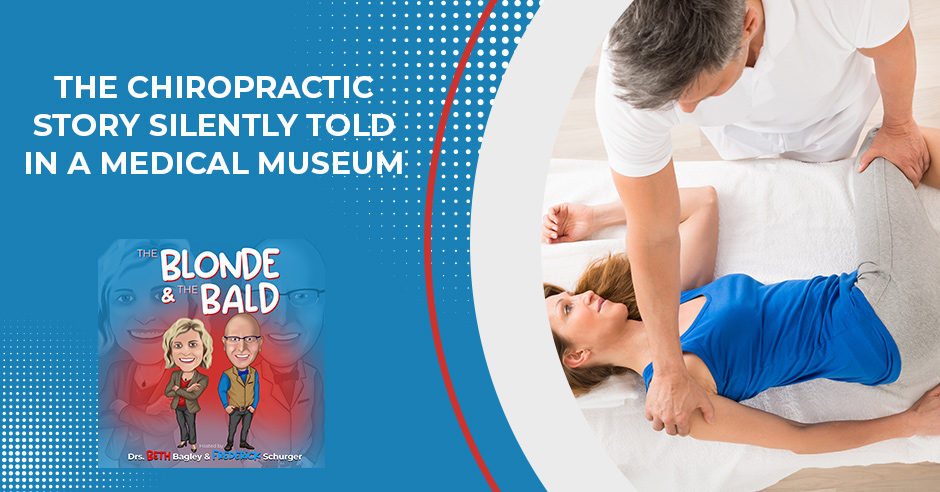
It's easy to break something when there's a misalignment in your structure. Our body is designed with certain fragility, and misalignment in our body can greatly affect our health. Dr. William Blair happened upon a case of a man in a medical museum who showcased proof of his theory of how bones get stuck out of place in one's neck. Join us as we tell the chiropractic story silently told in a medical museum.
Listen and read the full blog post here

Did you know that some chiropractors do more than adjust patients during their visits? Sometimes chiropractors don't even need to adjust you during your visit! That's an excellent sign of healing, and that's great news because that means you can go longer and longer between visits! On top of that, it might help with your allergies! In this episode, Drs. Frederick Schurger and Beth Bagley share the value of their profession and the importance of holding your adjustment. So tune in to this engaging episode with Frederick Schurger and Beth Bagley.
Listen and read the full blog post here
Welcome to The Blonde & The Bald, the podcast that showcases the amazing healing wonders of Blair chiropractic. Join Drs. Beth Bagley and Frederick Schurger as they discuss how their practices in the Midwest are using the latest science and cutting-edge technology to provide state-of-the-art chiropractic care. If you have ever been skeptical about chiropractic, these two doctors were probably even more skeptical than you are! What changed their mind and propelled them to the career that they have now? Join them as they introduce themselves in this episode and give us a sneak peek of what’s to come on the show. Tune in as they share their takeaways from the recent Blair conference, as well as their thoughts on the latest scientific and technological breakthroughs in the field.
---
This is going to be the inaugural show of the blonde and the bald.
Which one is bald?
In my first year, I was blonde. Apparently, in our family, the blonde went too bald very frequently.
At least you have a nicely shaped head. If I went bald, it would be not pretty.
Let's not go there and not even want to dare. Speaking of dares and things, what we might do, inadvertently, let's talk about the Blair Conference. What I'm thinking of what we'll do on this show, before we get them out there, we're going to do a bunch. That way we've got a bunch in the can already so as the holidays come in, we can be more relaxed if some of these will be lives. We should talk about certainly stuff that's topical as far as health in the world and tell people a little bit about ourselves and our own experiences. We'll do that on future ones. We got back from the Blair Conference. It was a great and beautiful weekend.
There were some things that, honestly, I was glad I was there. Many times, you go to a conference or spend all that time and money and you're like, “I should have stayed home.” I felt the opposite. I thought I got much good information, not just science stuff, but business stuff. It was incredible for me. I've got many action steps that I've already taken, which makes me feel completely overwhelmed. The biggest one for me, because it meant a lot to me for my own health, was the radiologist that came. She came and talked about the relationship between the jaw airway and the neck. All of a sudden, I've had a couple of dentists try to explain that to me through the years. I got it and I was like, “Sure,” but all of a sudden, I was enthralled in this entire two-hour presentation.
It was a full thing. I enjoyed it myself.
Dr. Dania Tamimi. It says that she's a chiropractor, which she's not.
She's a dental radiologist. She was from Saudi Arabia. She was fantastic. I know I'm going to take her Radiology course. It's an expensive class compared to what we typically come across, but the wealth of knowledge that she has is highly in demand.
We got the tip of the iceberg with those conversations she had. For readers, I wanted to go over a couple of the things that I wrote down. We know this. One of them was like we have discs in our neck, but there's a disc in the jaw. When people open, it's supposed to move with it. When people get the clicking, that means the disc is doing something weird then there's a breakdown of the jaw that happens.
There's a restructuring of the jaw, which is what we see a lot. People have already had this restructuring process go on. It was cool to hear her talk about it because the jaw is important to life because we talk, breath, chew and all the things. The body has the technology that it's made so well that it will restructure to still allow people to have somewhat of a functioning jaw even when it's damaged.
It's not just that. Unlike the discs in our spine, once the degeneration process starts, that damage is done. It's a scar on the spine, as Dr. Matthew Richardson likes to call it down in Palmer, Florida. I'm throwing names out and patients reading are going to be like, “Who? Do I care?” No, but the important part here is that, unlike our spine where we can't have those discs regenerate or at least they can't completely reheal, TMJ can, given the right circumstances and opportunities on its own. It is miraculous when you think about it. It's very exciting in those regards.
One more thing I wanted to bring up is that people at home can do this too. She did this test where you can see the relationship between the neck and the jaw where you put your teeth, don't clench them, but put them barely together and then shake your head. You can feel your teeth at the top and bottom move when you're moving your head because it is connected. As chiropractors, we're going to be like, “Here is more important.” A TMJ dentist is going to say, “Here is more important.” The truth is, who cares? They're both important.
Sometimes you got to work on both. The way I like to think about it is if your head is your garage and your TMJ, your jaw is your garage door, and your atlas is your foundation, sometimes because the atlas is off, the foundation is off, the bite will be off. You've seen some of these springs on these garage doors. If they jam up wrong, it's going to cause that house to move off the foundation incorrectly. It could even damage the foundation. You've got this back and forth between these things that need to be addressed and handled delicately, and truthfully by people who are truly experts and have studied this area for a very long time.
If your head is your garage and your jaw is your garage door, your atlas is your foundation.
That was my first takeaway, which I liked. Some other people that came, we had, Dr. Simon Senzon. I've read his stuff before and I've seen videos of him talking before, but I've never seen him in person. He has done such great things for our profession.
He's a chiropractor, got his Master's and now he's finishing up his PhD thesis. That was the juxtaposition juxtaposed. That was the crux of what he was presenting. What he had discovered by looking at all of the research that exists within chiropractic is a handful of papers that do not support themselves. They should not be from a peer-reviewing process, the process that we have in society that says good science follows these things here and the objectiveness of that science falls into certain guidelines.
He found eighteen papers that were outside before that should never have been approved. The two scary parts to that are many of the people who wrote those eighteen papers are writing the same papers. It's not like we have eighteen different people. We might have seven different people contributing and everybody else is referencing those papers. This is like this Alzheimer's thing that's popped up in the news media where they had a research that says, “It's the tau protein that we're looking at. This is the problem that we got to solve.” It was a complete lie. It was fabricated research. Unfortunately, the same thing happens for chiropractic.
That one is 17 or 18 years of research. Since then, it has been done based on this fabricated lie. How many millions of people have been affected by that? Where there are offering medications to try to fix something that's not the broken part?
They've seen time again and again that this is Alzheimer's. It didn't work out properly, then they said, “Let's try it anyways because it showed to be a little promising,” and yet what are the side effects from some of these drugs? Some of these drugs are nasty. We won't get into some of the side effects.
We could do a whole show on that.
We might have to come back to that.
It's kind of a poison. You've got one study and then all of these other studies say, “This is what I'm referencing,” but if that study was done poorly or, now all of these other studies are tainted and then studies that they are done against that they're tainted. That can happen in any profession, but it happened in the chiropractic profession.
This is where we've got to be careful because now we're starting to say, “What research is invalidated by those papers?” That's one aspect. I've got one patient who's going down the entire upper cervical chiropractic rabbit hole. He's loving this. He's getting excited. One of the other things that Dr. Senzon has done is he's gone through all of these chiropractic green books. I've got The Bigness Of The Fellow Within. This thing is one of my favorites. I'd love to say one time, we're going to read something out of this, but it would drive people batty.
He went through all of the green books, categorized them and has not only figured out how our history got us to where we are, but also, started to dispel some of the myths about why chiropractic did what it did. A lot of people are like, “This subluxation has no meaning,” and yet, getting back to these eighteen fatally flawed papers, they are saying, “Subluxation isn't something we should be using. Describe what is going on here in the upper neck.”
“I think I prefer using either atlas displacement complex or neuro structural shift because it's easier to understand.” In reality, these subluxations are supported by our literature. If we did some research to start to unpack what that is, we start figuring out what's going on as far as people's ability to function, heal and work the way they're supposed to, which goes into that one crazy guy in his presentation. The one with the cowbell.
Is that you?
That's me.
What you're saying is you want me to segue into the research project that you did in the paper that came out that has been published.
I already told you all about that. That's on another show. What were your takeaways from my presentation on that? What did you think?
You had done it before for me because we've been in done seminars together. I did know a lot about it and I've read the paper. In general, it was cool to see that there is a correlation between a specific upper cervical or cranial cervical junction adjustment and an immune response. Not just with our technique, which is the Blair technique, but with other specific upper cervical techniques too. There is more research to be done and my biggest takeaway is we need to know more.
I've been thinking about different ways that we can go back and redo parts of the study to figure out what our next game plans need to be so we can figure out how the response. It is because the study showed that within 30 minutes of getting adjusted, your innate immune system that attacks viruses and pathogens, as soon as they come into your nose, mouth or eyes, there's an immediate response to improving that function. After weeks, it drops back down to some new baseline. We don't know if that means anything. We don't know what the path of that curve is. That's the interesting part of that. I'm excited about it. It's something that we have known.
There was that Spanish flu back in the 1900s. Chiropractic hospitals had a better survivability rate than chiropractic and osteopathic hospitals, which suggests something tied to manipulative therapies because osteopaths were doing manipulative therapies back in the day. We had a better outcome, less mortality, and less people dying than the medical hospitals at that time.
There was also some correlation possibly between the introduction of aspirin at that time. If you look into it, in the chiropractic hospitals, they weren't doing sure aspirin therapy. It might not have been aspirin, but it was something like that could have also created poorer outcomes for them. It was the combination.
Sometimes, the best outcome is doing nothing. That scares people because the body is an amazing thing and able to heal itself.
Are you done touting how amazing you are?
I've got it in other places. If people want to ask to see it, I'll send them to those places.
We can do a whole show on it. Moving on. We had some discussions about the newer technology for chiropractors called CBCT. I don't have one yet, but I'm getting one. You already have one. Can you explain what CBCT means?
CBCT stands for Cone-Beam CT because it's a Computerized Tomography or CT. What's neat about the CBCT is it's able to take a picture and create a 3D image of your entire spine head skull, the whole nine yards, in about 20 to 30 seconds and you're out of the seat. It is a very exciting technology. Previously with an X-ray, we can take some nice digital pictures, but we weren't getting 3D. What the Blair technique has always been about is how we adjust our X-rays to take what we would call an oblique film, but basically to start looking at the body from a more 3D standpoint, and taking a picture of the joint. Now we can see it all in one piece, which is exciting.
I'm excited that you're going to be getting one down there very soon. That's awesome. It is a lower dose of radiation than even what we were taking previously for X-rays. It is very safe and fast. Patients love it because, within about five minutes, I can show them their skull and their head. We can look around it and see what's going on. We can see the degeneration. We can even put layers on top of it that show a little bit of their skin so they can see where their skin is. They can even see their nose.
It's fantastic. I love the technology because it's made my life much easier, to be able to see what's available, how we need to address it, and how we're going to adjust patients. Some people have big old what we call asteroids. It is sitting in front of their atlas, and we've got to figure out a different way to adjust them. In fact, I've got one young man who I adjust but I can't get to his atlas. I have to adapt my technique to adjust him and keep him doing well. I'm excited. You’ll going to love it when you get it.
The X-rays we take in the Blair analysis are time-consuming and hard to get right. I'm not against them, but it's hard, especially since I'm teaching the younger generation how to do it. There are less chances of messing up doing CBCT. The analysis is still time-consuming, but the actual taking of the imaging, I'm excited for that to be much better in the office. That's going to help us with time management too.
It allows us to be able to say, “I don't like that angle. I can shift this angle a little bit.” Now I see it from that perspective.
It’s all on the same image file. You don't have to retake anything. If somebody was to ask you, “CT, I've heard that's a lot of radiation,” what would you say?
This is where cone-beam technology is going to be the next generation. It already is the next generation of CT. When you're getting a CT, chest or head X-ray, it is more akin to that original X-ray technology where it's coming straight across. The cone-beam is literally creating a cone of information that is coming from the source out to where a plate as it were catches all the information through the skull, which has always been X-ray technology. You have your source over here, your plate or whatever it is that catches the information. On plain film X-ray, it was creating a hologram. Now we're catching all that, but because of the way that it's sending the information over and recording it, it requires much less radiation.
That’s incredible.
It is. From 100 years ago, when X-rays first came out, that was a high dose of radiation.
The technicians would get cancer.
People who were in there might get a burn because it took a minute to set that entire thing. Now, it's twenty seconds to go all the way around the patient, which is the longer it takes, the better resolution you get. I've got a twenty-second picture that's already at a low dose because of the way the technology works, that it's a fraction of the time and dosage compared to what other CTs have been in the past.
In comparison, I'm looking at a radiation dose chart. Is this about the same amount of radiation you get on an airplane flight from New York to LA?
I think that still holds up pretty well.
I saw it was between 10 to 40 and that's 40. That background radiation you'd get on a day living your life is already at ten.
Where we're at here is much less compared to somebody living up on top of Colorado, which is much higher. People living up there are not having any problems. They're smoking more pot. They're not having problems like that.
In general, what we're saying is that whether you're getting dental X-rays, regular X-rays or the CBCT, the technology that exists now creates such a small dose that we're no longer in a dangerous zone for anyone.
It is advanced so much, with the ways that they have been able to figure out how to make it more efficient. In comparison, our X-ray units needed 220 power. It's comparable to what some dryers and washers have needed in the past. The CBCT unit, the whole thing, can be plugged into a wall socket. To put it in perspective, this thing has got a lot of electronics going on in there and it still runs off out of a wall socket.
It's unbelievable to me. I'm excited. One of the other parts of going to a conference like that is networking, talking to your fellow doctors, and having good conversations. I love my Blair family. I get to see my family once a year to go to this conference and it's incredible. I get to see you more than once a year, thank goodness since we're about two hours apart, but for a lot of people, that's the only time we get to see them in person.
We had some good times. I got to go out to dinner with the three Liz’s.
I was one of them. I go by Beth though. Don't call me Liz.
The three Elizabeths. Because you were Beth, Lundy was Beth and Liz is Liz. I don't get to see Dr. Lundy once a year. I don't get to see Dr. Hafer. I'm lucky if I can see her twice a year.
Speaking of Liz Hafer, did you see her post on Facebook?
No. Did she pass?
She did. Now she has Dr. Sugar, you have a diplomat in Craniocervical Junction. Dr. Liz is now part of your club.
I was part of the inaugural class that started in 2013. The research paper that we did was a bunch of diplomats. I finished that in 2015 and Dr. Hafer finished that for herself. As a funny aside, we sat down for the Instructor Summit, Thursday night before the conference. I said, “I'm going to sit down here,” then Dr. Mychal Beebe and her husband, Dr. Tyler Evans, Dan Judge and Dr. Ian Bulow all sat down in a row on one side of the table. Dr. Hafer was on the other side and we made the joke. It's like, “Only DCCJP is over on this side. You can't be over there. You stay over there. You haven't passed yet.”
Now she can come to that side of the table. On the other hand, I am far away from that table. I'm not planning to come to that table anytime soon.
We have other plans to keep you busy. We might have close to a dozen DCCJPs in the Blair Society. We are well represented in that group because we've been forward-thinking on that. I'm excited. I think we've got about maybe 60 to 80 or somewhere in that ballpark after three classes. It's exciting. We've got a couple of others. Dr. Steinberg and Dr. Beard are planning on doing it sometime here in the near future. It'll be good for them. What else do we want to talk about?
I was thinking one of the things we could do is because we get to see miracles in our office every week. I say miracles, but it's science. We know what's happening, but it feels like a miracle because the healing is powerful and sometimes quick. I wanted to go over one case study in my office. This young lady came in with pretty severe vertigo episodes about twice a week. She's a nurse. She does a lot of bending, lifting, and twisting. She’s young. She’s in her early 30s, if not late 20s and it was affecting her life.
She went to an ENT. They gave her the normal Meclizine and one other thing, maybe steroids. I pretty much said, “Good luck.” The truth is I'm not blaming the ENTs. They don't know what we know. What we know is that when the top bone of the neck has a shift in it, it can cause problems with the vestibular system. The vestibular system is what keeps us steady. When you have ever maybe partake in drinking alcohol, that will affect the vestibular system.
That's why you see people fail with vertigo. They're standing and they start going because they're starting to have vertigo. They don't know where they are in space. Vertigo is pretty debilitating because you'll start seeing nystagmus where the eyes start twitching like this and they're spinning. They don't know how to rewrite themselves. Sometimes, for some people, vertigo can last for hours. They can be vomiting and it's awful. She didn't have it that bad, but it was affecting her ability to do her job as a nurse.
She came in and within the first week, instead of having two vertigo episodes, she only had one in two weeks. She was pretty excited because she could tell a difference. Ever since that last vertigo episode, she has had zero vertigo episodes. She's doing better holding her adjustments. She does work nights and it's a hard job. She may not hold it as well as some people, but she is doing excellent and she's ecstatic. Letting people out there know, if you've had vertigo, find a Blair upper cervical chiropractor. It's incredible. It changes lives. If there's no Blair upper cervical chiropractor available in your area, contact an upper cervical chiropractor.
If you have vertigo, find a Blair upper cervical chiropractor. It will change your life.
We've seen such great responses there. In fact, Dr. Berkhan, who forwarded all of Meniere's research that got a lot of this vertigo or Meniere's cases into our offices, his office has been closed because they did road work in front of his office. He took the advantage of that time to get some surgery done on his shoulder, which thankfully he's doing better now. He was telling me when we were at the Blair Conference. I was chatting with him on the phone.
He wasn't at the Blair conference.
That's why. He's been working twelve-hour days. He's starting to get back into the office. Oftentimes, he's probably still working and seeing patients for another hour or two. He's been getting people better. It is amazing what we can find and help people within those regards. In fact, I was thinking about, “What's my patient that I wanted to share?”
He's vertigo or Meniere's. He's got some other weird stuff from his time in the military that we're slowly getting him out of, and he's doing better and better every day. I'm hoping that he's able to get back to doing some work on his own so that he doesn't have such problems with it. When he gets adjusted, his body doesn't want to go six different ways as it tries to go through the healing process and fix everything in sight. It's always fun. We see so many changes.
I was talking with the father of one of my patients. He brought three of his daughters. They got checked and adjusted. All three have been holding steady since their first adjustment. They're not giving me any information. I asked dad, “How are the girls doing? What's your take on them?” He's like, “They're doing much better. They're clear, sharper focused and working better.” I think we had two migraines and the third one had a foot problem like dad did. I fixed his foot problem by putting his head on straight. He is like, “We're going to get that one too.” It is amazing the stuff that's connected. We don't even understand what happened.
Sometimes you can put it together, but honestly, sometimes I will tell people, “I don't even care how this helped, but I'm glad it did.”
Some days, it makes sense and some days, I'm like, “I'm tracing it. I understand the anatomy. I don't see where these two come together. It's one person,” and we get that one person functioning, healing and working the way we're supposed to.
That's why we have a passion for what we do. Honestly, it's hard what we do. Running a business is hard and all of things. We could make a lot more money doing other things, but I would never change what we do for anything because I get to see many people get their lives back and their health on track. If you don't have your health, you don't have anything.
If you don't have your health, you don't have anything.
We will definitely be talking about your past life and my past life before we got into chiropractic in the future.
I'll be open. I don't mind. Lastly, I want to say is, if somebody sees this show and there's somewhere to comment like you see on Facebook and you want to know something, there is a topic that you're like, “What does that mean? Does this help with this or anything?” We're always happy to answer questions. I like when this is an open dialogue. I'm hoping that at some point we can maybe bring a patient on and interview them. I can think of a few patients that wouldn't mind Zooming with us and talking about their experiences with this incredible healthcare that we love. We take it for granted a lot because we see things get better. We come to find out that doesn't happen in a lot of offices.
It doesn't. Even some days, it doesn't help when we don't get better or if we have a problem, we're in a pinch. I don't mind sharing that sometimes I'm in a pinch more often than I care to admit.
It's hard being a doctor for everybody else. We wouldn’t even doctor ourselves.
That's a good spot for us to wrap it up. In the meantime, people can find me at KeystoneChiroSpi.com. What's your website?
precisionchiropracticstl.com/.
Everyone will come and find us and we're going to have some fun with this show over the next several weeks, months to maybe even years. We'll see how far we go. We'll talk later.