Next, click the Subscribe button if you are not already subscribed.

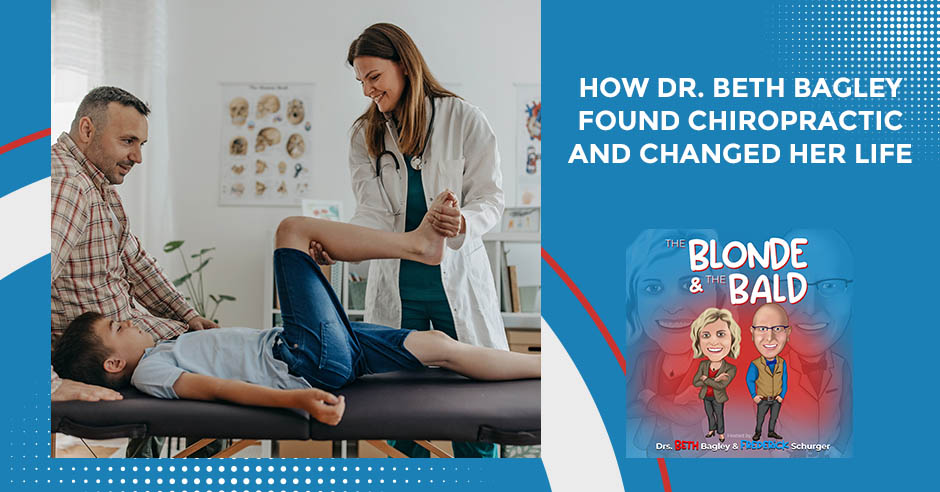
Chronic diseases tend to persist, and we succumb to the usual medical advice finding little relief. Dr. Beth Bagley has known this struggle until someone told her about a new way of looking at health with chiropractic. Soon, she found herself free from chronic problems and well on her path towards becoming a chiropractor. In this episode, we get to know her journey, how she was introduced to the practice, and how it changed her life. Together with co-host Frederick Schurger, Dr. Bagley shares with us how she discovered Upper Cervical Chiropractic and the Blair Technique. Get to know our host in this conversation as Dr. Bagley inspires us with the work she is doing in changing people’s lives.
---
How are you?
I'm good. It was a good day being a chiropractor.
I see about 25 or 30. It was a lot.
I had a calm afternoon. We only start seeing people in the afternoons on Wednesdays.
Same here.
I did wake up with a stiff neck. Chiropractors get hurt, too.
I had the most horrific morning. It was miserable. My normal morning routine is I wake up, I make my coffee, and as I'm waiting for my coffee to cool down, I'll sit and peruse the internet, except the internet wasn't cooperating with me. I reboot my computer and my local Wi-Fi. I reboot the modem for Comcast, and all morning long, the internet worked at 10% of what it can. It felt as bad as dial-up.
I watched this movie. I don't recommend it. I don't even want to say what movie it is. It's like a horror movie, and it had to do with the time of the pilgrims and Puritans. It was well-acted in a great period piece other than it being horribly scary. We complain about the internet, and the stuff that our ancestors went through to get us to where we are, we are just the luckiest group of beings there is that we have everything.
We have clean water. We have refrigeration for our meats. These are the important things.
One thing that they didn't have was 60-mile-per-hour car accidents. I'm not saying that people back then didn't have spinal problems, but they definitely didn't have the multiple whiplashes that we have now. I had a patient. She's had four major car accidents or problems that went on in her life. She has been diagnosed with fibromyalgia and chronic pain. She just got her first adjustment.
I haven't talked to her yet to see how she did with it, other than afterward, she said it's the first time she's been able to breathe in a couple of years, which I would say was a pretty good, profound result from one adjustment. I'm excited to see how she does. She said that she's excited to share her journey with people. I'm hoping that we could get her to come on to the show and give us a little bit of what it's like to be a patient in an upper cervical chiropractic office because it's been a while since either of us had just discovered this.
As I was going to go towards my joke about not having the internet and feeling like I was back on a modem, that's exactly what happens when your nervous system gets shut down. You're used to everything working, and it's like, "I could get used to this again. I could suffer. I'll go back to just reading text files as opposed to seeing videos and pictures." Eventually, the body breaks down because the communication from the brain to the body isn't working the way it's supposed to because that internet superhighway that is our brainstem and spinal cord isn't working the way it's supposed to, which makes life miserable.
I'm excited to have some people on as well. I've got a young man who was a Marine and had a really bad accident. It was an MVA. It wasn't like he was in battle or anything like that, but it was a severe accident that has kept him miserable for the better part of the decade now. He's doing great. He and I are both into knives. He got me this beautiful cutting card. It's the Greek God Atlas.
If someone's reading this, why would Atlas be anything to them? What would that mean?
I don't know if it would mean anything to them. We're just getting into this and talking about how what we work with is the first two bones in the neck, the first bone being called the Atlas, which is the Greek God who held the world on his shoulders. The head and the neck pivot around the axis. That's our focus. This is what sets us apart from other chiropractors that we're not doing the same thing that the vast majority of our colleagues are. This is why we see some of the really strange cases.
In fact, we're doing this on a Wednesday night because your schedule got messed up, and I'm running late because one of my cases that have had a whole bunch of problems, they needed to get in late, and we just finished up with them. If it wasn't for me, I don't know if this woman would be alive now. That's how bad the husband felt about where his wife was. It's pretty amazing.
In this episode, do we want to go over my story on how I got into chiropractic, or are we doing another?
We should do that. This would be a good time to do it.
We're talking about me.
I know. Who doesn't? Let's back up. Before we even get into your chiropractic story, you did not go to school initially for chiropractic. What is your bachelor's in?
Bachelor of Science and Biology. I got that thinking I was going to go to medical school. I had a pre-med study minor. I even took the MCAT thinking I'm going to medical school. I spent some time working in an ER as a volunteer on Friday nights at SLU Hospital, that's in Downtown St. Louis. I decided I did not want to be a medical doctor from that experience. I highly respect medical doctors, and I probably even respect more the nurses and staff because of the stuff they go through on a daily basis. It was traumatic. That didn't scare me so much. In ER, you have to turn your heart off.
You have to separate the love and the caring from yourself because if you've put that into it so much, and I know a lot of nurses still do, it's going to get sucked out. The stuff that they saw on a nightly basis of train accidents, car accidents, falls, gunshot wounds, and stabbings, was just awful. That didn't scare me so much. It's just that I just knew that I would lose my heart, and I have a big heart. At that point, I decided not to be a medical doctor, and that was okay, but I really love science. With my degree, I was able to land a job at a biotech company called Monsanto.
You went to the devil.
A lot of chiropractors don't necessarily like Monsanto. Now, it's called Bayer, but it was Monsanto back then. There are a lot of people that worked for that company. What I learned from that job is that I did not like working in a lab. I worked in the lab as a molecular biologist for a few years. It was fun sometimes, but a lot of times, it was really boring and I wasn't helping anyone. I was just helping myself and the company. My heart is to help people. I want to help people have a better life somehow. Honestly, at that point, I was just a kid trying to find a job. It was a good job. I made a lot of money. It was wonderful coming right out of school and making good money.
About two years into it, I decided that I maybe wanted to try something else. I happened to go to an open house at the Logan College of Chiropractic campus. About a few weeks later, I had already quit my job and applied for school, got in, and decided to become a chiropractor. Now, I had been under chiropractic care pretty much my whole life. My grandfather was a full spine-diversified chiropractor. He went to school with a G.I. Bill right after World War II. A chiropractor had saved his life. When he was a kid, he had rheumatic fever. Doesn't rheumatic fever go to your heart?
It can.
He was told by the medical community to make sure he gets an education because he'll never be able to do hard labor because it really affected him. Back then, who knows if a chiropractor even had a license or whatever. It could have been one of the backdoor chiropractors. You had to have a special knock to get in because they were being persecuted by the states and the medical boards, but he got to see a chiropractor. I don't even know the story of how that happened. I wish he was around to ask him. He'd love to be on our show. He got chiropractic care, and it just empowered him. He was physically stronger than anyone. He was amazing and strong enough to go to war in World War II.
When he got out, they had that G.I. Bill, which gave him the ability to go to chiropractic school. He went to Missouri Chiropractic College and came out and started a practice down in South City, St. Louis. As a kid, I would get adjusted by him usually at his house, but he never really explained it to me. I was just a kid. I was one of the youngest of the grandkids. My sister and I were the youngest. It was pretty much, "Lay down here. You're good. Get up. Next." We never had any discussions about chiropractic other than I knew what it was because he did it. I really didn't know anything about it. Even when I started school, I didn't know anything about chiropractic.
That's scary to say you went to school and you started off not knowing what you were even getting into, and I did not. I was a couple of semesters and trimesters into school. My whole life, I had had health problems. Starting in my early teens, I had pretty much headaches every day, and those continued. I had depression, anxiety, Irritable Bowel syndrome, and horrible menstrual cramps that would take me out of school 2 or 3 days a month. I would have panic attacks. Those started in my teenage years. I had a car accident when I was sixteen, and everything just got worse from there. I also had chronic insomnia since I was a kid. That was my normal. It took me three hours to fall asleep.
I had no idea how to fall asleep. I would go up to my sister and say, "Sarah, how do you fall asleep?" She'd be like, "Close your eyes when you go to sleep." My body just didn't know how to fall asleep. I was chronically exhausted. When I went to chiropractic school, I started hearing this new way of looking at health. I thought, "If chiropractic works, I'm going to stop taking my antidepressant medication. I'm going to stop doing this and that, and I'm going to be great."
When I went to chiropractic school, I started hearing this new way of looking at health and I thought, “if chiropractic works, I'm going to stop taking my antidepressant medication.”
Two semesters in, I was about to quit school because everything was worse. I happened upon a young man named Chris, who said, "You should meet this chiropractor. He does this weird thing called upper cervical." I was like, "I know cervical spine, but I never heard the word upper cervical." He said, "We should meet him." I said, "I'll come with you. That's fine. Are you driving?" We drove down to South County and met this chiropractor named Dr. Adam Tanase, who is now a very close friend. He explained the upper cervical to me, and I thought he was crazy because I had been adjusted my whole body.
He is crazy.
He is, in a good way. I had been adjusting my neck, back, and legs. I had been popped and cracked my whole life. Honestly, chiropractic had helped a lot. My back pain got better after I got chiropractic here. Neck pain and headaches got a little bit better, but never really 100%. The big thing is my health never changed. It was just always a chronic problem. He explained upper cervical to me and I thought, "Maybe I'll give this a chance." Honestly, I was about to quit school, and I was a semester away. I was handling school, but chiropractic was not working for me.
I didn't quit school because about four months after starting care with Dr. Tanase, I got my life back. Over the course of those four months, I stopped having panic attacks, back pain, and neck pain. I learned how to sleep, which was amazing for me. When I would put my head on the pillow, I'd be asleep in fifteen minutes, and I didn't even know what that was about. I'd wake up restored from sleep, which is amazing. Menstrual cramps, which I thought were part of being a woman, that's not part of being a woman.
You feel a little icky on your first day, and that's pretty normal, but not being able to get out of bed for three days is not normal. All these things that I claimed as my normal wasn't really my normal. My normal is vibrant and full of life and vitality. At that point, I decided not to quit chiropractic school, and to devote the rest of my time to learning this upper cervical thing. I was a little bit of an outcast in school at that point then because not a lot of chiropractors do this.
Certainly not at the campus down in St. Louis.
That's not a big thing at Logan. I lived in St. Louis my whole life, and I wasn't about to move because I was already in middle school. I stuck with it, and I went to seminars, met doctors, and did what I need to do to find more upper cervical-related studies. What I hadn't found was the Blair Technique, which was an incredible story in itself. Do we have time for that?
We definitely have time for that. Technically, the first time we met was not at the Blair Conference, but rather at the Upper Cervical Evolution. That would've been around April of 2007.
I went to the first Upper Cervical Evolution at the end of my chiropractic school.
I had just opened my practice in Springfield at that same time. I remember we ran into each other. We didn't have any time to chat because that entire weekend was a whirlwind, but I think that was the first time we met.
At the Green Valley Ranch. That's where the Blair Conference is going to be next.
Yes, it is. That's going to be a good conference, too. That's just always a good location.
I don't remember you from that.
I only vaguely remember you because, in a crowd, you stand out.
I do. I'm not standing now, but I'm almost 6'2", pretty tall for a female. One of the interesting things about me is you'll come up to me and hug me, and people will say "Hi. Good to see you." I'll look at them and be like, "I have no idea who you are." I won't say that out loud. I'm polite. I wish everybody wore name tags all the time.
I just have this, and everybody knows who I am now.
We stand out. We're the blonde and the bald. I was a few years into practice and saw some amazing results in my office. I always felt something was missing. The X-ray analysis wasn't that great. I was doing a technique called toggle.
It was one of the first upper cervical techniques which were called Toggle Recoil. Dr. BJ Palmer from Davenport, Iowa, called it the HIO or the Hole-In-One technique. I still don't quite understand what that is other than the fact that it's the most profound area to adjust in the body to get a person back to where it's supposed to be. I'm not a golfer, so I don't appreciate that analogy nearly as much.
That technique is fabulous. It's not as precise as I wanted it to be because coming from a science background, I like things to be very precise. Now, we're talking about people's brainstems. These strangers come to me and invest their money and their health, trusting me with their health, so I wanted to be the best doctor I could be. I happened upon the Blair technique not even knowing it existed. They were having a conference in St. Louis that year. I'd have to look up what year that was. I don't even know.
I'm curious. It's got to be 2010 or 2011.
I graduated in 2007. I started my practice in 2008. I'm going to guess it was 2010 and 2011.
It's somewhere in there.
I went to this conference. I was even late coming there because I had seen patients on that Friday, and then I left from there and brought my tables. I show up there, and somebody helps me grab the tables out. I don't even remember who I talked to. That was a world whirlwind, too, because then I started learning the Blair technique at that conference. There's something called the Primary, which they don't teach at the conferences anymore, but that's the first part of the Blair technique if you're a student.
I was listening about the atlas, that top bone we were talking about before, on how it moves, and realized that the technique I was using to analyze that bone on people's X-rays was not correct, and my mind exploded. When you realize that you have someone's life in your hands, and you are adjusting something that could give them back their life, and you're not doing it the way that you're not 100% know how to do it, it breaks you a little bit. I was broken coming out of that technique seminar in a good way because I knew I needed to be better. From there, I visited Dr. Schurger a few times. He taught the Blair technique Primary at his office in Springfield, Illinois. That's when my mind also exploded a few times.
When you realize that you have someone's life in your hands, and you are adjusting something that could give them back their life and not doing it a hundred percent, it breaks you a little bit.
It was fun to watch. Let me tell you, it's one of those few joys that I have when I have someone new coming in from either Toggle or one of the other upper cervical techniques, or just learning it for the first time and they see it. When we talk about how we're looking at the atlas from just a slightly different angle, people's eyes go wide open and explode. The head melts and explodes. It's entertaining as an instructor to see that. I'm like, "We're onto something." The next step is for them to repeat the course multiple times to really get good at this.
It made my practice so much more reliable of the adjustment. The way I can look at atlas and no uncertainty, just sure this is what's going on, and get people their lives back. Dr. Blair up there in the great beyond, I appreciate him figuring this out. Now, knowing that with the new technology, like the CBCT we talked about last time, that 3D imaging, knowing that everything he said was right. We find new things out, too, but the basic things that he said about how atlas moved, he was right on. How it misaligned, he was right on. It was really cool.
I'm just so grateful to be a chiropractor. There are great many things I could have done with my life, but I do feel like God's brought me to this. When people are saying, "I'm still searching for my profession or what I want to be when I grow up," I don't have that conversation. I know what I'm supposed to be. I know why I'm here. It's an incredible journey. Every day is different. There's a lot of the same. The business stuff, none of us chiropractors. I'm sure some of them like it, but that stuff exhausts me. What empowers me to continue to go on and do all that is to see these amazing changes in people. I love it.
It's great because we see people who are certainly senior citizen-style folks who come on in and are like, "Doc, I haven't been right in twenty years." The flip side is, "You should have been here 20 years ago." That's the first. The second part is we get them better, and within a couple of months, they're like, "I can do all the things I was supposed to do." What's really exciting is they've been with you for a couple of years, and they're doing things that their kids and their grandkids are like, "How do you keep up with this?"
I had two 80-year-old birthdays. The 84-year-old, the joke is, "I'm still doing all this, that, and the other." I'm like, "As long as you're not jumping out of perfectly good airplanes, we're doing all right." Personally, I think she's running laps around her children who are in their 40s, 50s, and 60s. It's really exciting to see that and all the generations, because oftentimes, we'll start seeing parents bring their little babies in, and we just go, "Whoop," and then they cry, poop, and go to sleep.
What I love about a baby that's not at ease is they're crunched up. Their legs are crunched up, and they're crunched. You get in there, and the adjustment on the baby has no popping, cracking, or anything scary, and you see the relaxation. The ease comes back. Patients will describe that ease coming back. Parents are like, "Whoa." They just see this amazing, unwinding of this child where they can stretch out and just be still. It's amazing.
Here's my favorite, and it's a funny story because one of the reasons I came to Springfield was because my good friend from undergrad was here, so we kept on visiting and said, "We're going to set up in Springfield." A couple of years after we set up and we're down here, they had their son. I've known mom since undergrad as well. We were all in school together, but she's a little bit reluctant about chiropractic. I get that. I see that a lot. I'll tell that story next when we talk about my story in chiropractic. She's like, "Jim, you can do whatever you want. Schurger will take care of you, but not me and not my baby."
My wife was working on her. One of the things, when they had the baby, he had the worst colic, was up all night, and would not go to sleep. They had a driving routine to get him to even calm down. He would not latch, so she wasn't able to breastfeed. She wasn't able to let down. There were all of these problems to get him going. After about five months, I have seen both of these people after one of our fraternity parties that are like, "You overdid it last night." The answer was yes. I've seen them in those states, and this was worse. That's how bad they were because neither of them was getting any sleep either.
Finally, she's like, "I'll get under care. You get him adjusted, too." That was my only requirement. She gets adjusted. She's doing a little bit better. He gets adjusted, this little baby boy, 5 to 6 months old. All of a sudden, he poops six times that first day. They're like, "Where is this coming from?" He was constipated, but there was still a little bit that would come out every day. The entire diaper's full.
They're supposed to poop.
Exactly. He sleeps. They put him down at 7:00. They're used to him up every couple of hours. They put him down about 7:00 PM, and somewhere in the middle of the night, his mom gets up to check on him just to make sure he's not dead because he hasn't woken up and cried. He is sleeping for the first time ever twelve hours straight through the night. He is at ease. Mom was not. Mom was still in that, "I got to wake up. It's time to make the donuts." She was meeting herself as she was going back to sleep, as she was waking up. It was one of those types of situations. I still laugh about it. It's been several years now.
Time flies.
It really does. That's a good place to wrap. What do you think? Anything else you wanted to share?
It was fun telling my story. I appreciate everyone who got through it. If you or anyone you know has issues going on, it's worth getting checked out. A Blair chiropractor is going to be in your area. I'm in St. Louis, and Dr. Schurger's in the middle of Southern Illinois. We're always open for a conversation, and that's what we're going to be doing in this show. We'll bring in some people that have had some amazing results.
Maybe we'll bring in some other doctors and hear about their stories. I'm excited to get more episodes going and hopefully get some people following us. Please do follow us if you get a chance. There are going to be ways to subscribe, and I'm sure it's all clickable around you. Follow us and subscribe. If you do have any questions or comments, leave those for us because we would love to answer those.
I have to get and finish up a CBCT analysis for a patient that's coming in to get her first adjustment. She's like, "You do migraines? I bet you can help me with that."
It was good to talk to you.
It was good talking with you. We'll talk soon.
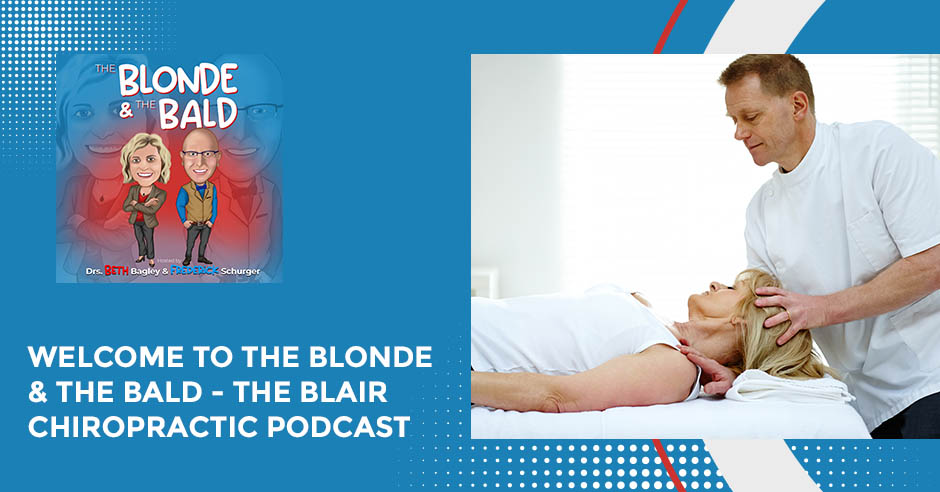
Welcome to The Blonde & The Bald, the podcast that showcases the amazing healing wonders of Blair chiropractic. Join Drs. Beth Bagley and Frederick Schurger as they discuss how their practices in the Midwest are using the latest science and cutting-edge technology to provide state-of-the-art chiropractic care. If you have ever been skeptical about chiropractic, these two doctors were probably even more skeptical than you are! What changed their mind and propelled them to the career that they have now? Join them as they introduce themselves in this episode and give us a sneak peek of what’s to come on the show. Tune in as they share their takeaways from the recent Blair conference, as well as their thoughts on the latest scientific and technological breakthroughs in the field.
---
This is going to be the inaugural show of the blonde and the bald.
Which one is bald?
In my first year, I was blonde. Apparently, in our family, the blonde went too bald very frequently.
At least you have a nicely shaped head. If I went bald, it would be not pretty.
Let's not go there and not even want to dare. Speaking of dares and things, what we might do, inadvertently, let's talk about the Blair Conference. What I'm thinking of what we'll do on this show, before we get them out there, we're going to do a bunch. That way we've got a bunch in the can already so as the holidays come in, we can be more relaxed if some of these will be lives. We should talk about certainly stuff that's topical as far as health in the world and tell people a little bit about ourselves and our own experiences. We'll do that on future ones. We got back from the Blair Conference. It was a great and beautiful weekend.
There were some things that, honestly, I was glad I was there. Many times, you go to a conference or spend all that time and money and you're like, “I should have stayed home.” I felt the opposite. I thought I got much good information, not just science stuff, but business stuff. It was incredible for me. I've got many action steps that I've already taken, which makes me feel completely overwhelmed. The biggest one for me, because it meant a lot to me for my own health, was the radiologist that came. She came and talked about the relationship between the jaw airway and the neck. All of a sudden, I've had a couple of dentists try to explain that to me through the years. I got it and I was like, “Sure,” but all of a sudden, I was enthralled in this entire two-hour presentation.
It was a full thing. I enjoyed it myself.
Dr. Dania Tamimi. It says that she's a chiropractor, which she's not.
She's a dental radiologist. She was from Saudi Arabia. She was fantastic. I know I'm going to take her Radiology course. It's an expensive class compared to what we typically come across, but the wealth of knowledge that she has is highly in demand.
We got the tip of the iceberg with those conversations she had. For readers, I wanted to go over a couple of the things that I wrote down. We know this. One of them was like we have discs in our neck, but there's a disc in the jaw. When people open, it's supposed to move with it. When people get the clicking, that means the disc is doing something weird then there's a breakdown of the jaw that happens.
There's a restructuring of the jaw, which is what we see a lot. People have already had this restructuring process go on. It was cool to hear her talk about it because the jaw is important to life because we talk, breath, chew and all the things. The body has the technology that it's made so well that it will restructure to still allow people to have somewhat of a functioning jaw even when it's damaged.
It's not just that. Unlike the discs in our spine, once the degeneration process starts, that damage is done. It's a scar on the spine, as Dr. Matthew Richardson likes to call it down in Palmer, Florida. I'm throwing names out and patients reading are going to be like, “Who? Do I care?” No, but the important part here is that, unlike our spine where we can't have those discs regenerate or at least they can't completely reheal, TMJ can, given the right circumstances and opportunities on its own. It is miraculous when you think about it. It's very exciting in those regards.
One more thing I wanted to bring up is that people at home can do this too. She did this test where you can see the relationship between the neck and the jaw where you put your teeth, don't clench them, but put them barely together and then shake your head. You can feel your teeth at the top and bottom move when you're moving your head because it is connected. As chiropractors, we're going to be like, “Here is more important.” A TMJ dentist is going to say, “Here is more important.” The truth is, who cares? They're both important.
Sometimes you got to work on both. The way I like to think about it is if your head is your garage and your TMJ, your jaw is your garage door, and your atlas is your foundation, sometimes because the atlas is off, the foundation is off, the bite will be off. You've seen some of these springs on these garage doors. If they jam up wrong, it's going to cause that house to move off the foundation incorrectly. It could even damage the foundation. You've got this back and forth between these things that need to be addressed and handled delicately, and truthfully by people who are truly experts and have studied this area for a very long time.
If your head is your garage and your jaw is your garage door, your atlas is your foundation.
That was my first takeaway, which I liked. Some other people that came, we had, Dr. Simon Senzon. I've read his stuff before and I've seen videos of him talking before, but I've never seen him in person. He has done such great things for our profession.
He's a chiropractor, got his Master's and now he's finishing up his PhD thesis. That was the juxtaposition juxtaposed. That was the crux of what he was presenting. What he had discovered by looking at all of the research that exists within chiropractic is a handful of papers that do not support themselves. They should not be from a peer-reviewing process, the process that we have in society that says good science follows these things here and the objectiveness of that science falls into certain guidelines.
He found eighteen papers that were outside before that should never have been approved. The two scary parts to that are many of the people who wrote those eighteen papers are writing the same papers. It's not like we have eighteen different people. We might have seven different people contributing and everybody else is referencing those papers. This is like this Alzheimer's thing that's popped up in the news media where they had a research that says, “It's the tau protein that we're looking at. This is the problem that we got to solve.” It was a complete lie. It was fabricated research. Unfortunately, the same thing happens for chiropractic.
That one is 17 or 18 years of research. Since then, it has been done based on this fabricated lie. How many millions of people have been affected by that? Where there are offering medications to try to fix something that's not the broken part?
They've seen time again and again that this is Alzheimer's. It didn't work out properly, then they said, “Let's try it anyways because it showed to be a little promising,” and yet what are the side effects from some of these drugs? Some of these drugs are nasty. We won't get into some of the side effects.
We could do a whole show on that.
We might have to come back to that.
It's kind of a poison. You've got one study and then all of these other studies say, “This is what I'm referencing,” but if that study was done poorly or, now all of these other studies are tainted and then studies that they are done against that they're tainted. That can happen in any profession, but it happened in the chiropractic profession.
This is where we've got to be careful because now we're starting to say, “What research is invalidated by those papers?” That's one aspect. I've got one patient who's going down the entire upper cervical chiropractic rabbit hole. He's loving this. He's getting excited. One of the other things that Dr. Senzon has done is he's gone through all of these chiropractic green books. I've got The Bigness Of The Fellow Within. This thing is one of my favorites. I'd love to say one time, we're going to read something out of this, but it would drive people batty.
He went through all of the green books, categorized them and has not only figured out how our history got us to where we are, but also, started to dispel some of the myths about why chiropractic did what it did. A lot of people are like, “This subluxation has no meaning,” and yet, getting back to these eighteen fatally flawed papers, they are saying, “Subluxation isn't something we should be using. Describe what is going on here in the upper neck.”
“I think I prefer using either atlas displacement complex or neuro structural shift because it's easier to understand.” In reality, these subluxations are supported by our literature. If we did some research to start to unpack what that is, we start figuring out what's going on as far as people's ability to function, heal and work the way they're supposed to, which goes into that one crazy guy in his presentation. The one with the cowbell.
Is that you?
That's me.
What you're saying is you want me to segue into the research project that you did in the paper that came out that has been published.
I already told you all about that. That's on another show. What were your takeaways from my presentation on that? What did you think?
You had done it before for me because we've been in done seminars together. I did know a lot about it and I've read the paper. In general, it was cool to see that there is a correlation between a specific upper cervical or cranial cervical junction adjustment and an immune response. Not just with our technique, which is the Blair technique, but with other specific upper cervical techniques too. There is more research to be done and my biggest takeaway is we need to know more.
I've been thinking about different ways that we can go back and redo parts of the study to figure out what our next game plans need to be so we can figure out how the response. It is because the study showed that within 30 minutes of getting adjusted, your innate immune system that attacks viruses and pathogens, as soon as they come into your nose, mouth or eyes, there's an immediate response to improving that function. After weeks, it drops back down to some new baseline. We don't know if that means anything. We don't know what the path of that curve is. That's the interesting part of that. I'm excited about it. It's something that we have known.
There was that Spanish flu back in the 1900s. Chiropractic hospitals had a better survivability rate than chiropractic and osteopathic hospitals, which suggests something tied to manipulative therapies because osteopaths were doing manipulative therapies back in the day. We had a better outcome, less mortality, and less people dying than the medical hospitals at that time.
There was also some correlation possibly between the introduction of aspirin at that time. If you look into it, in the chiropractic hospitals, they weren't doing sure aspirin therapy. It might not have been aspirin, but it was something like that could have also created poorer outcomes for them. It was the combination.
Sometimes, the best outcome is doing nothing. That scares people because the body is an amazing thing and able to heal itself.
Are you done touting how amazing you are?
I've got it in other places. If people want to ask to see it, I'll send them to those places.
We can do a whole show on it. Moving on. We had some discussions about the newer technology for chiropractors called CBCT. I don't have one yet, but I'm getting one. You already have one. Can you explain what CBCT means?
CBCT stands for Cone-Beam CT because it's a Computerized Tomography or CT. What's neat about the CBCT is it's able to take a picture and create a 3D image of your entire spine head skull, the whole nine yards, in about 20 to 30 seconds and you're out of the seat. It is a very exciting technology. Previously with an X-ray, we can take some nice digital pictures, but we weren't getting 3D. What the Blair technique has always been about is how we adjust our X-rays to take what we would call an oblique film, but basically to start looking at the body from a more 3D standpoint, and taking a picture of the joint. Now we can see it all in one piece, which is exciting.
I'm excited that you're going to be getting one down there very soon. That's awesome. It is a lower dose of radiation than even what we were taking previously for X-rays. It is very safe and fast. Patients love it because, within about five minutes, I can show them their skull and their head. We can look around it and see what's going on. We can see the degeneration. We can even put layers on top of it that show a little bit of their skin so they can see where their skin is. They can even see their nose.
It's fantastic. I love the technology because it's made my life much easier, to be able to see what's available, how we need to address it, and how we're going to adjust patients. Some people have big old what we call asteroids. It is sitting in front of their atlas, and we've got to figure out a different way to adjust them. In fact, I've got one young man who I adjust but I can't get to his atlas. I have to adapt my technique to adjust him and keep him doing well. I'm excited. You’ll going to love it when you get it.
The X-rays we take in the Blair analysis are time-consuming and hard to get right. I'm not against them, but it's hard, especially since I'm teaching the younger generation how to do it. There are less chances of messing up doing CBCT. The analysis is still time-consuming, but the actual taking of the imaging, I'm excited for that to be much better in the office. That's going to help us with time management too.
It allows us to be able to say, “I don't like that angle. I can shift this angle a little bit.” Now I see it from that perspective.
It’s all on the same image file. You don't have to retake anything. If somebody was to ask you, “CT, I've heard that's a lot of radiation,” what would you say?
This is where cone-beam technology is going to be the next generation. It already is the next generation of CT. When you're getting a CT, chest or head X-ray, it is more akin to that original X-ray technology where it's coming straight across. The cone-beam is literally creating a cone of information that is coming from the source out to where a plate as it were catches all the information through the skull, which has always been X-ray technology. You have your source over here, your plate or whatever it is that catches the information. On plain film X-ray, it was creating a hologram. Now we're catching all that, but because of the way that it's sending the information over and recording it, it requires much less radiation.
That’s incredible.
It is. From 100 years ago, when X-rays first came out, that was a high dose of radiation.
The technicians would get cancer.
People who were in there might get a burn because it took a minute to set that entire thing. Now, it's twenty seconds to go all the way around the patient, which is the longer it takes, the better resolution you get. I've got a twenty-second picture that's already at a low dose because of the way the technology works, that it's a fraction of the time and dosage compared to what other CTs have been in the past.
In comparison, I'm looking at a radiation dose chart. Is this about the same amount of radiation you get on an airplane flight from New York to LA?
I think that still holds up pretty well.
I saw it was between 10 to 40 and that's 40. That background radiation you'd get on a day living your life is already at ten.
Where we're at here is much less compared to somebody living up on top of Colorado, which is much higher. People living up there are not having any problems. They're smoking more pot. They're not having problems like that.
In general, what we're saying is that whether you're getting dental X-rays, regular X-rays or the CBCT, the technology that exists now creates such a small dose that we're no longer in a dangerous zone for anyone.
It is advanced so much, with the ways that they have been able to figure out how to make it more efficient. In comparison, our X-ray units needed 220 power. It's comparable to what some dryers and washers have needed in the past. The CBCT unit, the whole thing, can be plugged into a wall socket. To put it in perspective, this thing has got a lot of electronics going on in there and it still runs off out of a wall socket.
It's unbelievable to me. I'm excited. One of the other parts of going to a conference like that is networking, talking to your fellow doctors, and having good conversations. I love my Blair family. I get to see my family once a year to go to this conference and it's incredible. I get to see you more than once a year, thank goodness since we're about two hours apart, but for a lot of people, that's the only time we get to see them in person.
We had some good times. I got to go out to dinner with the three Liz’s.
I was one of them. I go by Beth though. Don't call me Liz.
The three Elizabeths. Because you were Beth, Lundy was Beth and Liz is Liz. I don't get to see Dr. Lundy once a year. I don't get to see Dr. Hafer. I'm lucky if I can see her twice a year.
Speaking of Liz Hafer, did you see her post on Facebook?
No. Did she pass?
She did. Now she has Dr. Sugar, you have a diplomat in Craniocervical Junction. Dr. Liz is now part of your club.
I was part of the inaugural class that started in 2013. The research paper that we did was a bunch of diplomats. I finished that in 2015 and Dr. Hafer finished that for herself. As a funny aside, we sat down for the Instructor Summit, Thursday night before the conference. I said, “I'm going to sit down here,” then Dr. Mychal Beebe and her husband, Dr. Tyler Evans, Dan Judge and Dr. Ian Bulow all sat down in a row on one side of the table. Dr. Hafer was on the other side and we made the joke. It's like, “Only DCCJP is over on this side. You can't be over there. You stay over there. You haven't passed yet.”
Now she can come to that side of the table. On the other hand, I am far away from that table. I'm not planning to come to that table anytime soon.
We have other plans to keep you busy. We might have close to a dozen DCCJPs in the Blair Society. We are well represented in that group because we've been forward-thinking on that. I'm excited. I think we've got about maybe 60 to 80 or somewhere in that ballpark after three classes. It's exciting. We've got a couple of others. Dr. Steinberg and Dr. Beard are planning on doing it sometime here in the near future. It'll be good for them. What else do we want to talk about?
I was thinking one of the things we could do is because we get to see miracles in our office every week. I say miracles, but it's science. We know what's happening, but it feels like a miracle because the healing is powerful and sometimes quick. I wanted to go over one case study in my office. This young lady came in with pretty severe vertigo episodes about twice a week. She's a nurse. She does a lot of bending, lifting, and twisting. She’s young. She’s in her early 30s, if not late 20s and it was affecting her life.
She went to an ENT. They gave her the normal Meclizine and one other thing, maybe steroids. I pretty much said, “Good luck.” The truth is I'm not blaming the ENTs. They don't know what we know. What we know is that when the top bone of the neck has a shift in it, it can cause problems with the vestibular system. The vestibular system is what keeps us steady. When you have ever maybe partake in drinking alcohol, that will affect the vestibular system.
That's why you see people fail with vertigo. They're standing and they start going because they're starting to have vertigo. They don't know where they are in space. Vertigo is pretty debilitating because you'll start seeing nystagmus where the eyes start twitching like this and they're spinning. They don't know how to rewrite themselves. Sometimes, for some people, vertigo can last for hours. They can be vomiting and it's awful. She didn't have it that bad, but it was affecting her ability to do her job as a nurse.
She came in and within the first week, instead of having two vertigo episodes, she only had one in two weeks. She was pretty excited because she could tell a difference. Ever since that last vertigo episode, she has had zero vertigo episodes. She's doing better holding her adjustments. She does work nights and it's a hard job. She may not hold it as well as some people, but she is doing excellent and she's ecstatic. Letting people out there know, if you've had vertigo, find a Blair upper cervical chiropractor. It's incredible. It changes lives. If there's no Blair upper cervical chiropractor available in your area, contact an upper cervical chiropractor.
If you have vertigo, find a Blair upper cervical chiropractor. It will change your life.
We've seen such great responses there. In fact, Dr. Berkhan, who forwarded all of Meniere's research that got a lot of this vertigo or Meniere's cases into our offices, his office has been closed because they did road work in front of his office. He took the advantage of that time to get some surgery done on his shoulder, which thankfully he's doing better now. He was telling me when we were at the Blair Conference. I was chatting with him on the phone.
He wasn't at the Blair conference.
That's why. He's been working twelve-hour days. He's starting to get back into the office. Oftentimes, he's probably still working and seeing patients for another hour or two. He's been getting people better. It is amazing what we can find and help people within those regards. In fact, I was thinking about, “What's my patient that I wanted to share?”
He's vertigo or Meniere's. He's got some other weird stuff from his time in the military that we're slowly getting him out of, and he's doing better and better every day. I'm hoping that he's able to get back to doing some work on his own so that he doesn't have such problems with it. When he gets adjusted, his body doesn't want to go six different ways as it tries to go through the healing process and fix everything in sight. It's always fun. We see so many changes.
I was talking with the father of one of my patients. He brought three of his daughters. They got checked and adjusted. All three have been holding steady since their first adjustment. They're not giving me any information. I asked dad, “How are the girls doing? What's your take on them?” He's like, “They're doing much better. They're clear, sharper focused and working better.” I think we had two migraines and the third one had a foot problem like dad did. I fixed his foot problem by putting his head on straight. He is like, “We're going to get that one too.” It is amazing the stuff that's connected. We don't even understand what happened.
Sometimes you can put it together, but honestly, sometimes I will tell people, “I don't even care how this helped, but I'm glad it did.”
Some days, it makes sense and some days, I'm like, “I'm tracing it. I understand the anatomy. I don't see where these two come together. It's one person,” and we get that one person functioning, healing and working the way we're supposed to.
That's why we have a passion for what we do. Honestly, it's hard what we do. Running a business is hard and all of things. We could make a lot more money doing other things, but I would never change what we do for anything because I get to see many people get their lives back and their health on track. If you don't have your health, you don't have anything.
If you don't have your health, you don't have anything.
We will definitely be talking about your past life and my past life before we got into chiropractic in the future.
I'll be open. I don't mind. Lastly, I want to say is, if somebody sees this show and there's somewhere to comment like you see on Facebook and you want to know something, there is a topic that you're like, “What does that mean? Does this help with this or anything?” We're always happy to answer questions. I like when this is an open dialogue. I'm hoping that at some point we can maybe bring a patient on and interview them. I can think of a few patients that wouldn't mind Zooming with us and talking about their experiences with this incredible healthcare that we love. We take it for granted a lot because we see things get better. We come to find out that doesn't happen in a lot of offices.
It doesn't. Even some days, it doesn't help when we don't get better or if we have a problem, we're in a pinch. I don't mind sharing that sometimes I'm in a pinch more often than I care to admit.
It's hard being a doctor for everybody else. We wouldn’t even doctor ourselves.
That's a good spot for us to wrap it up. In the meantime, people can find me at KeystoneChiroSpi.com. What's your website?
precisionchiropracticstl.com/.
Everyone will come and find us and we're going to have some fun with this show over the next several weeks, months to maybe even years. We'll see how far we go. We'll talk later.
To rate our podcast “5-stars” on Apple Podcasts or Podchaser please scroll to the corresponding instructions below. All other platforms do not have ratings or reviews for podcasts on their apps.

First, ensure that you are signed in by clicking the Account menu at the top of your screen and selecting your Apple ID.
Next, click the Subscribe button if you are not already subscribed.

Then scroll down and click on Write a Review.


First click on Subscribe if you have not done so already.

Then click on the Ratings and Reviews tab.

Then click Write a Review and fill out the form to leave a rating and review.


First, tap on the Rate Podcast button.

Then fill out the form and tap the Save button.