
There's been weird discussions about biohacking lately, and a lot of people in the Chiropractic community don't realize that Chiropractic IS the best biohack out there. Drs. Beth Bagley and Frederick Schurger cover what is going on that actually supports how Chiropractic completes a lot of what most Biohackers would say are the top 8-10 items that qualify as biohacking. Whether or not you consider yourself a biohacker, see how you can benefit from chiropractic care from longevity to strength & from improved immune function to overall well-being.
---
Dr. Bagley, how are you?
I am well. How are you doing, Dr. Schurger?
I am doing excellent. I have had a good week.
I heard you ate 300 grams of protein.
I did.
I ate 400 grams of protein. I'm better. It was closer to 40.
That's the problem.
It was not a good protein day for me, but I'm glad it was a good protein day for you.
When I stepped on the scale, it was only one pound up. I'm not unhappy with that change.
The increase in protein leads us to what we're going to talk about, which is something called biohacking.
Dr. Bagley, the question, and this is going to be the title of the episode because people will already have seen it, but the question is, what is the best biohacking? Why is it chiropractic? I sat down, and I've had a couple of people talking about this. What's this big deal that people don't think chiropractic is biohacking? Chiropractic was probably one of the first bio hacks that was properly introduced.

BJ Palmer was the original biohacker. He was such an innovator in our profession but in awesome things.
Our chiropractic in radio and printing. He was printing X-ray. The list goes on. That's one example of somebody who has gone through and, because of what he was doing for his health, was able to take that to a new level for many people. It's been this weird back and forth. People are like, “Isn't chiropractic biohacking?” It is.
I love the Brave browser. For those of you who haven't been paying attention, the Brave browser is one of the cleaner browsers out there. None of the browsers is great for hiding all your information and making sure you don't get messed up. I asked it and did a search. What are the best reasons to biohack? The AI-generated list is eight items that I would generally agree with. These are the benefits of biohacking. I'm going to hit down the list, go back, and hit each one of these individually.
I have an aside that has nothing to do with what we're talking about. I'm the color commentator for the night. My mom bought a new computer. She, who is not great at computers, said, “I want to put the Brave browser on.” I was like, “My mom knows some stuff.” It’s a new computer, Windows. I was helping her do it. I downloaded it from Brave.com and tried to install it.
We love Windows and Bill Gates because he is the ultimate biohacker or biokiller. It's fine. I know it's not him, but the company has made it hard to install applications that are not Windows-approved. I looked up three different ways to change the settings, and I had to go back to work at that point, but I still couldn't figure it out. I was working on it for twenty minutes and still could not install it. I could download the app, but I couldn’t install it on her computer.
This is a several-year problem that I thought was solved because Bill Gates, with his Internet Explorer, killed the Netscape browser, which was a superior browser to the Internet Explorer. He made it almost near impossible. They're revisiting that.
It made me mad. I was like, “There is going to be a way that I can do it.” For someone her age who's not computer savvy, this is going to be another half an hour of me trying to find the setting because everywhere that the internet says it is, they've moved it.
That's the best way to use Internet Explorer to download any other browser.
It's not even the Internet. It's called Microsoft Edge.
That's what it is now, along with all the problems with Microsoft. Back to biohacking, we've got eight bullet points we're going to go through and explain why each one of these and some of this crossover. It’s only six items in reality.
I'm going to read the disclaimer here. First of all, because we're talking about it, it doesn't mean you should do it. Talk to your doctor about this.
If AI generates an answer, check it.
It could be right or wrong.
It could be completely fabricated.
The first thing it says is that biohacking is a practice that involves using various techniques and methods to optimize one's physical and mental well-being. Some of the best reasons to biohack include, and here we start with our list.
Improving health is number one.
That's why going to biohack to not. That's the point of it.
Number two is enhancing cognitive function. Number three is increasing energy and vitality. Number four is reducing stress and anxiety. Number five is extending lifespan.
That’s a big one. A lot of people talk about that.
That's becoming more popular for various reasons.
I'm going to download my consciousness into the internet and live forever.
Number six is optimizing physical performance. Seven is improving mental clarity and focus. The final one is enhancing creativity and innovation. I can see how enhancing creativity and innovation will fall under cognitive function. That mental clarity and focus also fall under cognitive function. You can see where these overlap.
Improving health right off the bat, we do this day in, day out, in chiropractic. This doesn't necessarily directly impact those of us who do something like blare up or cervical. Eliminating aches and pains is improving one's health. As you have more pain, you have a problem where nerves that fire and wire together. Those pain receptors are overwhelming your nervous system. That's a major problem.
Improving health is a win for the weak. It wasn't even my patient. It is Dr. Thomas's patient, but I got to see her. She's on her second or third visit. She goes, “I am feeling so much better.” I was like, “That's great.” She was excited and bubbly about it.” She goes, “I've also noticed at this time of night, my tinnitus would be terrible. I don't have it at all.” I said, “That is exciting.”
I told her out loud that there are different types of tinnitus. Some respond well to this type of care, and some don't. I said, “I'm excited that yours seems to be responding.” I can't imagine it because I have some form of tinnitus from the injury. Having that high-pitched squealing is when it's that loud. That's a biohack. It’s like, “How do I get rid of tinnitus?” One of them is chiropractic. I love that. Do you have any wins that you had?
I do, but I'm going to bring it in at a different point here on the list.
I'll allow it.
Other things that improve your health is improving your immune function. I'm looking at neuroimmune function. They found that eighteen found a significant effect on immune markers out of 21. It’s 86% of the pieces and parts of the studies that they looked at that found a significant effect on your immune function when you're under chiropractic care. It’s not necessarily talking about what we do directly because what we do directly shows a direct impact on our secretory IgA. It’s a significant improvement and increase in that immediate time after an adjustment within 30 minutes.
Let's break that down for someone who doesn't know what any of that is. IgA is an immunoglobulin, which is a clump of proteins.
Secretory IgA is your frontline defense for your immune system.
It's going to find bad guys.
We have two immune systems technically running in our body. It's more than that. There's some back-and-forth playing with it. We have the innate immune system, which is all our mucus membranes and our gut. If someone sneezes in your face, your innate immune system is what's going to fight off those bugs if they are toxic or a problem.
That's the first line of defense. Secretory means you're secreting it and how you guys tested it with saliva.
Secretory IgA is the most abundant immunoglobulin in the body. This is significant and impactful. It tells us that this study here was looking at other immune markers. I don't believe they looked at secretory IgA. They published this study at about the same time we did. Secretory IgA has a spike right off the bat. It goes up as soon as you get exposed to something that is toxic or noxious to your body. Within a couple of days, it drops back down. It's the one that learns. The other immune system is the adaptive one.
I had to google it, sorry.
No, that's fine. Sometimes, every word doesn't sit in our brains, especially after a long day of work. The adaptive immune system learns from what the innate immune system is finding. They talk back and forth. From this, we are able to develop long-term immunity to things. This is why there was this back and forth about, unlike every disease we've ever come into in mankind. COVID, having it once, does not show immunity to it in the future. There were some lesser degrees, but that's a Coronavirus problem that is less a COVID problem. Coronaviruses are changing rapidly.
This is why it is impossible to get a vaccine for Coronavirus.
That's neither here nor there. We're talking about improving health. When you get adjusted right off the bat, your secretory IgA and your innate immune system increase their function to levels to deal with whatever's going on in your body. If you have an infection, a cut, a bruise, or anything where the body would be numbly coming in to work on, it's going to make an improvement to that. It's going to fight off the baddies and communicate to that adaptive immune system.
This was a study done with upper cervical chiropractors.
The secretory IgA was done solely with upper cervical chiropractors. I was one of those doctors. I can definitively say that when I adjust someone, the odds are good that their secretory IgA increases because all ten of my patients showed an increase.
The aside is we also hear that from our patients. Teachers start coming in, and they don't get sick the whole year, whereas they get sick left and right. When that kid coughs in their face, IgA is working to be the frontline of defense so that they no longer have the baddies in them as much, and they can fight it off faster or completely. Reason number one chiropractic is the ultimate biohack is it increases health with immune system function.
The next point was enhancing cognitive function. For all of these points, we could probably go on. I will drone on and on.
I'm going to try to stop you.
The second one is enhancing cognitive function and improving their ability to function and do other things. The one study that I pulled up because I remembered it was improving in signs and symptoms of ADHD and functional outcomes in four children receiving torque release chiropractic. It wasn't a lot of kids. We had a handful of children in this group. Their symptoms improved by an average of 17%. For functional status improved, on average, by 23%. General well-being improved on average by 21%. We see ADHD kids all the time. All of a sudden, they were having problems in school, and their grades went up.
It's cool to see that. One thing I tell parents is, “Adults tend to feel pain when they misline.” Not everybody will feel pain, but we tend to. Kids exhibit more. Some of them will have pain. I'm not saying they don't. A lot of them will exhibit behavior changes rather than pain. That could be anything from concentration issues to insomnia. Kids sleep and concentrate better. They also have fewer outbursts, like anger issues. We can see a ton of stuff like that. It's amazing.
I had one young man. His grandfather brought him in because he was doing poorly in school, but yet, you are talking with the kid. You knew he was smart. Both he and his brother, who had bad asthma, were sharp as tacks. The older one was having a hard time in school. His cervical curve was in the wrong direction.
It should be a banana shape. If it's not a banana shape, it is in the wrong direction.
He was one of my first patients to have that curve turn around almost immediately, which was exciting. e started doing better in school. Talking about wins, I've got a concussion case. She's been on disability for a year now. We've met Kelly. We've talked to Kelly in the past, but she's had trouble being functionally present when she's sharing her story or trying to make it into the office. She was having a rough week. She's been doing better.
I'm hoping we broke through on something with upper cervical work and the NRT. It’s the nasal release work that I'm doing now. She was more clear and responsive. She understood. The room was physically brighter to her because she could perceive things better. I was excited to see that change in her after working on her. I'm hoping that continues on. I had another case. She was the one who prompted how we worked on Kelly. She was having some trouble. We unlock some stuff for her. I'm hoping that's going to help her hold her adjustment better. That's enhancing cognitive function.
One more thing for my own personal cognitive function. When I am in need of a chiropractic adjustment, I know it before pain comes on because of my cognitive function decline. It's not that I can't talk to people, but it'll take me longer to come up with the words. Everyone forgets a word here and there. We forgot adaptive, but it's different than that. It's easy words. My brain goes past the word. I have to run around and find it again. When I read, I will read a paragraph and forget what I read. I'll have to read it again.
I remember as a kid, that's what I had to do a lot. I was a smart kid. I got all A's. It took me forever to read. I would learn more by people talking to me and writing down notes. To this day, I don't learn by reading well without taking notes with it. If I'm making an adjustment, I can read a paragraph and understand it immediately unless it's something you wrote.
That's fair because sometimes I have to reread what I write to see if I wrote it right. I'm with you on that. I always use the analogy of Charlie from Flowers from Algernon after he got his big smart brain medication and how it slowly went into that cognitive decline down the line. We've talked about that with a couple of different movies that have come out. The most disturbing one is Lawnmower Man. Don't watch number two. If you have not seen Lawnmower Man, it is worth watching.
I introduced my kids to Idiocracy. There are a lot of like things we say. It's like one of those pop culture references. I was like, “Now you understand why we say that.” It doesn't hold up great because it's hokey. Are we living in idiocracy now?
The funny thing is they didn't think Crocs were going to last. That's why they chose Crocs. They hadn't taken over the market.
The next biohack I see is increasing energy and vitality.
I've got a list of things that are going to help with that. It’s diet and exercise, but sleep patterns are a big part of this because most people don't consider how much better life is when you get 6 to 8, but more like 7 to 9 hours of sleep every night. If you are in pain, you don't get sleep. It doesn't happen. I have many patients that are coming in. They're telling me, “If I get any straight sleep, it's 3 to 4 hours tops.
Most people don't consider how much better life is when you get six to nine hours of sleep every night.
Sometimes, you have a physical problem that is preventing you from getting a good night's sleep. People wake up in the middle of the night to use the restroom, especially as we get older. That's one problem. The bigger problem is if that's not the main issue and other things are waking you up, you are not getting restorative, recuperative functional sleep that is keeping you healthy and vital.
I always bring things back to me.
It’s all about you.
Most things are about me. As a child, I had chronic insomnia. I would lay next to my sister's bed, poke her, and say, “Sarah, how do you fall asleep?” She could fall asleep like that. I had that continuing since I was in my early twenties. I found the upper cervical got adjusted. It was not long until I realized I was sleeping. It took me 10 to 15 minutes to fall asleep. Not two hours to fall asleep. That affects all things when you sleep well. If you can biohack your sleep, you're right. Why is chiropractic the ultimate biohack? It affects sleep. Most of our patients will say, “After I got that adjustment, I had the best night of sleep in my life. I was like, “Yeah. That's awesome.”
It's not uncommon. Last time, I was down, and you adjusted me. It's not uncommon for people to rest for 20 to 30 minutes after their adjustment in nice recliners or on a comfortable little bench-style bed. It's not uncommon to have people snoring away after they get adjusted. It's fantastic when it happens. This is why I tell people, “Snoring is optional. That might be a little bit of a warning.” Sometimes, they complain when I come to get them up after twenty minutes. They’re like, “Doc, can I stay?” I've had some people who I've let rest for about an hour and a half because I was able to work it into my schedule that I didn't need that extra resting chair.
It's one of the better benefits of chiropractic. As you start sleeping, you have a better recovery. All of these biohacking devices that Oura ring, Apple Watch, the Garmin, and all these things that track sleep oftentimes start showing improvements, and they tell you how hard you can push your day based upon how well you slept. Let's go on to reducing stress and anxiety. How about you sleep better through the night? There is a lot of overlap on these items.
One of the better benefits of chiropractic is as you start to sleep, you have better recovery.
One of the reasons people don't sleep a lot of time is there are circular thought processes happening because of anxiety and stress. They keep thinking, “I've got this. I've got that.” One of my hacks is I keep a pad and paper next to my bed. If something comes to my mind, which it often does, I write it down and let that one go because I know I can pick that up in the morning. That's something you guys can use. I’m bringing it back to me. I had panic attacks before chiropractic care. I do not have panic attacks anymore.
We've talked about the mood bone and the C3 involved. C3 can influence your diaphragm's function. The atlas and the vagus nerve have an intimate connection there. Because of that intimate connection, the vagus controls your breathing and your heart rate. If your heart rate is way high, you cannot control your breath. One of the common things to help reduce stress and anxiety is meditation and deep breathing, which all tie into that autonomic function.
One of the autonomic markers that they're using now to measure how that is balanced is something called HRV or heart rate variability. It's not a heart thing. It's not a heart rate thing. It's a variability that is controlled by the nervous system. The more variability you have, the better off you are. You start talking to the biohackers because everyone's got some HRV metric that they're looking at. Deep sleep, meditation, and deep breathing help you with that marker.
When people are stuck in that fight or flight or that sympathetic dominance and chiropractic, what would I tell patients, and I’m bringing it back to, is simplicity is when we're out of balance, and our parasympathetic and sympathetic are not balancing like they should balance each other. Chiropractic adjustment helps that balance. I see it in patients.
I have this one new patient who is stressed and anxious. After her adjustments, she's able to breathe better and talk clearer. They're not perfect yet, but they go down. I'm excited to meet her again in a month when she's been under care longer. That anxiety is real and horrendous when you have that anxiety or constant fear struggle happening in your brain. There's no reason for it. If you're getting chased by a bear, you're supposed to have anxiety. It's supposed to make your heart rate speed up so you can run or fight because you would fight.
I would fight.
I know you would. I'd let you fight, and I would run.
This is what happens in the world.
I'll accept you as the champion and fight the bear for us. When you constantly feel like you're being chased by a bear, that is not a way to live. That is a way to have your heart feel like it's going to beat out of your chest and not be able to sleep at night. Chiropractic, being the ultimate biohack, we see it daily that anxiety and stress. We can't get rid of stress. We can't make that go away. We can help your body handle stress better with the chiropractic adjustment.

Getting to the bears chasing you in the woods is the ultimate sympathetic dominance type of situation. What we understand about our lifestyles in modern Western society is that we live in a sympathetic, dominant state. We never have the ability to properly relax into that parasympathetic state, which is to rest, digest, and heal. We have two states in our body. We have healing, growing, and adapting, which is that parasympathetic state. We have breaking down and dying, which is the sympathetic state.
We need a sympathetic state for survival.
It wakes us up. It's what makes our workouts beneficial for building muscle because we're breaking down and dying in that shortened period to make us stronger afterward. This is why when you start looking at the research, talking about long workouts, you're losing your benefit after about 35 to 40 minutes tops, maybe an hour for some people. Thirty minutes is all you need to stress the body and say, “All right.” I can walk away and won't be completely wiped out. If you've ever done a workout that took you an hour and you couldn't move it for a day, you overdid it. It is the same concept going on.
Let's skip down to optimizing physical performance, and we'll come back to the next one.
Let's do that one next.
We all put strength training and cardio flexibility into optimizing physical performance. When people biohack, like hiring a personal trainer, it’s awesome. What can make your personal training and kettlebell swings more effective is having your body in balance. If it's not in balance, you can hurt yourself. You will not get an effective workout because you are not utilizing your muscles in a balanced way. There's bringing back to chiropractic. Everything comes back to chiropractic.
What's the website that we show to patients?
That full-body picture is going to be a good picture to examine because that's going to be the one we want to take a look at. You should be able to share now. This imbalance that we start to see is because when the atlas goes out of place, the brain has to keep the head level.
Our eyes and ears are responding to the horizon and gravity because of how things are pulling. If our head and that atlas are shifted out of place, we can bang on the lower back here all day long for that lower back pain that you have. Oftentimes, those are hot low backs. We go to the top, adjust the atlas, and everything balances out. Everything starts to come back to where it's supposed to be. If it's in that out-of-balance state, you've got some muscles that are going to be more tight and contracted on one side.
I see this regularly. I would love to see this taking a little bit more study with gym goers. How well is their bench press staying balanced in alignment versus out of alignment? I started watching people in the gym. This was before COVID. I noticed how off-balance the bar was. It’s always something that I felt with my CDO brain. The bar should be balanced because I want to get both sides of the muscles to hypertrophy ideally and strengthen together. People are out of balance. You can't figure out why one side is growing bigger, and the other side is taking its time. Will it ever be perfect? No, but it'll be better. You won't injure yourself as easily.
You can still injure yourself.
I've done it. I was out of adjustment. That's how that works. We get you functioning better by getting everything balanced. After my first chiropractic adjustment, I took several months to get good at kung fu.
I warn my golfers because that's such a precise thing that they do. If you're a good golfer, your swing got it lined in. You've got it perfect for you, but if you have back pain or you’re having a problem, you know you need chiropractic care. It can sometimes change your golf swing in the long run. It will change it for the better. In the short term, you can have some bad games.
You need to learn how to practice how you're going to hit the ball. This goes for any sport when you're in alignment versus out of alignment. A lot of people who are athletic start to notice when they're out of adjustment faster than anybody else would because they are highly tuned to their bodies already. I saw Dr. Shiloh. She's like, “Yeah, it's not right.” She knows because she's athletic and in tune with her body. She knew it was off.
We have patients like that. I've got one who is in tune with her body. She can tell me which bones are out of place. She's right.
Some people are sensitive. Everyone, no.
I'm not good at telling you which side or what bone. Sometimes, I can tell something's not right, but I can't tell you exactly what's wrong. That's why I trust my doctors.
This is why when Dr. Schuler checked me, we joked about it because my C4 was out. That's the one that she adjusted when I told her the listing that I wanted to be adjusted. I told her the wrong listing. That's on me. She adjusted it perfectly right. This screwed me up for about a month. This is why it's important to have the right listing. This is why it's important that we take new pictures periodically to make sure something hasn't changed.
The next one that we have is extending lifespan.
This one is interesting. They believe that certain techniques and methods can help extend their lifespan by optimizing their health, reducing oxidative stress, and promoting cellular regeneration. I want to talk about this interesting concept of telomeres. In our DNA, we have these strands of nucleic acids.
It's the end of the DNA.
The telomere is the end of the DNA, which is an odd little repeating string at the end. Back in 1953, Leonard Hayflick, a PhD anatomy professor at the University of California in San Francisco, discovered that human cells divided about 50 times and died. This is what he called the Hayflick limit. He continued to research. Several years ago, scientists discovered the reason for the Hayflick limit was something called a telomere. These are short caps of DNA at the end of a chromosome. Each time the cell divides, the telomere shortens a little bit.
What that does is that it allows the way the cell division happens. Something has to give, and they do it at the end of the chain. You have all these telomeres, which are the same thing over again. The telomeres shorten over time, and they become potentially these scent cells that are all the rage. This is why people talk about fasting to have the body gobble up these scent cells that are not healing, growing, and contributing. Ideally, they could be cleaned out. They said that the telomere link has been proposed as a marker of biological aging. Psychological stress could affect cell aging through at least three non-mutually exclusive pathways: Immune cell function or distribution, oxidative stress, and telomere activity.
If you guys ever look up a president on his first day in office and his president on his last day of office, there have been 4 or 8 years in between. That person has aged so much.
You see a lot of gray hair in those individuals as long as they don't color it. Here's the funny thing. I realize that my siblings aren't living their best lives by being fully under chiropractic care because I'm the oldest of them, and I don't have gray hair on my body. An interesting study was conducted by Christopher Fedor, who is part of the chiropractic biophysics group. Matt McCoy was on this paper. What they did is they looked at a telomere sequence of DNA nucleotides. It's TTAGGG. That's the repeating sequence at the end.
They did a blood test. You can get these telomere tests to see what your biological age is because you can do all of these biohacking things to extend your telomere length. They did one of the tests for this young lady. She had five months of care. It’s a different chiropractic technique than what we practiced, but it's similar.
Five months of care encompassing 36 visits. The patient reported being virtually pain-free and had been able to sleep through the night without having to go to the bathroom to urinate. This report documents the successful outcome of a 35-year-old with neck and mid-back pain and nocturnal polyuria, as well as unhealthy spinal alignment, posture, and autonomic dysfunction.
She's not sleeping well through the night. She has to go to the bathroom multiple times throughout the night. They measured pre and post-telomere length. What they found at the end is they had an 8.23% increase in telomere length over a five-month period under chiropractic care. This is one case. This is not definitive, but this is big stuff.
The case suggests that for the first time, cervical spinal alignment and posture may be directly related to telomere length, which is health longevity. That correction thereof may have a directly related effect on health longevity, as represented by telomere length. It is cool. There's no control group. There's no long-term follow-up. There are problems with this, but this was an interesting study that examined the meat and potatoes of canned chiropractic adjustments in care benefit assembly liver markers, which has not been studied and has not been compared to chiropractic. The short answer is yes, which is exciting.
Cervical spinal alignment and posture may be directly related to telomere length, which is health longevity.
I would love for our profession to do a large study on that.
I would love to see even a small study with a case series or do 50 patients to see what that looks like under upper cervical care because we've got the secretory IgA study. We need something similar to that to look at in that vein. The next one is improving mental clarity and focus.
I feel like we've already gone over that one.
This is why I look at that one.
One thing we haven't talked about is the no tropic and the brain enhancement, like supplements. Some people take mushrooms.
There's chaga and lion's mane. There are all sorts of different things out there that we could argue we have forgotten about for the past 100 years since the inception of modern medicine came along. In fact, because of the inception of modern medicine, a lot of things were herbal homeopathic. I saw something on homeopathic that said, “There is a validation for them reducing to what apparently looks like water of a toxic substance.”
There's something to that. Some days, research is like that. You find something that's interesting, and it's like, “I got to go get back to that.” Life gets busy. Neotropics is an interesting word that might simply mean magnesium. It's a mineral that should be in our soil that we should be getting from our food. Because of things like diphosphate that bind magnesium well in the soil, we don't get the amount of magnesium we should be having.
That is all over the radio here in Missouri. There's something that's going through our state to ban glyphosate because it started here.
Bayer Monsanto is still majorly headquartered there.
I don't know if it's called headquarters anymore, but there's a lot. I’m not saying anything bad to my patients that work for them. I used to work for them back in the day. I hope it does get passed. I don't think that that chemical should be sprayed anywhere near anything that we eat or drink.
What's the one about atrazine that I came across?
That gay frog.
If you have an Alex Jones Was Right jar, you might have a lot of money in that jar. Atrazine is owned by a company whose parent company apparently is Chinese. I'm going to leave that there. With all this brain training, meditation, and neurotrophic for clarity and focus, I think the world of meditation. I need to do it more. I've been out of practice. When I do it, everything gets better.
Neotropics might be as simple as something like magnesium that I've got behind me here that I take every night to get better sleep. I'm tracking that heart rate variability, that autonomic function based on what the Oura ring tells me. When I've missed my magnesium at dinner, it's at least 2 or 3 points lower than it could be or should be.
If you're going to bed at 10:00 or 11:00, take it with your dinner.
I take it with dinner. I'll finish dinner. There's a wind down with the dogs. I’m getting them fed and getting them their treat. They'll go outside after I feed them. I'll get up, fill up my water glass, and grab it. I've got it sitting next to the water to take it.
I tend to take it about half an hour before I go to bed.
I've taken it right before bed. I would take it with dinner or right thereabouts because I have found that I will get to bed more easily and quickly. I won't pull the temper tantrum.
You're like, “I'm not tired. I can read for a little bit. I've got some research to do.” You're like, “No, I'm going to bed.”
The NeuroMag that I take helps you say, “I'm done. I’ll go to bed.” Opposed to, “I'm going to lay back here. I'm going to close my eyes.”
I’m going to give it to Jason. I don't know if he's been taking it because he is terrible about that. Jason is my husband, for those who are reading who don't know. He is that person. He will read, and he's fine. He'll halfway fall asleep. I'm like, “Go to bed.”
It's horrible. My dad is the same way. We'll visit with him. He'll have Dr. Paul. That's the one he likes. He's a vet up in Michigan. The guy is wild. He's fantastic. Dad will fall asleep watching, and he's watched all the episodes. He's watching them again for background noise. He'll be working on a Sudoku puzzle, and the next thing you know, his head will fall forward.
This is terrible for your neck.
I had adjusted him that day. He's usually a little bit better afterward. We wonder why he's out of adjustment. It's beneficial. Does magnesium glyconate work? Probably.
That's what I use.
There's some back and forth in the research, but I double up because I find the benefit of both. One is quick across the blood-brain barrier, the NeuroMag, whereas the Glyconate might be a slower crossing. In fact, when we were joking about 300 grams of protein, the one guy that I was watching prompted me to say, “Let's try it.” It is Thomas Lauer, who's a great biohacker. He's got fantastic information on YouTube, but he was pointing out this.
He was pointing out an interesting idea that maybe mixing 300 grams of whey protein is a bad idea. Whey protein right after your workout, you get that quick uptake of protein might be a good idea, and back it with some meat protein later on so that you have that slower burn down the way. It’s the same thing with magnesium. I'm going to guess when they start figuring out how that's working. They'll say the mag team crosses fast, and the Glyconate crosses a little bit slower. A slow burn gets you better sleep throughout the night.
The last one, we're skipping it because it's enhancing creativity and innovation. That has to do with all of the mental clarity, focus, and meditation.
It was talking about heart rate variability and using auricular vagal nerve stimulation. There are three different things going on here. One of the things that is happening is that as you improve your vagal tone, your cerebral blood flow improves. As you improve your cervical curve and have your head better over your shoulders, you increase that cerebral blood flow coming up through the carotids. As you start moving forward, the jugulars are having a harder time draining the blood flow out of the brain and getting rid of all the waste.
I would suspect there is a limit to how well between having your head over your shoulders and stretching forward that even though it won't collapse the carotids, it will start to cause them to be stretched and elongated across the artery so that you don't get a normal flow of blood going to the brain. Those are a couple of things that stand out.
If you're in fight or flight, there's no chance you can be creative. If you're being chased by a bear, it is not a good time to write a song about love. It doesn't happen. Helping people balance their nervous system will increase the person's ability to be creative. We see that in our office where someone who's an artist gets depressed because they're no longer creating art. They start getting adjusted. They can start creating again, and depression goes away, which is amazing. It makes my chiropractor's heart happy.
Helping people balance their nervous system will increase the person's ability to be creative.
This reminds me of a story that I was sharing with another patient when I was out in Dr. Hall's office in Los Angeles. He had a young lady as a patient. You could tell she was a good salesperson. She was happy when she was in alignment, but she had gone out to California to find her dream of music and songwriting. Unfortunately, the community she would've gone into is sex, drugs, and rock and roll. She got caught up in that. She was a little depressive. That ended up pushing her down into a dark place.
He took her on as a patient. Within several years of me leaving that office, she was recording. Her music career was doing something more than where she had been. She was married and had a young child at that point in time. By doing that much, she was able to turn her life around so that she could properly say, “I don't need the drugs and alcohol. I can do this without this crutch.” A lot of people are depressed.
On that note, the ultimate biohack is chiropractic. Where can they find you, Dr. Schurger?
I'm in Springfield, Illinois. KeystoneChiroSPI.com and Keystone Chiro in a lot of the socials. Find us.
I am in the West part of St. Louis. We're at PrecisionChiropraticSTL.com. You can find me on TikTok. One of my videos went viral. I got 19,000 views. That's the most I've ever had. Find me on TikTok, @DrBethBagley. Find us on all the socials, like, and subscribe. We will see you next time.
Bye, folks. Have a good one.
I believe that's correct

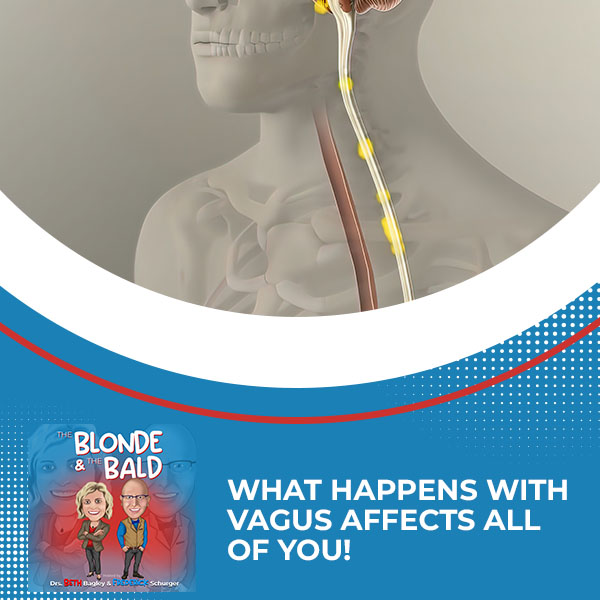
Did you know that your parasympathetic nervous system that controls your digestion, heart rate, and immune system? When there is an imbalance in it, it affects everything else. In this episode, Dr. Bagley and Dr. Schurger delve into the cranial nerve you didn't know about, the vagus nerve. The vagus nerve is the main nerve of our parasympathetic nervous system. Join us to go over what the "wandering" nerve does for your health & how some problems with your health start in your neck!
---
We are having a grand time. We won't tell you why, but we are having a grand time already.
We should record when we're just talking about the show because I think it's going to be more interesting than most of our shows, but there are curse words that are said that we're not going to say, all sorts of things.
The people who do production have to do extra work on the show.
Sometimes there are hard people that come into the office. We love them, we give them all of our energy, and it takes a lot to be a doctor.
Some days it takes a lot out of us. We joked a couple of episodes ago about, "It doesn't look like you work a whole lot of hours." No. The hours we work are the hours that are allowed. The hours we don't work are us decompressing and doing other work.
We just don't see patients during those hours.
Oftentimes, it's a lot of, "I need my quiet time. I need my thing." This is a full day for us, but after a full day, I go home and I eat dinner. My dinner is consistently the same every night.
It’s meat with eggs and meat and fats.
It's eggs and bacon, and there is some extra fat. You are correct. I have my little bit of keto brick, and then maybe if I'm craving popcorn, I might pop up some popcorn.
He's so boring.
Yeah, it is. It's great.
I know you love that.
I know I have that, and then I'm going to decompress. I'm going to read my book. I'm going to figure out what's going on in The Wheel of Time series now that I have been exposed to this piece of fiction.
Is that the books you're reading right now? I just watched that on Amazon. They woke it up a little bit.
It's the first book. It's a weird little adaption. There are parts that, after having read the book, and then going back. Books are always better. I'm begging questions as to why they did it the way they did it. I don't care. Whatever. Probably because they had to get people on contract.
One of the things I ran into in the office was a patient having done some research on the vagus nerve. She had some weird reactions in her body to a dental procedure. I love that you're going to be going over some of this stuff because I want to relearn some of the things because you're good at that. What I will try to do for everyone is, what he says, I will bring it into an English translation out of science translation.
The presentation and the slides that we're going to use were from something that I presented to a group talking about, how do we measure this? What is the importance of measuring these? They're really small electrical impulses in the body and how important they are. It's at a high level, it's taught to doctors, and doctors need to understand this, but we got to translate it down to the patients. Sometimes we got to translate it down for ourselves so we can even understand it.
For those of you who are tuning in, there are some stuff here that might be worth watching on YouTube as we do this. One of the phrases that I like to use is something called attenuated autonomic insufficiency. It boils down to say, the automatic operating system, as it were, of your body, if it is out of balance, it is attenuated. It is less than where it's supposed to be.
Is it keeping you alive? Yeah, but there's a difference between being alive, in a coma, and effectively in a vegetative state. You have high-level athletes. Michael Phelps comes to mind, who for twelve years was at the prime of his swimming game. Now, you've got other people in other sports who are doing the same thing, trying to figure out how they can be healthier and stronger.
You were joking about the meat diet, but Dr. Sean Baker, one of the lead folks in the carnivore world, in his '50s, is setting all-natural, never done drugs as far as hormone-replacement type stuff in that regard. He is still the world record holder in one of these rowing competitions. The man is not any small man. He's probably 6'4", I'd guess around 210 to 220, somewhere in that range and deadlifts all the time. He played rugby and football through high school and then into college. He can do these sprint-level activities largely because he's doing things to bring up his ability for his autonomic nervous system to function better.
Real quick, I want to explain autonomic. You said automatic, so that's a great way to say it. In school, if you've taken a psychology class, you may have heard something like flight or fight, which is a part of it, and he's going to go over that. I want you to start thinking about there are two types of nervous systems out there.
We've got the stuff that we can control, like moving our arms and legs and taking a deep breath in on purpose. There are the things that we don't control, which is if you're sleeping, how often are you breathing? If a bear walks in the room, what does your heart rate do? That's the difference. You don't have to think about your heart rate right now to make it go. We're talking about those automatic functions of the body.
When we start thinking about the motor functions of the body and the voluntary stuff that we are doing, as you pointed out, how fast you want to walk down the road is dictated by how fast you can walk. Whereas these autonomic impulses, you've got two sides to this. You've got your voluntary stuff, and then you have your automatic stuff that you can influence, but it's always going to run at some level.
This is the question. How do we improve that autonomic function through various modalities? Chiropractic is certainly one of the very powerful ways that you can do this, but one of the crazy things is, I broke down and bought a 110-gallon feed truck tub, filled it with water, and I had been in it every morning. It is awesome.
Are you putting ice in it?
No, it's outside and it's sitting at about 45 degrees, so it's cold. I'm not going to pretend that I'm in there for ten minutes. This is not, "Go sit and enjoy yourself in the hot tub." This is, "I've got a minute. The timer goes off. I'm done." I tested the water temperature in the afternoon. It was sitting probably about 45 degrees, which is probably where it's been sitting all week. It's been up to the 50s here in the area.
Even though it's February and it's supposed to be way colder than that.
It's supposed to freeze.
You'll have an extra cold bath.
I might have some ice that I got to crack through to get into it. We'll see what happens. The point being is, that kind of cold exposure influences this autonomic response and improves our body's ability to function by doing some things. By immersing yourself in the cold and in order to stay there, you have to control your breathing. As you control your breathing, you start impacting these other systems, which is crazy because it starts getting things better, especially as you get used to it. The irony of the thing is, after being in the cold water, I get out and I'm drying myself off. I'm going back into the house to get my coffee, but it doesn't feel nearly as cold as when I was in the water.
Anyway, let's talk about this autonomic automatic nervous system. There are two sides to this coin. The fight and flight, which is our sympathetic. This is when you have a lion chasing you and you got to get away right now. It doesn't obviously need to be a lion. It could be a lot of different things. There are actually three Fs, but this is a family-friendly show, so it's fight or flight. Most people can figure out what the third one is because it's not family-friendly. The parasympathetic side is rest, digest, and heal. There's a balance. You need both.
If you only rested, digested, and healed, you'd never get out of bed. In the morning, your sympathetics come on, they turn up. You have that cortisol reaction that helps wake you up and warm up your body, which is why I hop into to cold to kick that into overdrive a little bit. When you're ready to go to sleep as I'm reading my book, usually, what happens is one aisle goes this way and the other one goes that way. The words start turning on the page and I'm like, "I'm going to put the book down and I'm going to fall asleep." That's the parasympathetic trying to bring my brain down to say, "You're ready for bed."
If your sympathetics and parasympathetics are out of balance, a lot of people will have sleep issues like insomnia. "I can't turn my brain off when I go to sleep." That's because your sympathetics are going high and your parasympathetics are turned off or low. That chiropractic helps a lot with that, but we're going to talk about some other things too. Keep going.

The sympathetics, there's a couple of different spots that it sits. It sits basically in the brain stem area. Certainly, part of it in the cortex. Some in the hypothalamus, but this is all brainstem, and this is high-level brainstem going on down. Most of the sympathetics traditionally have been taught that they come out of your spinal cord along basically your upper back T1 through L4. Yet there is some older research that suggests it has higher levels that it comes off the spinal cord up to C4 or C5. There's some question into that, and then there's a couple of ganglion, something called the stellate ganglion that comes up from those lower ones that come up into the neck. Sometimes words come out of my mouth and I'm mixing stuff up, but I'm pretty sure that's a stellate ganglion.
Maybe you need an adjustment.
I'm probably pretty good, but that's another story. It is a superior cervical ganglion. You have a couple of others that are coming off the cranial nerves for both your ophthalmic C5 or cranial nerve 5, which we were talking about. This is part of that trigeminal nucleus. You've got the cranial nerve 3, which is largely involved with eyesight.
There are some sympathetics on that side. That's a lot of your pupilary light reflex. That's a slow response. As funny as it sounds, it's actually a slower response to the dangers around in your life. Unfortunately, we live in this fight or flight response most of the time. The parasympathetic side is more rest, digest, and heal. It tends to be faster and we have that ganglion. In fact, the parasympathetic is what causes it to contract as opposed to open up. Most sympathetics are going to cause a contraction of vessels. Certainly, it's going to raise your blood pressure. It's going to warm you up. It's going to get your heart rate going.
Get your muscles ready for action.
Whereas the parasympathetics are going to start driving you down and start relaxing you. We've got a couple of different nucleus. I'm not going to get into it. We're going to focus in vagus and that's going to take a long time. You have the pelvic nerves coming off the sacrum or your tailbone. We're not going to cover the pelvic nerves. We might cover them peripherally, but the vagus nerve is what I want to focus on.
Vagus nerve is also known as cranial nerve 10. A cranial nerve is a nerve that doesn't come out of the spine but comes out of the brainstem area. That's all the way at the top of the neck, above where you can feel your skull. Cranial nerves are important and they pretty much are what's keeping us alive. Our brainstem is really important and those cranial nerves are, too. Vagus gets a lot of attention because it is impacted a lot. I see a lot of people with trauma responses. I don't know if we call inactivation or activation. It's almost like inactivation like it needs to be activated.
The vagus nerve is also known as the cranial nerve 10. A cranial nerve is a nerve that doesn't come out of the spine but comes out of the brainstem area.
We're going to touch on that because in the concussion space and a lot of other health problems, this has become one of those, it's not quite a buzzword, but it's definitely a buzz because it's becoming more popular. Certainly in chiropractic and how we apply it, but also, in most healthcare and most medicine are looking at this a whole lot closer than they used to.
The vagus nerve is unique because it is one of the few cranial nerves that not only drops out of your skull but also down and affects so much in your body. We're going to go over the branches of that. This may come out a little bit more academic, but it helps to visualize all these pieces. Most nerves go one direction. The vagus is unique because it has directions in and out of the brain. Your afferent nerves, they come back in, they tell you what's going on. Your efferent nerves are going out. I believe that's correct.
It's two-way communication within one nerve bundle where a lot of the nerves can only just be one-directional and there are other nerves that do other things. This one does both.
It's mostly the ones that are looking out into the system and feeding back into the brain. It has some that go out, but for the vast majority, it's looking at what's out in the body and feeding back, which is why 70% to 80% of them are considered afferent. The hub of the vagus nerve is something called the nucleus tractus solitarius. This will come back a little bit later. We call this the NTS. This is a major hub.
What is that and where is that?
It's in the brainstem just above the atlas, which is the first interesting thing about it. When I call it a hub, let's say you have a dozen USB devices that you're interacting with for your computer. My laptop has 2 USB inputs, but I need all 12 of these feeding in. They make little adapters or little hubs that allow you to put multiple things in, and then one wire comes out and your computer can make sense of all of that stuff coming in.
This is exactly that kind of hub where it might be aggregating all of that information into that one spot. It then disseminates stuff to the rest of the body on that parasympathetic and rest digest side of the nervous system. That's why I like to have people think about it that way because this is your major input to tell your body, "How do I start relaxing? How do I start doing things?" A lot of those afferent nerves are the perception for inflammation of the body.
Are you going to go through where these nerves are going?
Yes. That's next. The first branch comes around the back of the spinal brainstem cord area and innervates the meninges on either side of your brain. Let’s talk about the meninges real quick. There are three levels. We’ve heard of meningitis. Meningitis is an inflammation of the surrounding tissue. It’s not the brain, but it’s the tissue around the brain.
It’s like the covering.
We have three levels of meninges. We have the dura, which is considered the tough mother. This stuff is really rigid. It is trying to protect your brain from everything outside. In fact, that’s the blood-brain barrier that’s going on. The next one is the arachnoid which has a lot of vessels around it. That one’s a little bit tighter to the brain. The last one is the pia. The pia mater is right on top of your spinal cord and your brain.
This is the stuff and the material that interacts with your brain and your body. You have three layers to prevent you from directly getting stuff into the nervous system. You've got a box on your computer. You don't want anything to get into the box, especially if it's sitting underneath your desk and your foot decides to go into the CPU. That's a bad thing. That's why we have these things.
It is a protective layer.
It is, yet it has sensory inputs via the vagus nerve. I'm not going to get into any more detail on that because that's a whole other ballpark.
The interesting thing I want to bring up, which might validate some people is, if someone feels like they have pain in their brain like a migraine, can we relate this possibly to a vagal nerve problem?
Could be. I would not rule it out, but a lot of that brain-burning pain may not come from this.
That could be something else.
I would say that's probably more of a vascular issue overall.
I think it could be a mixture, in my opinion.
I would not call this a pain fiber necessarily, although 70% to 80% of it is looking at inflammation. There may be other inflammatory things going on that are subclinical, yet you can still feel it. We're on the second branch now. This is what they call the auricular or Arnold's branch. It helps control some of your perception. A dermatome is basically your skin sensations, as far as how the nerves perceive what's happening at the skin level, which is different than how your body moves. It's really curious.
The placement's different. If someone has shingles per se somewhere on their body, it's usually on one little section on one side of the body following the dermatone and following that nerve that's going to the skin. Hopefully, you never had shingles, but if you know someone who has had shingles, it's very commonly across the side.
The second branch comes around the auricular, so that's all ear, what they're talking about there. This is on the skin level. In fact, if anyone's ever heard of some of this auricular therapy that exists where they go into the ear or that daith, that is influencing this vagus nerve.
This is what I bring up about they get daith piercings to stop migraines. That's what people are doing.
People ask me, "Does it work?" I said, "It's only $30. It's painful.” A lot of people like that.
I’ve had some patients say anecdotally that it’s helped. I’ve had some that said they didn’t see a difference.
Same. In fact, one of my patients said she got both of them hoping it might help, but it didn’t do anything. The only thing that was touching her migraines was getting her head on straight, but her comment to me was, “I’m going to keep it so that I look like I'm the cool mom."
They're hard to see. I don't usually see them on patients until they're on their sides about to get adjusted. I was like, "You've got one of those." They're on the outer ear but inside of the outer ear. It's not easy to see.
Once you've got it, you might as well keep it because it was super painful and maybe it's helping a little bit. This is a lot of inner ear stuff that's being influenced by that second branch. There is some influence as they're using electrical vagal stimulators to improve vagal tone overall in the body. There are some really good evidence that we should focus on the left ear over the right ear, which I will come back to.
The third branch is the pharyngeal, the pharynx, and the soft palate. It's your mucus membrane. All that secretory IgA stuff that we've been talking about on and off, that's where this is being influenced by. The pharynx and the soft palate are important because if you've ever had a popsicle stick without the popsicle on it stuck into the back of your throat and had the gag reflex, that is that branch of the vagus nerve. If you're the kind of person who says, "I can brush my teeth and I never gag," your vagus nerve isn't working.
It's not a good thing. You're supposed to be able to gag.
A gag reflex is a good indicator that this is working properly. I'm teasing for something coming up here in a little bit, but if you're not gagging on the right, we have other problems. The fourth branch is the superior laryngeal nerve. This is getting into your thyroid cartilage or cricothyroid area, so the tension of your vocal cords for your higher notes, notes that I cannot hit, but Dr. Bagley can very well.
A gag reflex is a good indicator that this is working properly.
Another aside is I'm a singer. When my head is not straight, I absolutely can tell a difference in my voice and my ability to study my voice. There are a couple of things, but I do think that this is part of it.
It wouldn't surprise me that we have some vagal tone influences. I'll come back and explain why the atlas can influence the vagus. We're on the fifth branch. More recurrent laryngeal nerves, but it addresses the muscles around your larynx, esophagus, and trachea. What you're describing as your ability to sing as well is coming through here. All the mucus membranes are influenced by that vagus nerve.
How about dry mouth?
Definitely could be related. There's an autoimmune condition where all the mucus membranes dry up. It'll come back to me after dinner. The sixth branch is the right and left superior cardiac. The deep and superficial cardiac plexus is formed here. When we say deep and superficial, superficial is right at the top of your skin, on the surface. Deep is when it starts going deeper into either the nerves, into the muscles, or into the body overall. That's what we mean by deep and superficial.
We're getting into and creating the cardiac plexus, so this is the cardiac supply for the heart or it ties into the cardiac supply for the heart along with the sympathetic nerves. If you have run a mile and you're waiting for everyone to catch up and you're trying to catch your breath, this is where the parasympathetics are trying to bring down that heart rate back to a normal level.
It’s Sjogren's.
That's it. Thank you. I don't have to think about it after dinner now.
I thought that's what it was, but I was like, “I'm going to look it up so I don't look dumb.”
This is why the internet is great. This is also why if the internet goes down, I will have reference books handy.
You and my husband both. You guys love your books.
There are a lot of them. Here's the interesting thing. This is the last branch of the vagus nerve before it enters the chest. So far, the vagus nerve is taking care of the ear, it's coming down, getting in the back of your throat, getting into your thyroid area, esophagus, and larynx, and then it starts sitting right up here. Before it goes into the heart itself, it starts mingling with the sympathetics for the heart, and then it drops into the chest.
This is the first branch in the chest. You have your inferior cardiac branches that are deep into the cardiac plexus. The left originates from the recurrent laryngeal nerve which is another nerve that's out there, but it influences the atrial ventricular node. This is the bottom half, the inferior cardiac branch of the heart, but the right branch. The left branch gets the AV node, which most people don't think about. The right branch is the sinoatrial node. This is your lub dub. A big part of your heart rhythm is controlled by the sinoatrial node. This is where pacemakers are being influenced.

This is why stemming the right ear might be a problem because it could have a direct impact on that sinoatrial node. This is one of those, talk to your doctor if you are investigating this pathway because there is some back and forth as to whether or not that's safe. Certainly, it is also a concern for us as upper cervical doctors.
When we have a patient coming into our office who has a pacemaker, when we get them adjusted, that pacemaker is geared to run at a certain rate and help make sure that they're working good. A lot of people, after they get adjusted, can have pacemaker problems. You need to be aware of that and make the patient aware of that after their adjustment. There might be some changes as well as they might need to call their cardiologists and have a tune-up just to make sure everything's working the way it's supposed to. Same thing applies to blood pressure as well when you get an adjustment.
I see that more often.
I think that's going to be more common.
I haven't seen a pacemaker in a long time. Maybe they're not doing it as much.
Wouldn't that be grand?
I think because they're doing ablations more now, maybe they're not going to pacemakers as much because honestly, I remember I saw them more years ago, but I don't see them as much.
The other thing is we've gotten much better about how we address heart disease across the board. Heart disease and cancer run back and forth between number 1 and number 2 as far as what's going to get you. Certainly, we've learned that we can be more aggressive with heart disease and get people the kind of care they need. Maybe what ends up happening is the vagal and sympathetic tone that goes to that sinoatrial node doesn't get shot or doesn't die in the process. There's less of a need. I'm speculating. We should probably pose that question to Dr. Peter McCullough and see if that seems to hold true.
Let's move to the eighth branch. It's the second in the chest. This one innervates the lungs. This is going to help you get that better deep breath. It is supplying the front of the lungs and it joins with the sympathetics because the entire breathing process is a dance between your sympathetics and your parasympathetics.
The entire breathing process is a dance between your sympathetic and your parasympathetic.
If you decide you're going to lift a heavy weight overhead, you're going to need more air and you're going to be breathing heavier, so that's going to come up. As soon as you put those weights down, you can relax and that will help. It's that back and forth. The third in the chest is the ninth branch. This is going to the posterior or the back part of the lungs. Similar functions. The tenth branch is the last in the chest. I have the chest defined as everything in the ribcage before we get into the abdomen.
Above the diaphragm.
The tenth branch is the last in the chest. It's for the esophagus and it's pretty much left and right. It has been pretty straightforward at this point. After this, the left goes one direction and the right goes a different direction. The left vagus at the eleventh goes to the anterior gastric, which doesn't sound like a big difference, but it's going to the front and the top of your stomach. The right goes to the back and bottom portions of the stomach. You've got two different influences there. If you've ever thought about, "I have a heartburn. I wonder what's going on there," how is heartburn in the right vagus where all the acid is largely pulling due to gravity affecting the heart also in the right vagus? Isn't that curious?
It is curious.
Are these direct? I don't know. When the right vagus has problems, the right vagus has problems. It might affect multiple aspects of the body. The twelfth branch is the left vagus, and it's just all left vagus at this point. It's all right abdomen. It's going to get your liver. Basically, everything around the liver, which is the hepatic plexus. Plexus means it's all over the place, and hepatic is liver.
It mixes together. That's the end of the line. That's where the vagus stops working. It doesn't go into your legs and toes.
This is the end of the line for the left branch or for the left vagus.
Where does the right go?
The right stays in the right abdomen. It's influencing the liver as well, and it's also the end of the line, but they're a little different. End of the left vagus is in the right abdomen. The right vagus, that side looked very familiar. Still, twelfth branch, we're on the right vagus. This is the celiac branch that then goes to the adrenals, kidneys, pancreas, intestines, especially the upper two-thirds of the colon influenced by this, and the spleen.
The right vagus is a workhorse all through and through. That's a huge influence through there and this is the end of the line for the right vagus. When you think of the nerves coming from the brain, the intestines, only the upper two-thirds of the colon are influenced by the vagus nerve, whereas the lower third is coming up from the pelvis.
This is why there's not a whole lot of information on this generally because it's not been studied as much because everything that happens in the vagus influences your body. Whereas the pelvic nerves, that happens too. It's less sexy. No surprise that control of your colon, rectum, prostate, reproductive organs, bladder wall, and various sphincters, people are like, "Those are supposed to work, but we're not going to pay attention to that."
They're kind of important.
It really is. That's coming up from the sacral and your sacrum affecting your lower part, but there is a lot of coordination from the spinal cord between these sacral nerves and your vagal tone. There's a connection there.
That's why doctors, I'm one of them, that does the Logan basic technique are very into this information.
It makes sense because sometimes the thing that's bugging you up top is in your hips. Sometimes the thing that's bugging you in your hips is up top. It's good to look. I do a little bit of Sacro-Occipital Technique in the same way as you do with the Logan Basic.
Our number one is always the Sawyer Technique because we can cover so much on that.
The great thing is I've seen many cases of bedwetting, which should be pelvic nerves get better just by adjusting the atlas. The thing about the sympathetics is they tend to be much slower than the parasympathetic supply through the right vagus. The sympathetic supply to the sinoatrial node.
We're back in the heart.
It has the capacity to get your heart rate up above 200 beats per minute.
That's pretty fast.
Yeah, it's very fast. That effect can be seen after two seconds. It peaks at 4 seconds and it'll end after 10 seconds. When you got to get going, it's going to ramp everything up, but it's only going to be around for a little bit because hopefully, you got away from the lion. Maybe your friend didn't, but hopefully, you did.
Just push him in the way and run.
Just remember, when you're putting your shoes on, take your time to tie your shoelaces because you only have to outrun your friend. You don't have to outrun the lion. Isn't that horrible? That is miserable.
At the Saint Louis Zoo, there's a bear that has escaped twice. He's the smartest little bear there is.
What's his nickname going to be?
It should be Houdini.
I don't know why I kept on seeing the Cocaine Bear show up on various podcasts. I'm like, “That's weird but it's curious.” In any case, back to the heart running in the way it's supposed to. The parasympathetic supply to the heart through that right vagus, the same sinoatrial node, affects it in less than 1 second, peaks within that second, and lasts for only 2 seconds. It is 80% to 90% faster than the sympathetic supply. It's using a different chemical.
The speed differential is the neurotransmitter that they're using. It's a low frequency versus high frequency, which we'll come back to here in a moment as to why low and high frequency is important. Norepinephrine activates an enzyme complex that takes 8 to 10 seconds to complete, which is that sympathetic because you can see it ends after ten seconds.
Whereas acetylcholine, which is funny because the best place to get choline is fresh eggs, is an ion channel activation and it only takes a second to cause an effect. This is why it runs faster. We're looking at the brainstem from the back. We see a number of different places that influence the nucleus tractus solitarius. One of them is this intermediate nucleus that goes right into there, so it's one step removed.
Anytime you have a nerve going into a nucleus, one nerve going into a nucleus will have a profound effect on that nucleus. When that nucleus then will have multiple places that it's coming off of to other places, the next nucleus still has a pretty profound effect from step one. What is interesting when we start looking at the upper cervical is that there is a possible role in autonomic or respiratory control. It's because the muscle spindles in the cranial cervical junction around the atlas and axis directly influence, go right into that intermediate nucleus, and then one step away from the nucleus tractus solitarius.
What you said is important, but I want to get it to the point where someone who has not gone to school for this would understand it. The muscle spindles, which means the information that the muscles give to our body, so muscles give information constantly to us.
This is the information coming into the body from the muscle sensation, knowing where it is in space.
The muscle knowing where it is in space and sending that information, that's what a spindle does. It's going to directly affect when it's up here in the top of the neck, up to the upper cervical of the cranial cervical junction, it directly is influencing what's happening in the nucleus, which is like the hub of cranial nerve 10, which is also known as vagus.
Almost. First, this is the hub before that. This is the nucleus intermedius that has a ton of influence to various things, but one of them ends up being the nucleus tractus solitarius. If I was Seven Degrees of Kevin Bacon, it's exactly that. Let's use Joe Rogan as an example. If I wanted to tell Joe something, I'd have to go through several intermediaries to get my message to him. Odds are my message will not be the same message.
Let's use Tim Pool as my intermediary. I probably can get connected because I subscribe to his thing. I could probably get one of them to entertain an idea that I presented. They present that to the next level, so the intermediary one then presents it to Tim. Tim says, "This isn't a bad idea." He sends it to Joe, but it's got to go through Jamie first, and then it finally gets to Joe.
It's not my idea at that point in time. It's pretty much Tim's idea at this point in time because Tim says, "That's a really good idea. I'm going to present that." These guys are good because they won't take credit along the way, but somebody's going to take credit along the way if it's going to somebody else. This is where you get muddy water in between the signals between the hub to the hub. However, for whatever reason, let's say that Tim Pool and I become great friends.
That would be your dream, by the way. "My friend, Tim."
I like wearing beanies. Tim introduced me to Joe, and then Joe says, "I like that idea," that's that two-step difference. That is where the nucleus intermedius talks directly to that nucleus tractus solitarius and then can have that profound impact on the parasympathetic or the rest, digest, and heal side of the nervous system.
Let's back it up to patients who are tuning in. When you were looking at the thermography graph that we do every visit, when we take that graph, we are getting a snapshot of what your nervous system is doing. How stressed out is it? If it is stressed out and it's stressed out in a way that has caused you to go out of adjustment, we see the same thing over and over again. It is not a healing pattern because you only have two states of the body. Rest, digest, and heal, and fight or flight. Effectively, fight or flight is breaking down and dying. It gets you away from the lion.
It should turn off.
If you're always stuck in that fight or flight, then you are slowly breaking yourself down. You get sick, exhausted, and pass out because you're like, "I don't have time. I don't have the energy to do this thing." When we see that pattern present, which is controlled by the sympathetics, we know that there is a problem that something has raised your stress level.
Does that mean you're out of adjustment every time? Not necessarily. I had a patient who was like, "I feel great, doc. Mom was in to visit." His mom's like 89 to 90. His mom is a go-getter. She's all over the place. He comes in and he's like, "Yeah, I feel pretty good. I think I'm going to be holding today." I check him and something's off on the graph. I check his legs and he's off. He's pulling a half-inch-short, which all is telling me he's probably out of adjustment.
I'm not finding the indicators to tell me that he's out of adjustment, so I have him go rest. The graph changes a little bit. The legs are still doing something weird. I basically tell him, "You have some underlying stress going on. Take it easy. This is not the day to go run a marathon. However, be aware of your body because you may need to get in next week to get checked beforehand."
This is where we can start to see the bigger picture of how your body is in or out of adjustment or just under stress. I see that fairly regularly with people. There was a day where every time I took a graph, I looked at it and I'm like, "We're getting you adjusted." When I went to do the leg checks, that was confirming what was happening. This is where all of this nervous system comes into play. I think this graph and picture is a lot, but once you start to piece pieces together, you'll know.
Someone who's a patient or someone who's interested in upper cervical care and is not wanting to be a doctor. In general, just know that there is a relationship between the top of the neck and the cranial nerves. We're trying to explain how that then affects the hot button issue, which is vagus or vagal tone.
This also goes to the impact that the upper neck has on the nervous system on a much larger scale, so it's not just fixing your neck for your neck pain. It is affecting everything throughout the body. Whereas I love traditional chiropractors, but if I've got a problem in the middle of my back, I know guys who pop that left, right, and center all day long. That is not going to have the same profound effect of the entire body and getting it back into balance.
A lot of people are like, "Why don't you pop my back?" It's not that I couldn't. I did know how to at one point, but I absolutely study and am very proficient at adjusting the top of the neck. Just because I've taken all that time to do that, a lot of times I don't need to adjust the lower stuff because it gets better. If it does, there are 50 chiropractors right around me that can do that for you. I do the thing that they don't do.
I want to wrap up with a couple of things because we're going long here. Both of us have had full days. The first picture is a heart rate variability picture. These two red pictures of the red stuff, they're actually the same data except for the data at the top has not been corrected. There is a technology called heart rate variability. Oura Rings and WHOOP Straps are becoming more popular. Apple watches sort of have it. The Oura Ring sort of has it. What it's looking at is the beat-to-beat intervals that are going on.
We do a couple of other things. Certainly, we do the thermography and we do the pupillary light reflex in my office. We're still seeing what that all pans out to be, so we'll get a better sense of how well your nervous system and autonomic balance are working. One of the things that we know about this heart rate variability and why these two pictures look so different, and yet it's the same data. It's because the one on the bottom looks like the lub dub.
This is the traditional PQRSTU wave. This is the wave that the heart makes every beat that it makes. If you look at the one on the bottom, you can see that PQRST wave presenting properly. The one on the top needed to be corrected by hand. This is a five-minute sampling. It doesn't come out looking right until you do each and every beat. This ends up being the problem with most of our devices is, they're using some algorithm to get it close.
This is why good HRV measurements, 1) the equipment costs a lot of money. 2) It takes a lot of time. 3) The reason I like the Ouras and the WHOOPs, the stuff that is looking at you overnight is it gets a bigger sample size so that algorithm cleans up the data better than what a five-minute sample would do. A good five-minute sample with the right equipment will still give you a much better indication of where you are. There are 3 or 4 different measurements that they use for this. One is called SDNN, which is an overall measurement of your variability.
Before we go way into this, I want to say what you haven't explained yet is heart rate variability.
That's what I was going to talk about. Let's start right here. For those of you who remember the old keyboards that had a drum track on them from the '80s. The problem with those, the early ones, is you would have such an exacting beat that it would drive people crazy and it didn't sound good.
Was it a Casio? Is that what those were?
There were Casios. We had a Yamaha. There were a bunch of different brands that were playing with this. The problem was, when you had a beat that was constant like that, it didn't feel good as the music goes, which is why when a drummer who's playing a really good beat, they're grooving. They're having some fun with it. They're setting that beat. The beat's pretty much there, but there's a little bit of back-and-forth tension that goes on.
The same tension happens in our bodies. The more variability that we have, the healthier we are. The less variability or if you're more like a robot, odds are you might be a robot and that's bad for your health. You want that variability in your system so that your body works better. There are a number of different frequency measurements, which goes back to the acetylcholine and norepinephrine mentioned, where it was like high frequency and low frequency. The acetylcholine happens quickly. When you do the frequencies, it's one over time.
If it only takes one second, you do some math, 1 over 1 second is a very high-frequency number, whereas one over a big number is a very low-frequency number. Sympathetics tend to be more low-frequency. Parasympathetics end up being high-frequency. In fact, it was largely the Russians who figured all this stuff out.
They've done good research in this field. They did really good science. If you can read a little bit of Russian and get into their old databases of all their health stuff, there's a lot of good health information in there. There are a number of different ways that we can figure out and piece out these frequencies by looking at the heart rate and then running it through algorithms to figure out what's going on. The vagus nerve largely influences that. This is a large portion we're looking at.
If you have a healthy vagus nerve, vagal tone, or whatever you want to call it, you will have a good amount of heart rate variability. If you have a poor vagal tone or your vagus nerve is not working right, it doesn't vary much. It becomes robot-like, like the Casios or the Yamahas of the '80s.
If you have a healthy vagus nerve, vagal tone, or whatever you want to call it, you will have a good amount of heart rate variability.
Correct, even though some people still collect those things.
They should. They're awesome.
Some of those were really good. This is why daily readings in the morning are probably the most ideal. As I said, I like the Oura Ring and the WHOOP because they give you an overnight sampling. The more data you have, the better picture you get because you can fudge the data a little bit to say, "I did really good tonight." Whereas other nights, maybe less so or if you got a smaller window.
There are a number of apps on the phone that work with a Polar heart rate strap that you could do every morning when you wake up. Put a slap on the strap, take a five-minute reading, and see where you're at. There are different ways if people are interested in doing this on their own. In fact, I would recommend if you are interested in doing this. Instead of trying to find a doctor's office that has heart rate variability, I would invest in one of these technologies to measure and see where you are. That's going to give you a better picture all the way around. Dr. Bagley, let's wrap it up. Any other questions?
I know you could talk forever on this, and you have before. In general, I think it was a really good quick overview. I know it didn't feel quick, but there are lots more. A quick overview on sympathetics, parasympathetics, the powerful vagus nerve, and one of the ways that we can test it which is heart rate variability. In general, we see incredible results with Blair Upper Cervical Care and how the interactions with the vagus nerve can happen. We see changes in how people's digestive tract works, how their heart's working, and how their breathing is. This could be an explanation of why we're seeing this so much.
There are incredible results with Blair upper cervical care and how interactions with the vagus nerve can happen.
I've got a second thing I want to quickly hit on. When the vagus nerve comes out of the skull, it actually comes out along the parallel to both the carotid artery which is on the inside and the jugular vein on either side. It's sitting in between two large vascular pieces. The carotid arteries tend to maintain good muscle tone.
Arteries, in general, have muscle tones. It's sitting right on the front part of your atlas with the carotid and the jugulars on either side. We commonly see on MRI when there's a subluxation present that one of the carotids sometimes, but oftentimes one of the jugulars is occluded, basically shut down and not working the way it's supposed to, which the vagus is right here. It's affecting the vagus on that side, too.
What you're saying is it's not just the interaction at the brainstem, but it's maybe a physical interaction between the atlas bone, that top bone in the neck, and the vagus nerve itself that's coming out.
That absolutely may be possible. Multiple components and multiple pieces. Many times I have somebody come in with, "Doc, I got neck pains and migraines. I had this lung problem that has cleared up recently." I'm like, "Did we talk about a lung problem?" "No, I never mentioned it. It had been around so long. I don't even think about it." It's one of those things. What are all the pieces to the parts? Can we point to one thing? The only thing I keep on pointing to is the atlas.
I do that a lot, too. It was so good to talk to you again. I hope the people tuning in have heard some things that they enjoyed and also understand better about how your nervous system works. If you could leave us a like, a subscribe, or do a little comment, that always helps. If you have questions, throw some up there. We will be looking at those and answering your questions in future shows. I'm Dr. Beth Bagley and I'm in St. Louis, Missouri. You can find me at precisionchiropracticstl.com/.
I'm Dr. Frederick Schurger, KeystoneChiroSPI.com in Springfield, Illinois.